
What Is Steam Boiler?- Definition, Working, and Types
Steam has powered industry for more than two centuries, and it remains one of the most efficient carriers of heat energy ever discovered. From textile dyeing units in Surat to pharmaceutical sterilization rooms in Baddi, almost every process industry in India depends on one core piece of equipment: the steam boiler.
If you have ever wondered exactly what a steam boiler is, how it works, and which type suits your factory, this guide answers all of it in one place. As a manufacturer with over 25 years of experience and 5,000+ installations worldwide, Balkrishna Boilers Pvt Ltd — through both Balkrishn.com and IndianBoilers.com — designs and builds the full range of technologies discussed below, so this article doubles as a practical buying reference as well as a technical explainer.
1. What Is a Steam Boiler? (Definition)
A steam boiler, sometimes called a steam generator, is a closed, pressure-rated vessel that converts water into steam by applying heat from a fuel source or an electrical source. The vessel has to remain sealed because steam occupies far more volume than the water it came from, and that expansion needs to happen under controlled pressure rather than escaping freely.
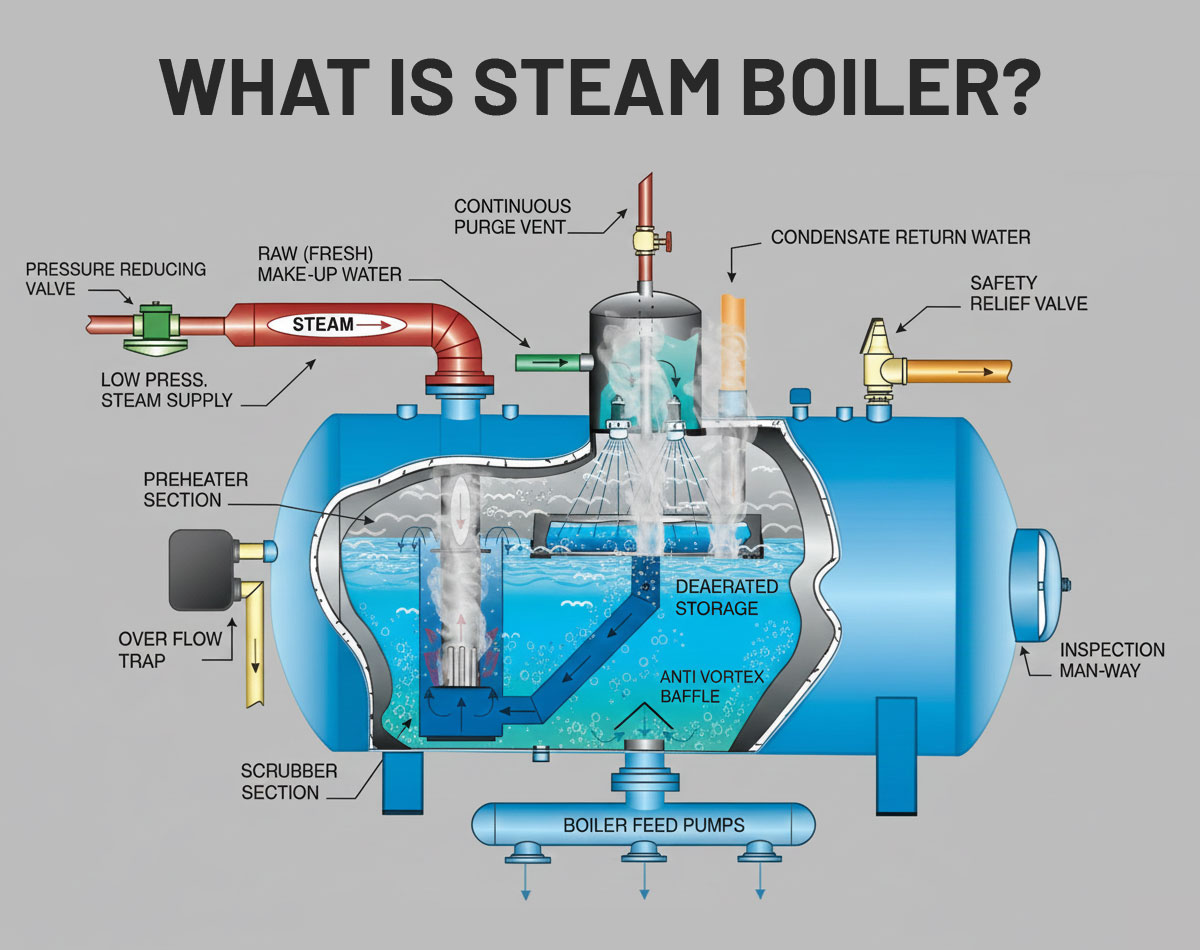
Once generated, steam carries a large quantity of latent heat, which is exactly why it is used so widely — a small mass of steam can deliver a disproportionately large amount of usable heat energy to a process, a radiator, or a turbine.
At IndianBoilers.com, this core definition plays out across several distinct product lines depending on the fuel and heating method a plant uses:
- Fuel-fired systems: the STEAMJET oil/gas fired steam boiler and the STEAMAX wood/briquette fired steam boiler, also listed on Balkrishn.com as STEAMJET and STEAMAX.
- Electric systems: the ELECTROMAX electric IBR steam boiler and the INDUCTRON induction boiler, mirrored on Balkrishn.com as ELECTROMAX and INDUCTRON.
All of these fall under the broader Steam Boiler product category on IndianBoilers.com, and the equivalent Steam Boiler range on Balkrishn.com.
2. What Does a Steam Boiler Actually Do?
Beyond the textbook definition, a steam boiler exists to perform four practical jobs on a factory floor:
| Function | What It Means in Practice |
|---|---|
| Heat transfer | Moving heat from a flame, hot flue gas, or heating element into water with the least possible loss. |
| Steam generation | Converting that water into steam at the flow rate the plant needs, usually measured in TPH (tonnes per hour) or kg/hr. |
| Pressure regulation | Holding steam at a set pressure — a textile dyeing line might run at around 10 bar, while a captive power plant may need pressures well above 60–100 bar. |
| Safety containment | Keeping high-pressure, high-temperature steam fully contained until it’s released through controlled outlets. |
Getting these four functions right is what separates a well-engineered boiler from one that constantly needs repairs — which is why component selection (below) matters so much.
3. Key Components of a Steam Boiler
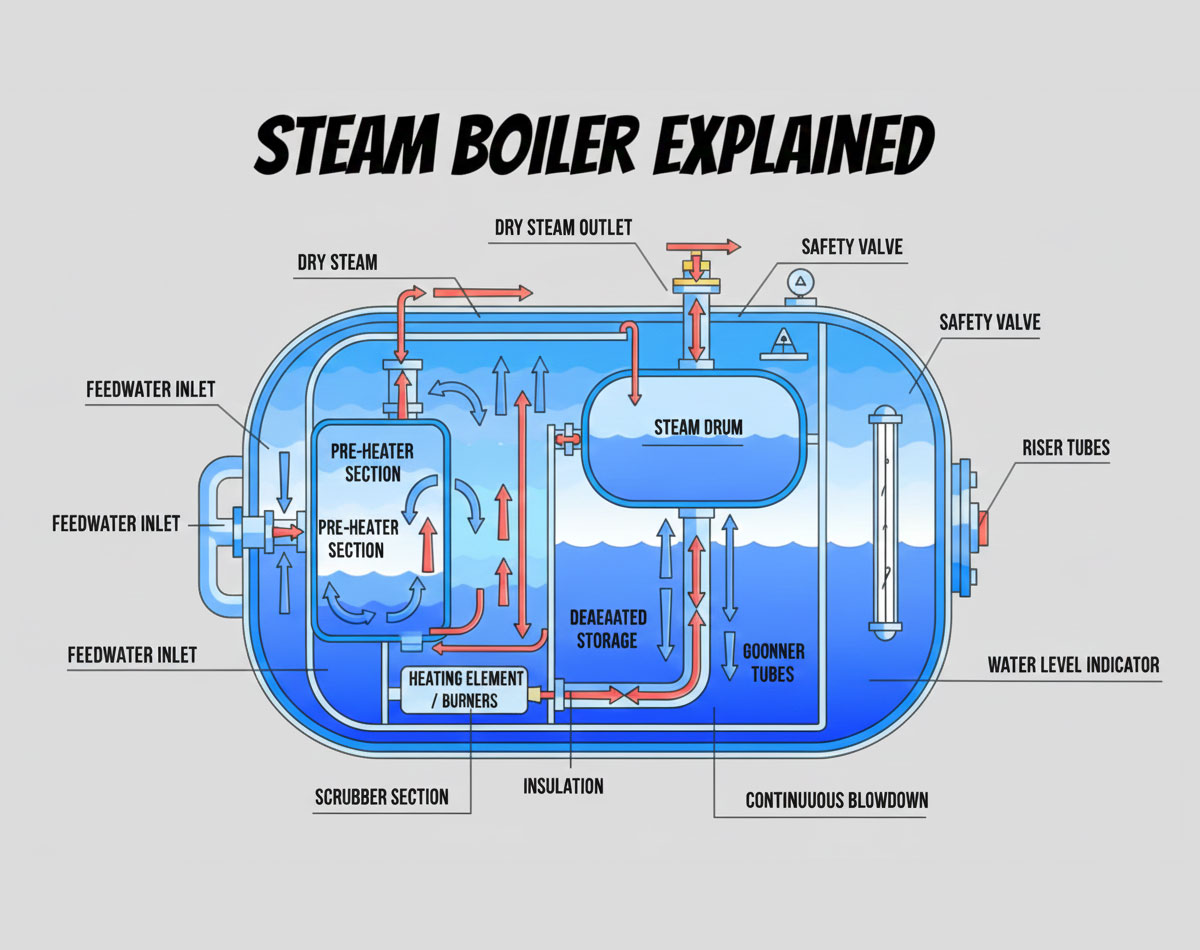
A boiler is a system, not a single tank. It combines a pressure vessel with a set of auxiliaries that keep it safe and efficient.
A. Shell and Pressure Parts
- Shell/Drum — the main vessel holding water and steam.
- Tubes — carry either hot gas (fire-tube design) or water (water-tube design) to maximize the surface area available for heat exchange.
- Furnace/Combustion Chamber — where fuel is burned in fired designs such as STEAMJET and STEAMAX.
- Heating Elements — submerged resistance rods used in electric units like ELECTROMAX.
- Insulation and Casing — cuts down radiant heat loss from the shell surface.
B. Auxiliaries and Controls
- Burner or Stoker — introduces and ignites fuel; STEAMJET uses a burner, while STEAMAX uses a stoker/grate system for solid biomass fuel.
- Economizer — recovers waste heat from flue gas to preheat incoming feedwater, a key efficiency lever.
- Air Preheater — raises combustion air temperature using flue gas heat before it reaches the furnace.
- Feedwater Pump — delivers treated water into the drum at the correct pressure.
- Safety Valve — releases excess pressure automatically if the system exceeds its rated limit.
- Water Level Gauge Glass — a visual, real-time check on drum water level, critical to preventing dry-firing.
- Blowdown Valve — periodically flushes out concentrated solids and sludge to control scaling and corrosion.
Choosing the right combination of these parts depends heavily on fuel type and plant duty cycle — something the Steam Boiler category page breaks down model by model.
4. How a Steam Boiler Works: The Full Cycle
The working principle follows a repeating loop of water treatment, heating, and steam delivery:
- Feedwater treatment — raw water is softened and de-aerated to strip out dissolved oxygen, CO₂, and hardness salts that would otherwise cause scaling and corrosion inside the tubes.
- Heat generation — in fired boilers, combustion produces flue gas temperatures that can reach around 1,500°C; in electric units, resistance elements or an induction core convert electricity directly into heat.
- Heat transfer — heat crosses from the source into the feedwater through the tube walls. This step decides most of the boiler’s overall thermal efficiency.
- Vaporization — water absorbs enough latent heat to flash into saturated steam, which collects in the steam space above the water line.
- Steam utilization — the main steam valve routes steam through the plant to do useful work: heating a dye bath, driving an autoclave, or spinning a turbine.
- Condensate return — once steam gives up its latent heat downstream, it condenses back into water and is returned to the feedwater tank, closing the loop and saving both water and fuel.
5. Steam Boiler Efficiency: What to Expect
Boiler efficiency measures how much of the input energy actually ends up as usable steam energy rather than being lost up the stack or through the shell.
| Boiler Type | Typical Efficiency | Main Loss Factors |
|---|---|---|
| Fossil fuel-fired (STEAMJET) | 80–88% | Flue gas losses (the biggest single factor), radiation losses, blowdown losses. |
| Biomass-fired (STEAMAX) | 70–85% | Flue gas and radiation losses, plus higher excess-air requirements for solid fuel combustion. |
| Electric (ELECTROMAX) | ~99.5% | Virtually no flue gas loss — only minor radiation loss from the vessel surface. |
This is one reason many plants now run a hybrid setup: a fuel-fired unit like STEAMJET for base load, paired with an electric unit like ELECTROMAX for peak-shaving or clean-room applications where zero on-site emissions matter.
6. Types of Steam Boilers
By Heat-Transfer Design
Fire-tube boilers pass hot combustion gases through tubes that sit inside a water-filled shell. They hold a large water volume, start up more slowly, and suit stable, saturated-steam loads at moderate pressure — a good fit for low-to-medium capacity requirements.
Water-tube boilers do the opposite: water flows through tubes that are surrounded by hot gas. With a smaller water volume, they start up faster, handle higher pressures, and scale to much higher capacities — the design of choice for superheated steam and power-generation duty.
By Fuel Source
| Type | Fuel | Key Benefit | Product Example |
|---|---|---|---|
| Oil/Gas Fired | Liquid or gaseous fuel | High energy density, precise combustion control | STEAMJET |
| Biomass Fired | Wood, briquettes, agro-waste | Low fuel cost, supports sustainability goals | STEAMAX |
| Resistance Electric | Immersed heating elements | ~99.5% efficiency, zero on-site emissions | ELECTROMAX |
| Induction Electric | Electromagnetic core heating | Scale-resistant, very low maintenance | INDUCTRON |
If biomass firing is on your shortlist, it’s worth reading how fuel choice actually plays out in the field — our guides on Rice Husk vs Mustard Straw for boiler ROI and Biomass Pellet vs Biomass Briquette performance compare real-world fuel economics side by side.
7. Advantages and Disadvantages
General advantages: steam is an outstanding heat-transfer medium, carries very high latent heat, is easy to pipe across a plant, and remains the standard medium for power generation.
General disadvantages: boilers involve significant upfront capital cost, require ongoing water treatment, and sit under strict regulatory oversight such as the Indian Boilers Act.
Fuel-fired trade-offs: high capacity and pressure are achievable and fuel is often cheaper per unit of energy than electricity, but combustion produces CO₂, NOx, and SOx, needs fuel handling infrastructure, and typically caps out around 88% efficiency due to stack losses.
Electric trade-offs: near-100% efficiency, zero on-site emissions, precise temperature control, and quiet, low-maintenance operation come at the cost of a heavier electrical load and running costs tied closely to your power tariff.
8. Applications of Steam Boilers Across Industries
- Pharmaceuticals & Healthcare — sterilization via autoclaves and clean-room humidification, often using ELECTROMAX or INDUCTRON for purity-sensitive processes.
- Food & Beverage — pasteurization, retort cooking, clean-in-place (CIP) systems, and general process heating.
- Textiles — dyeing, sizing, drying, and calendering.
- Power Generation — high-pressure, high-capacity water-tube boilers driving turbines.
- Chemical & Refining — process pumps, reaction-vessel heating, distillation support.
- Pulp & Paper — digesting wood chips and drying paper sheets.
Industry-specific fit matters as much as the boiler itself — our related reads on boiler selection for food processing units and the best boiler for textile, pharma, and food industries go deeper into matching technology to sector.
9. Characteristics of a Well-Engineered Steam Boiler
- Safety — multiple safety valves and interlocks for high-pressure operation.
- Accessibility — easy access for inspection, tube cleaning, and blowdown maintenance.
- High heat-transfer rate — maximum surface area exposed to the heat source.
- Responsiveness — the ability to modulate output as plant demand changes.
- Durability — long service life through quality materials and proper water treatment.
- Efficiency — the highest practical conversion of fuel or electrical input into usable steam.
10. Why Manufacturers Choose Balkrishna Boilers
Balkrishna Boilers Pvt Ltd has spent over 25 years engineering steam, thermal fluid, and hot air systems for more than 5,000 installations across 30+ countries. Whether you need a robust fuel-fired workhorse or a near-zero-emission electric system, the full range is available through both Balkrishn.com and IndianBoilers.com:
- Steam Boiler range — STEAMJET, STEAMAX, COMBIPOWER, ENERPOWER, HUSKPOWER, STEAMGEN, and more.
- Electric Boiler range — ELECTROMAX, INDUCTRON, ELECTROAQUA, ELECTROAIR.
- Thermic Fluid Heater range — including DELTAPAC and THERMPAC.
- Hot Water Boiler range — AQUAJET and AQUAMAX.
- Hot Air Generator range — AIRJET, AIRMAX, AIRPOWER.
For a broader look at how waste heat recovery and emissions technology now factor into boiler selection, see our guides on waste heat recovery boilers for cement plants and biomass boiler emission control systems.
Conclusion
A steam boiler is, at its core, a controlled system for turning water into usable heat energy — but the right choice for your plant depends on fuel availability, required pressure and capacity, emissions targets, and maintenance capacity. Fire-tube designs suit stable, moderate-pressure loads; water-tube designs suit high-capacity power applications; and electric technologies like ELECTROMAX and INDUCTRON are increasingly chosen where efficiency and zero on-site emissions outweigh electricity cost.
Ready to select the right steam solution for your operation? Contact IndianBoilers.com or get in touch via Balkrishn.com for an expert consultation on which technology — STEAMJET, STEAMAX, ELECTROMAX, or INDUCTRON — fits your facility best.
Frequently Asked Questions
Q1. What is the main difference between a fire-tube and a water-tube steam boiler? In a fire-tube boiler, hot gases travel through tubes surrounded by water; in a water-tube boiler, water travels through tubes surrounded by hot gases. Fire-tube units suit moderate pressure and stable loads, while water-tube units handle higher pressure and higher capacity, which is why they dominate power-generation duty. Both formats are available across the Steam Boiler category.
Q2. Is an electric steam boiler more efficient than a fuel-fired one? Yes — electric units like ELECTROMAX reach around 99.5% thermal efficiency because there is no flue gas loss, compared with 80–88% for fuel-fired designs such as STEAMJET. The trade-off is that running cost depends on your local electricity tariff rather than fuel price.
Q3. Which steam boiler is best for small pharmaceutical or food processing units? Smaller, purity-sensitive operations often prefer electric or induction technology such as ELECTROMAX or INDUCTRON for clean, precise steam generation. For a deeper comparison across sectors, see our guide on the best boiler for textile, pharma, and food industries.
Q4. How often does a steam boiler need blowdown maintenance? Blowdown frequency depends on feedwater quality and boiler load, but regular blowdown — daily in many plants — is essential to prevent scale buildup and corrosion. Water treatment quality upstream directly affects how often this is needed.
Q5. Can one boiler run on multiple fuels? Yes, multi-fuel designs are increasingly common in Indian industry, letting a plant switch between biomass, oil, or gas depending on availability and cost. Our detailed breakdown on multi-fuel boilers and the future of industrial heating in India covers how this flexibility works in practice.