
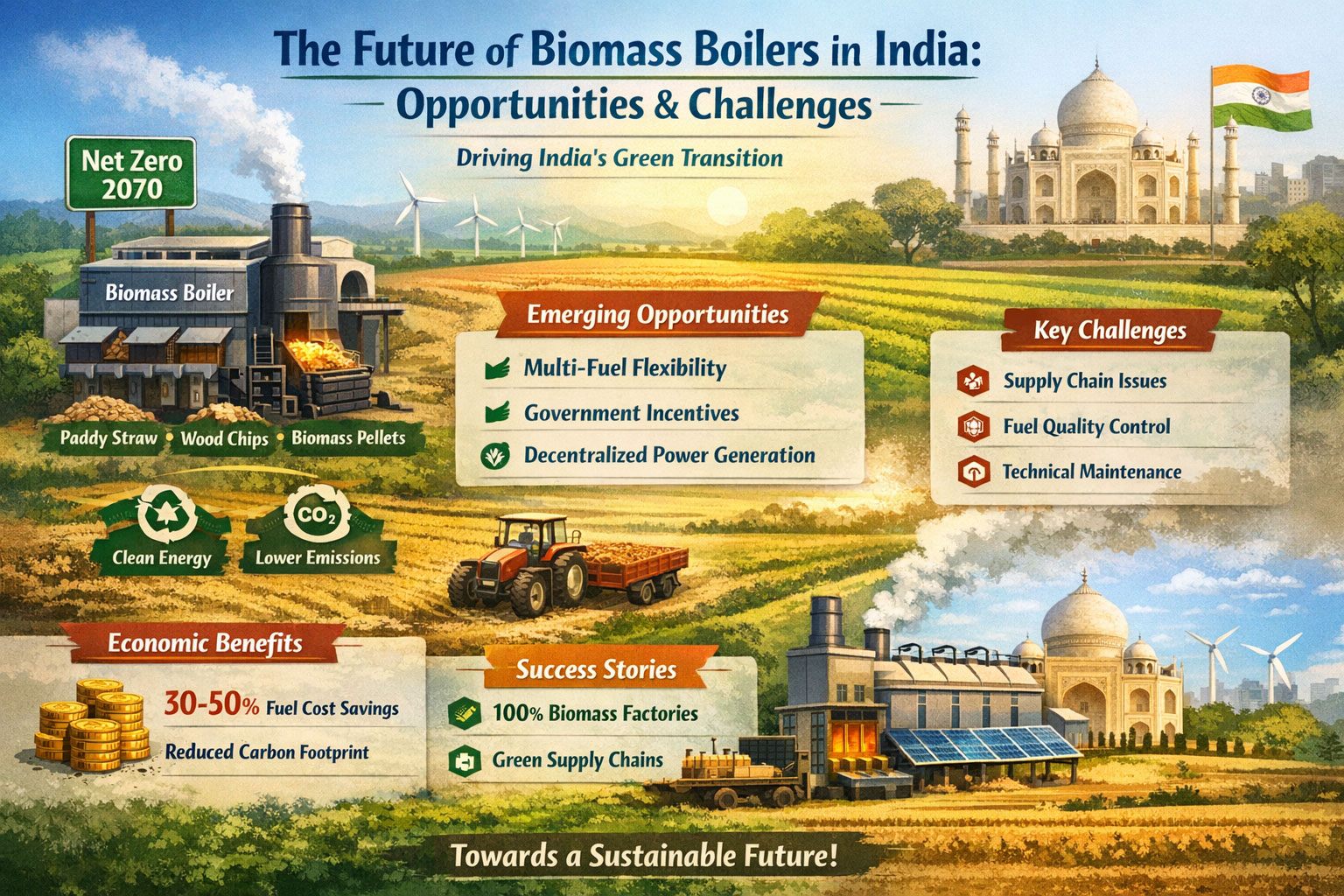
The Future of Biomass Boilers in India: Where the Real Opportunities and Real Obstacles Actually Lie
India’s stated pathway toward Net Zero by 2070, alongside tightening CPCB emission norms and persistently volatile fossil fuel pricing, is reshaping how industrial plants think about their heat source — not as a sustainability afterthought, but as a genuine cost and compliance decision. Biomass sits at the center of that shift, and for good reason: India is one of the world’s largest agricultural producers, generating enormous volumes of crop residue every year. But turning that raw availability into reliable industrial heat still comes with real engineering and supply-chain challenges worth understanding honestly, not glossing over. This piece looks at both sides — the genuine opportunity and the genuine friction — for a plant manager actually weighing this decision in 2026.
The Scale of the Resource, Precisely Stated
The Ministry of New and Renewable Energy (MNRE) has estimated India’s total biomass availability at roughly 750 million tonnes annually across all sources — agricultural residue, forestry by-products, and processing waste combined. Crop residue specifically is more commonly estimated in the 500–620 million tonnes range by various government and academic studies, with surplus residue (beyond what’s already used for fodder, fuel, or soil amendment) estimated at somewhere between 140 and 230 million tonnes depending on methodology and year. These figures vary across sources because measurement approaches differ, but the consistent conclusion across every study is the same: India generates far more agricultural residue than current utilisation captures, and a meaningful share of that surplus is still burned in the open field — a practice that contributes materially to seasonal air quality problems, particularly across North India.
Converting that surplus into industrial boiler fuel serves two purposes simultaneously: turning an agricultural disposal liability into commercial fuel value, and reducing industrial reliance on coal and furnace oil, both of which carry volatile, internationally-linked pricing that Indian plants have limited control over.
Where the Genuine Opportunities Are
Multi-Fuel Flexibility Is a Real Engineering Advance
Older biomass boilers were often designed around a single fuel type, leaving plants exposed if that specific fuel’s local price or availability shifted. Modern combustion engineering increasingly allows a single system to handle rice husk, wood chips, and biomass pellets with only modest efficiency variation between them, genuinely protecting industries from seasonal fuel shortages rather than locking them to one supply chain. Our overview of multi-fuel boilers as the future of industrial heating in India covers this engineering approach in more depth.
Government Policy Support — What’s Actually Confirmed
It’s worth being precise here, since scheme details shift and outdated claims do a disservice to anyone planning a project budget around them. MNRE’s National Bioenergy Programme supports biomass pellet manufacturing and related projects through Central Financial Assistance, with the current phase running through 31 March 2026 — as of this writing, no confirmed Phase II extension exists, so any plant planning around this incentive should verify current status directly with MNRE rather than assuming indefinite continuation.
On carbon credits specifically: India’s compliance carbon market (the Indian Carbon Market, or ICM) currently applies to obligated entities in a defined set of energy-intensive sectors — aluminium, cement, chlor-alkali, pulp and paper, petroleum refining, petrochemicals, and textiles — above specific size thresholds, not automatically to every business installing a biomass boiler. If your plant sits outside these sectors and thresholds, “monetizing carbon savings” isn’t an automatic outcome of a fuel switch — it would require separate registration under a voluntary crediting mechanism with its own verification costs. Confirm your specific eligibility with the Bureau of Energy Efficiency (BEE) or a carbon markets consultant before factoring credit revenue into a project’s ROI case.
What’s more broadly and reliably true: as CPCB and state pollution control boards continue tightening SOx and NOx limits, biomass’s naturally low sulfur content genuinely does make emission compliance more straightforward than for high-sulfur fossil fuels — this is a real, durable advantage independent of any specific subsidy scheme’s current status.
Decentralized Cogeneration Is a Genuine Growth Area
Beyond process steam alone, biomass cogeneration — generating both electricity and process steam from the same fuel input — is a growing option for industries seeking to reduce grid dependency and improve overall energy utilisation. This “behind-the-meter” generation is particularly relevant for facilities in industrial clusters with unreliable grid supply, where energy security carries value beyond the direct cost comparison alone. Rice mills and sugar mills, given their on-site biomass by-products, are particularly natural fits for this model — our engineering guide to travelling grate boilers for sugar mills covers this specific application.
The Real Challenges — Given Honest Weight
Supply Chain Fragmentation Is the Biggest Practical Obstacle
Unlike coal, which moves through a relatively centralized distribution network, biomass supply is inherently decentralized — collecting, transporting, and storing low-density agricultural residue from many small sources is genuinely more logistically complex and costly than sourcing a single fossil fuel from established terminals. The most effective solution has been the growth of dedicated biomass pelleting infrastructure, which converts loose, low-density residue into standardized, denser fuel that’s meaningfully more practical and cost-effective to transport and store. Working with established pellet and briquette aggregators, rather than attempting to source loose biomass directly, has become the standard way plants manage this challenge in practice.
Fuel Quality Consistency Remains a Genuine Engineering Concern
Biomass fuel quality varies by moisture content, ash percentage, and calorific value — far more than a standardized fossil fuel does. High moisture content, common in green wood or fresh paddy straw, directly causes incomplete combustion, elevated flue gas temperature, and can shorten boiler component life if not properly managed. Our detailed breakdown of fuel moisture vs boiler efficiency — finding the ideal range sets out target moisture bands worth negotiating into your fuel supply contract, and automated fuel-feeding systems with real-time combustion sensing — now standard on well-engineered installations — help combustion systems adjust automatically to fuel variability rather than requiring constant manual operator correction.
Clinkering and Corrosion Demand Specific Material Engineering
Certain biomass fuels, particularly those with high alkali content like wheat straw, and high-silica fuels like rice husk, can cause clinkering and slagging on boiler tubes if furnace design doesn’t specifically account for this. This isn’t a reason to avoid these fuels — they remain genuinely cost-effective and widely used — but it does mean furnace and grate design need to be engineered around the specific fuel’s ash chemistry rather than treated as interchangeable with a low-ash fuel like wood pellets. Our guides on grate speed’s effect on steam production and fuel consumption and Vibrating Grate vs Reciprocating Grate technology go deeper into matching grate mechanism to specific fuel ash characteristics.
Technology Trends Shaping the Next Generation
| Technology | What It Delivers |
|---|---|
| PLC-based combustion automation | Reduces operator error and optimises fuel-to-air ratio automatically for consistent efficiency |
| Hybrid integration (waste heat recovery) | Combines biomass combustion with recovered process heat, further reducing net fuel demand |
| Advanced dust collection (ESP, bag filters) | Meets tightening particulate emission limits with substantially cleaner stack output |
| Continuous digital monitoring | Tracks fuel consumption, combustion parameters, and emissions in real time rather than periodic manual checks |
Our pieces on how AI and IoT are transforming biomass boiler operations and digital twin technology for boiler efficiency and reliability cover the digital monitoring layer in more depth, while our biomass boiler emission control systems guide covers the filtration side.
The Economics, Stated Honestly
For a genuine fuel-switch conversion from furnace oil or LDO, fuel cost reductions in the range of 20% to 50% are commonly achievable, with the exact figure depending heavily on your current fuel type, local biomass pricing, and boiler efficiency — always calculate this against your own current fuel invoice rather than accepting a blanket industry percentage. Payback periods for the capital investment commonly fall in the 12 to 24 month range for many industrial applications, though larger, higher-utilisation installations frequently see faster payback given the compounding effect of fuel savings against a fixed capital cost.
Separately from direct fuel economics, Indian exporters facing increasing demand from international buyers for documented “green supply chain” credentials do gain a genuine competitive positioning advantage by using biomass-generated process heat — though this is a market-driven advantage from buyer preference, distinct from any formal carbon credit or border-tax mechanism, and shouldn’t be conflated with the ICM or CBAM specifics covered above.
What’s Actually Happening in Indian Industrial Clusters
Industrial belts in states like Gujarat and Uttar Pradesh have seen a genuine, ongoing shift as manufacturers facing rising imported coal costs move toward biomass pellets and other regionally available residues, installing higher-efficiency multi-pass boilers as part of that transition. This is a real, broad industry trend rather than an isolated example — worth noting as a pattern rather than a single verified case study, since specific facility-level performance figures should always be confirmed directly with a plant rather than cited as a general industry statistic.
Planning a Transition: What to Get Right First
Plants considering this shift over the next few years should treat fuel-supply confirmation as seriously as the boiler purchase itself — securing a genuine, standing relationship with a briquette or pellet aggregator before finalising equipment specification avoids the most common way biomass projects underperform their projected savings. Equally, matching furnace and grate technology to your specific fuel’s ash and moisture profile from the outset, rather than adapting a generic design afterward, determines whether you actually achieve the efficiency and reliability figures used to justify the investment. The opportunity in Indian biomass is genuinely substantial, but it’s realised through this kind of careful, fuel-specific engineering — not simply by installing “a biomass boiler” and expecting generic industry averages to apply automatically to your plant.
Our Role in This Transition
Balkrishna Boilers Pvt Ltd — IndianBoilers.com and Balkrishn.com — designs IBR-approved biomass steam, thermic fluid, and hot air systems engineered specifically around the fuel-flexibility, ash-management, and automation principles described above. Our Steam Boiler range includes husk-specific HUSKPOWER and the compact COMCUBE system, alongside waste-heat-focused ENERPOWER for plants looking to combine biomass combustion with heat recovery.
Frequently Asked Questions
How much biomass surplus does India actually have available? Estimates vary by methodology, but government and academic studies consistently put surplus crop residue in the range of 140–230 million tonnes annually, on top of significant additional biomass from forestry and processing waste — a substantial, underutilised resource by any reasonable estimate.
Is the National Bioenergy Programme subsidy guaranteed to be available when I’m ready to invest? The current phase runs through 31 March 2026 with no confirmed Phase II as of this writing — always verify current scheme status with MNRE directly before budgeting a project around a specific incentive figure.
Can any manufacturer earn carbon credits from switching to biomass? Only automatically if your plant falls within a sector and size threshold currently covered by India’s compliance carbon market. Otherwise, voluntary crediting mechanisms exist but require separate registration and verification — it’s not a default outcome of the boiler purchase itself.
Is fuel quality inconsistency a dealbreaker for biomass adoption? No — it’s a genuine engineering challenge that’s been substantially addressed through automated fuel feeding, real-time combustion sensing, and working with established pellet/briquette suppliers rather than loose spot-market biomass. It’s a factor to plan around, not a reason to avoid the fuel switch.
Talk to Our Engineering Team
If you’re evaluating a transition to biomass and want a technical proposal sized to your actual load, local fuel access, and current fuel costs, get in touch with our engineering team or browse our complete product range.
Further reading: Biomass Boilers in India: Fueling Growth with Rice Husk Power · The Complete Guide to Biomass Boilers for Steam Generation · Reduce Your Carbon Footprint with Biomass Boiler Technology · Biomass Boiler Trends in 2026