Indian Boilers.com

Thermic Fluid Heater

Category: Thermic Fluid Heater

Our Latest News And Updates

Thermic Fluid Heater Fuel Options: Coal, Biomass, or Gas?

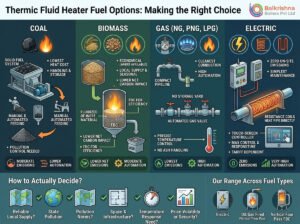
Thermic Fluid Heater Fuel Options: Coal, Biomass, or Gas?

Fuel choice is one of the first decisions a plant makes when specifying a thermic fluid heater — and it’s a decision that shapes running cost, compliance requirements, and day-to-day operations for the life of the system. Unlike sizing or fluid selection, which can be adjusted or corrected later without enormous cost, fuel choice is largely locked in at commissioning,

Read More »
Understanding Heat Transfer in Thermic Fluid Heater Systems

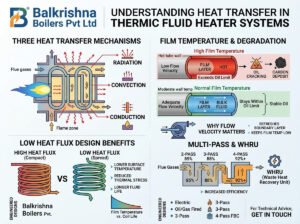
Understanding Heat Transfer in Thermic Fluid Heater Systems

Most of the practical guidance around thermic fluid heaters — sizing, maintenance, troubleshooting — sits on top of a small set of heat transfer principles. Once you understand how heat actually moves from flame to fluid to process, a lot of the “why” behind maintenance schedules, fluid selection, and coil design stops being a list of rules to follow and

Read More »
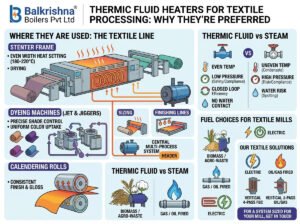
Thermic Fluid Heaters for Textile Processing: Why They're Preferred

Thermic Fluid Heaters for Textile Processing: Why They’re Preferred

Walk through any textile processing house running stenters, dyeing ranges, or calendering lines, and you’ll find thermic fluid heaters doing the heavy lifting behind the scenes. It’s one of the industries where the technology has become close to the default choice, and not by accident — textile processing has a set of temperature and uniformity demands that map almost exactly

Read More »
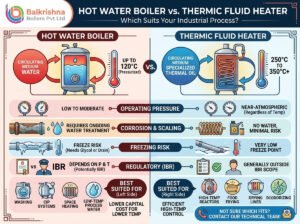
Thermic Fluid Heater vs Hot Water Boiler: Key Differences

Thermic Fluid Heater vs Hot Water Boiler: Key Differences

Not every process needs 300°C. A lot of industrial heating — washing, low-temperature process water, space heating, moderate-temperature cleaning and sterilization — sits comfortably in a range that a hot water boiler handles perfectly well, without reaching for the higher capability (and higher cost) of a thermic fluid heater. The two technologies overlap at the edges but are built for

Read More »
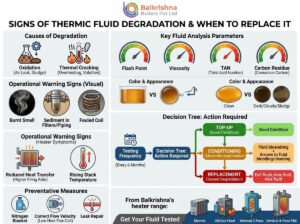
Signs of Thermic Fluid Degradation and When to Replace It

Signs of Thermic Fluid Degradation and When to Replace It

The fluid running through a thermic fluid heater is a consumable, not a permanent fixture — and treating it as permanent is one of the most common ways plants end up with an expensive coil replacement instead of a routine fluid change. Thermal fluid degrades gradually, through oxidation and thermal cracking, and the tricky part is that it keeps circulating

Read More »
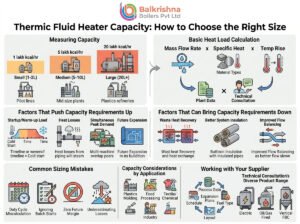
Thermic Fluid Heater Capacity: How to Choose the Right Size

Thermic Fluid Heater Capacity: How to Choose the Right Size

Sizing a thermic fluid heater wrong is one of the more expensive mistakes a plant can make — and it’s easy to make in either direction. Undersize the unit and the process never quite hits its required temperature, especially at peak demand, leaving you retrofitting a second heater within a year or two. Oversize it and you’ve spent capital on

Read More »
Thermic Fluid Heater Safety Precautions Every Operator Should Follow

Thermic Fluid Heater Safety Precautions Every Operator Should Follow

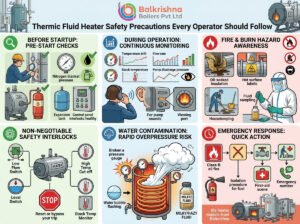
A thermic fluid heater is inherently safer than a comparable high-pressure steam boiler — that’s a large part of why the technology exists. But “safer than steam” doesn’t mean “no risk.” A thermic fluid system runs hot combustible oil through a closed loop at temperatures well above the flash point of ordinary fuels, and the specific hazards it carries are

Read More »
How Thermic Fluid Heaters Improve Energy Efficiency

How Thermic Fluid Heaters Improve Energy Efficiency

Fuel is usually the single largest recurring cost of running process heat in an industrial plant, which means efficiency isn’t an abstract engineering metric — it shows up directly on the monthly fuel bill. When plants compare a thermic fluid heater against steam or direct-fired alternatives, efficiency is usually one of the first numbers they ask about, and for good

Read More »
Thermic Fluid Heater Applications in Food Processing Plants

Thermic Fluid Heater Applications in Food Processing Plants

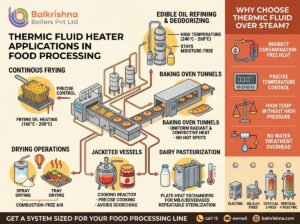
Food processing has a heating requirement most other industries don’t: the heat source has to be indirect, precisely controlled, and never allowed to contaminate the product. Water and steam carry risks of contamination, scaling, and microbial growth if not treated rigorously. That’s a large part of why so many food plants — from edible oil refineries to snack manufacturers —

Read More »
Thermic Fluid Heater Applications in the Plastics Industry

Thermic Fluid Heater Applications in the Plastics Industry

Plastics processing runs on temperature control. A few degrees too hot or too cold at the mold, the die, or the roller, and you’re looking at warping, uneven wall thickness, poor surface finish, or a batch that simply doesn’t hold dimension. It’s one of the few industries where the heating system isn’t a background utility — it’s directly wired into

Read More »
Common Thermic Fluid Heater Problems and Their Solutions

Common Thermic Fluid Heater Problems and Their Solutions

Call out enough thermic fluid heater breakdowns across enough plants, and you start seeing the same nine or ten problems again and again. The equipment changes — different capacities, different fuels, different industries — but the failure modes repeat because they all trace back to the same handful of root causes: fluid degradation, coil fouling, and instrumentation that got ignored

Read More »

Thermic Fluid Heater Applications in the Plastics Industry

Plastics processing runs on temperature control. A few degrees too hot or too cold at the mold, the die, or the roller, and you’re looking at warping, uneven wall thickness, poor surface finish, or a batch that simply doesn’t hold dimension. It’s one of the few industries where the heating system isn’t a background utility — it’s directly wired into

Read More »
Scroll to Top
Get a Quote

Please use the form to submit your inquiry.

    X
    Get A Quote