
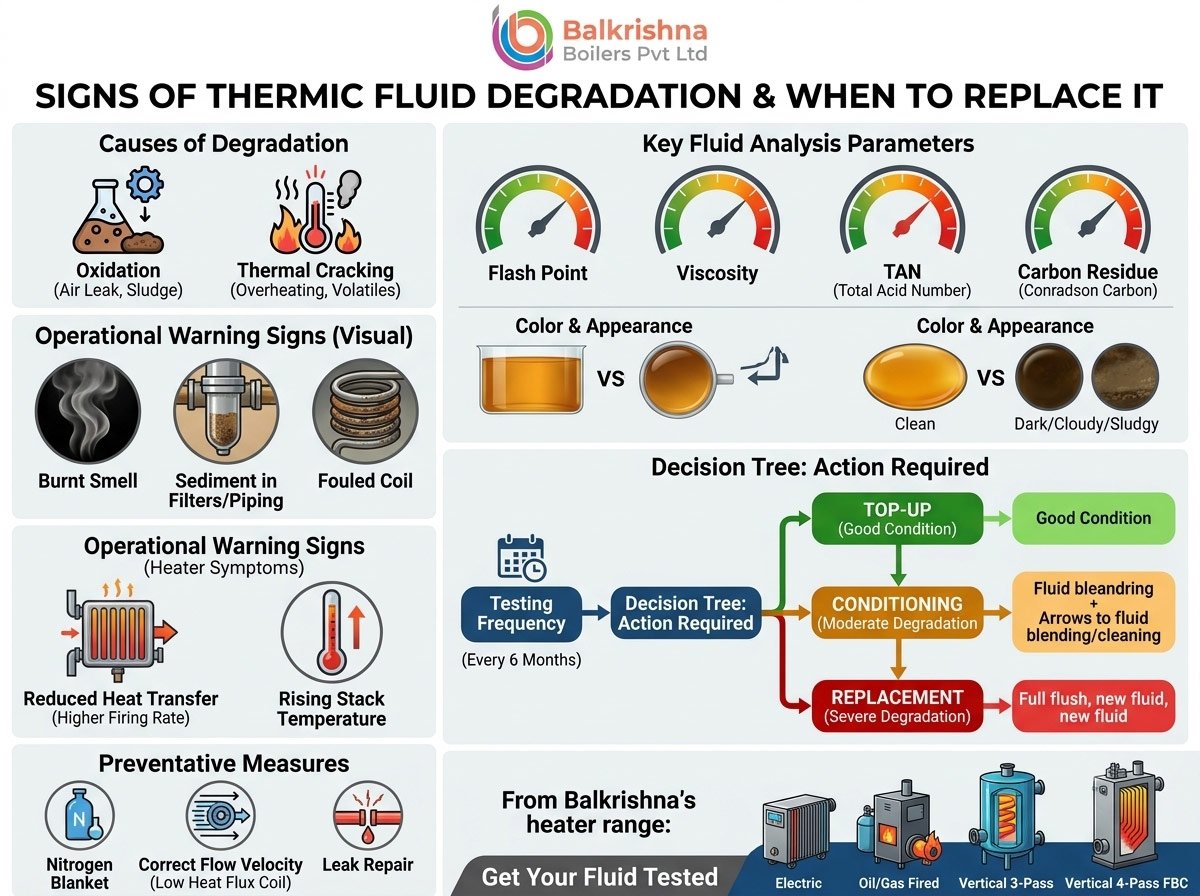
The fluid running through a thermic fluid heater is a consumable, not a permanent fixture — and treating it as permanent is one of the most common ways plants end up with an expensive coil replacement instead of a routine fluid change. Thermal fluid degrades gradually, through oxidation and thermal cracking, and the tricky part is that it keeps circulating and “working” right up until the degradation is severe enough to cause a visible problem — reduced heat transfer, a fouled coil, or in worst cases, a fire risk from a fluid whose flash point has dropped well below its safe operating margin.
This guide covers exactly what degradation looks like, how to read a fluid analysis report, and how to decide between topping up, conditioning, or a full replacement.
Why Thermal Fluid Degrades
Two chemical processes account for almost all thermal fluid degradation:
Oxidation happens when the fluid is exposed to oxygen, typically because the nitrogen blanket on the expansion tank has failed, is poorly maintained, or the system has an air leak drawing oxygen into the headspace. Oxidation produces acidic compounds and sludge, gradually thickening the fluid and reducing its heat transfer efficiency.
Thermal cracking (carbonization) happens when the fluid is exposed to temperatures beyond its rated limit — often not the bulk fluid temperature, but the localized film temperature at the coil wall, which can run significantly hotter than the bulk fluid if flow velocity is too low. Cracked fluid breaks down into lighter, more volatile fractions and heavier carbon residue, both of which are problems: the lighter fractions lower the flash point (a safety concern), while the carbon residue deposits on coil surfaces and causes fouling.
Most real-world degradation is some combination of both processes happening simultaneously, which is why a proper fluid analysis looks at several parameters together rather than any single number in isolation.
The Fluid Analysis Parameters That Matter
A proper thermal fluid analysis, done by a qualified lab, checks:
Flash point. This is the most safety-critical number on the report. A dropping flash point means light, volatile cracked fractions are accumulating in the fluid, raising fire risk. Most fluid specifications define a minimum acceptable flash point relative to the fluid’s original rating — a significant drop from that baseline is a clear signal that cracking is underway and the situation needs attention, not routine monitoring.
Viscosity. Both rising and falling viscosity from the original specification indicate degradation, just from different causes — oxidation typically thickens the fluid (rising viscosity, more sludge), while cracking can thin it (falling viscosity, from the breakdown into lighter fractions). Either direction affects the fluid’s ability to transfer heat and flow properly through the coil.
Total Acid Number (TAN). A rising TAN is the clearest indicator of oxidation. Acidic byproducts don’t just indicate fluid degradation — they can also be mildly corrosive to system metallurgy over extended exposure, which is another reason a rising TAN shouldn’t be left unaddressed.
Carbon residue (Conradson Carbon). This measures the fluid’s tendency to leave carbon deposits when exposed to high heat — rising carbon residue correlates directly with coil fouling risk, since it’s essentially measuring the same chemistry that deposits carbon on the tube wall in service.
Color and appearance. Less precise than the lab parameters above, but a useful quick indicator — fresh thermal fluid is typically light amber to pale yellow; darkening over time is expected to some degree, but a rapid shift to dark brown or black, especially combined with cloudiness or visible particulate, warrants closer investigation.
Visual and Operational Warning Signs Between Lab Tests
You don’t need to wait for the scheduled six-month analysis to notice degradation — several signs are visible during normal operation:
- A sharp, burnt smell from the fluid or around the expansion tank, which typically indicates active thermal cracking.
- Dark, cloudy, or sludgy appearance when drawing a sample from a test port.
- Sediment or sludge accumulation in filters, strainers, or low points in the piping.
- Reduced heat transfer performance — the process needs a higher firing rate or longer time to reach the same temperature it used to hit more easily, which is often the first practical symptom plant staff notice, even before anyone thinks to test the fluid itself.
- Rising stack temperature at constant firing rate, which can indicate coil fouling from carbon deposits building up as a consequence of degraded fluid. Our guide to common thermic fluid heater problems and their solutions covers how this specific symptom chain plays out in the field.
None of these signs alone confirms the extent of degradation with certainty — that’s what the lab analysis is for — but any one of them is a reason to pull a sample and test sooner than your next scheduled interval.
How Often to Test
We recommend a fluid analysis every six months as standard practice, regardless of how the fluid looks or how the system is running. This regular cadence is what catches gradual degradation early enough to act on it economically — waiting for a visible or operational symptom to prompt testing means you’re often already further into degradation than you’d like to be. Systems running at higher average temperatures, closer to the fluid’s rated maximum, or with a history of interlock trips or leaks should be tested more frequently, since these conditions accelerate degradation.
Reading the Trend, Not Just the Single Report
A single fluid analysis report tells you where the fluid stands today; comparing it against the previous report tells you the rate of degradation, which matters more for planning. A flash point that’s dropped 5°C over six months is a very different situation from one that’s dropped 25°C over the same period, even if both currently sit above the minimum threshold — the first suggests years of remaining service life, the second suggests the fluid may fall below the safe threshold well before the next scheduled test. Keep every fluid analysis report on file and review them side by side, not just against the pass/fail threshold on the most recent one.
Top-Up, Fluid Conditioning, or Full Replacement?
Once you have analysis results in hand, the decision generally falls into one of three categories:
Top-up with fresh fluid. Appropriate when parameters are still comfortably within acceptable range and the system has simply lost some fluid volume to minor evaporation or a very minor historical leak. This isn’t a degradation response so much as routine volume maintenance.
Fluid conditioning or partial replacement. Appropriate when parameters show moderate degradation — a TAN that’s risen but flash point remains solidly acceptable, for instance — where blending in a portion of fresh fluid, combined with addressing the root cause (nitrogen blanket, flow issues), can bring the system back into a healthy operating range without a full drain.
Full drain and replacement. Necessary when flash point has dropped close to or below the safety threshold, when carbon residue and viscosity indicate advanced cracking, or when visible sludge and sediment suggest the fluid is actively fouling the system. A full replacement should typically be paired with a system flush and, if coil fouling is suspected, a coil inspection or decarbonization — replacing degraded fluid into a fouled coil doesn’t fully solve the underlying problem. Our maintenance guide covers the annual deep-service process, including coil inspection, in more detail.
This decision is best made in consultation with whoever is interpreting your fluid analysis report — the acceptable thresholds vary somewhat by fluid type and manufacturer specification, so a generic rule of thumb is less reliable than reading your specific fluid’s data sheet against your lab results.
Expected Fluid Lifespan
As a general guide:
- Quality mineral-based thermal oils typically last 3 to 5 years with disciplined maintenance and correct operating temperature.
- Synthetic thermal fluids can run 8 to 10 years, reflecting their higher thermal stability, though at a higher initial cost.
These figures assume the fluid is operated within its rated temperature range and the system is maintained per the schedule in our maintenance guide — a fluid consistently run above its rated temperature, or in a system with poor nitrogen blanketing, will degrade well ahead of these ranges regardless of nominal fluid quality. Actual condition from fluid analysis should always take priority over the calendar when deciding on replacement.
Choosing the Right Fluid to Begin With
A significant share of “premature” degradation cases actually trace back to the wrong fluid grade for the process temperature, rather than a maintenance failure. Running a fluid rated for a lower maximum temperature than your process actually reaches — even intermittently, during upset conditions or startup spikes — accelerates cracking regardless of how well the rest of the system is maintained. Our thermic fluid heater oil selection guide covers how to match fluid type and grade to your actual operating temperature range, including startup and peak conditions, not just steady-state running temperature.
Preventing Accelerated Degradation
Beyond correct fluid selection, the practices that most directly extend fluid life are:
- Maintaining correct nitrogen blanket pressure on the expansion tank at all times.
- Ensuring adequate flow velocity through the coil to avoid localized film overheating — a low heat flux coil design, covered in our piece on how thermic fluid heaters improve energy efficiency, is one of the most effective structural protections against this.
- Fixing leaks promptly rather than topping up repeatedly, since a system that’s continuously losing and replacing fluid is also continuously exposing fresh fluid to oxidation at the leak point.
- Following the six-month fluid analysis schedule without exception, even when the system seems to be running fine.
Get Your Fluid Tested or Discuss Replacement Options
At Balkrishna Boilers Pvt Ltd, we support fluid analysis interpretation, conditioning, and full replacement for thermic fluid heaters — whether originally supplied by us or another manufacturer — across our range:
- Electric Thermic Fluid Heater
- Oil / Gas Fired Thermic Fluid Heater
- Vertical Three Pass Oil / Gas Fired Thermic Fluid Heater
- Vertical Four Pass FBC Thermic Fluid Heater
If your fluid is overdue for testing, or a recent report has you weighing top-up against full replacement, get in touch with your latest analysis results and we’ll help you make the call.