
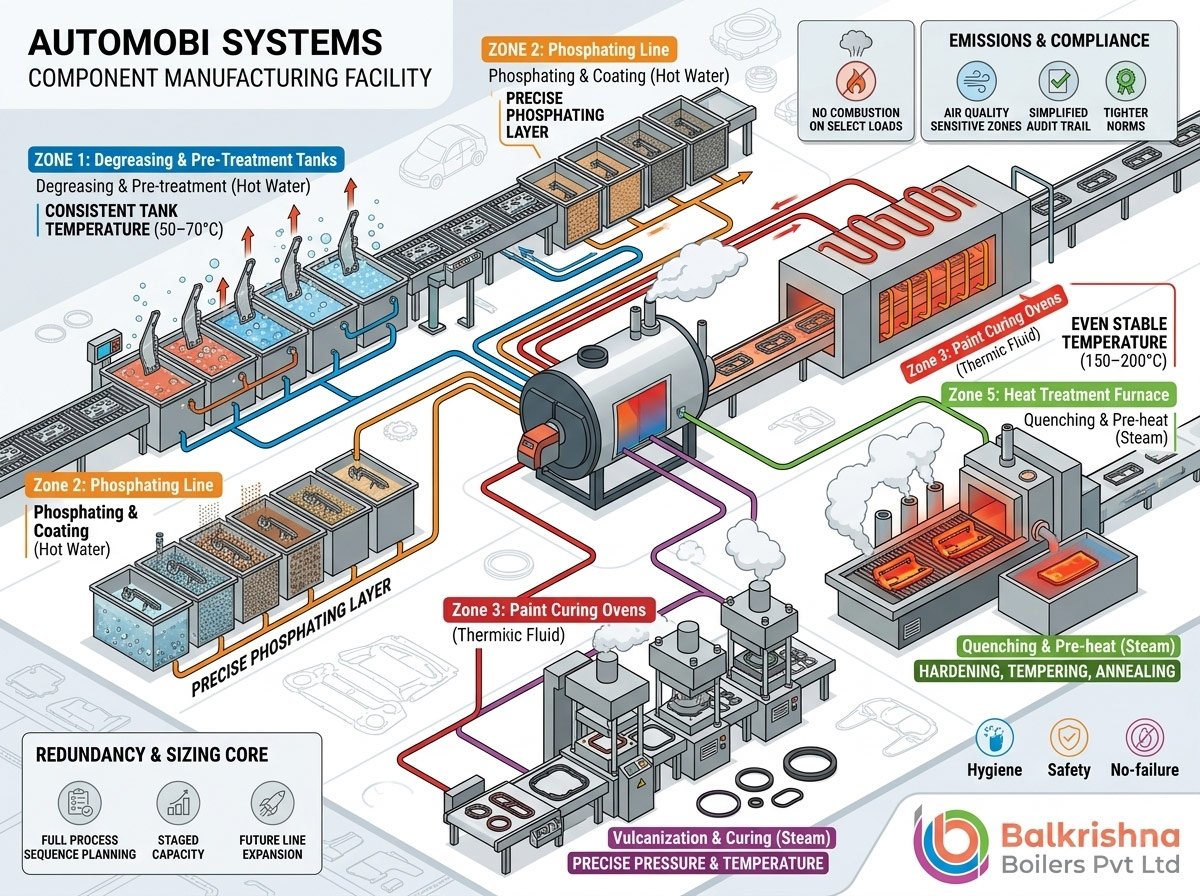
Automobile component manufacturing runs on heat at nearly every stage of the line. Before a bracket, panel, or casing ever reaches assembly, it typically passes through degreasing, phosphating or pre-treatment tanks, a paint shop with curing ovens, and in many cases a heat treatment furnace for hardening or tempering. Each of these stages has its own temperature window, its own tolerance for variation, and its own consequence for getting it wrong — a paint curing oven running cold leaves an unfinished coat that fails adhesion testing; a pre-treatment tank at the wrong temperature leaves components under-phosphated and prone to corrosion after they leave the plant.
Auto component manufacturers also work under some of the tightest quality and delivery standards in Indian manufacturing, supplying OEMs that run their own audits on supplier processes, including utilities. That makes boiler selection here less about picking one large system and more about matching the right heat source, precisely, to each stage of a multi-step process line. This guide walks through what auto component plants actually need from their thermal systems and which equipment fits each stage.
Why Auto Component Lines Need Several Different Kinds of Heat
A typical auto component manufacturing line — whether producing sheet metal parts, forgings, castings, or rubber and plastic components — runs through several distinct thermal stages:
- Degreasing and pre-treatment — components pass through hot alkaline or acid dip tanks to remove oil and prepare the surface for coating, typically in the 50–70°C range with tight consistency requirements.
- Phosphating — a critical corrosion-protection step that depends on precise tank temperature to form a consistent phosphate layer before painting.
- Paint curing ovens — E-coat and topcoat curing needs stable, evenly distributed heat, often in the 150–200°C range, where uneven heating shows up directly as coating defects.
- Heat treatment — hardening, tempering, and annealing of forged or machined components require furnace temperatures that are both precise and repeatable, batch after batch.
- Rubber and plastic component molding — vulcanization and curing processes for gaskets, seals, and bushings depend on steam or hot oil at controlled temperature and pressure.
Because these stages sit on the same production line but need very different heat delivery methods — dip-tank hot water, oven-grade hot air, and precision thermic fluid heat — most auto component plants run a combination of systems rather than a single boiler serving the entire line.
Thermic Fluid Heaters: The Standard for Paint Ovens and Curing Lines
Paint shops are where thermic fluid heating earns its reputation in the auto component industry. A thermic fluid heater circulates hot oil through the oven’s heat exchanger coils, giving paint curing ovens the even, closely controlled heat distribution that coating quality depends on — without the pressure risks or condensate issues that come with steam-heated ovens.
Ranges like THERMPAC and DELTAPAC are commonly specified for E-coat and topcoat curing ovens, where stable surface temperature across the full oven length directly affects finish quality and adhesion test results. For plants running continuous curing lines with tighter footprint constraints, vertical options such as the VTF Series or VTM Series deliver the same thermal precision in a smaller installation area.
If your plant is weighing thermic fluid against steam for a curing or pre-treatment application, our earlier posts <a href=”https://www.indianboilers.com/thermic-fluid-heater-vs-steam-boiler-which-suits-your-process/”>Thermic Fluid Heater vs Steam Boiler: Which Suits Your Process?</a> and <a href=”https://www.indianboilers.com/electric-boilers-vs-thermic-fluid-heaters-making-the-right-choice/”>Electric Boilers vs Thermic Fluid Heaters: Making the Right Choice</a> both work through the trade-offs in detail — worth reading together if your plant is deciding between all three heat sources for a new line.
Hot Water Boilers: Phosphating and Pre-Treatment Tanks
Pre-treatment and phosphating lines depend on dip-tank water held at a consistent temperature across every tank in the sequence — degreasing, rinsing, phosphating, and passivation each have their own target range, and drift in any one tank shows up as inconsistent coating adhesion further down the line. A hot water boiler dedicated to the pre-treatment section keeps these tanks at temperature independently of the paint oven and heat treatment furnace demand elsewhere on the line.
Models such as AQUAJET and AQUAMAX suit continuous multi-tank pre-treatment lines well, holding steady temperature across several tanks fed from a common loop, while the compact VST Series fits smaller component plants or lines retrofitted into existing floor space. Running pre-treatment on its own hot water system, rather than drawing from the same boiler serving the paint oven, also protects the coating line from temperature fluctuation whenever oven demand spikes.
Steam Boilers: Rubber, Plastic Components, and Heavier Process Load
Auto component plants producing rubber and plastic parts — gaskets, seals, bushings, hoses — typically need steam for vulcanization and curing presses, where precise pressure and temperature control directly determine part quality and dimensional consistency. A steam boiler remains the standard here, distributing steam to multiple presses through a single header with pressure regulated at each point of use.
Compact, fast-recovery ranges like STEAMAX and STEAMGEN suit component plants running a moderate number of curing presses on a scheduled cycle, while higher-output ranges such as COMBIPOWER fit larger plants running multiple press lines, degreasing tanks, and utility steam simultaneously. Forging and casting operations that run their own quenching or washing lines alongside the main process also typically draw from this same steam system rather than adding a separate unit for what is, in practice, a shared utility load.
Hot Air Generators: Direct Oven Heating and Drying Stages
Some paint and coating lines use direct or indirect hot air rather than a thermic fluid loop, particularly for flash-off zones and drying stages between coating steps. A hot air generator delivers this heat directly into the oven or drying chamber, which can offer faster response between batches than a thermic fluid system in applications where rapid heat-up and cool-down matter more than absolute temperature precision.
Ranges like AIRPAC and AIRTHERM are commonly used for these drying and flash-off applications, while compact models such as AIRJET suit smaller component lines with tighter space constraints around the drying zone. The choice between hot air and thermic fluid for a given oven stage usually comes down to whether the process needs faster thermal cycling (hot air) or tighter, steadier temperature control across a longer curing dwell (thermic fluid) — a specification decision worth confirming with your oven equipment supplier before finalizing the heat source.
Heat Treatment: Where Precision Matters Most
Hardening, tempering, and annealing furnaces used for forged and machined components demand some of the tightest temperature control on the entire plant floor — a few degrees of variation can change the metallurgical properties of a hardened component enough to fail a customer’s quality audit. While furnace heating itself is often a specialized, dedicated system separate from general plant utilities, the utility boilers supporting quenching, washing, and pre-heat stages around the furnace still need to hold consistent temperature so they don’t become the variable that throws off an otherwise well-controlled heat treatment process.
This is an area where working closely with an experienced boiler engineering team, rather than treating utility heating as an afterthought to the furnace specification, pays off directly in reduced rejection rates.
Emissions and Compliance in Auto Component Manufacturing
Auto component plants increasingly operate under the same tightening emission norms affecting Indian manufacturing more broadly, particularly plants located in industrial clusters near residential areas or under stricter state pollution control board oversight. This has pushed more component manufacturers toward electric boilers for select applications — particularly smaller pre-treatment or utility hot water loads where combustion emissions aren’t worth the compliance overhead for the capacity needed.
Ranges such as ELECTROMAX and ELECTROPAC fit this role well for smaller utility loads. Our earlier post <a href=”https://www.indianboilers.com/how-electric-boilers-help-meet-pollution-control-norms/”>How Electric Boilers Help Meet Pollution Control Norms</a> covers this shift in more depth, and <a href=”https://www.indianboilers.com/future-of-electric-boilers-in-indias-green-manufacturing-push/”>Future of Electric Boilers in India’s Green Manufacturing Push</a> looks at where this trend is heading across manufacturing more broadly, including auto component clusters. For plants evaluating the switch on a specific load, <a href=”https://www.indianboilers.com/electric-boiler-roi-when-does-it-pay-off/”>Electric Boiler ROI: When Does It Pay Off?</a> and <a href=”https://www.indianboilers.com/electric-boiler-power-consumption-formulas-and-examples/”>Electric Boiler Power Consumption: Formulas and Examples</a> help with the cost comparison, while <a href=”https://www.indianboilers.com/electric-boiler-water-quality-requirements-explained/”>Electric Boiler Water Quality Requirements Explained</a> and <a href=”https://www.indianboilers.com/electric-boiler-installation-what-to-expect/”>Electric Boiler Installation: What to Expect</a> cover what to plan for once a decision is made.
It’s worth noting that the same pre-treatment dip-tank logic that applies here is close in principle to what we’ve covered for other dip-and-coat processes — our post on <a href=”https://www.indianboilers.com/are-electric-boilers-a-good-fit-for-textile-dyeing-units/”>Are Electric Boilers a Good Fit for Textile Dyeing Units?</a> looks at a comparable tank-heating application from a different industry, and the underlying considerations around temperature consistency and control translate well to a phosphating line.
Sizing: Build Around the Full Process Sequence, Not Just the Biggest Load
A common mistake in auto component plant utility planning is sizing the boiler system around the single largest process step — usually the paint oven — and treating pre-treatment, curing presses, and heat treatment support as smaller add-ons. In practice, these stages run concurrently through most of a production shift, and undersizing any one of them creates a bottleneck that slows the entire line, not just the underserved stage. A realistic sizing exercise accounts for:
- Simultaneous demand across pre-treatment, paint curing, and press operations during a full shift
- Startup demand when a line comes back online after a changeover or maintenance window
- Reserve capacity for utility steam and hot water shared across multiple process areas
- Future line expansion, since auto component plants frequently add capacity or new process stages as OEM contracts grow
Working through this with an engineering team, using actual process-stage demand data rather than a single peak-load estimate, avoids the common outcome of a well-specified paint oven becoming bottlenecked by an undersized pre-treatment or utility system elsewhere on the line.
Why Auto Component Manufacturers Work With Balkrishna Boilers
Balkrishna Boilers Pvt Ltd has spent over two decades engineering thermal systems for precision-driven manufacturing sectors, including plants where coating consistency, dimensional tolerance, and OEM audit compliance leave no room for utility-driven variation. Our <a href=”https://www.indianboilers.com/industries/”>industries page</a> covers the wider range of sectors we serve, and our <a href=”https://balkrishn.com/client.php”>client list</a> includes manufacturers operating under the same process-control standards auto component plants are held to by their OEM customers.
Whether your plant needs a thermic fluid system for paint curing, a dedicated hot water loop for pre-treatment tanks, steam for rubber and plastic component presses, or a combination across a multi-stage process line, our team can help specify the right configuration for your process rather than sizing a single unit around the largest visible load.
Frequently Asked Questions
What type of heating is best for a paint curing oven? Most paint curing ovens run on thermic fluid heaters such as THERMPAC or DELTAPAC, which give the even, stable temperature distribution that coating adhesion and finish quality depend on.
Can one boiler serve both pre-treatment tanks and the paint oven? It’s possible in smaller plants, but most auto component manufacturers run these as separate systems so a spike in oven demand doesn’t cause temperature drift in the phosphating and pre-treatment tanks feeding the line.
Are electric boilers suitable for auto component pre-treatment lines? Yes, particularly for smaller utility hot water loads where combustion emissions and compliance overhead aren’t justified by the capacity needed — many plants use electric systems for this purpose while keeping fuel-fired systems for the larger paint oven and press loads.
How often should utility boilers on an auto component line be serviced? Given the tight tolerance requirements of coating and heat treatment processes, monthly inspection is recommended, with a full annual service and water-quality check to prevent scale buildup that could introduce temperature inconsistency into a process line.
Planning utility systems for a new paint shop, pre-treatment line, or component press facility? <a href=”https://www.indianboilers.com/contact-us/”>Get in touch with our engineering team</a> or explore our full <a href=”https://balkrishn.com/ourProduct.php”>product range</a> to find the right fit for your process.