
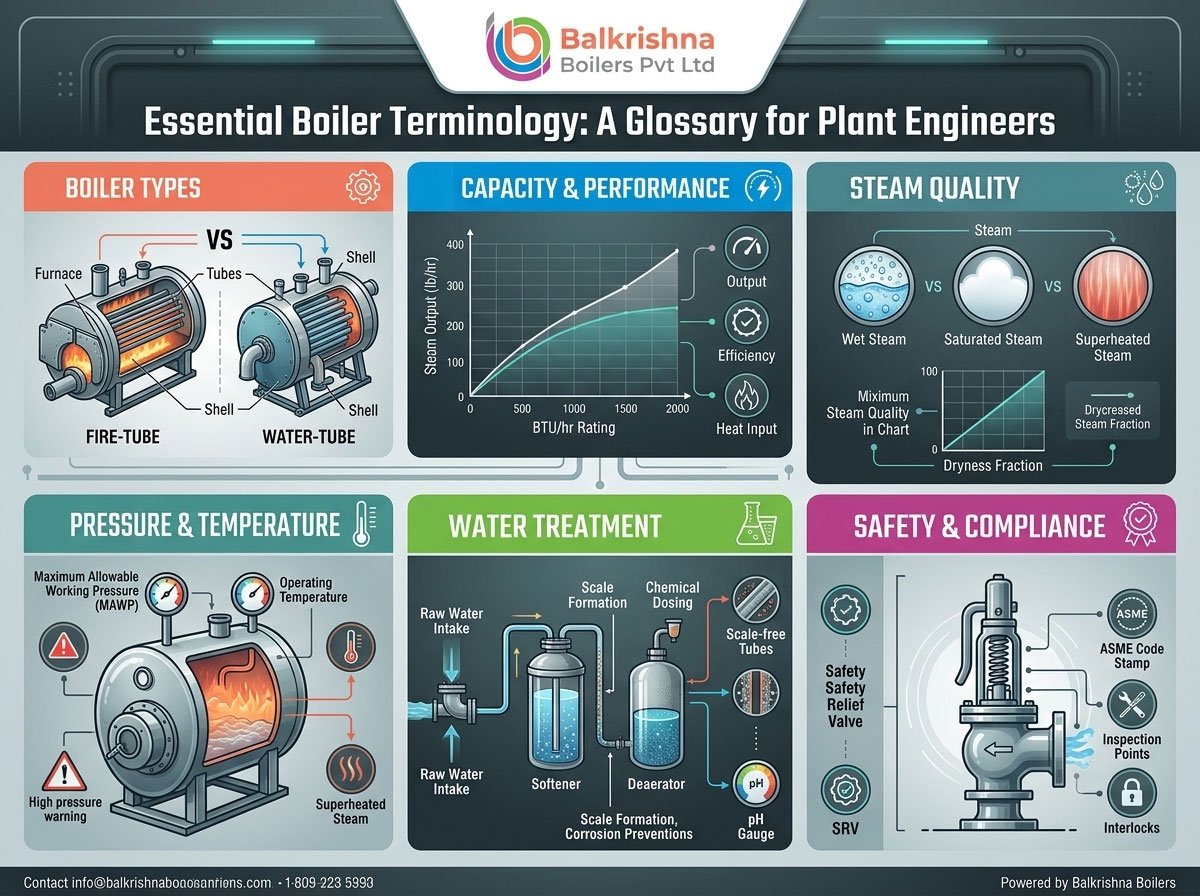
A boiler datasheet, an inspection report and a vendor quotation can describe the same machine in three different vocabularies. One document says “capacity” and means kilograms per hour. Another means “from and at 100°C”. A third quotes boiler horsepower. When people on the same project use these terms loosely, the result is wrong specifications, delayed approvals and arguments during commissioning.
This glossary puts the most important boiler terms in one place, in plain language. It is written for plant engineers, maintenance teams, utility managers and purchase heads who need to specify, run and audit steam and heating systems with confidence. Balkrishna Boilers Pvt. Ltd. has spent over 25 years designing and installing industrial boilers and heaters for process industries, and these are the terms our engineers hear on the plant floor every day.
1. Boiler Types and Construction Terms
Boiler: A closed pressure vessel in which heat from burning fuel, or from electricity, converts water into steam or hot water. It is the core of any steam system. Our full range is on the Steam Boiler page.
Fire-tube boiler: Hot flue gases travel inside tubes that are surrounded by water. These boilers are compact, simple to operate and common in small and mid-sized factories. For selection guidance, read What is a Fire Tube Boiler?
Water-tube boiler: Water flows inside the tubes while hot gases pass outside. This design suits higher pressures and larger capacities. Our guide on What is a Water Tube Boiler? compares it with the fire-tube type.
Furnace: The chamber where fuel burns and radiant heat is released.
Shell: The main pressure-holding body of a fire-tube boiler.
Tube plate (tube sheet): The plate into which boiler tubes are fixed at each end.
Smoke box: The chamber at the end of the boiler where flue gases collect before leaving through the chimney.
Thermic fluid heater: A heater that circulates thermal oil instead of water. It delivers high process temperatures at low pressure, which is why pharma, chemical and textile plants use it. Browse the Thermic Fluid Heater category or the thermic fluid heater range at balkrishn.com. To see one in the field, read how we installed a VTM Series thermic fluid heater at Infinium Pharmachem Limited.
Hot air generator: A unit that heats fresh air indirectly for drying and process applications, without contaminating the air stream. See the Hot Air Generator category.
2. Capacity and Performance Terms
Steam capacity (evaporation rate): The amount of steam produced per hour, shown in kg/hr or TPH (tonnes per hour). It is the number most buyers ask for first, but it means little without the operating pressure and feed water temperature.
From and at 100°C: A standard rating basis. It states the output as if feed water entered at 100°C and was converted to steam at atmospheric pressure. This lets you compare boilers fairly, because a boiler fed with cold water has to work harder than one fed with hot water.
Equivalent evaporation: Actual steam output converted to the “from and at 100°C” basis.
Factor of evaporation: The ratio used to convert actual evaporation into equivalent evaporation. It depends on steam pressure and feed water temperature.
Boiler horsepower (BHP): An older capacity unit still seen in imported equipment. One BHP is about 15.65 kg of steam per hour from and at 100°C.
Boiler efficiency: The share of fuel energy that ends up in the steam. There are two ways to measure it:
- Direct method: steam energy output divided by fuel energy input.
- Indirect method: 100% minus all measured losses, such as stack loss, radiation loss and blowdown loss. It is more useful for diagnosing where heat is going.
Turndown ratio: The range over which a burner can reduce its output while still firing safely and stably. A plant with fluctuating steam demand benefits from a high turndown ratio, because the burner does not have to switch on and off repeatedly.
Steam-to-fuel ratio: Kilograms of steam produced per kilogram of fuel burnt. It is a quick daily check on efficiency.
3. Pressure and Temperature Terms
Working pressure: The normal operating pressure of the boiler, shown in kg/cm², bar or psi.
Design pressure / MAWP (Maximum Allowable Working Pressure): The highest pressure the boiler is designed, certified and stamped for. Working pressure should always stay below it.
Hydraulic test pressure: The water pressure applied during inspection to prove the strength of the pressure parts. Under Indian regulations it is typically a set multiple of working pressure, commonly 1.5 times.
Saturation temperature: The temperature at which water boils at a given pressure. Higher pressure means a higher boiling point.
Latent heat: The heat needed to turn water into steam without changing its temperature. Most of the energy that steam delivers to a process comes from this latent heat.
Enthalpy: The total heat content of water or steam per unit mass. It is used in efficiency and energy balance calculations.
4. Steam Quality Terms
Saturated steam: Steam at exactly the boiling temperature for its pressure. It is the type used in most process heating.
Superheated steam: Steam heated beyond saturation temperature. It carries no moisture and is mainly used for turbines and certain processes.
Wet steam: Steam that carries tiny water droplets. It lowers heat transfer, causes corrosion and erodes valves and pipework.
Dryness fraction: The proportion of a steam–water mixture that is actual steam. A dryness fraction of 0.98 means 98% steam and 2% water.
Carryover: Water, foam or dissolved solids leaving the boiler along with the steam.
Priming: A sudden surge of water leaving with the steam, often triggered by a high water level, sudden load swings or excessive TDS.
Foaming: A stable layer of bubbles on the water surface, usually caused by high dissolved or suspended solids or oil contamination.
Water hammer: A violent shock in steam lines when condensate is driven at high speed by steam. It can damage pipes, valves and fittings. Proper drainage and slow valve opening prevent it.
5. Water Treatment Terms
Water quality decides how long a boiler lasts, so this vocabulary matters in every maintenance meeting.
Feed water: Water supplied to the boiler. It is a mix of make-up water and returned condensate.
Make-up water: Treated fresh water added to replace what is lost through blowdown, leaks and steam that is not returned.
Condensate: Steam that has given up its heat and turned back into water. It is hot and already treated, so returning it saves fuel, chemicals and water.
TDS (Total Dissolved Solids): The concentration of dissolved matter in boiler water. It rises as water boils off and must be held within limits.
Blowdown: Controlled discharge of boiler water to manage TDS.
- Surface (continuous) blowdown removes dissolved solids from the water surface.
- Bottom blowdown removes settled sludge from the lowest point.
Scale: A hard mineral deposit on heating surfaces. Even a thin layer reduces heat transfer, raises fuel use and can cause tube overheating.
Deaerator: A device that removes dissolved oxygen and other gases from feed water to prevent internal corrosion.
pH and alkalinity: Control parameters that protect boiler metal from corrosion and help prevent scale.
6. Boiler Mountings and Accessories
Mountings are the fittings required for safe operation. Accessories improve efficiency or convenience. Our detailed guide, Boiler Mountings Explained, covers each one in depth.
Safety valve: Opens automatically to release steam when pressure exceeds the set limit. It is the last line of defence against over-pressure.
Water level gauge: Shows the water level in the boiler. Operators check it constantly, because a low level is one of the most dangerous conditions.
Pressure gauge: Shows steam pressure inside the boiler.
Steam stop valve: The main valve that controls steam flow from the boiler to the plant. Read Steam Stop Valve: How It Controls Steam Safely Without Energy Loss.
Feed check valve: A non-return valve on the feed line that lets water in and stops it flowing back.
Blowdown valve: Used to discharge sludge and control TDS.
Air vent valve: Releases trapped air during start-up so that steam can fill the boiler properly. See Air Vent Valve in Boilers.
Fusible plug: A safety plug that melts at a set temperature if the water level drops too low, warning operators before the shell overheats. Learn more in What is a Fusible Plug in a Boiler?
Manhole and mudhole: Openings for internal inspection and cleaning.
Economiser: Recovers heat from flue gases to pre-heat feed water.
Air pre-heater: Uses flue gas heat to warm combustion air.
Superheater: Raises steam temperature above saturation temperature.
For a broader view of valve families and where each is used, see Types of Boiler Valves Explained.
7. Combustion and Draft Terms
Excess air: Air supplied beyond the theoretical requirement to make sure fuel burns completely. Too little causes smoke and unburnt fuel. Too much carries heat out of the chimney.
Flue gas: The mixture of gases produced by combustion and leaving the boiler.
Stack temperature: The flue gas temperature at the chimney. A rising stack temperature usually means fouled heat-transfer surfaces or poor combustion.
Draft: The pressure difference that moves air and flue gases through the boiler. It may be natural, forced (FD fan), induced (ID fan) or balanced.
Pre-purge: A ventilation cycle that clears unburnt gases from the furnace before ignition. It prevents furnace explosions.
Flame failure protection: A control that cuts the fuel supply immediately if the flame goes out.
Air pollution control equipment: Systems that clean flue gas before release. Common types include bag filters, wet scrubbers and ESPs. See the full Pollution Control Equipment range.
8. Safety and Compliance Terms (India)
IBR (Indian Boiler Regulations): The statutory rules that govern the design, manufacture, inspection, registration and operation of boilers in India. Compliance is a legal requirement for steam boilers within its scope.
Boiler attendant / boiler operation engineer: A certified person qualified to operate a boiler. The required certification depends on the boiler’s size and class.
Third-party inspection: An independent check of materials, fabrication and testing before dispatch.
Low-water cut-off: An interlock that stops firing automatically when the water level falls below the safe limit.
Boiler explosion: A catastrophic failure that usually follows low water, over-pressure or poor maintenance. Our article How to Prevent Boiler Explosions lists the practices that stop it.
9. Choosing the Right Boiler: Terms Mapped to Products
Understanding the terminology helps you ask better questions when you select equipment:
- Steam for process heating, sterilisation or cooking: Look at the Steam Boiler category. Product pages include COMBIPOWER, STEAMAX and PELLETAX.
- High temperature at low pressure: Look at the Thermic Fluid Heater category and the VTM Series.
- Hot water for washing, heating or jacketed vessels: See the Hot Water Boiler category and AQUAJET.
- Clean, on-site steam without a fuel store: See the Electric Boiler category and ELECTRO AQUA.
- Drying and process air: See the Hot Air Generator category and AIRPAC.
Industry also shapes the choice. Our application pages show how boilers serve pharma, dairy, textile, chemical and other sectors. Related reads include Boilers for Milk Powder and Dairy Product Manufacturing and Boilers for Solvent and Chemical Recovery Plants.
Frequently Asked Questions
What is the difference between working pressure and design pressure?
Working pressure is the pressure at which the boiler normally runs. Design pressure (MAWP) is the maximum the boiler is built and certified to withstand. Working pressure must always be lower.
What does “from and at 100°C” mean?
It is a standard basis for rating boiler capacity. It assumes feed water at 100°C and steam generated at atmospheric pressure, so different boilers can be compared on equal terms.
What is the difference between priming and carryover?
Priming is a sudden surge of water that leaves with the steam. Carryover is the broader term for any water, foam or solids moving out of the boiler with steam.
Why is TDS important?
High TDS leads to foaming, priming and scale. Regular blowdown keeps it within safe limits.
Do all boilers in India need to follow IBR?
Steam boilers that fall within the scope of the Indian Boiler Regulations must comply. Thermic fluid heaters and some small units are treated differently, so confirm the position for your equipment with the competent authority.
Conclusion
Precise vocabulary prevents expensive mistakes. When everyone on a project uses the same terms for capacity, pressure, steam quality, water treatment and safety, specifications are clearer, audits are faster and troubleshooting is easier. Keep this glossary handy for your next tender, inspection or training session.
Balkrishna Boilers Pvt. Ltd. is a manufacturer of industrial steam boilers, thermic fluid heaters, hot water boilers, hot air generators, electric boilers and pollution control equipment, with over 25 years of experience and more than 5,000 installations. If you need help sizing a boiler or understanding a quotation, our engineers are ready to assist.
Request a Quote | Explore Our Products | Read More Boiler Guides