
A steam boiler is designed to convert treated water into steam and deliver that steam reliably to an industrial process. However, generating steam efficiently is not only about the furnace, heating surface, fuel system or pressure controls. Small components that manage air, water and steam movement can have a significant influence on the reliability and performance of the entire system.
One such component is the air vent valve.
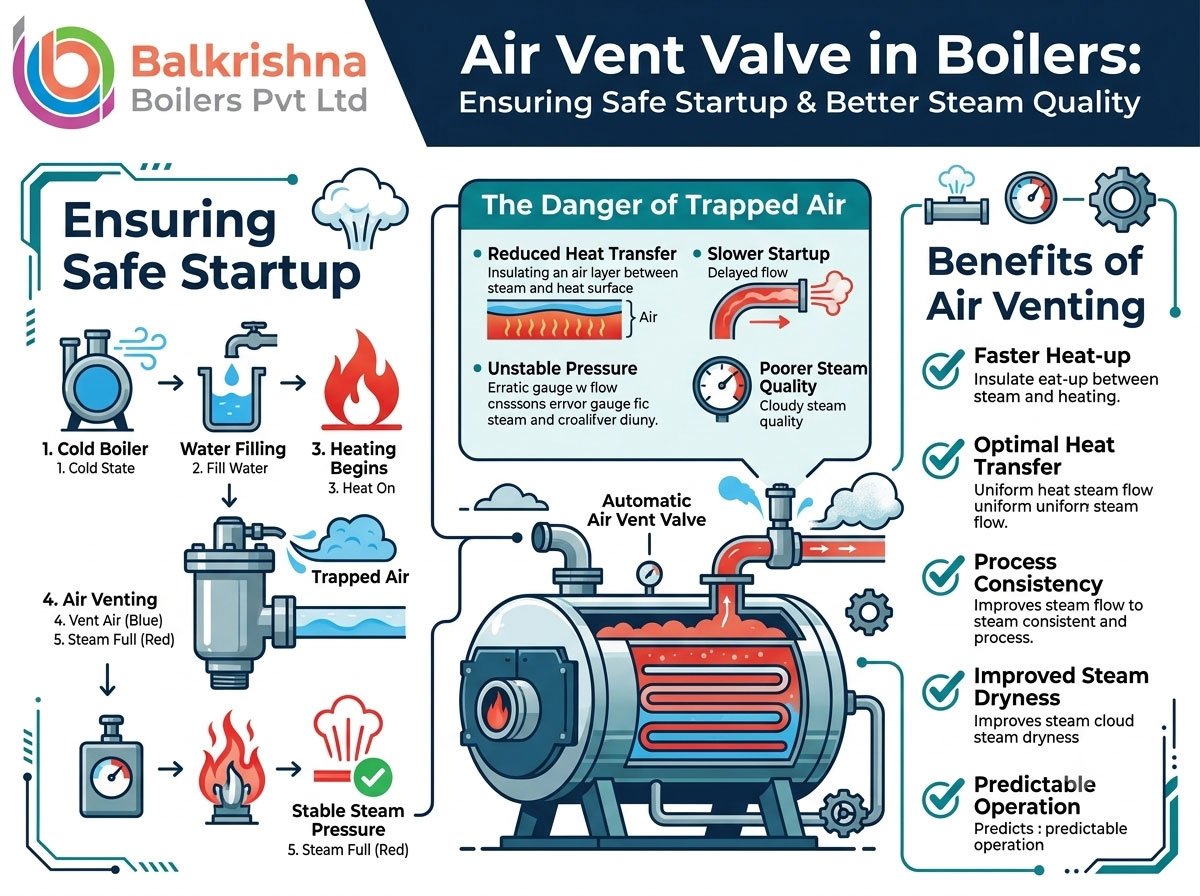
An air vent valve in a boiler is used to release trapped air and other non-condensable gases from parts of the steam or boiler system where they can interfere with normal operation. Air can enter a boiler system during filling, draining, maintenance, shutdown periods and through various connections. If it remains trapped, it can affect heat transfer, startup performance, pressure behaviour and steam-system efficiency.
During boiler startup, removing unwanted air is particularly important. A properly designed and operated venting arrangement allows the boiler and connected steam system to transition from an air-filled condition toward a steam-filled condition in a controlled manner.
For industries operating industrial steam boilers, biomass boilers, oil/gas-fired boilers or electric boilers, understanding the purpose of air venting is therefore an important part of boiler operation and maintenance.
What Is an Air Vent Valve in a Boiler?
An air vent valve is a device installed at an appropriate location in a boiler or steam system to allow trapped air and non-condensable gases to escape.
When a boiler is cold and not producing steam, portions of the system contain air. As the boiler starts heating, water temperature rises and steam begins to form. The air already occupying the steam space, piping or high points must be displaced.
The air vent provides a controlled path for this unwanted air to leave the system.
Once steam reaches the vent location, the venting arrangement may be closed manually or automatically, depending on the boiler design and valve arrangement.
It is important to understand that an air vent valve is not a replacement for a boiler safety valve.
A safety valve is designed to protect the pressure vessel against excessive pressure by relieving steam when the specified pressure condition is reached. An air vent, by contrast, primarily addresses trapped air and non-condensable gases during filling, startup and operation.
These devices therefore perform different functions and form different parts of a complete boiler safety and operating system.
For additional information about boiler protection, see our guide on How to Prevent Boiler Explosions: A Safety Guide.
Why Does Air Enter a Steam Boiler System?
Air can be present in a boiler system for several normal operational reasons.
1. Cold Startup
When a boiler is shut down and cooled, steam condenses and the internal system returns toward atmospheric conditions. Air can consequently occupy the steam space and connected piping.
2. Boiler Filling
When a boiler is filled with water after maintenance or a prolonged shutdown, air may remain in the upper portions of the vessel and connected piping.
3. Maintenance Activities
Opening manholes, inspection ports, valves, pipelines or other components introduces atmospheric air into the system.
4. Condensation
When steam condenses, the volume occupied by the steam decreases significantly. Depending on system configuration and pressure conditions, this can contribute to air entering or accumulating in parts of the steam system.
5. Piping Configuration
High points, dead legs and poorly designed piping arrangements can create locations where air becomes trapped.
This is why proper boiler and steam-piping design should consider not only steam flow but also air removal, condensate drainage and safe startup.
What Happens When Air Remains Trapped in a Boiler?
Air may appear harmless because it is simply part of the atmosphere. Inside a steam system, however, unwanted air can create several operational problems.
1. Reduced Heat Transfer
Steam transfers heat very effectively when it can directly contact the heat-transfer surface.
A layer of air or other non-condensable gas between steam and the heat-transfer surface can act as an insulating barrier. This can reduce the effectiveness of condensation and heat transfer.
The result may be longer heating times or higher steam consumption for a particular process.
2. Slower Boiler Startup
During startup, the boiler must heat water and establish steam pressure.
If air remains trapped within the steam space or connected system, the system does not immediately behave like a pure steam environment. Proper venting helps remove that initial air and supports a controlled transition to normal steam operation.
This is particularly relevant in industrial plants where production depends on predictable boiler startup.
Balkrishna Boilers’ product portfolio includes systems designed for different industrial steam requirements, including packaged and biomass-fired configurations. The company’s main product portfolio covers steam boilers along with electric boilers, thermic fluid heaters, hot water boilers and other process-heating systems.
3. Unstable Pressure Behaviour
Air and steam do not behave in the same way.
A pressure indication in a system containing a mixture of air and steam does not necessarily represent the same operating condition as a system containing predominantly steam.
Effective air removal therefore contributes to more predictable steam-system operation.
4. Reduced Steam Quality
Steam quality is particularly important in processes where heat transfer must remain consistent.
Excessive air or other non-condensable gases can interfere with condensation and heat transfer at the point of use. This can be important in applications such as:
- Food processing
- Pharmaceutical manufacturing
- Textile processing
- Chemical processing
- Rubber and tyre manufacturing
- Paper and packaging
- Industrial drying
- Sterilization
For example, pharmaceutical applications can have strict requirements concerning steam purity, pressure stability and process consistency.
How Does an Air Vent Valve Work During Boiler Startup?
A simplified startup sequence helps explain the importance of the air vent.
Step 1: Cold Boiler Condition
When the boiler is cold, the steam space and connected piping may contain atmospheric air.
Step 2: Water Filling
Treated feedwater is introduced into the boiler until the required operating water level is achieved.
Step 3: Heating Begins
The burner, electric heating system or other heat source is started according to the manufacturer’s operating procedure.
Step 4: Steam Formation Begins
As the water temperature increases, steam starts forming within the boiler.
Step 5: Air Is Displaced
The increasing steam volume pushes air toward designated venting points.
Step 6: Air Venting Takes Place
The air vent allows trapped air and non-condensable gases to escape.
Step 7: Steam Reaches the Vent
Once steam reaches the vent location, the operator or automatic venting arrangement responds according to the system design.
Step 8: Normal Steam Operation
After startup and appropriate venting, the boiler continues toward its normal operating pressure and steam-generation condition.
The exact procedure depends on boiler design, pressure, fuel system, controls and applicable operating requirements. Operators should always follow the manufacturer’s startup procedure rather than using a generic sequence as a substitute for the equipment manual.
Air Vent Valve vs Safety Valve: What Is the Difference?
These two components are sometimes confused because both are associated with boiler safety and pressure systems.
| Feature | Air Vent Valve | Safety Valve |
|---|---|---|
| Main purpose | Removes trapped air/non-condensable gases | Protects against excessive pressure |
| Typical importance | Startup and air removal | Overpressure protection |
| Operating condition | Mainly during filling/startup and specific operating conditions | Activates at its specified pressure setting |
| Protects against | Air accumulation and related operating problems | Dangerous overpressure |
| Replacement for the other? | No | No |
A properly engineered boiler requires the correct combination of operating controls and safety devices.
Current IndianBoilers.com safety guidance also emphasizes layered protection involving safety valves, low-water protection, pressure controls, flame safeguards and automatic interlocks.
How Air Venting Helps Improve Steam Quality
The phrase steam quality can refer to several different characteristics depending on the application, including dryness, purity and consistency.
Air removal is especially relevant to heat-transfer performance.
When steam condenses on a heat-transfer surface, it releases latent heat. If a non-condensable gas layer is present, it can interfere with the contact between steam and the surface.
This can lead to:
- Reduced heat-transfer efficiency
- Slower process heating
- Uneven temperature distribution
- Longer heating cycles
- Increased steam demand
- Difficulty maintaining process conditions
However, an air vent alone does not guarantee high-quality steam.
Steam quality also depends on factors such as:
- Boiler water chemistry
- Water treatment
- Boiler operating pressure
- Steam-space design
- Steam separation
- Proper blowdown
- Load fluctuations
- Carryover control
- Piping design
- Condensate management
For example, boiler blowdown is important because dissolved solids and suspended material can concentrate in boiler water as steam is generated.
This means air removal and water-side management should be considered together when optimizing steam performance.
Air Vent Valve and Boiler Water Treatment
It is easy to think of air venting and water treatment as completely separate subjects. In practice, both contribute to reliable steam generation.
Poorly treated boiler water can lead to:
- Scale formation
- Corrosion
- Foaming
- Priming
- Carryover
- Reduced heat-transfer performance
An air vent cannot correct these problems.
Similarly, excellent water treatment cannot eliminate the need for appropriate air removal during startup.
A well-managed steam boiler therefore needs a complete operating strategy covering:
Feedwater → Water Treatment → Boiler → Air Removal → Steam Separation → Steam Distribution → Condensate Return
Each stage influences the next.
Air Venting in Biomass and Solid-Fuel Boilers
Air management is particularly important in biomass and solid-fuel boiler systems because startup and combustion involve additional equipment such as fans, fuel feeders, furnaces and combustion-control systems.
Balkrishna Boilers’ biomass steam boiler range includes systems designed around fuel flexibility, combustion management and industrial steam generation. The IndianBoilers.com biomass range includes options for fuels such as wood, briquettes and other biomass materials.
Explore the Biomass Fired Steam Boiler range
During startup, the operator must manage several conditions simultaneously:
- Boiler water level
- Furnace condition
- Combustion air
- Fuel feed
- Steam pressure
- Flue-gas movement
- Air venting
- Safety interlocks
The air vent should therefore be treated as one part of the overall startup procedure rather than as an isolated component.
Air Venting in Oil and Gas Fired Steam Boilers
Oil- and gas-fired boilers generally offer highly controllable combustion and can reach operating conditions relatively quickly when correctly designed and operated.
For example, the STEAMJET Oil/Gas Fired Steam Boiler range listed by IndianBoilers.com is available from 500 kg/hr to 10 TPH and includes burner and monitoring options designed for industrial applications.
View Oil / Gas Fired Steam Boiler – 500 Kg/hr to 10 TPH
Even with an efficient burner, the steam side still needs proper startup and venting practices.
Fast combustion does not eliminate the presence of air inside a cold steam system.
Air Venting in High-Pressure Industrial Boilers
Higher-pressure boilers require especially disciplined operating procedures because the system stores greater amounts of thermal and pressure energy.
IndianBoilers.com offers high-pressure industrial steam boiler configurations where pressure stability and steam quality are important operating considerations. The listed 750 kg/hr high-pressure model, for example, is designed for industrial applications requiring consistent steam supply and pressure stability.
Explore High-Pressure Industrial Steam Boiler – 750 Kg/hr
For higher-pressure systems, startup should always follow the manufacturer’s specified sequence, including required venting, pressure-rise rates, water-level checks and safety-control verification.
Common Problems Caused by Poor Air Venting
If air removal is inadequate, operators may notice several symptoms.
Slow Heating
The process may take longer than expected to reach the required temperature.
Uneven Heat Transfer
Some equipment may heat differently from other equipment connected to the same steam network.
Unstable Process Conditions
Temperature or pressure may fluctuate when the system is transitioning from startup to normal operation.
Higher Steam Consumption
Poor heat transfer can result in greater steam demand for achieving the same process result.
Corrosion Risk
Non-condensable gases, particularly oxygen, can contribute to corrosion under suitable conditions. Proper water treatment, deaeration and condensate management remain important parts of corrosion control.
These symptoms should not automatically be attributed to the air vent. They can also result from incorrect pressure control, steam traps, water chemistry, undersized piping, poor insulation, inadequate steam separation or other system issues.
Best Practices for Boiler Air Vent Operation
A practical boiler-room checklist can help operators maintain reliable startup performance.
Before Startup
- Check boiler water level.
- Verify feedwater availability.
- Confirm relevant valves are in their prescribed positions.
- Inspect the air vent arrangement.
- Confirm safety devices and interlocks are available.
- Check the manufacturer’s startup procedure.
During Startup
- Increase temperature and pressure gradually according to the boiler manufacturer’s procedure.
- Observe the air vent condition.
- Monitor pressure and water level continuously.
- Watch for abnormal vibration, noise or leakage.
- Never bypass safety interlocks.
After Startup
- Confirm stable operating pressure.
- Check steam quality indicators relevant to the process.
- Inspect steam lines and condensate systems.
- Monitor abnormal temperature or pressure changes.
- Record operating parameters in the boiler log.
During Maintenance
- Inspect valves for leakage or sticking.
- Check associated piping and connections.
- Clean or replace components according to the manufacturer’s maintenance schedule.
- Verify that the venting arrangement is correctly restored after maintenance.
Why Steam Separation Is Also Important
Removing air is only one part of producing useful steam.
Steam leaving a boiler can potentially carry small water droplets if separation is inadequate. This phenomenon, commonly referred to as water carryover, can reduce the effective quality of steam supplied to process equipment.
A properly designed steam system therefore considers:
Air Removal + Steam Separation + Water Chemistry + Blowdown + Condensate Management
IndianBoilers.com’s industrial boiler information highlights internal moisture separation as part of its approach to producing high-dryness steam.
This is particularly relevant when steam is being supplied to equipment where water carryover can cause operational problems.
Air Vent Valve and Preventive Boiler Maintenance
Air vent inspection should be included in a broader preventive maintenance program.
A boiler maintenance program should cover:
- Safety valves
- Pressure gauges
- Water-level controls
- Low-water cut-offs
- Air vents
- Steam traps
- Feedwater pumps
- Feedwater valves
- Burners
- Flame safeguards
- Fuel systems
- Fans
- Blowdown systems
- Steam piping
- Insulation
- Control panels
- PLC and instrumentation
Modern boiler safety depends on multiple layers rather than one component.
For plants looking to improve overall boiler safety, our article Electric Boiler Safety Features You Shouldn’t Compromise On also discusses the importance of layered protection and low-water protection.
Choosing the Right Industrial Steam Boiler
Air venting is an important part of boiler operation, but selecting the correct boiler for the process is equally important.
Before specifying an industrial boiler, consider:
Steam Capacity
Determine the actual steam requirement in kg/hr or TPH, including peak demand.
Operating Pressure
Select the required working pressure based on the process and distribution system.
Fuel Availability
Depending on the location and process, the boiler may operate using biomass, wood, briquettes, coal, oil, gas or electricity.
Steam Quality
Consider whether the application requires general process steam, high-dryness steam or a more controlled steam-quality environment.
Automation
PLC-based controls, monitoring and automatic safety interlocks can simplify operation and provide better visibility into boiler performance.
Water Treatment
The feedwater and condensate system should be considered when evaluating the boiler as a complete steam-generation system.
You can explore the complete Steam Boiler category on IndianBoilers.com, which includes multiple industrial steam-generation configurations.
Steam Boiler Solutions from Balkrishna Boilers Pvt Ltd
Balkrishna Boilers Pvt Ltd manufactures industrial heating equipment for a wide range of process applications.
Its product portfolio spans:
- Steam Boilers
- Biomass Boilers
- Electric Boilers
- Thermic Fluid Heaters
- Hot Water Boilers
- Hot Air Generators
- Pollution Control Equipment
The company’s Balkrishn.com portfolio presents these systems as part of a broader industrial heating and process-solutions range.
Explore Balkrishna Boilers’ Industrial Heating Solutions
For applications requiring high-temperature process heating rather than direct steam generation, the Thermic Fluid Heater range provides a different heat-transfer approach.
Explore Thermic Fluid Heater Solutions
Frequently Asked Questions About Air Vent Valves in Boilers
What is the purpose of an air vent valve in a boiler?
The primary purpose is to release trapped air and non-condensable gases from appropriate parts of the boiler or steam system, particularly during filling and startup.
Is an air vent valve the same as a safety valve?
No. An air vent manages trapped air, while a safety valve protects against excessive pressure. They perform different functions.
Why is air removal important during boiler startup?
Removing trapped air allows the system to transition properly from a cold, air-filled condition to normal steam operation. It can also support more effective heat transfer and predictable startup behaviour.
Can trapped air reduce steam quality?
It can interfere with heat transfer and condensation, potentially affecting process heating performance. However, overall steam quality also depends on water chemistry, steam separation, pressure control and condensate management.
Does every boiler require the same type of air vent?
No. The correct arrangement depends on boiler design, pressure, piping configuration, operating procedure and applicable engineering requirements.
Can an air vent replace a safety valve?
No. An air vent must never be considered a substitute for a correctly selected and maintained safety valve.
How often should an air vent valve be inspected?
Inspection frequency should follow the boiler manufacturer’s recommendations, plant maintenance program and applicable statutory requirements. Operators should also investigate leakage, sticking or abnormal operation whenever observed.
Conclusion: A Small Valve With an Important Role in Boiler Performance
An air vent valve in a boiler may be a relatively small component, but its role during startup and air removal can have a meaningful effect on steam-system performance.
When a cold boiler is started, trapped air must be displaced as steam begins to form. Proper venting helps the system transition toward normal steam operation and can support more effective heat transfer.
However, air venting should never be viewed in isolation.
Reliable boiler performance depends on the complete system:
Correct Boiler Design + Proper Water Treatment + Air Removal + Steam Separation + Pressure Control + Safety Devices + Preventive Maintenance + Trained Operators
Whether the plant operates a biomass-fired steam boiler, oil/gas-fired boiler, electric boiler or another industrial heating system, these fundamentals remain important.
For businesses planning a new steam-generation system or upgrading an existing boiler plant, the right approach is to evaluate capacity, pressure, fuel, steam quality, automation, water treatment and safety requirements together.
Balkrishna Boilers Pvt Ltd, through IndianBoilers.com and Balkrishn.com, provides industrial boiler and process-heating solutions for diverse applications.