
Electric Boiler Safety Features You Shouldn’t Compromise On
Electric boilers are widely, and correctly, considered safer than fuel-fired systems — there’s no open flame, no fuel storage, and no flue gas to manage. But “safer by design” doesn’t mean “safe regardless of design.” Not every electric boiler on the market is built to the same standard, and the safety systems that actually matter are often the first thing a lower-cost, poorly engineered unit cuts corners on.
At Indian Boilers.com, part of Balkrishna Boilers Pvt Ltd, our engineers get asked a version of the same question by nearly every serious buyer: what should I actually be checking before I sign off on a supplier? This guide answers that directly — the specific safety features a properly engineered electric boiler should have, why each one matters, and what happens when they’re missing or poorly implemented.
Why Electric Boiler Safety Still Deserves Real Scrutiny
It’s easy to assume that removing combustion removes most of the risk, and in one sense that’s true — fire risk, flue gas, and fuel-handling hazards are eliminated entirely. But an electric boiler still operates under pressure, still heats water to steam temperatures, and still carries significant electrical current through its heating elements. The risks haven’t disappeared; they’ve shifted from combustion-related to pressure-related and electrical.
A well-engineered unit manages these risks through multiple, layered safety systems — not a single device, but a combination that protects against different failure modes independently. This layered approach is exactly what to look for, and exactly what a cut-price unit is most likely to compromise on.
The Safety Features That Should Never Be Optional
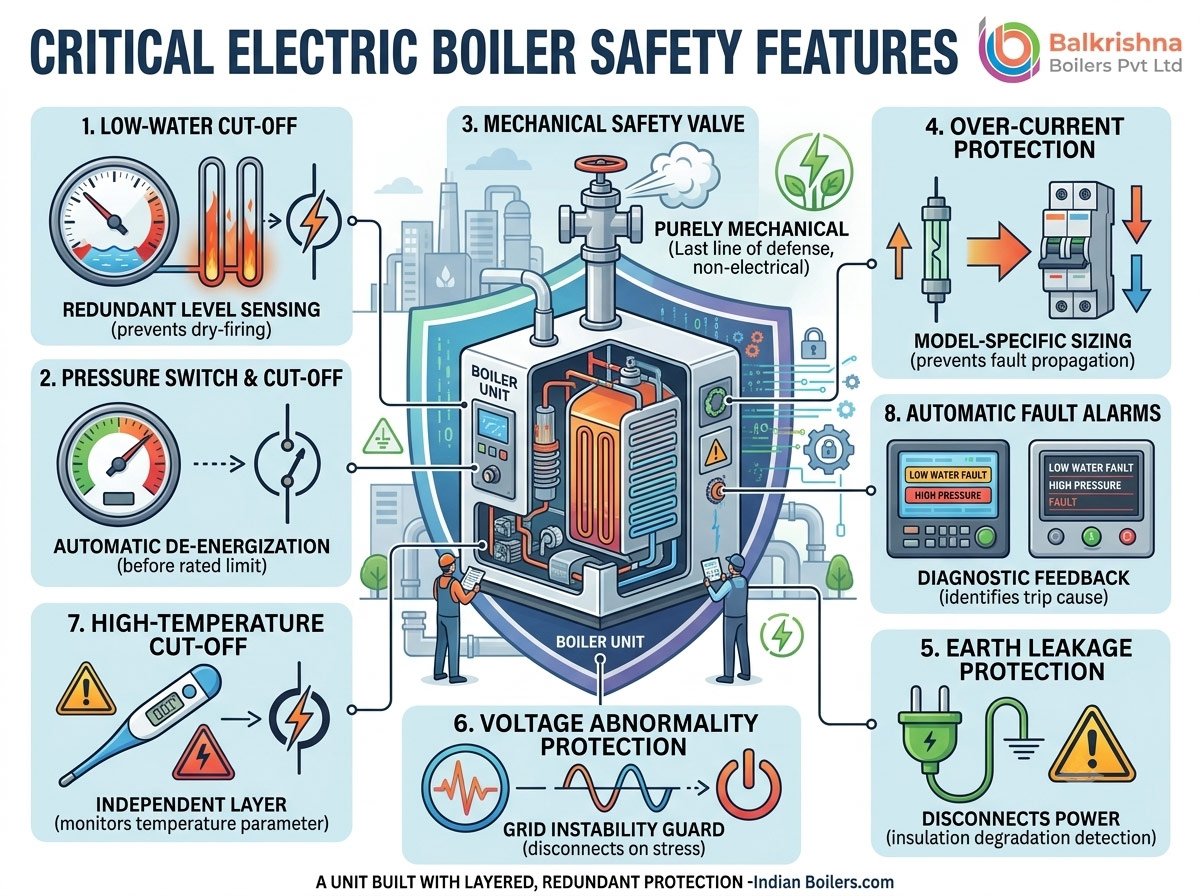
1. Low-Water Cut-Off
This is, without question, the single most critical safety device on any steam boiler — electric or fuel-fired. Heating elements immersed in water rely on that water to carry heat away as fast as it’s generated. If water level drops below the elements while they’re still energized, they overheat rapidly, risking element burnout, vessel damage, or in a worst-case scenario, a serious safety incident.
A low-water cut-off continuously monitors water level and automatically de-energizes the heating elements if level drops below a safe threshold — before dry-firing can occur. This should never be a single-point system; better-engineered units include redundant level sensing, so a single sensor failure doesn’t leave the boiler unprotected.
What to check: Confirm the cut-off is tested at commissioning and can be manually tested during routine maintenance, not just installed and assumed to work.
2. Pressure Switches and Automatic Cut-Off
Every electric boiler needs a pressure switch that automatically de-energizes the heating elements if operating pressure exceeds the safe threshold — before it approaches the vessel’s rated limit. This is the electrical-side equivalent of the mechanical safety valve, giving the system a controlled, automatic response to rising pressure well before a mechanical release is ever needed.
What to check: Ask what pressure the cut-off is set to trip at, and confirm it sits with an appropriate safety margin below the vessel’s design pressure — not right at the limit.
3. Mechanical Safety Valve
Even with electronic pressure cut-off in place, a mechanical safety valve is the last line of defense — a purely mechanical device that releases pressure if it exceeds a set threshold, independent of any electrical or control system. This matters precisely because it doesn’t rely on power, sensors, or control logic functioning correctly; it works even if every electronic safety system on the boiler has failed simultaneously.
What to check: Safety valves should be sized correctly for the vessel’s rated capacity and tested periodically — not just installed once at commissioning and left untouched for years.
4. Over-Current and Short-Circuit Protection
Because heating elements draw significant current, protection against overload and short-circuit conditions is essential — both to protect the boiler itself and to prevent a fault from propagating into your facility’s wider electrical system. This typically takes the form of correctly rated circuit breakers or fuses, sized specifically for the boiler’s load profile rather than generic protection borrowed from unrelated equipment.
What to check: Confirm protection devices are sized for the specific model’s electrical load, and that they’re tested to trip correctly — not just present on the panel.
5. Earth Leakage and Insulation Protection
Given that heating elements sit directly in water, insulation integrity between the electrical system and the water/vessel is critical. Earth leakage protection detects current leaking to earth — often an early sign of insulation degradation — and disconnects power before it becomes a shock hazard.
What to check: Insulation resistance should be tested at commissioning and periodically thereafter, particularly in humid environments where insulation can degrade gradually over time without obvious external signs.
6. Voltage Abnormality Protection
Industrial power supply isn’t always stable — voltage fluctuations, phase imbalance, and single-phasing conditions can all stress heating elements and control electronics if left unmanaged. Voltage abnormality protection monitors incoming supply and disconnects the boiler if conditions fall outside a safe operating range, protecting both the elements and the control system from damage.
What to check: This matters especially in industrial areas with less stable grid supply — ask specifically whether this protection is included as standard or only on higher-tier models.
7. High-Temperature Cut-Off
In addition to pressure-based protection, a properly engineered unit should include temperature-based cut-off as an independent safety layer — disconnecting power if water or steam temperature exceeds a safe threshold, regardless of what pressure readings show. This gives the system two independent physical parameters being monitored, rather than relying on pressure alone to catch every abnormal condition.
8. Automatic Fault Alarms and Indicators
Beyond the cut-off mechanisms themselves, a well-designed control panel should clearly indicate what triggered a shutdown — low water, high pressure, electrical fault, or voltage abnormality — rather than simply stopping with no diagnostic information. This matters practically: a maintenance team troubleshooting a tripped boiler needs to know what happened, not just that something did.
Why Cheaper Units Often Cut Corners Here
Safety systems add real cost — quality sensors, redundant monitoring, properly rated protection devices, and rigorous testing at commissioning all carry a price. On a unit competing purely on upfront cost, these are often exactly where corners get cut, because the compromise isn’t visible until something goes wrong. A boiler with a single, unredundant water level sensor and a generic pressure switch will look identical on a spec sheet to one with proper redundancy and independently rated protection — until the day the cheaper system’s single point of failure actually fails.
This is why evaluating a supplier on safety architecture, not just price and capacity, matters as much for an industrial electric boiler as it does for a combustion system.
Safety Questions to Ask Before You Buy
When evaluating any electric boiler supplier, these are the questions worth asking directly:
- Is the low-water cut-off a redundant system, or a single sensor?
- What pressure and temperature does the automatic cut-off trip at, relative to the vessel’s rated design pressure?
- Are protection devices (over-current, earth leakage, voltage abnormality) sized specifically for this model, or generic components?
- Is the safety valve independently tested and certified, and at what interval should it be re-tested?
- Does the control panel provide clear fault diagnostics, or just a generic shutdown?
- What certifications does the boiler carry — IBR for higher-pressure applications, CE, or other relevant industrial standards?
A supplier that can answer these clearly and specifically, rather than in general marketing terms, is a strong signal of genuine engineering rigor.
How These Features Show Up Across Our Range
Every unit in our Electric Boiler range — from the smaller 0.5 Ton Electric Steam Boiler to higher-capacity models like the 5 Ton Electric Boiler — is built with the full layered protection described above: redundant water-level sensing, independently rated pressure and temperature cut-off, properly sized electrical protection, and certified safety valves. For applications requiring IBR certification, our IBR Electric Steam Boiler range is engineered and tested to that statutory standard specifically.
On the Balkrishna Boilers side, this same safety architecture runs across our Electric Boiler series — ELECTROMAX, ELECTROAQUA, ELECTROAIR, ELECTROPAC, and INDUCTRON — regardless of capacity or application.
Safety and Maintenance Go Together
Safety systems only protect you if they’re actually verified to work — a low-water cut-off that’s never been tested since commissioning is a false sense of security, not real protection. This is exactly why routine testing of every safety device should be a fixed part of your maintenance schedule, not an afterthought. Our guide to electric boiler maintenance for plant owners covers exactly how often each safety device should be checked and what a proper testing routine looks like.
Safety as Part of Your Buying Decision
If you’re evaluating an electric boiler purchase — whether for a large industrial application or a smaller SME installation covered in our buyer’s guide for small and medium enterprises — safety architecture deserves the same scrutiny as capacity, pressure rating, and price. A unit that’s slightly more expensive but genuinely engineered with redundant, independently tested protection is almost always the better long-term investment, both financially and operationally.
Final Thoughts
Electric boilers are inherently safer than combustion systems, but that inherent advantage only holds if the unit is properly engineered with layered, redundant protection across water level, pressure, temperature, and electrical faults. Low-water cut-off, pressure and temperature protection, correctly rated electrical safeguards, and a certified mechanical safety valve aren’t optional extras — they’re the features that separate a genuinely safe industrial electric boiler from one that simply looks similar on a spec sheet.
If you’d like our engineers to walk through the specific safety architecture of any model in our range, get in touch with our team, or explore the full Electric Boiler range on Indian Boilers.com and Balkrishna Boilers for detailed specifications.
Suggested Meta Title: Electric Boiler Safety Features You Shouldn’t Compromise On | Indian Boilers.com Suggested Meta Description: Learn the critical safety features every industrial electric boiler needs — low-water cut-off, pressure protection, and more — before you buy. Suggested URL slug: /electric-boiler-safety-features-you-shouldnt-compromise-on/ Suggested Blog Category: Electric Boiler, Industrial Boiler
Electric boilers are widely, and correctly, considered safer than fuel-fired systems — there’s no open flame, no fuel storage, and no flue gas to manage. But “safer by design” doesn’t mean “safe regardless of design.” Not every electric boiler on the market is built to the same standard, and the safety systems that actually matter are often the first thing a lower-cost, poorly engineered unit cuts corners on.
At Indian Boilers.com, part of Balkrishna Boilers Pvt Ltd, our engineers get asked a version of the same question by nearly every serious buyer: what should I actually be checking before I sign off on a supplier? This guide answers that directly — the specific safety features a properly engineered electric boiler should have, why each one matters, and what happens when they’re missing or poorly implemented.
Why Electric Boiler Safety Still Deserves Real Scrutiny
It’s easy to assume that removing combustion removes most of the risk, and in one sense that’s true — fire risk, flue gas, and fuel-handling hazards are eliminated entirely. But an electric boiler still operates under pressure, still heats water to steam temperatures, and still carries significant electrical current through its heating elements. The risks haven’t disappeared; they’ve shifted from combustion-related to pressure-related and electrical.
A well-engineered unit manages these risks through multiple, layered safety systems — not a single device, but a combination that protects against different failure modes independently. This layered approach is exactly what to look for, and exactly what a cut-price unit is most likely to compromise on.
The Safety Features That Should Never Be Optional
1. Low-Water Cut-Off
This is, without question, the single most critical safety device on any steam boiler — electric or fuel-fired. Heating elements immersed in water rely on that water to carry heat away as fast as it’s generated. If water level drops below the elements while they’re still energized, they overheat rapidly, risking element burnout, vessel damage, or in a worst-case scenario, a serious safety incident.
A low-water cut-off continuously monitors water level and automatically de-energizes the heating elements if level drops below a safe threshold — before dry-firing can occur. This should never be a single-point system; better-engineered units include redundant level sensing, so a single sensor failure doesn’t leave the boiler unprotected.
What to check: Confirm the cut-off is tested at commissioning and can be manually tested during routine maintenance, not just installed and assumed to work.
2. Pressure Switches and Automatic Cut-Off
Every electric boiler needs a pressure switch that automatically de-energizes the heating elements if operating pressure exceeds the safe threshold — before it approaches the vessel’s rated limit. This is the electrical-side equivalent of the mechanical safety valve, giving the system a controlled, automatic response to rising pressure well before a mechanical release is ever needed.
What to check: Ask what pressure the cut-off is set to trip at, and confirm it sits with an appropriate safety margin below the vessel’s design pressure — not right at the limit.
3. Mechanical Safety Valve
Even with electronic pressure cut-off in place, a mechanical safety valve is the last line of defense — a purely mechanical device that releases pressure if it exceeds a set threshold, independent of any electrical or control system. This matters precisely because it doesn’t rely on power, sensors, or control logic functioning correctly; it works even if every electronic safety system on the boiler has failed simultaneously.
What to check: Safety valves should be sized correctly for the vessel’s rated capacity and tested periodically — not just installed once at commissioning and left untouched for years.
4. Over-Current and Short-Circuit Protection
Because heating elements draw significant current, protection against overload and short-circuit conditions is essential — both to protect the boiler itself and to prevent a fault from propagating into your facility’s wider electrical system. This typically takes the form of correctly rated circuit breakers or fuses, sized specifically for the boiler’s load profile rather than generic protection borrowed from unrelated equipment.
What to check: Confirm protection devices are sized for the specific model’s electrical load, and that they’re tested to trip correctly — not just present on the panel.
5. Earth Leakage and Insulation Protection
Given that heating elements sit directly in water, insulation integrity between the electrical system and the water/vessel is critical. Earth leakage protection detects current leaking to earth — often an early sign of insulation degradation — and disconnects power before it becomes a shock hazard.
What to check: Insulation resistance should be tested at commissioning and periodically thereafter, particularly in humid environments where insulation can degrade gradually over time without obvious external signs.
6. Voltage Abnormality Protection
Industrial power supply isn’t always stable — voltage fluctuations, phase imbalance, and single-phasing conditions can all stress heating elements and control electronics if left unmanaged. Voltage abnormality protection monitors incoming supply and disconnects the boiler if conditions fall outside a safe operating range, protecting both the elements and the control system from damage.
What to check: This matters especially in industrial areas with less stable grid supply — ask specifically whether this protection is included as standard or only on higher-tier models.
7. High-Temperature Cut-Off
In addition to pressure-based protection, a properly engineered unit should include temperature-based cut-off as an independent safety layer — disconnecting power if water or steam temperature exceeds a safe threshold, regardless of what pressure readings show. This gives the system two independent physical parameters being monitored, rather than relying on pressure alone to catch every abnormal condition.
8. Automatic Fault Alarms and Indicators
Beyond the cut-off mechanisms themselves, a well-designed control panel should clearly indicate what triggered a shutdown — low water, high pressure, electrical fault, or voltage abnormality — rather than simply stopping with no diagnostic information. This matters practically: a maintenance team troubleshooting a tripped boiler needs to know what happened, not just that something did.
Why Cheaper Units Often Cut Corners Here
Safety systems add real cost — quality sensors, redundant monitoring, properly rated protection devices, and rigorous testing at commissioning all carry a price. On a unit competing purely on upfront cost, these are often exactly where corners get cut, because the compromise isn’t visible until something goes wrong. A boiler with a single, unredundant water level sensor and a generic pressure switch will look identical on a spec sheet to one with proper redundancy and independently rated protection — until the day the cheaper system’s single point of failure actually fails.
This is why evaluating a supplier on safety architecture, not just price and capacity, matters as much for an industrial electric boiler as it does for a combustion system.
Safety Questions to Ask Before You Buy
When evaluating any electric boiler supplier, these are the questions worth asking directly:
- Is the low-water cut-off a redundant system, or a single sensor?
- What pressure and temperature does the automatic cut-off trip at, relative to the vessel’s rated design pressure?
- Are protection devices (over-current, earth leakage, voltage abnormality) sized specifically for this model, or generic components?
- Is the safety valve independently tested and certified, and at what interval should it be re-tested?
- Does the control panel provide clear fault diagnostics, or just a generic shutdown?
- What certifications does the boiler carry — IBR for higher-pressure applications, CE, or other relevant industrial standards?
A supplier that can answer these clearly and specifically, rather than in general marketing terms, is a strong signal of genuine engineering rigor.
How These Features Show Up Across Our Range
Every unit in our Electric Boiler range — from the smaller 0.5 Ton Electric Steam Boiler to higher-capacity models like the 5 Ton Electric Boiler — is built with the full layered protection described above: redundant water-level sensing, independently rated pressure and temperature cut-off, properly sized electrical protection, and certified safety valves. For applications requiring IBR certification, our IBR Electric Steam Boiler range is engineered and tested to that statutory standard specifically.
On the Balkrishna Boilers side, this same safety architecture runs across our Electric Boiler series — ELECTROMAX, ELECTROAQUA, ELECTROAIR, ELECTROPAC, and INDUCTRON — regardless of capacity or application.
Safety and Maintenance Go Together
Safety systems only protect you if they’re actually verified to work — a low-water cut-off that’s never been tested since commissioning is a false sense of security, not real protection. This is exactly why routine testing of every safety device should be a fixed part of your maintenance schedule, not an afterthought. Our guide to electric boiler maintenance for plant owners covers exactly how often each safety device should be checked and what a proper testing routine looks like.
Safety as Part of Your Buying Decision
If you’re evaluating an electric boiler purchase — whether for a large industrial application or a smaller SME installation covered in our buyer’s guide for small and medium enterprises — safety architecture deserves the same scrutiny as capacity, pressure rating, and price. A unit that’s slightly more expensive but genuinely engineered with redundant, independently tested protection is almost always the better long-term investment, both financially and operationally.
Final Thoughts
Electric boilers are inherently safer than combustion systems, but that inherent advantage only holds if the unit is properly engineered with layered, redundant protection across water level, pressure, temperature, and electrical faults. Low-water cut-off, pressure and temperature protection, correctly rated electrical safeguards, and a certified mechanical safety valve aren’t optional extras — they’re the features that separate a genuinely safe industrial electric boiler from one that simply looks similar on a spec sheet.
If you’d like our engineers to walk through the specific safety architecture of any model in our range, get in touch with our team, or explore the full Electric Boiler range on Indian Boilers.com and Balkrishna Boilers for detailed specifications.