
Bread, biscuits, cakes, and confectionery all depend on heat that behaves exactly the same way, batch after batch. A tunnel oven running 5°C hotter than it should scorches the crust before the crumb sets. A proofer that can’t hold humidity ruins the rise. A sugar-boiling pan without steady, controllable steam either undercooks the syrup or crystallizes it too fast. In an industry where product consistency is the entire business, the thermal system behind the scenes matters as much as the recipe itself.
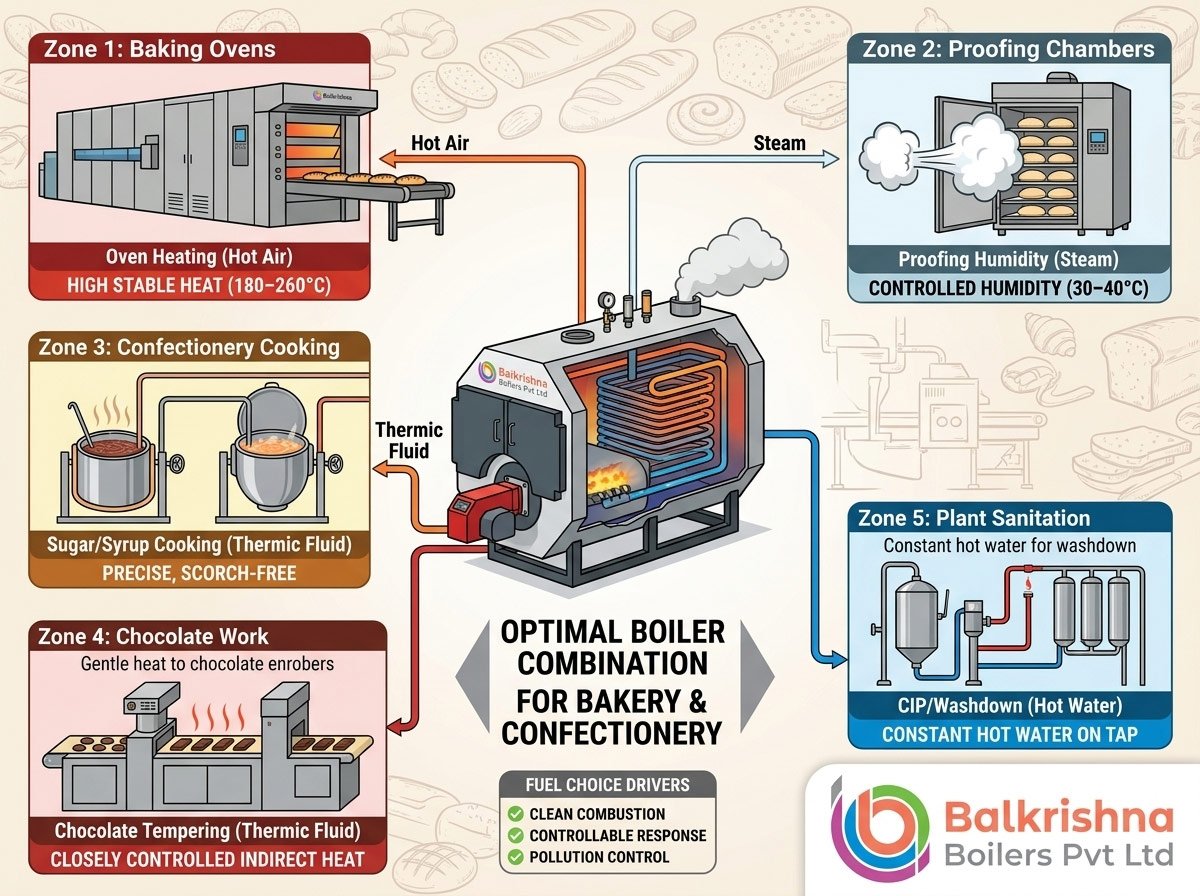
Bakery and confectionery plants are unusual among process industries because they need several different kinds of heat at once — dry radiant heat for baking, moist heat for proofing, indirect heat for chocolate and sugar work, and hot water for constant washdown and hygiene. No single boiler type covers all of that well, which is exactly why most bakery plants run a combination of systems rather than one large boiler doing everything. This guide walks through what each process step actually needs and which equipment fits.
Why Bakery and Confectionery Plants Need More Than One Heat Source
A typical mid-sized bakery or confectionery unit runs several thermal processes side by side:
- Baking — tunnel ovens, deck ovens, and rotary rack ovens need high, stable, evenly distributed heat, usually in the 180–260°C range depending on the product.
- Proofing — dough needs controlled warmth and humidity, typically 30–40°C with steam injection to prevent the surface from drying out.
- Sugar and syrup cooking — confectionery work (toffee, hard candy, fondant, jams) needs precise, scorch-free heating, often through jacketed kettles.
- Chocolate tempering and enrobing — needs gentle, closely controlled indirect heat, since chocolate is sensitive to even small temperature swings.
- Cleaning and sanitation (CIP/washdown) — hot water for daily equipment washdown, especially in units producing cream-filled or dairy-based confectionery.
Because these processes run in parallel through most of a production shift, the boiler question in a bakery isn’t “which boiler” but “which combination of systems” — and getting that combination right is what keeps ovens, proofers, and cooking pans running without one process starving another of heat.
Hot Air Generators: The Core of Oven Heating
For tunnel ovens, rack ovens, and biscuit lines, a hot air generator is usually the primary heat source. Rather than heating the product with steam or a liquid medium, a hot air generator delivers direct or indirect hot air straight into the oven chamber — which gives bakeries the fast heat-up and even temperature distribution that a good crust and crumb depend on.
Ranges like AIRPAC and AIRTHERM are commonly specified for tunnel and rack oven duty, where consistent airflow temperature across the full length of the oven matters more than raw output. For smaller biscuit or cookie lines, compact models such as AIRJET or AIRMAX fit tighter production floors without sacrificing response time between batches.
One detail worth getting right at the design stage: whether your oven needs direct-fired hot air (fuel combustion gases mixed into the airflow) or indirect hot air (heat exchanged through a clean air stream, with combustion gases kept separate). Confectionery and packaged bakery products, where flue-gas contact with the product isn’t acceptable, generally call for indirect systems — a specification decision worth confirming with your oven manufacturer before finalizing the heat source.
Thermic Fluid Heaters: Precision for Sugar, Chocolate, and Jacketed Cooking
Confectionery work — sugar syrup boiling, chocolate tempering, jam and jelly cooking, fondant preparation — depends on heat that can be held at a precise temperature without scorching. This is exactly the strength of a thermic fluid heater: hot thermic fluid circulates through a jacketed kettle or coil, transferring heat evenly across the vessel surface without the pressure spikes or condensate issues that come with direct steam injection.
For jacketed cooking pans and confectionery kettles, ranges such as THERMPAC and DELTAPAC deliver the stable, controllable surface temperature that sugar work demands. Where floor space around the cooking line is limited, vertical options like the VTF Series or VFF Series keep the footprint small while still handling the thermal load. Confectionery plants running continuous enrobing or tempering lines also benefit from the tighter temperature control a thermic fluid loop offers compared to raising and lowering steam pressure for the same job.
If you’re deciding between a thermic fluid system and steam for your cooking line, our earlier post <a href=”https://www.indianboilers.com/thermic-fluid-heater-vs-steam-boiler-which-suits-your-process/”>Thermic Fluid Heater vs Steam Boiler: Which Suits Your Process?</a> covers the trade-off in more depth, and <a href=”https://www.indianboilers.com/what-is-a-thermic-fluid-heater-and-how-is-it-used/”>What is a Thermic Fluid Heater and How is It Used?</a> is a useful primer if this is your first time specifying one.
Steam Boilers: Proofing, Sterilizing, and Utility Load
Steam still has a firm place in most bakery plants, particularly for proofing chambers, where injected steam keeps dough surfaces moist during the rise, and for general utility steam used in mixing, sterilizing equipment, and certain confectionery cooking processes that specifically call for direct steam contact.
A steam boiler sized for proofing and utility load doesn’t need to be as large as one running a full brewery or textile dye-house — but it does need fast response, since proofing steam demand can spike sharply as trays move through on a schedule. Compact, quick-recovery ranges like STEAMAX and STEAMGEN suit this kind of intermittent, on-demand steam draw well, while higher-output ranges such as COMBIPOWER fit larger integrated bakeries running multiple proofers and cooking lines off one system.
Hot Water Boilers: Washdown and Daily Hygiene
Bakery and confectionery plants, especially those handling cream, dairy fillings, or fresh-fruit-based confectionery, run frequent washdown cycles to meet food-safety standards. A dedicated hot water boiler, separate from the oven and cooking-line heat sources, keeps washdown running on its own schedule without pulling capacity away from baking or proofing when a shift is at full output.
Models like AQUAJET and AQUAMAX are commonly used for this exact duty — consistent hot water on tap for CIP and washdown, sized independently of the oven’s heat demand. Plants with limited floor space near the cleaning stations often opt for the compact VST Series instead.
Electric Boilers: A Fit for Premium and Hygiene-Sensitive Confectionery
Premium chocolate units, small-batch confectionery producers, and bakeries operating in dense urban locations increasingly look at electric boilers for the same reason many pharmaceutical and craft food producers do: no combustion, no flue gas, and no fuel storage on site. That matters directly in confectionery, where any risk of contamination from combustion byproducts is unacceptable, and it matters practically in urban bakeries where a boiler room built around fuel handling simply isn’t an option.
Ranges such as ELECTROMAX and ELECTROPAC give smaller bakery and confectionery operations precise steam or hot water without the operational overhead of a fuel-fired system. As with any food-grade application, our earlier post <a href=”https://www.indianboilers.com/electric-boilers-in-the-pharmaceutical-industry-why-theyre-preferred/”>Electric Boilers in the Pharmaceutical Industry: Why They’re Preferred</a> covers many of the same hygiene arguments that apply directly to confectionery, and <a href=”https://www.indianboilers.com/electric-boiler-water-quality-requirements-explained/”>Electric Boiler Water Quality Requirements Explained</a> is worth reviewing before installation, since scale buildup on immersed elements affects both efficiency and product-contact safety in food applications. If running costs are the main hesitation, <a href=”https://www.indianboilers.com/electric-boiler-roi-when-does-it-pay-off/”>Electric Boiler ROI: When Does It Pay Off?</a> lays out the calculation clearly, and <a href=”https://www.indianboilers.com/electric-boiler-power-consumption-formulas-and-examples/”>Electric Boiler Power Consumption: Formulas and Examples</a> helps estimate what a proofing or CIP-sized unit would actually draw.
Fuel Choice: What Actually Drives the Decision in Bakeries
Fuel selection for bakery ovens and boilers usually comes down to three practical factors:
- Gas-fired systems are the most common choice for tunnel ovens and hot air generators, offering clean combustion and fast, controllable response — important for a product line where oven temperature directly affects crust color and texture.
- Biomass or briquette-fired systems suit larger bakeries and confectionery units looking to reduce fuel cost, particularly where consistent biomass supply is available locally, though they need more attendant supervision than gas.
- Electric systems remove combustion from the equation entirely, an increasingly relevant option as pollution control norms tighten in urban and semi-urban food-manufacturing zones — a trend covered in more detail in our post on the <a href=”https://www.indianboilers.com/future-of-electric-boilers-in-indias-green-manufacturing-push/”>Future of Electric Boilers in India’s Green Manufacturing Push</a>.
Most established bakery plants run a fuel-fired hot air generator or thermic fluid system for the heavy oven and cooking load, with a smaller electric or gas-fired unit handling proofing steam and washdown hot water separately.
Sizing: Match the System to Your Actual Production Rhythm
A frequent mistake in bakery thermal system design is sizing purely around oven capacity and treating proofing, cooking, and washdown as an afterthought. In practice, these processes often peak at overlapping points in a shift — proofers demanding steam just as the cooking line starts a sugar batch, or washdown running while the next oven cycle is heating up. A realistic sizing exercise should account for:
- Oven heat-up time versus continuous running load through a shift
- Peak steam demand during proofing cycles, which can spike sharply and briefly
- Washdown scheduling relative to production peaks
- Seasonal production increases, especially around festival and holiday demand spikes common in the Indian bakery and confectionery trade
Working through this with an engineering team before finalizing equipment avoids the common outcome of an oven running well but proofing or cooking capacity becoming the actual bottleneck once the plant is at full production.
Why Bakery and Confectionery Plants Work With Balkrishna Boilers
Balkrishna Boilers Pvt Ltd has engineered thermal systems for food and process industries for over two decades, with equipment installed across dairy, food processing, pharmaceutical, and confectionery plants that share the same core demands as a bakery: consistent heat, fast response, and equipment built to run through daily hygiene cycles without losing efficiency. Our <a href=”https://www.indianboilers.com/industries/”>industries page</a> covers the wider range of sectors we serve, and our <a href=”https://balkrishn.com/client.php”>client list</a> includes food and beverage plants operating under the same quality standards bakeries and confectionery units are held to.
Whether you’re setting up a new tunnel oven line, adding a proofing steam system, or building out a complete thermal package spanning baking, cooking, and washdown, our team can help specify the right combination of equipment for your process rather than a single unit sized in isolation.
Frequently Asked Questions
What type of boiler is best for a tunnel oven bakery? Most tunnel oven lines run on a hot air generator, such as AIRPAC or AIRTHERM, as the primary heat source, often paired with a smaller steam boiler for proofing and a hot water system for washdown.
Can one system handle both baking and sugar cooking in a confectionery unit? Not efficiently. Baking needs direct or indirect hot air, while sugar and chocolate work needs the precise, scorch-free heat of a thermic fluid system — most plants run these as separate systems rather than one combined unit.
Is an electric boiler practical for a small confectionery business? Yes, particularly for premium or small-batch producers where hygiene, floor space, and the absence of fuel storage matter more than running cost per unit of energy.
How often should bakery boilers and hot air generators be serviced? Given daily washdown cycles and continuous oven operation, monthly inspection is recommended, with a full annual service and water-quality check for any steam or hot water system to prevent scale buildup and maintain consistent oven and proofing performance.
Planning a new bakery or confectionery line, or upgrading an existing oven and proofing system? <a href=”https://www.indianboilers.com/contact-us/”>Get in touch with our engineering team</a> or explore our full <a href=”https://balkrishn.com/ourProduct.php”>product range</a> to find the right fit for your process.