
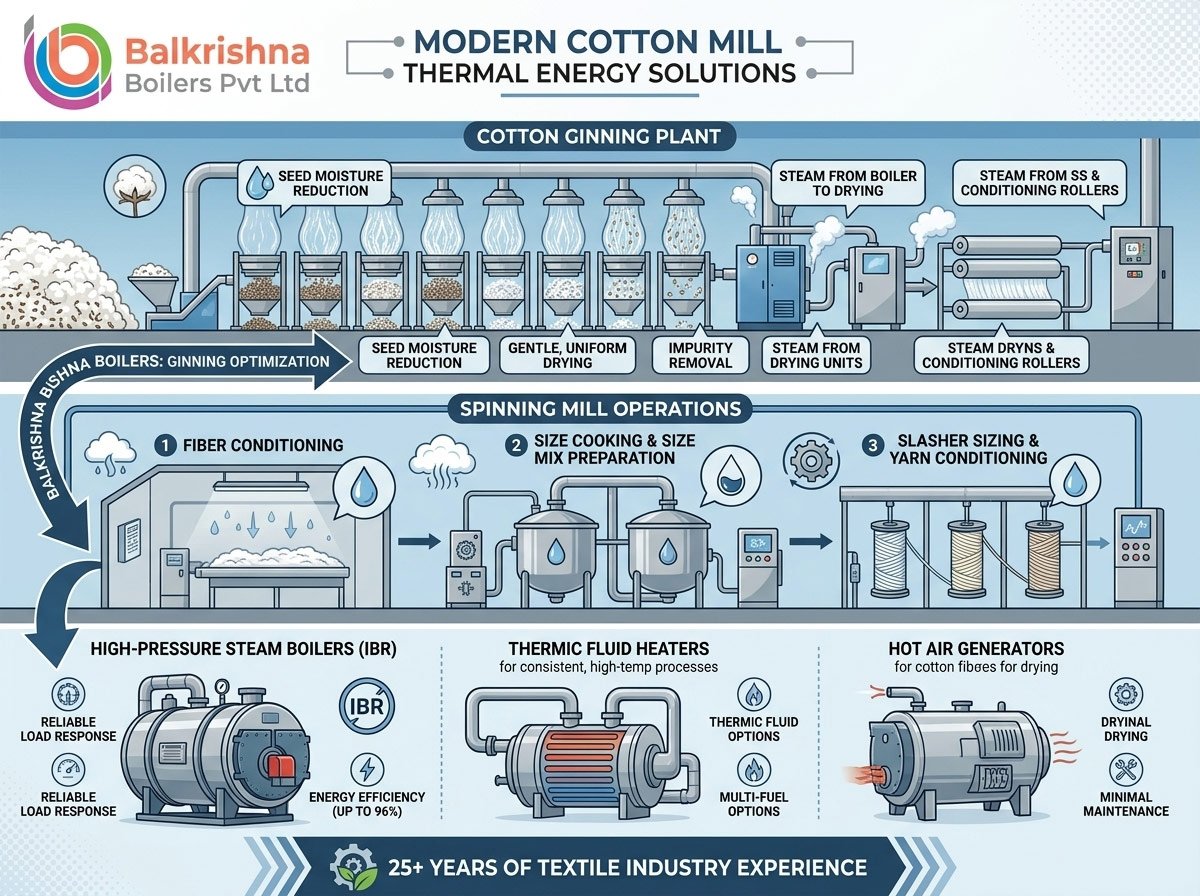
Cotton is a fiber that behaves differently depending on how much moisture it’s holding — too dry and it becomes brittle, snapping under the mechanical stress of ginning and spinning; too wet and it clogs machinery, tangles in the gin saw, or produces uneven, weak yarn. Managing that moisture balance, along with the steam demands of yarn conditioning, humidification, and dyeing further down the line, is exactly why thermal equipment sits at the center of every well-run ginning and spinning operation, even though cotton processing isn’t always thought of as a “heat-heavy” industry the way textile wet-processing is.
At Balkrishna Boilers Pvt Ltd, based in Ahmedabad — in the heart of Gujarat’s cotton belt — we manufacture steam boilers and hot air generators that are already running in ginning factories and spinning mills across India. This guide walks through where thermal equipment fits into cotton processing, from the ginning floor through to spun yarn.
Where Heat and Moisture Control Matter in Cotton Processing
Cotton processing runs through several distinct stages, and each one has its own relationship with heat, humidity, and moisture:
- Seed cotton drying and cleaning — raw seed cotton arriving at the gin often carries excess field moisture, which needs to be reduced before ginning for clean fiber-seed separation and to prevent trash and fiber damage.
- Ginning — the mechanical separation of lint from seed, which runs most efficiently within a fairly narrow moisture band; too dry and fiber breaks, too wet and the process jams or leaves excess trash in the lint.
- Bale pressing and storage — pressed cotton bales need stable moisture content for consistent weight, grading, and storage life.
- Blow room and carding (spinning prep) — where humidification becomes critical, since static and fiber breakage both increase in overly dry conditions.
- Spinning, doubling, and winding — controlled humidity keeps yarn tension consistent and reduces end breaks, directly affecting spinning efficiency.
- Yarn conditioning — autoclave-based steam conditioning stabilizes yarn twist and relieves internal stress before it goes to weaving or knitting.
- Package/yarn dyeing (in composite or vertically integrated mills) — one of the most steam-intensive stages in the entire cotton value chain.
Ginning is largely about moisture reduction and control; spinning is largely about humidity maintenance and steam-based conditioning. That distinction is exactly why the right thermal equipment for a standalone gin often looks different from what a composite spinning mill needs.
Hot Air Generators: Drying and Moisture Conditioning on the Ginning Floor
For ginning factories specifically, hot air generators play a critical role that’s easy to underestimate. Seed cotton arriving with high moisture content — common during humid harvest conditions — needs controlled drying before it enters the gin stand. Without it, fiber-seed separation efficiency drops, trash content in the lint rises, and gin saw wear accelerates. At the same time, over-drying damages fiber strength, so the heat source needs tight, repeatable temperature control rather than raw high-heat blasting.
Our Oil/Gas Fired Hot Air Generator (AIRJET series) is well suited to continuous ginning operations that need consistent, controllable drying air across a full harvest season, and its indirect-fired design keeps combustion by-products away from the fiber stream — an important consideration given how flammable dry cotton lint and dust can be. Ginning units in areas with local biomass availability sometimes evaluate the Wood/Briquette Fired Hot Air Generator for lower-cost supplementary drying capacity. This category is also available on Balkrishn.com’s Hot Air Generator page, which lists the equivalent AIRJET, AIRPAC, and AIRTHERM models.
Steam Boilers: The Core Utility for Spinning Mills
Once cotton moves past ginning into a spinning mill, the thermal profile shifts almost entirely to steam. As we cover in detail in our dedicated guide, Steam Boilers for Textile Mills: Best Models in India, steam plays a role in <cite index=”37-1″>humidification in spinning to steam calendering in finishing</cite>, and capacity requirements scale enormously depending on mill size — from smaller MSME operations to large integrated facilities. A few spinning-mill-specific applications stand out:
- Humidification plants in the blow room, carding, and spinning departments, where controlled humidity reduces static, fiber breakage, and end breaks, directly improving spinning efficiency and yarn quality.
- Yarn conditioning autoclaves, which use steam to relieve twist-related internal stress in freshly spun yarn before it moves downstream — a step that directly affects fabric quality later in weaving or knitting.
- Package and hank yarn dyeing, in composite mills that dye yarn before weaving, which is one of the highest steam-consuming stages in the entire cotton textile chain.
- Sizing operations, in mills that also run their own warping and sizing lines ahead of weaving, where steam-heated size boxes and drying cylinders prepare warp yarn for the loom.
For mills running on Gujarat’s gas grid, our 5 Ton PNG/LPG Fired Steam Boiler is engineered specifically for <cite index=”42-1″>continuous steam for dyeing, printing, and stenter operations</cite> in high-volume textile plants, with a three-pass wet-back design that captures maximum heat and minimizes chimney losses. Mills that prefer solid fuel economics can consider our 5 Ton Coal Fired Steam Boiler, built with heavy-duty submerged arc welded construction and integrated multi-cyclone dust collection for emissions compliance. Smaller ginning-adjacent spinning units or MSME-scale mills often find our Gas Fired Steam Boiler (200 KG to 850 KG/hr) or Oil Fired Boiler — including our flagship STEAMJET and VEPOMAX series — a better fit for their scale and fuel access. Mills running on agricultural residue, including cotton stalk and ginning by-products, can also evaluate our Agro-Waste Fired Steam Boiler as a way to convert local biomass into process steam. The complete range is available on Balkrishn.com’s Steam Boiler category page, featuring the STEAMJET, STEAMAX, and COMCUBE series.
Water Tube Boilers for Large Composite Mills
Large-scale, vertically integrated spinning-cum-weaving mills that combine humidification, dyeing, sizing, and finishing under one roof often need steam capacity and pressure beyond what a standard fire-tube boiler efficiently delivers. For these operations, our Water Tube Boiler range offers rapid steam generation — reaching full working pressure within minutes of a cold start — along with the high-pressure performance needed for demanding dyeing and finishing processes across a multi-department mill. As explained in our broader piece on what an industrial steam boiler is, steam remains the backbone of process industries because of how efficiently it moves and controls thermal energy — a principle that applies directly to a composite textile mill running several steam-hungry departments simultaneously.
Electric Boilers: Precision Steam for Dyeing and Quality-Sensitive Processes
A number of spinning and composite mills, particularly those producing higher-value yarn or fabric for export markets, are evaluating electric boilers for specific quality-sensitive circuits. As covered in Why Electric Boilers Are the Best Choice for Low-Emission Plants, electric heating delivers exceptionally fine-tuned temperature and pressure control, which matters in package dyeing where inconsistent steam quality can lead to uneven dye uptake and costly reprocessing. Electric boilers also eliminate fuel storage, combustion emissions, and chimney requirements — a genuine advantage for mills located in urban or densely packed industrial clusters, and a point we explore further in our guide on where electric steam boilers are used beyond laundries and hospitals. The Electric Boiler category on Balkrishn.com — including the ELECTRON, ELECTROMAX, and INDUCTRON series — covers this equivalent range for mills evaluating a shift toward cleaner, more precise steam generation.
Fuel Selection for Ginning and Spinning Operations
Fuel choice in this sector tends to follow both scale and location:
- Natural gas (PNG/LPG) is the preferred choice for larger composite mills in Gujarat’s established gas grid areas, offering clean combustion and fast, reliable steam ramp-up for dyeing and finishing.
- Coal remains common for larger mills prioritizing lower fuel cost over combustion cleanliness, particularly where dust collection and emissions systems are already in place.
- Agro-waste and biomass, including ginning by-products like cotton stalk residue, offer a lower-cost option for mills close to their own or nearby agricultural supply.
- Electricity is increasingly used for smaller, precision-critical circuits such as yarn conditioning and package dyeing, even in mills that run their bulk steam load on fuel-fired boilers.
Fire Safety: A Non-Negotiable in Cotton Processing
Cotton lint, dust, and trash are highly combustible, and this shapes equipment selection throughout a ginning and spinning facility:
- Indirect-fired hot air generators are essential wherever drying air comes into contact with cotton fiber or dust, keeping combustion gases and any flame path fully separated from the product stream.
- Spark-free zoning and dust control around any thermal equipment installed near the gin floor, blow room, or carding department is standard practice given how readily airborne cotton dust can ignite.
- Regular housekeeping and dust extraction around boiler and hot air generator installations reduces fire load in an environment where fine fiber dust accumulates quickly.
A reputable boiler and hot air generator manufacturer serving this sector should factor hazardous-area considerations into the proposal from the outset, not as an afterthought.
Sizing Your Thermal System for a Ginning or Spinning Operation
A few questions our engineering team works through with ginning and spinning clients:
- Are you a standalone gin, a spinning mill, or a composite operation? This single factor determines whether hot air drying, steam humidification, or both dominate your thermal requirement.
- What’s your seasonal throughput pattern? Ginning capacity often needs to handle sharp seasonal peaks during harvest, while spinning mills typically run more consistent year-round loads.
- Do you dye yarn in-house? Package or hank dyeing significantly increases steam demand compared to a mill that only spins and sells grey yarn.
- What fuel is realistically available at your location? Gas grid access, coal logistics, and local biomass availability all shape the most economical equipment choice.
- What’s your expansion timeline? Cotton processing capacity often scales in step with harvest-season demand; sizing utilities with headroom avoids a disruptive mid-season retrofit.
Why Ginning and Spinning Mills Choose Balkrishna Boilers
With over 25 years of experience and more than 5,000 installations across textile, chemical, and process industries, Balkrishna Boilers Pvt Ltd brings deep, sector-specific engineering to cotton processing:
- Indirect-fired hot air generators engineered with cotton dust and fire safety in mind, for ginning floors that need reliable seasonal drying capacity.
- Fuel-flexible steam boilers, from compact gas-fired units for MSME gins to high-pressure water tube systems for composite mills.
- Electric boiler options for mills pursuing precision dyeing quality or export-grade emissions compliance.
- End-to-end project engineering, from capacity calculation through piping, dust collection integration, and commissioning.
Whether you need a single hot air generator for your ginning floor or a fully integrated steam system covering humidification, yarn conditioning, and dyeing, our team can engineer a solution around your specific throughput and fuel infrastructure.
Frequently Asked Questions
Does a cotton ginning factory need a steam boiler? Not usually as a primary requirement — ginning is mostly a mechanical, moisture-sensitive process, so a hot air generator for seed cotton drying is typically more relevant than a steam boiler, unless the facility is combined with downstream processing.
Why is humidification so important in spinning mills? Cotton fiber becomes brittle and prone to breakage in overly dry air, increasing end breaks and reducing spinning efficiency. Steam-assisted humidification plants keep blow room, carding, and spinning departments within the moisture range fiber needs to process cleanly.
What’s the most steam-intensive stage in a composite cotton mill? Package or hank yarn dyeing is typically the highest steam consumer in a composite mill, followed by sizing and finishing operations, as covered in our guide on steam boilers for textile mills.
Are indirect-fired hot air generators necessary for cotton drying? Yes. Cotton dust and lint are highly combustible, so keeping combustion gases and any flame path fully separated from the fiber stream is essential for fire safety, not just product quality.
What capacity boiler does a small spinning unit typically need? It varies by scale, but many MSME-level spinning units start with a 200 KG to 850 KG gas fired steam boiler for humidification and conditioning needs, scaling up to multi-ton capacity as dyeing or finishing operations are added.
Ready to design the right thermal system for your ginning factory or spinning mill? Get in touch with our engineering team or request a quote from Balkrishna Boilers with your throughput, process details, and fuel infrastructure, and we’ll propose a solution built for your operation.