
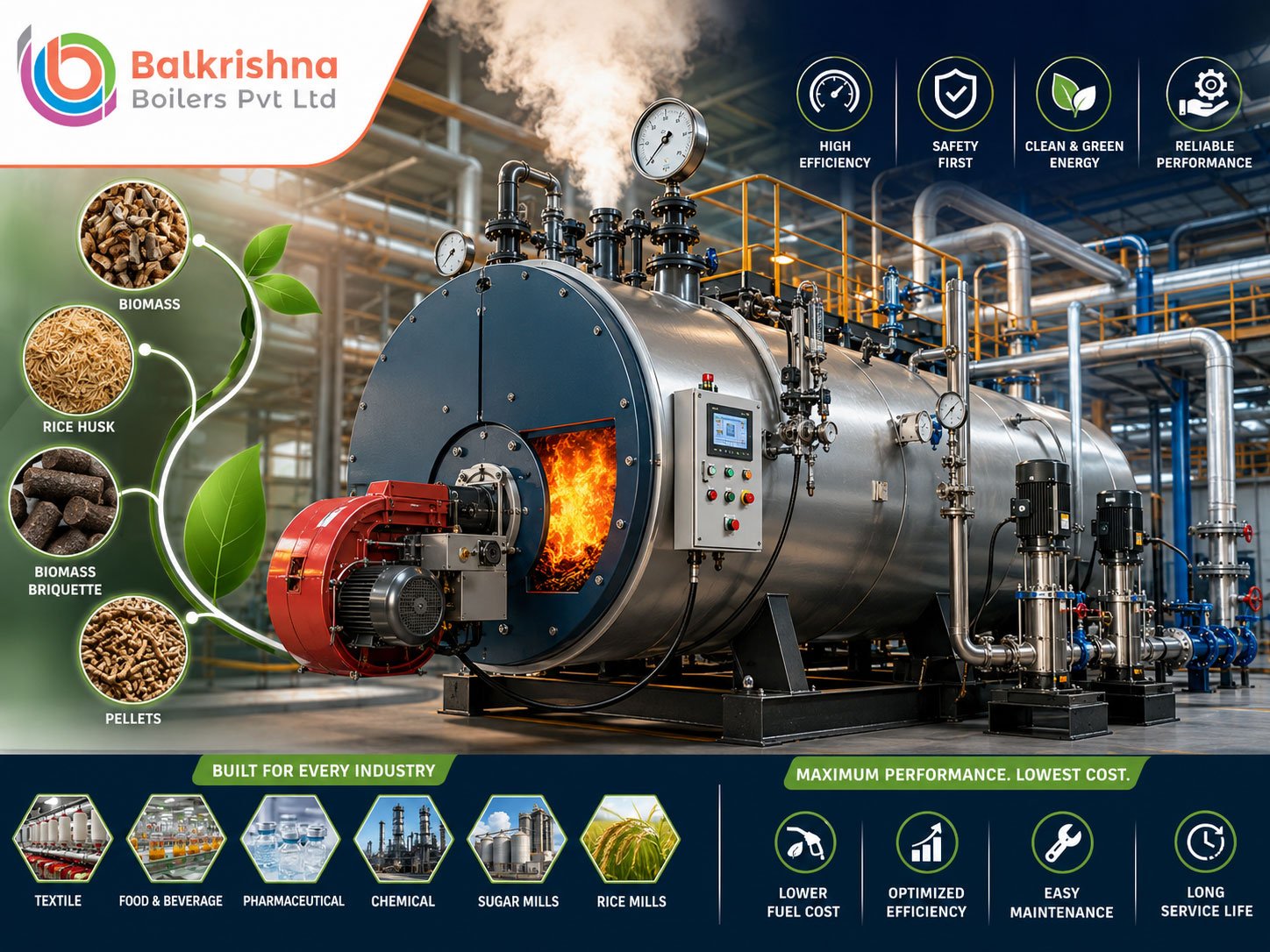
What Is an Industrial Steam Boiler? A Complete Guide for Plant Owners and Engineers
If you run a manufacturing plant, a textile unit, a food processing facility, or a pharma production line, chances are steam touches almost every stage of your process. Behind that steam is a single piece of equipment that quietly keeps your entire operation running — the industrial steam boiler.
In this guide, we’ll break down exactly what an industrial steam boiler is, how it works, the different types available, how to size one correctly, and what to look for before you invest. Whether you’re replacing an old unit or installing your first boiler, this article will help you make an informed decision.
What Is an Industrial Steam Boiler?
An industrial steam boiler is a closed, pressurized vessel that uses a fuel source — oil, gas, biomass, coal, or electricity — to heat water until it converts into steam. That steam is then piped out under pressure to power industrial processes such as heating, drying, sterilization, cooking, dyeing, or even electricity generation through a turbine.
In simple terms, think of it as an industrial-scale kettle, engineered to handle extreme pressure and temperature safely, continuously, and efficiently, day after day, year after year.
Unlike a domestic water heater, an industrial steam boiler is designed for continuous duty cycles, high thermal loads, and strict safety compliance under regulations like the Indian Boiler Regulations (IBR). It’s a core capital asset for any process-heavy industry, and choosing the right one directly affects your fuel costs, production uptime, and compliance record.
How Does an Industrial Steam Boiler Work?
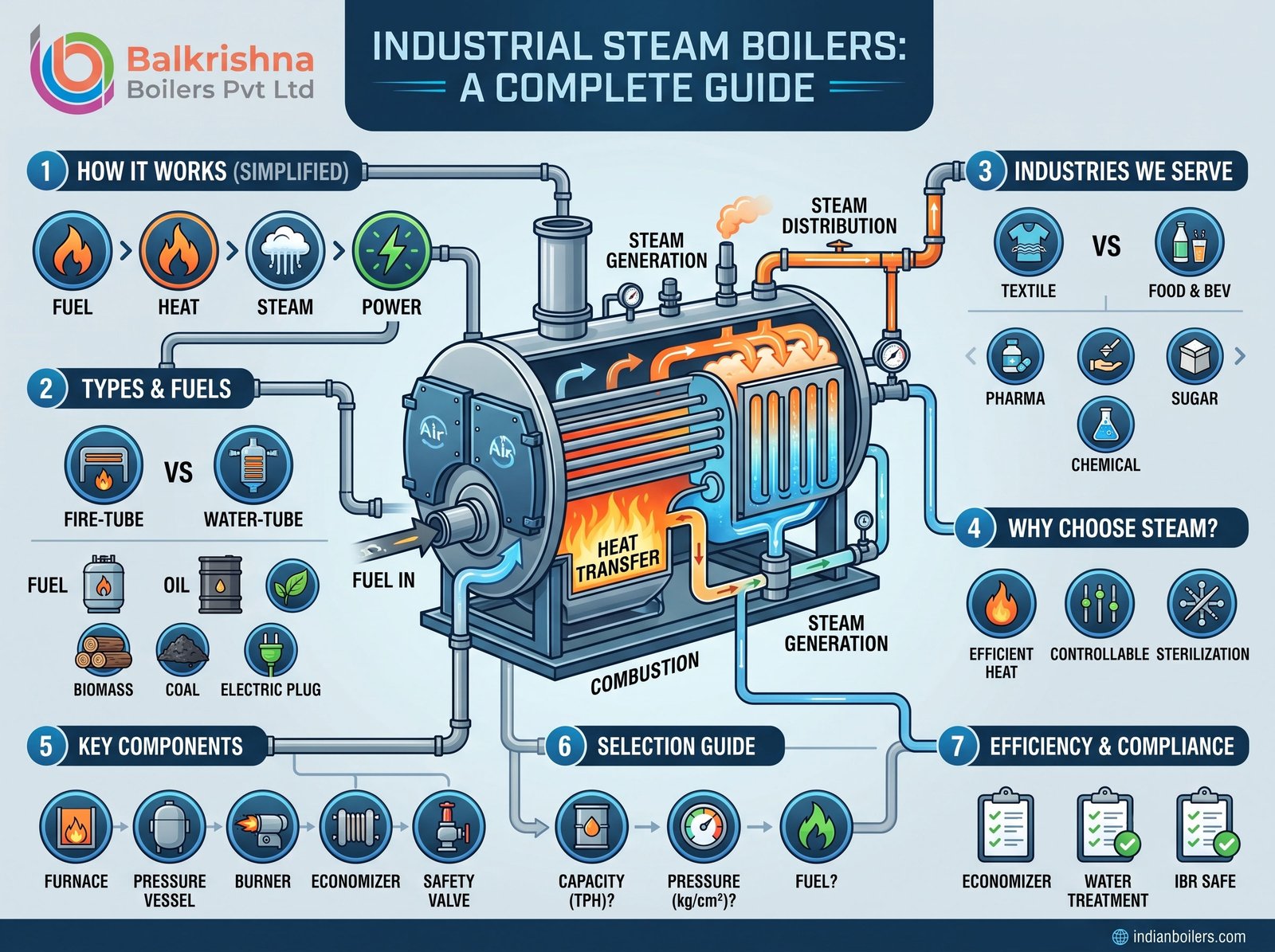
The working principle of a steam boiler is straightforward, even though the engineering behind it is sophisticated:
- Fuel Combustion: Fuel (biomass, oil, gas, coal, or electric resistance heating) is burned or activated in the furnace or combustion chamber.
- Heat Transfer: The heat generated is transferred to water held inside a sealed pressure vessel, either by hot flue gases passing through tubes surrounded by water, or by water flowing through tubes surrounded by hot gases.
- Steam Generation: As water reaches its boiling point, it converts into steam. Because the vessel is sealed, pressure builds rapidly.
- Steam Distribution: This high-pressure steam is piped through the plant to wherever thermal energy is needed — process vessels, dryers, autoclaves, or turbines.
- Feedwater Return: Condensate is often recovered and returned to the boiler as feedwater, improving overall efficiency.
When water converts to steam, it expands in volume by roughly 1,600 times. That expansion is what gives steam its enormous capacity to do mechanical and thermal work — from spinning a turbine to sterilizing a pharmaceutical batch in minutes.
Why Do Industries Need Steam Boilers?
Steam isn’t just “hot water in gas form” — it’s one of the most efficient and controllable ways to move heat energy through a facility. That’s why industrial steam boilers remain the backbone of process industries across India:
- Textile Industry: Steam boilers are essential for dyeing, bleaching, and finishing fabric, where consistent temperature control affects fabric quality.
- Food & Beverage: Steam is used for cooking, pasteurization, and sterilization, where hygiene and precise temperatures are non-negotiable.
- Pharmaceuticals: Clean steam is critical for sterilizing equipment and maintaining GMP compliance.
- Rice Mills: Steam boilers power parboiling operations, a step that directly affects milling yield and grain quality.
- Chemical & Process Plants: Steam drives reactors, distillation columns, and heating jackets across countless chemical processes.
- Sugar Mills: Boilers here often run on bagasse, supporting both process steam and cogeneration.
If your facility depends on consistent heat, drying, or sterilization, a properly sized steam boiler isn’t optional — it’s the engine room of your entire operation.
Types of Industrial Steam Boilers
Boilers are broadly classified based on how heat interacts with water, and further by the fuel they consume.
1. Fire-Tube Boilers
In a fire-tube design, hot combustion gases pass through tubes that are submerged in water. These are compact, cost-effective, and well suited to small-to-medium capacity requirements — typically up to 20–25 TPH. Most Indian SMEs in textiles, food processing, and rice milling rely on fire-tube boilers because they’re simpler to operate and maintain.
2. Water-Tube Boilers
Here, water flows inside the tubes while hot gases circulate around them. Water-tube boilers handle much higher pressures and capacities, making them the preferred choice for power plants and large-scale cogeneration facilities.
Classification by Fuel Type
Beyond design, boilers are also chosen based on the fuel that’s most economical and available at your plant location:
- Oil / Gas Fired Steam Boilers — Clean-burning, quick to commission, and ideal where a gas pipeline or reliable fuel oil supply is available.
- Biomass Fired Steam Boilers — Run on agricultural residue like rice husk, groundnut husk and shell, cotton stalk, or coffee husk, and are among the most cost-effective options for continuous process industries.
- Agro Waste Fired Steam Boilers — Purpose-built for facilities that want to convert farm and crop residue into usable thermal energy.
- Electric Steam Boilers — Including IBR Electric Steam Boilers and Electric Steam Boilers (100–400 kg/hr), useful where clean, flameless steam generation is required or where fuel logistics are difficult.
- Solid Fuel / FBC Boilers — Such as the 1–10 TPH Solid Fuel Fired FBC Steam Boiler, designed for fluidized bed combustion of a wide range of solid fuels.
You can browse our full range of designs and capacities on our Steam Boiler product category page, or explore our Electric Boiler range if you’re specifically evaluating electric steam generation.
Grate-Based Biomass Boilers
If biomass is your fuel of choice, the grate technology matters as much as the fuel itself. We’ve covered this in detail in our guides on chain grate boiler speed and its effect on steam production, reciprocating grate retrofits for existing plants, and vibrating grate vs reciprocating grate performance. If you’re new to biomass boilers altogether, our article on what a biomass boiler is is a good starting point.
Balkrishna Boilers also offers a wide portfolio of purpose-built steam boiler models under our own engineering line, including COMBIPOWER, HUSKPOWER, STEAMGEN, STEAMJET, STEAMPOWER, PELLETAX, VEPOMAX, and WILLSTEAM — each engineered for a specific fuel and capacity band. You can see the complete lineup on our Steam Boiler range at balkrishn.com.
Key Components of an Industrial Steam Boiler
Understanding the major parts of a boiler helps when you’re evaluating quotations or planning maintenance:
- Furnace / Combustion Chamber: Where fuel is burned to generate heat.
- Pressure Vessel (Shell): The sealed chamber that holds water and steam under pressure.
- Burner: Controls fuel-air mixing and combustion for oil, gas, or electric units.
- Economizer: Recovers waste heat from flue gases to pre-heat incoming feedwater, improving fuel efficiency.
- Air Pre-heater (APH): Uses exhaust heat to warm combustion air before it enters the furnace.
- Safety Valves: Automatically release excess steam if pressure exceeds safe limits.
- Water Level Indicators & Low-Water Alarms: Prevent dry-firing, one of the most common causes of boiler damage.
- Blowdown System: Removes accumulated sludge and dissolved solids from the boiler water.
Modern packaged boilers arrive with the burner, controls, and pump pre-assembled at the factory, requiring minimal on-site work before commissioning — a “plug and play” approach that significantly shortens installation timelines.
How to Choose the Right Industrial Steam Boiler
Selecting a boiler isn’t just about picking a capacity off a brochure. Here’s what actually determines the right fit for your plant:
1. Steam Capacity (TPH or kg/hr)
Calculate your peak simultaneous steam demand across all connected equipment, then add a 10–15% margin for future expansion and system losses. Undersizing leads to production bottlenecks; oversizing wastes capital and reduces part-load efficiency.
2. Working Pressure
Your process equipment — reactors, autoclaves, dryers — will dictate the minimum working pressure (kg/cm²) you need. Always size the boiler pressure rating with a safety margin above your highest-pressure application.
3. Fuel Availability and Cost
Fuel is typically the single largest recurring cost of running a boiler. Biomass fuels like husk and briquettes usually offer the lowest running cost but need more handling and ash disposal. Natural gas is clean and efficient but depends on pipeline access. Oil offers compact, low-maintenance operation but at a higher running cost. Choosing fuel based on local availability, not just price per unit, is often what determines long-term ROI.
4. IBR vs Non-IBR Classification
Under the Indian Boiler Regulations, boilers above a certain capacity or pressure threshold must be registered and periodically inspected by government-appointed authorities. Smaller units (often called SIB — Small Industrial Boilers) may fall outside mandatory IBR registration, though safety standards still apply. Always confirm the applicable classification before finalizing your purchase.
5. Automation Level
From manual-fire units to fully PLC-automated systems with remote monitoring, the level of automation affects both upfront cost and ongoing labor requirements. For plants running multiple shifts, automation typically pays for itself through reduced fuel wastage and fewer operator-dependent errors.
6. Water Treatment Compatibility
Hard water is one of the most underrated threats to boiler life. Just 1 mm of scale buildup inside tubes can increase fuel consumption by 7–10% and, left unaddressed, can lead to tube failure. Confirm your boiler’s feedwater treatment requirements before commissioning.
Efficiency Tips for Industrial Steam Boilers
Once installed, efficiency is largely a function of maintenance discipline:
- Install an economizer to recover waste heat from flue gases.
- Add an air pre-heater to reduce fuel consumption further.
- Perform regular soot blowing to keep heat-transfer surfaces clean.
- Maintain consistent blowdown schedules — typically once per shift — to prevent sludge buildup.
- Use properly treated feedwater to avoid scale formation.
- Monitor for high-moisture or inconsistent fuel, particularly with biomass boilers, since fuel moisture directly impacts combustion efficiency. Our article on fuel moisture vs boiler efficiency covers this in more depth for reciprocating grate systems.
With good maintenance, most industrial boilers deliver a service life of 20 to 25 years, and clients typically recover their investment within 12 to 18 months through fuel savings alone when upgrading from older, less efficient units.
IBR Compliance and Safety
Because steam boilers operate under significant pressure, safety compliance isn’t a formality — it’s essential. Every unit should include redundant safety systems: high-pressure cut-offs, low-water level alarms, flame sensors, and spring-loaded safety valves. For IBR-applicable boilers, government-certified inspection at installation and at defined intervals thereafter is mandatory, covering everything from the pressure vessel design to mounting and accessory compliance.
Reputable manufacturers handle the full compliance journey for you — from design approval and fabrication to IBR certification and commissioning — so your plant doesn’t face regulatory delays after installation.
Industrial Steam Boiler vs Other Heating Equipment
It’s worth clarifying how a steam boiler differs from adjacent equipment you may also be evaluating:
- Hot Water Boiler: Generates hot water rather than steam, typically used for space heating or lower-temperature process needs rather than high-pressure applications.
- Thermic Fluid Heater: Heats thermic fluid instead of water, offering high-temperature heat transfer at relatively low pressure — a good fit where steam isn’t strictly required.
- Hot Air Generator: Produces direct hot air for drying applications rather than steam or hot water.
If your process specifically requires steam — for sterilization, humidity, or driving mechanical work — a steam boiler remains the right choice over these alternatives.
Final Thoughts
An industrial steam boiler is far more than a piece of utility equipment — it’s the thermal backbone of your plant’s production capability. Getting the fuel type, capacity, pressure rating, and automation level right from day one determines your fuel costs, uptime, and compliance standing for the next two decades.
Whether you’re setting up a new facility or replacing an aging unit, it pays to work with a manufacturer who understands both the engineering and the regulatory side of the equation.
Explore our complete range of steam boilers:
Or read more on related topics: What Is a Biomass Boiler? | Travelling Grate Boilers for Sugar Mills
For a custom recommendation based on your fuel availability, steam demand, and industry, get in touch with our engineering team for a free technical consultation.
Frequently Asked Questions
What is the difference between a fire-tube and a water-tube steam boiler? In a fire-tube boiler, hot gases pass through tubes surrounded by water — suited for low-to-medium pressure applications up to about 20 TPH. In a water-tube boiler, water flows through tubes surrounded by hot gases, allowing much higher pressure and capacity, typically used in power plants.
How is boiler capacity measured? Capacity is typically measured in kg/hr or TPH (Tons Per Hour), based on the total steam output the boiler can generate.
What is the typical lifespan of an industrial steam boiler? With proper maintenance and water treatment, a well-manufactured industrial steam boiler typically lasts 20 to 25 years.
Do all industrial steam boilers need IBR certification? Boilers above a defined capacity or pressure threshold require IBR registration and inspection. Smaller units may be classified as Small Industrial Boilers (SIB) and fall outside mandatory registration, though safety practices still apply.
Which fuel is most cost-effective for a steam boiler? Biomass fuels like husk and briquettes generally offer the lowest running cost but require more handling. Natural gas is clean and efficient but needs pipeline access. Oil offers low maintenance at a higher running cost. The right choice depends on local fuel availability and plant scale.