
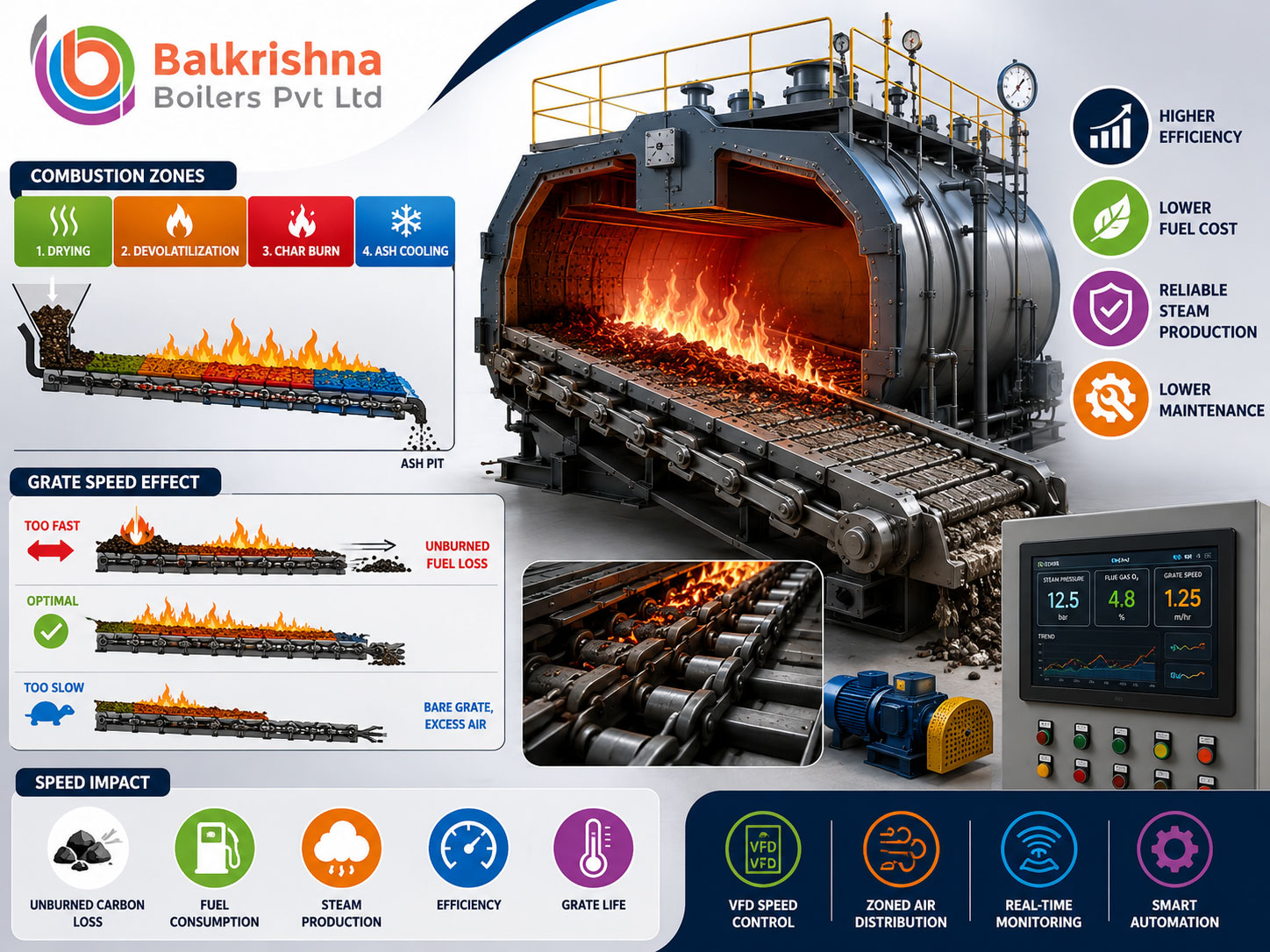
Chain Grate Speed: The Operating Variable Most Plants Get Wrong
Chain grate boilers remain a genuine workhorse across Indian industry for burning coal, wood chips, and agro-waste briquettes — reliable, well-understood technology. What’s less well understood, even among experienced operators, is that grate speed isn’t a variable you can safely adjust reactively. Speeding up the chain the moment steam demand spikes, or slowing it the moment pressure climbs, feels intuitive — but it destabilizes combustion zones across the grate in ways that directly cost fuel, efficiency, and equipment life.
This guide breaks down the actual mechanics of how grate speed governs combustion — the physics behind it, what happens when it’s wrong in either direction, and how to actually tune it properly.
1. The Combustion Journey: Four Zones, One Continuous Fuel Bed
Unlike a reciprocating grate — which mixes and tumbles fuel, covered in our reciprocating grate mechanics guide — a chain grate moves fuel statically across the furnace floor as a continuous layer, passing through four distinct combustion zones in sequence:
Zone 1 — Drying and preheating. Moisture drives off as raw fuel enters the furnace, absorbing radiant heat from the overhead refractory arch and the existing flame zone ahead of it.
Zone 2 — Devolatilization and ignition. Volatile gases (CO, methane, and complex hydrocarbons) release rapidly and ignite above the fuel bed.
Zone 3 — Fixed carbon (char) combustion. Remaining solid carbon burns intensely on the grate bed, fed by primary air supplied from beneath.
Zone 4 — Burnout and ash cooling. Carbon combustion concludes, leaving inert ash; primary air cools the ash layer before it drops off the rear sprocket into the ash extraction system.
2. The Physics: Why Grate Speed Determines Everything
Grate speed determines residence time — how long fuel actually spends inside the combustion chamber — governed by a straightforward relationship:
Tᵣ = L / Vg
Where Tᵣ is residence time, L is effective grate length, and Vg is grate linear speed.
This single equation explains the entire operational problem: too fast, and fuel reaches the end of the furnace before finishing combustion. Too slow, and the combustion line shifts too far forward, leaving a large portion of the rear grate bare and exposed to cold excess air. Every downstream consequence covered below traces back to this residence time mismatch.
3. What Happens When the Grate Runs Too Fast
Operators commonly increase grate speed to meet a sudden steam demand spike without correspondingly adjusting air flow or fuel gate height — and this creates genuine thermal and financial penalties.
High unburned carbon loss — the burnout zone gets pushed off the rear sprocket into the ash pit before combustion completes, sending unburned fixed carbon directly into the ash extractor. Unburned carbon in bottom ash can climb from an optimal range under 2% to well over 12-15%, translating directly into a meaningful drop in boiler thermal efficiency — visible on the ground as red glowing char or black unburned fuel in the ash hopper.
Ignition line displacement — high grate speed drags the ignition line further down the furnace length. Since incoming fuel needs sufficient radiant heat from the ignition arch to reach devolatilization temperature, moving the fuel bed too fast effectively cools the front arch, risking ignition instability, flame flickering, incomplete volatile combustion, and visible black smoke from the stack.
Reduced thermal efficiency — because a meaningful fraction of the fuel’s heating value drops into the ash pit unburned, the boiler has to burn substantially more fuel per hour to maintain the same steam output — a direct, measurable cost of running too fast.
4. What Happens When the Grate Runs Too Slow
The failure mode here is different but equally costly.
Fire line shrinkage and excess air ingress — fuel burns out completely within roughly the first 40-50% of grate length, leaving the rear half covered in bare ash with little or no fuel. Primary air blown under this bare rear section encounters far less resistance than it would through a thick fuel bed at the front, so cold air rushes through, diluting furnace gas temperature and carrying sensible heat straight out the chimney — visible as flue gas oxygen levels climbing well above the healthy range, directly dropping thermal efficiency.
Thermal warping and grate bar burnout — grate bars depend on two protective mechanisms to avoid thermal failure: continuous cool under-grate primary air flow, and a protective ash layer sitting on top of the bars. When fire burns out too early on a slow-moving grate, bare grate bars sit directly exposed to intense refractory radiant heat without that protective ash blanket — a genuine risk of overheating, warping, cracking, or bars fusing together, causing mechanical jams and unscheduled downtime.
5. Grate Speed and Fuel Bed Height Are Inseparable Variables
Grate speed can’t be optimized in isolation — it’s intrinsically linked to fuel bed height (commonly controlled via the coal gate). Total fuel mass flow rate follows:
ṁf = W × H × Vg × ρb
Where W is grate width, H is fuel bed height, Vg is grate speed, and ρb is fuel bulk density.
Thin bed + high grate speed — rapid ignition and fast response to demand changes, but genuinely at risk of “blow-holes” forming in the thin fuel layer, letting primary air bypass through gaps and causing incomplete combustion with particulate carryover into the convective bank.
Thick bed + slow grate speed — provides substantial thermal mass and stability during steady demand, but air penetration through a deep, dense bed becomes difficult, risking air starvation (and resulting CO formation) at the bottom of the bed while large clinkers form at the top surface, particularly with high-ash or low ash-fusion-temperature fuels.
Balanced bed + variable-speed control — the genuine target: optimal ignition, complete burnout, and maximum thermal efficiency, achieved by treating bed height and grate speed as two variables tuned together rather than adjusting one reactively without the other.
6. The Practical Operating Matrix
| Parameter | Running Too Fast | Optimal Range | Running Too Slow |
|---|---|---|---|
| Active combustion zone | Extends past rear grate into ash pit | Concludes ~80-85% down grate length | Concludes under 50% down grate length |
| Ash zone length at rear | None | 15-20% of grate length | Roughly 50% bare/ash-only |
| Unburned carbon in ash | ~10%+ (high fuel waste) | Under 2.5% (optimal conversion) | Under 1% — but at the cost of grate damage |
| Flue gas O₂ level | Low to moderate (incomplete burn) | Roughly 4.0-5.5% (balanced excess air) | 8%+ (excess air heat loss) |
| Grate bar metal temperature | Moderate | Roughly 250-350°C | Above 500°C — real warping risk |
| Steam pressure stability | Drops under load spikes | Stable at set point | Lags noticeably behind load shifts |
7. Five Practical Strategies to Optimize Grate Speed
1. Upgrade to Variable Frequency Drives (VFDs) on grate motors. Legacy systems using fixed-speed gearboxes or mechanical ratchets offer only limited step adjustments. A VFD on the main grate drive enables precise, effectively infinite speed control, fine-tuned to actual process steam demand rather than coarse fixed increments.
2. Implement zoned air compartment control. Match under-grate air damper settings to the active fire line your current grate speed establishes: low-to-moderate pressure in the drying zone (front) to avoid blowing raw fines, highest pressure in the combustion zone (middle) to drive rapid carbon oxidation, and minimal pressure in the ash zone (rear) — just enough to cool ash without inviting cold air ingress into the furnace.
3. Adjust grate speed for fuel moisture. When switching to high-moisture biomass or rain-soaked coal, slowing the grate genuinely helps — it increases residence time in the drying zone, giving radiant heat more time to evaporate surface moisture before fuel reaches the primary combustion zone, preventing the flame-quenching a wetter fuel would otherwise cause at standard speed.
4. Calibrate coal gate height by fuel type. Standard starting points: roughly 75-100mm bed height for crushed coal (10-25mm particle size), and roughly 120-150mm for agro-briquettes or wood chips. Once bed height is set appropriately for your current fuel, grate speed becomes your primary control variable for adjusting steam generation rate.
5. Integrate SCADA automation. Connecting grate speed control into a centralized PLC/SCADA system monitoring live steam header pressure, steam flow rate, flue gas oxygen, and furnace draft lets the system automatically modulate grate speed and fan VFDs in tandem — holding fuel-to-air ratio within peak efficiency limits continuously, rather than relying on periodic manual adjustment that inevitably lags behind actual conditions.
Conclusion: Grate Speed Is a Precision Variable, Not a Reactive Dial
The instinct to speed up or slow down a chain grate reactively in response to steam demand is understandable, but it’s precisely the habit that destabilizes combustion zones and drives the efficiency losses covered above. Grate speed, properly understood, is a precision variable that has to be tuned alongside fuel bed height and air distribution — not adjusted in isolation as a quick fix for a pressure reading.
Balkrishna Boilers Pvt Ltd engineers chain and traveling grate systems with precision alloy grate bars, multi-zone air distribution, and full SCADA/VFD automation built in from the start — and provides turnkey retrofits for plants running legacy fixed-speed systems. Explore our range on IndianBoilers.com or Balkrishn.com.
Running a chain grate system and want a combustion tuning assessment? Contact our thermal application engineers for a technical evaluation of your current grate speed and air distribution setup.
Related Reading
- Reciprocating Grates: The Mechanical Engineering Behind Clinker-Proof Biomass Combustion
- Retrofitting to a Reciprocating Grate: The Engineering Path for Existing Plants
- Traveling Grate Boilers for Sugar Mills: The Ultimate Engineering Guide
- Fuel Moisture vs Boiler Efficiency: Finding the Ideal Range for Reciprocating Grate Boilers
- Digital Twins for Boilers: Simulating a Steam Plant Before It Ever Fails