
Reciprocating Grates: The Mechanical Engineering Behind Clinker-Proof Biomass Combustion
Biomass fuel is genuinely difficult to burn well. Unlike uniform, predictable bituminous coal, agricultural residue — paddy straw, cotton stalks, mustard husk, sugarcane bagasse — arrives with wildly variable moisture, low bulk density, and, critically, an ash chemistry that actively works against clean combustion. Reciprocating grate technology exists specifically because passive grate designs simply can’t manage that ash chemistry problem, and understanding the mechanical solution is genuinely useful before specifying equipment for a biomass conversion.
If you’re specifically weighing fuel moisture handling or comparing grate types generally, our fuel moisture vs. boiler efficiency guide and vibrating vs. reciprocating grate comparison cover that ground specifically. This piece focuses on the mechanical engineering that makes reciprocating grates the standard answer to biomass’s most stubborn combustion problem: ash chemistry.
1. The Real Problem: Why Biomass Ash Fights Back
To understand why reciprocating grates exist, you need to understand the specific chemistry working against you with agro-residue fuel.
Many biomass types — rice straw and similar agro-residues in particular — carry meaningfully high potassium, sodium, and silica content in their ash. These alkali metals cause the ash to fuse and melt at relatively low furnace temperatures, commonly below 850–900°C — a temperature range well within normal furnace operating conditions, not an unusual extreme. On a stationary or passively-conveyed fuel bed, this liquid ash fuses into large, glass-like sheets called clinkers, which physically choke combustion air passages and can cause genuine structural damage to grate components over time.
This is compounded by a second, related problem: light, irregular biomass particles create pockets of varying density across a passive fuel bed. Combustion air naturally takes the path of least resistance, “channeling” through low-density gaps and leaving denser fuel piles starved of oxygen — a direct cause of incomplete combustion and elevated unburnt carbon losses.
Passive grate designs — stationary grates, standard chain or traveling grate stokers — have no mechanism to address either problem once the fuel bed is laid down. This is precisely the gap reciprocating grate technology fills.
2. The Mechanical Solution: How a Reciprocating Grate Actually Moves
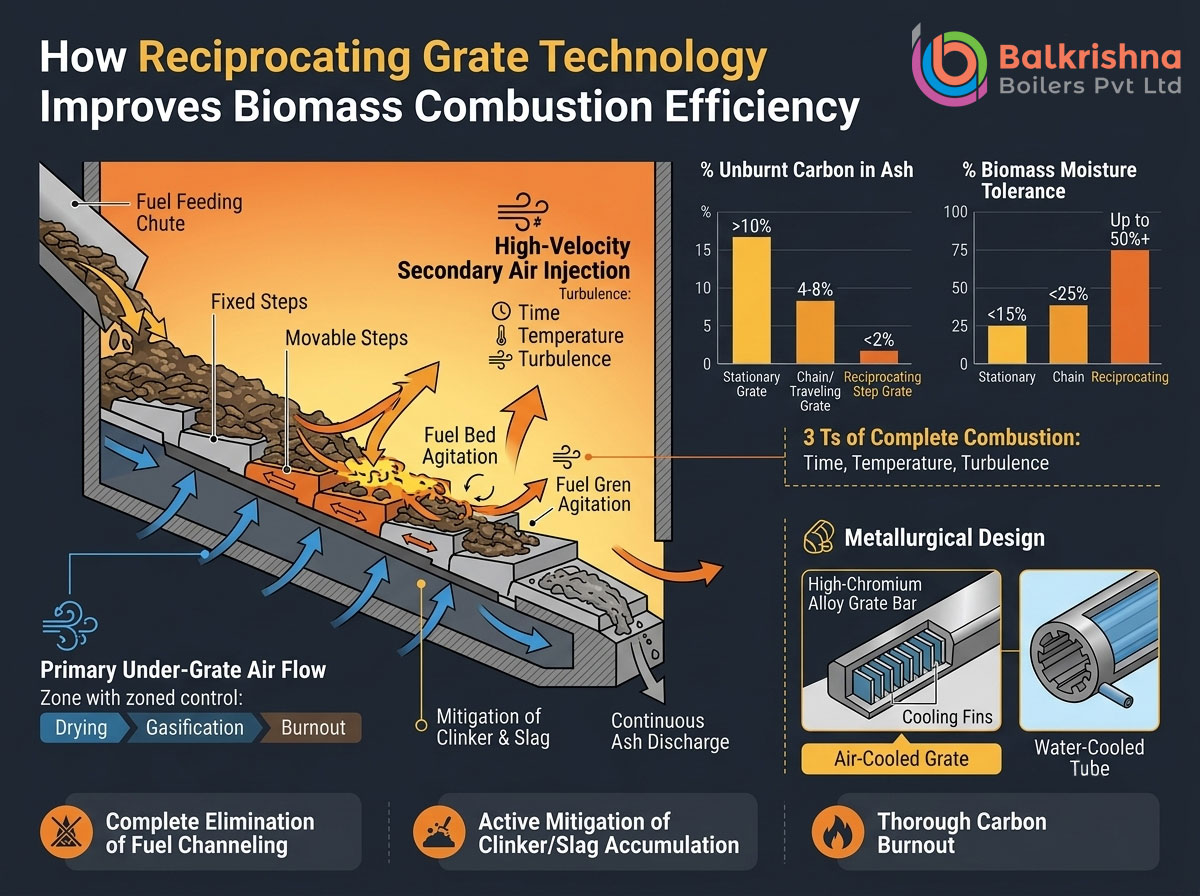
A reciprocating grate — sometimes called a step grate — is an active, sloped mechanical hearth built from overlapping rows of heat-resistant alloy bars, typically inclined at an angle of roughly 15° to 25°.
Rows alternate between fixed bars, anchored permanently to the structural frame, and movable bars, connected to a hydraulic drive or eccentric mechanical pushrod. As the hydraulic cylinders cycle, the movable steps execute a deliberate stroke — commonly in the 50–100 mm range — that drives two distinct mechanical outcomes simultaneously: it propels the fuel layer steadily down the incline toward the ash discharge zone, and it continuously agitates the fuel bed, flipping and tumbling material rather than letting it sit undisturbed.
3. The Shearing Mechanism: How Reciprocating Grates Actually Defeat Clinkers
This is the mechanical detail that most directly explains why this technology solves the ash chemistry problem covered in section one.
The continuous relative motion between fixed and movable bars — each row sliding against its neighbor with every stroke — creates genuine mechanical shearing force across the fuel bed. As alkali-rich ash begins to cool and attempt to fuse, that shearing action continuously grinds, fractures, and breaks apart micro-clinkers before they can merge into the large, blockage-causing sheets a passive bed would allow to form. The resulting loose, fragmented ash simply falls through the engineered gaps between bars or moves smoothly down the slope into the ash hopper — a genuinely self-cleaning mechanism, rather than requiring manual intervention to break up clinker formations after the fact.
This shearing action simultaneously solves the channeling problem from section one — because the bed is continuously disrupted and rolled over, air channels physically cannot form and persist the way they would in an undisturbed fuel layer, which keeps bed porosity uniform across the full furnace width and ensures primary combustion air reaches fuel evenly rather than concentrating through low-resistance gaps.
4. Staged Air Zoning: Matching Air Supply to Combustion Chemistry
Complete biomass combustion genuinely requires a multi-staged air approach, because biomass releases a substantial majority of its combustible energy as volatile gases very early in the combustion process — commonly cited around 70-80% of total fuel weight released as volatiles before char combustion even begins in earnest.
Reciprocating grate furnaces address this with segmented air plenums beneath the hearth, creating distinct combustion zones along the fuel’s path down the incline: a drying zone with deliberately low air flow near fuel entry, a gasification zone with higher air flow where volatile release peaks, and a burnout zone with moderate air flow where remaining char completes combustion before ash discharge. By metering primary under-grate air precisely to each zone’s actual stoichiometric requirement rather than applying a single uniform air rate across the whole furnace, operators can hold overall excess air meaningfully lower than a non-zoned system would allow — and since excess air directly carries heat up the stack unused, this zoning is a genuine, measurable efficiency contributor.
5. Residence Time Control: Matching Grate Speed to Fuel Difficulty
Dense, compressed biomass fuels — briquettes made from agricultural residue, for instance — need prolonged heat exposure to burn completely through to their core, unlike loose, low-density biomass that combusts more readily. Because the hydraulic drive’s stroke frequency and length are directly adjustable, operators can precisely calibrate how long fuel remains on the grate before reaching ash discharge. A batch of unusually moist or coarsely-sized fuel can be given a slower grate movement, extending its time in the high-temperature zone exactly as long as needed to achieve thorough burnout — a genuine operational flexibility that a fixed-speed passive grate simply doesn’t offer. Our Agro-Waste Fired Steam Boiler range applies exactly this kind of adjustable residence time control for compressed briquette fuel specifically.
6. Comparing Grate Technologies
| Parameter | Stationary Grate | Chain/Traveling Grate | Reciprocating (Step) Grate |
|---|---|---|---|
| Bed agitation | None (manual only) | Minimal, passive conveying | High and continuous |
| Clinker management | Requires manual shutdown | High risk of jamming | Self-cleaning shearing action |
| Automation compatibility | Poor | Good | Excellent, fully programmable |
For a fuller comparison specifically between reciprocating and vibrating grate technology — a related but mechanically distinct alternative — our vibrating vs. reciprocating grate comparison covers that specific decision.
7. Metallurgy and Cooling: Why Material Choice Determines Service Life
Reciprocating grate bars operate inside a genuinely punishing environment — furnace temperatures commonly ranging 900–1150°C, combined with continuous mechanical motion and direct exposure to abrasive, chemically aggressive ash. Material selection directly determines how long the equipment actually survives that environment.
High-chromium and nickel-iron alloy construction is the standard answer: chromium content provides an oxidation-resistant protective layer that resists thermal scaling, while nickel maintains structural tensile strength at elevated operating temperature, preventing the warping or cracking that lower-grade materials would experience under sustained thermal cycling.
Cooling strategy varies by scale. Air-cooled grates use internal cooling fins on the underside of the bars, with incoming primary combustion air sweeping across those fins to draw heat away from the metal before it reaches the fuel bed — an elegant approach that uses air already destined for combustion to simultaneously protect the grate. For ultra-high-capacity power plant applications, water-cooled reciprocating grates bond the bars to a network of flexible water tubes tied directly into the boiler’s natural circulation loop, holding grate metal at a stable, low temperature and virtually eliminating thermal wear as a failure mode.
8. Frequently Asked Questions
Can a reciprocating grate boiler burn coal as well as biomass? Yes — reciprocating grates offer genuine fuel flexibility, capable of burning low-grade bituminous coal, lignite, or a coal-biomass blend without requiring mechanical modification, which is a meaningful advantage for facilities hedging between fuel types.
What does routine maintenance actually involve? Checking hydraulic oil levels, inspecting drive cylinder alignment, and visually inspecting grate bars during scheduled washouts. Thanks to high-chromium metallurgy, individual bar replacement is genuinely infrequent and can typically be completed during routine shutdowns without dismantling the main drive assembly.
How does this technology affect emissions? By maintaining tightly controlled fuel-to-air ratios and ensuring complete carbon burnout through the mechanisms covered above, reciprocating grates naturally reduce carbon monoxide emissions and meaningfully lower particulate carryover into the flue gas compared to hand-fired or simpler passive grate systems.
Conclusion: The Mechanics Solve a Chemistry Problem
Reciprocating grate technology isn’t a generic upgrade — it’s a specific mechanical answer to a specific chemistry problem: alkali-rich biomass ash that fuses into clinkers on any passive fuel bed. The continuous shearing action between fixed and movable bars, paired with staged air zoning and adjustable residence time, is what actually converts genuinely difficult agricultural residue into clean, complete combustion at industrial scale.
Balkrishna Boilers Pvt Ltd custom-engineers incline angle, air zoning, and hydraulic stroke profiles to match the specific agricultural waste available in your region, alongside full pollution control integration. Explore our biomass and agro-waste range on IndianBoilers.com or Balkrishn.com.
Converting to biomass and want the right grate technology specified for your local fuel? Contact our combustion design engineers for a fuel-specific configuration.
Related Reading
- Fuel Moisture vs Boiler Efficiency: Finding the Ideal Range for Reciprocating Grate Boilers
- How Reciprocating Grate Boilers Handle High-Moisture Biomass Better Than Conventional Boilers
- Vibrating Grate Boiler vs Reciprocating Grate Boiler: Which Technology Delivers Better Performance?
- Bagasse and Pellets: The Engineering Behind India’s Two Biggest Biomass Fuels
- Understanding the Working Principle of Biomass Steam Boilers