
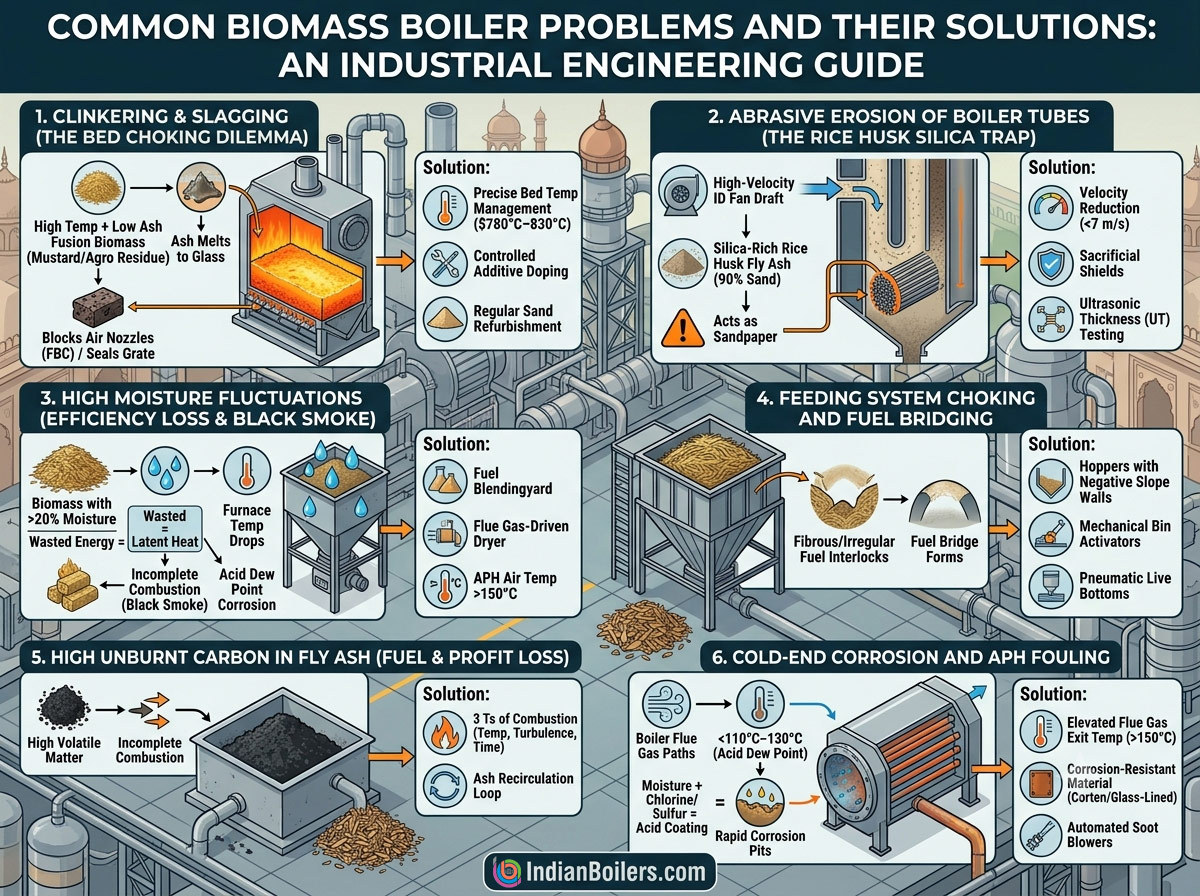
Common Biomass Boiler Problems and How to Actually Fix Them
Biomass fuel is inherently more variable than coal or oil — moisture, ash chemistry, and particle size shift batch to batch in ways a fossil fuel simply doesn’t. That variability is exactly what causes most of the recurring headaches Indian plants run into after switching to biomass boilers: clinkering, tube erosion, feeding stoppages, and efficiency drift that creeps up gradually rather than announcing itself. None of these are reasons to avoid biomass — they’re engineering problems with well-understood engineering solutions. This guide walks through the six most common failure modes and what actually fixes them, not just patches them temporarily.
1. Clinkering and Slagging: The Bed-Choking Problem
Clinkering is arguably the most pervasive issue in biomass combustion, particularly in Fluidized Bed Combustion (FBC) and grate boilers running agricultural residue across North and Western India.
What’s happening: Agricultural residues like mustard straw, paddy straw, and cotton stalks carry elevated concentrations of alkali metals — mainly potassium and sodium — along with silica. These compounds lower the fuel’s ash fusion temperature, often below 850–900°C. If furnace bed temperature exceeds that threshold, the ash melts and coats fluidizing sand particles or grate bars, hardening into dense, glassy clinkers as it cools. Clinkers block air nozzles or grate openings, choking combustion and eventually forcing a shutdown.
The fixes that actually work:
- Precise bed temperature monitoring. Multi-point thermocouples inside the FBC bed, with combustion held strictly in the 780–830°C range, keep temperature below the danger threshold rather than reacting after clinkering has already started.
- Over-Fire Air (OFA) optimization. High-velocity secondary air completes volatile combustion above the bed rather than concentrating heat directly on the grate or sand bed.
- Additive doping. Mixing dolomite, high-purity limestone, or aluminosilicate compounds into the fuel matrix chemically binds alkali metals, raising the effective ash fusion temperature and preventing liquid slag formation.
- Regular sand refurbishment. In FBC systems, continuously purging a portion of old fluidizing sand and replenishing with fresh, correctly sieved material prevents progressive agglomeration.
2. Abrasive Tube Erosion: The Rice Husk Silica Trap
Plants running dedicated rice husk FBC systems across Punjab, Haryana, UP, and West Bengal deal with this as a major recurring maintenance cost.
What’s happening: Rice husk ash is roughly 85–90% amorphous silica — essentially fine sand. When Induced Draft (ID) fans pull flue gas through the boiler passes at velocities above 10–12 m/s, that silica-laden gas becomes a continuous, low-grade sandblasting operation against evaporator tubes, superheater coils, and economizer bends. Over months, this thins carbon steel tube walls until they can no longer contain internal steam pressure — a genuine, serious failure mode if left unaddressed.
The fixes that actually work:
- Flue gas velocity reduction. Properly designed convective pass cross-sectional areas keep flue gas velocity below roughly 6–7 m/s, substantially reducing the kinetic energy behind the abrasive impact.
- Sacrificial erosion shields. Half-round SS 304 or SS 310 metallic guards installed on the front-facing surfaces of the first tube row in each convective pass absorb wear that would otherwise hit pressure-retaining tubes directly.
- Erosion-resistant refractory coating. Ceramic-based or high-temperature coatings on tube bends and sharp gas-direction changes — the highest-erosion points — extend service life meaningfully.
- Ultrasonic thickness (UT) testing. Mandatory non-destructive testing at every scheduled shutdown catches localized thinning before it becomes a catastrophic tube failure.
Our overview of grate speed’s effect on steam production and fuel consumption covers how combustion technology choice interacts with this erosion risk for husk-heavy operations.
3. Moisture Fluctuations: Efficiency Loss and Black Smoke
Biomass is genuinely hygroscopic — it absorbs ambient moisture readily, which becomes a serious operational issue during monsoon season or when handling freshly harvested bagasse and wood chips.
What’s happening: When fuel moisture exceeds roughly 20–25%, a meaningful share of combustion heat is consumed simply vaporising the internal water before any useful heat transfer occurs. This triggers a cascade: furnace temperature drops below the ignition threshold for volatile gases, incomplete combustion produces black smoke that risks CPCB non-compliance, and excess flue gas moisture can combine with trace sulfur to form acids that corrode metal surfaces if the gas drops below its acid dew point in the economizer or air preheater.
The fixes that actually work:
- Fuel blending. Never feed raw, wet biomass directly — a dedicated covered blending yard mixing wet fuel with dry biomass (premium pellets or dry sawdust) stabilises moisture below roughly 12–15% before it reaches the furnace.
- Flue gas-driven fuel drying. A rotary drum or flash dryer routing otherwise-wasted heat from the air preheater exhaust back through incoming wet biomass pre-dries fuel before it hits the feeders.
- Air preheater optimization. Raising primary air temperature above roughly 150°C via a properly designed multi-pass APH rapidly flashes off surface moisture the moment fuel enters the grate.
Our detailed breakdown of fuel moisture vs boiler efficiency — finding the ideal range and how reciprocating grate boilers handle high-moisture biomass better than conventional designs go deeper into managing this specific risk.
4. Feeding System Choking and Fuel Bridging
Unlike liquid or gaseous fuel, biomass doesn’t flow predictably — its irregular shape and fibrous texture make automated handling a genuine engineering challenge.
What’s happening: Loose fibrous residues like bagasse, loose mustard straw, and wood shavings interlock when piled in a storage hopper, forming an empty dome-like structure over the discharge outlet — known as bridging. The upper hopper stays visibly full while the screw feeder beneath runs empty, causing a sudden steam pressure drop that can destabilise downstream production without warning.
The fixes that actually work:
- Hopper geometry redesign. At least one vertical or negatively sloped hopper wall prevents fibers from locking into a stable arch configuration.
- Mechanical bin activators. Motorized paddle rotators or heavy-duty agitators inside the lower hopper section continuously break down forming bridges before they stabilise.
- Pneumatic live bottoms. Automated compressed-air pulsing nozzles periodically dislodge stagnant biomass, keeping material flowing smoothly into the rotary feeder.
5. High Unburnt Carbon in Fly Ash: A Direct Fuel and Profit Loss
Black, unburnt carbon in your ash pit or cyclone collectors is quite literally combustible fuel value leaving the system unused.
What’s happening: Biomass carries high volatile matter content — often 65–75% — meaning it decomposes rapidly into flammable gases once it hits a hot furnace. If those gases don’t find sufficient oxygen, or are pulled out of the furnace too quickly by a poorly calibrated ID fan, they escape unburned into the convective zones. In grate systems, light rice husk or sawdust particles can also be lifted off the grate by strong primary air drafts before combustion completes.
The fixes that actually work — the “3 Ts” of combustion:
- Temperature. Maintain furnace temperature above roughly 800°C to reliably ignite volatiles.
- Turbulence. High-pressure secondary air creates a swirling vortex that thoroughly mixes volatile gases with available oxygen.
- Time (residence time). An adequately sized freeboard combustion zone gives light, floating particles enough time to burn completely before reaching the tube banks.
- Ash recirculation. A fly ash reinjection loop collects carbon-heavy ash from settling chambers and feeds it back into the high-temperature bed to extract remaining thermal energy rather than discarding it unused.
6. Cold-End Corrosion and Air Preheater Fouling
Fouling in heat recovery equipment acts as an insulating layer that gradually strangles boiler efficiency, often without an obvious single trigger event.
What’s happening: Many biomass feedstocks — particularly fast-growing grasses and crop stalks — carry elevated chlorine and trace sulfur, forming acidic vapors during combustion. If the boiler runs at low load, or incoming combustion air over-cools the APH tubes, flue gas temperature can drop below the acid dew point (typically 110–130°C), condensing acidic vapor directly onto internal carbon steel surfaces, causing corrosion pitting and clogging narrow tube lanes with sticky, acidic ash deposits that progressively choke ID fan draft capacity.
The fixes that actually work:
- Maintain elevated flue gas exit temperature. Keeping final exhaust temperature above roughly 140–150°C when burning high-chlorine agro-biomass avoids dropping below the acid dew point.
- Corrosion-resistant material upgrades. Retrofitting cold-end APH sections with Corten steel or glass-lined/enamel-coated tubes resists acidic adhesion far better than standard carbon steel.
- Automated soot blowers. High-pressure steam or acoustic soot blowers in the economizer and APH banks, run on a scheduled interval, prevent ash deposits from stabilising on tube surfaces.
Our biomass boiler emission control systems guide and Pollution Control Equipment range cover the broader compliance picture that intersects with this corrosion risk.
Diagnostic Quick-Reference
| Symptom | Probable Cause | Immediate Action | Long-Term Fix |
|---|---|---|---|
| Thick white/grey smoke, steam pressure dropping | Excessively wet fuel batch | Blend with dry pellets immediately; raise APH air temperature | Covered fuel storage; flue gas-driven fuel dryer |
| Sudden drop in ID fan draft, high back-pressure | Ash clinkering blocking nozzles/grate lanes | Reduce load safely; clear visible clinkers via inspection doors | Additive doping; lower bed operating temperature |
| Frequent tube leaks in convective pass zones | High-velocity silica erosion (common with rice husk) | Patch leak; weld sacrificial SS shields on affected tubes | Redesign convective pass for lower gas velocity |
| Screw conveyor running, steam pressure falling | Fuel bridging/rat-holing in hopper | Manually break bridge; activate hopper vibrators | Retrofit hopper geometry; install bin activators |
Why These Problems Aren’t a Reason to Avoid Biomass
Most biomass boiler problems don’t stem from a flawed fuel choice — they come from mismatching genuinely variable fuel properties with a static, non-adaptive boiler control system originally designed around a more consistent fossil fuel. A well-engineered biomass system, with combustion control matched specifically to your fuel’s ash chemistry and moisture profile, avoids the majority of these failure modes from the outset rather than requiring constant firefighting after commissioning. Our comparisons of Rice Husk vs Mustard Straw and Biomass Pellet vs Biomass Briquette performance are worth reviewing before finalising a fuel supply strategy, since fuel choice directly shapes which of these six problems you’re most likely to encounter.
Digital Monitoring Catches These Problems Earlier
Continuous sensing of bed temperature, flue gas velocity, and stack exit temperature turns these failure modes from surprise shutdowns into early-warning trends an operator can act on before a breakdown occurs. Our pieces on how AI and IoT are transforming biomass boiler operations and digital twin technology for boiler efficiency and reliability cover this monitoring layer in more depth.
Our Engineering Approach
Balkrishna Boilers Pvt Ltd — IndianBoilers.com and Balkrishn.com — engineers multi-fuel systems with automated ash removal, smart air-to-fuel ratio control, and erosion-resistant internal component geometry designed specifically for the fuel variability of Indian industrial biomass. Our Steam Boiler range includes the compact COMCUBE and husk-specific HUSKPOWER, both engineered around the specific failure modes described above.
Frequently Asked Questions
Are these problems specific to older boiler designs, or do modern systems face them too? Modern, well-engineered systems substantially reduce the frequency and severity of these issues through better combustion control, materials selection, and monitoring — but the underlying fuel variability is inherent to biomass itself, so ongoing maintenance discipline remains essential regardless of equipment age.
Can one boiler design solve all six problems at once? A properly specified system addresses the risks relevant to your specific fuel — a rice husk operation needs erosion mitigation more than clinkering prevention, while a mustard-straw system needs the reverse. Matching design to your actual fuel is more effective than assuming a single generic “biomass-ready” design covers every risk equally.
How often should thickness testing and inspection happen? At minimum during every scheduled seasonal shutdown for erosion-prone systems, with more frequent checks warranted for high-silica fuels like rice husk given the continuous abrasive wear involved.
Talk to Our Engineering Team
If your plant is dealing with recurring clinkering, tube erosion, or feeding issues, get in touch with our combustion engineering team for an on-site thermal audit, or browse our complete product range.
Further reading: Fuel Moisture vs Boiler Efficiency · Rice Husk vs. Mustard Straw: Which Biomass Fuel Offers Better ROI? · Biomass Pellet vs. Biomass Briquette: Which Fuel Gives Better Boiler Performance? · Biomass Boiler Emission Control Systems: A Complete Guide