
Digital Twins for Boilers: Simulating a Steam Plant Before It Ever Fails
There’s a meaningful difference between a sensor telling you what your boiler is doing right now and a system that can tell you what your boiler should be doing, and flag the gap between the two before it becomes a failure. That distinction is what separates simple IoT monitoring — covered in our smart sensors in thermic fluid heaters post — from genuine digital twin technology, which builds a living, physics-based simulation of your equipment that runs continuously alongside the real thing.
This guide covers what a digital twin actually is architecturally, how it differs from simpler monitoring approaches, and where it delivers genuine value for industrial boiler operations. If you want the broader picture of how AI and IoT are changing boiler operations generally, our AI and IoT in biomass boiler operations post covers that wider landscape.
1. What Actually Makes Something a “Digital Twin”
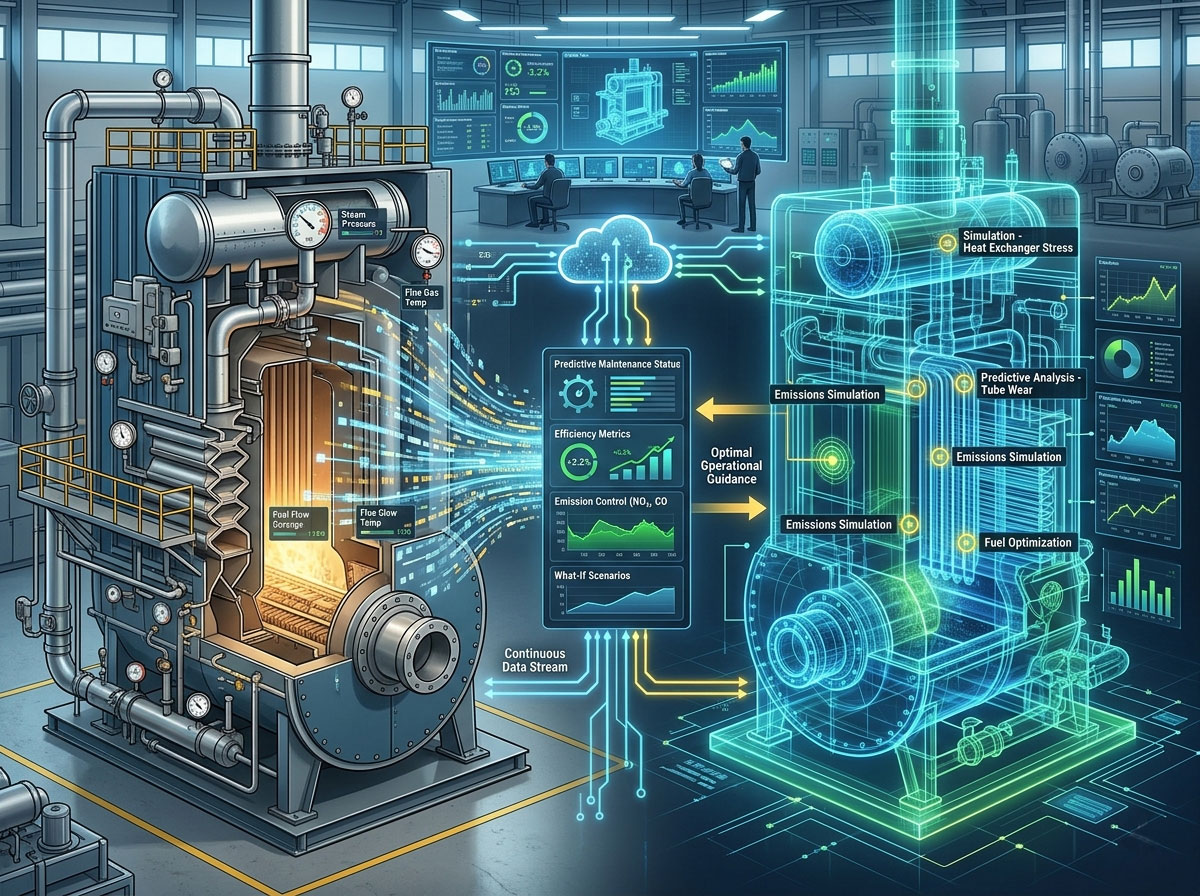
A digital twin isn’t just a 3D model or a dashboard — it’s a dynamic, continuously-updated simulation built on three distinct layers working together.
IoT sensor integration — real-time data streams from the physical boiler, covering steam pressure, flue gas temperature, fuel flow rates, and feedwater chemistry, continuously feeding the digital system.
Physics-based modeling — this is the layer that genuinely distinguishes a digital twin from simple monitoring. Rather than just displaying current readings, the twin runs actual thermodynamic equations to calculate how the boiler should be performing right now, given current ambient conditions, fuel quality, and load — creating a continuously-updated expected-performance baseline to compare live data against.
Machine learning refinement — over time, the system learns your specific plant’s actual behavior patterns, which lets it identify subtle deviations from expected performance that a human operator, or even a simpler threshold-based alert system, would likely miss entirely.
The combination of these three layers — live data, physics-based expectation, and learned behavior — is what lets a digital twin move beyond “here’s what’s happening” into “here’s what’s about to happen, and here’s how it differs from what should be happening.”
2. Predictive Maintenance: Catching Failures Before They’re Failures
Traditional boiler maintenance runs on a fixed schedule — inspect every month, deep-clean every quarter, overhaul annually, regardless of actual equipment condition. A digital twin replaces that calendar-driven approach with condition-driven maintenance, based on what the equipment is actually experiencing.
By continuously monitoring stress factors on heat exchangers and tube surfaces against the physics-based expected baseline, a properly implemented digital twin can flag a developing tube leak or scale buildup meaningfully ahead of the point where it would become an unplanned failure — often with enough lead time to schedule the repair during a planned outage window rather than reacting to an emergency shutdown. This shift — from calendar-based to condition-based maintenance — is the single biggest operational change digital twin technology enables, and it’s the reason the technology earns its keep well beyond any efficiency gain alone.
3. Fuel Optimization: Precision the Human Eye Can’t Match
Fuel quality genuinely varies across combustion sources — biomass moisture content shifts by batch, gas composition varies by supplier, and even well-maintained equipment drifts slightly from its baseline calibration over time. A digital twin calculates the precise air-to-fuel ratio needed for complete combustion in real time, continuously adjusting for these variations rather than relying on a fixed setting calibrated once and left alone.
Even a modest 2–3% improvement in combustion efficiency, sustained continuously rather than achieved once and allowed to drift, compounds into meaningful fuel savings across a full year of operation. And because complete combustion simultaneously reduces NOx and CO emissions, this fuel optimization delivers an emissions benefit alongside the cost benefit — directly relevant as environmental norms continue tightening. This applies whether your equipment runs on biomass, oil, or gas — the physics-based modeling approach works across fuel types, adapting its expected baseline to whichever combustion source you’re running.
4. Virtual Commissioning and Risk-Free Training
Before making any physical change to a boiler system — upgrading a burner, testing a new process load, adjusting a control setpoint — a digital twin lets you test that change virtually first. This “what-if” analysis confirms the physical system will handle a proposed change safely before you ever touch the actual equipment, which is a genuinely valuable risk-reduction step for any modification to equipment that’s simultaneously expensive to damage and dangerous to get wrong.
The same simulation capability extends to operator training. New operators can practice responding to rare, high-stakes emergency scenarios — a sudden low-water condition, a rapid pressure excursion — in a completely risk-free simulated environment, building genuine response competency before they ever need to apply it to the real system under actual pressure.
5. What Digital Twin Technology Actually Monitors, Component by Component
| Component | What the Digital Twin Tracks |
|---|---|
| Heat exchanger | Fouling factors and thermal stress accumulation over time |
| Burner system | Flame geometry and fuel-air mixture optimization |
| Steam drum | Water level dynamics specifically during rapid load changes |
| Economizer | Waste heat recovery efficiency against expected baseline |
Each of these components has its own physics-based expected behavior, and the twin’s value comes from continuously comparing live performance against that expectation across all of them simultaneously — something no single operator watching a bank of physical gauges could realistically track with the same consistency.
6. How This Differs From Simpler IoT Monitoring
It’s worth being precise about this distinction, since “smart” and “connected” boiler technology spans a real range of sophistication.
Basic IoT sensors and alerts, covered in our smart sensors in thermic fluid heaters post, tell you what’s happening right now and flag when a reading crosses a fixed threshold — genuinely useful, but reactive by nature, and blind to gradual drift that stays within threshold limits while still representing a developing problem.
A true digital twin goes further by maintaining a continuously-updated physics-based expectation of what should be happening, which lets it catch subtle deviations well before they’d trigger a simple threshold alert — the difference between a smoke detector and a system that can smell smoke building before there’s technically smoke yet.
Both approaches have their place, and in practice, digital twin technology is typically layered on top of solid IoT sensor infrastructure rather than replacing it — the sensors provide the real-time data the physics-based model needs to function at all.
7. Genuine Implementation Challenges Worth Planning For
Digital twin adoption isn’t without real friction, and it’s worth going in with clear eyes about what it takes:
Data silos — bridging the gap between legacy analog gauges and instrumentation common in older boiler installations and the modern digital sensor infrastructure a twin requires is a genuine integration project, not a plug-and-play upgrade.
Cybersecurity — the bidirectional data flow between your boiler room and a cloud-based digital platform introduces a genuine attack surface that needs proper security architecture, particularly for critical infrastructure like a plant’s steam supply.
Skill gaps — operators need training to interpret complex data visualizations and physics-based deviation alerts, a meaningfully different skill set than reading physical gauges, and this training investment is a real cost worth budgeting alongside the technology itself.
8. Where This Technology Is Heading
As Indian manufacturing continues moving toward Industry 4.0 practices, digital twin technology is increasingly becoming a standard specification on high-capacity boiler installations rather than a premium add-on. It represents a genuine shift in how boiler equipment gets thought about — from a static piece of hardware you inspect on a schedule, to an ongoing, continuously-monitored service relationship between the physical asset and its digital counterpart. For industries where steam reliability directly determines production continuity, this shift is increasingly a competitive necessity rather than an optional upgrade.
Conclusion: The Value Is in the Comparison, Not Just the Data
A digital twin’s real power isn’t the sensor data itself — plenty of systems already collect that. It’s the continuous, physics-based comparison between what your boiler is actually doing and what it should be doing under current conditions, which is what surfaces developing problems long before a simple threshold alert ever would. For plants running high-capacity or continuous operations where unplanned downtime carries real cost, that early-warning capability is genuinely transformative.
Balkrishna Boilers Pvt Ltd integrates digital monitoring and predictive capability across our modern boiler range. Explore our full range on IndianBoilers.com or Balkrishn.com.
Interested in predictive monitoring capability for your boiler installation? Contact our engineering team to discuss digital twin and IoT integration options for your specific equipment.
Related Reading
- Smart Sensors in Thermic Fluid Heaters – What Actually Matters?
- How AI and IoT Are Transforming Biomass Boiler Operations in 2026
- How Modern Boilers Achieve 90%+ Thermal Efficiency
- The Steam Boiler Maintenance Checklist Every Indian Plant Actually Needs
- Common Biomass Boiler Problems and Their Solutions: An Industrial Engineering Guide