
Smart Sensors on a Thermic Fluid Heater: Which Ones Actually Earn Their Cost
“Smart” gets attached to almost every piece of industrial equipment sold today, often without much substance behind the label. For a thermic fluid heater, the useful version of “smart” isn’t complexity for its own sake — it’s visibility into the specific failure modes that actually threaten your process, before they become expensive problems. If you’re new to thermic fluid heating generally, our what is a thermic fluid heater beginner’s guide covers the fundamentals first.
This piece breaks down the specific sensor types that genuinely matter on a TFH system, what each one actually protects against, and why. For the broader concept of physics-based simulation sitting on top of sensor data, our digital twin technology guide covers that distinct, more advanced layer.
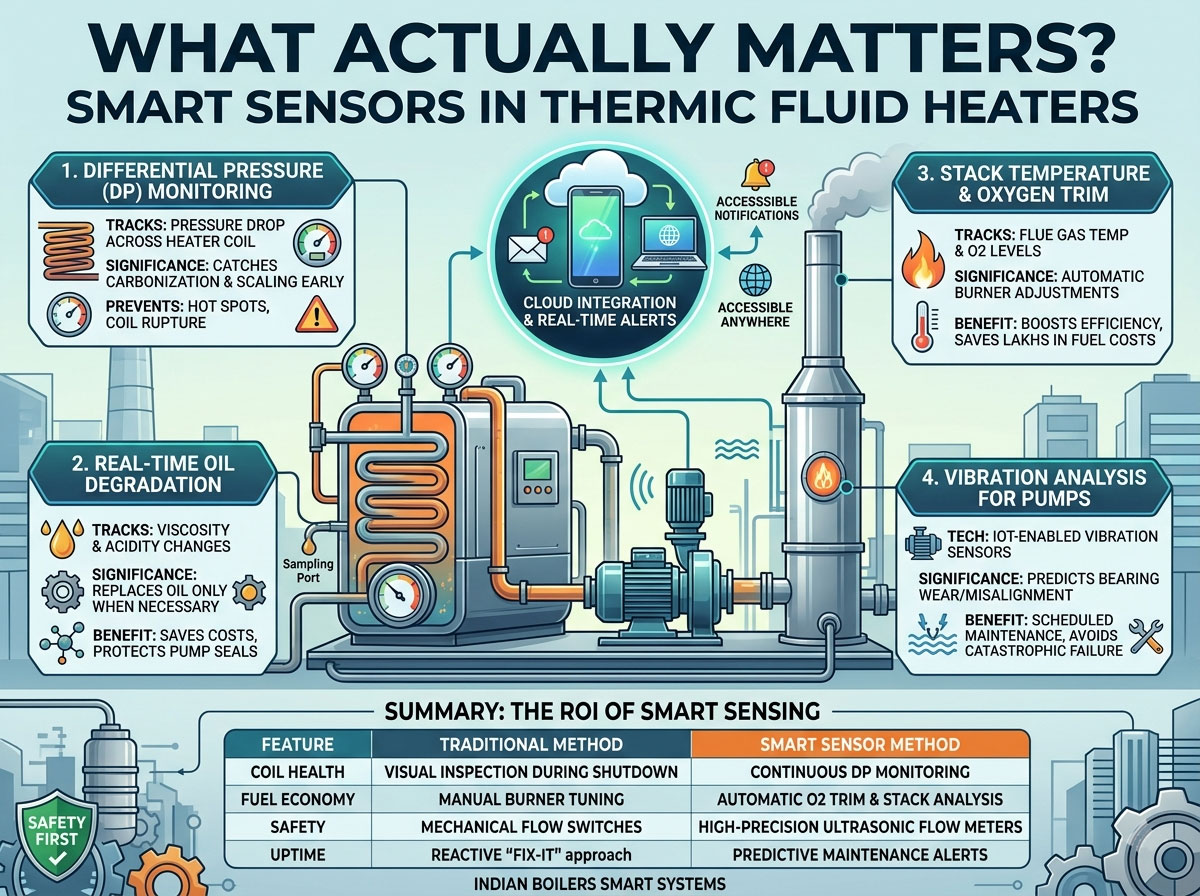
1. Differential Pressure (DP) Monitoring: The Earliest Warning You’ll Get
Many operators rely on a simple pressure gauge and call it monitoring — but a differential pressure sensor measuring the pressure drop specifically across the heater coil is doing genuinely more diagnostic work.
What it actually tracks: the pressure difference between the coil’s inlet and outlet as fluid flows through.
Why it matters: a gradually increasing DP reading is one of the earliest, most reliable indicators of carbonization or scaling building up inside the coil — deposits that restrict flow and create localized hot spots on the coil surface. Left unaddressed, those hot spots are precisely what leads to coil rupture, a genuinely serious failure mode for a system carrying high-temperature thermal fluid. Catching a rising DP trend early converts a potential coil failure into a scheduled cleaning.
2. Real-Time Fluid Degradation Monitoring: Oil Isn’t “Set and Forget”
Thermal fluid isn’t a permanent, unchanging component of the system — thermal cracking and oxidation gradually alter its chemistry over months and years of continuous high-temperature operation.
The traditional approach waits for a scheduled lab sample, often every six months, to check fluid condition — which means degradation between samples goes unnoticed until the next test, or until a problem actually manifests.
The smart sensor approach uses inline sensors monitoring changes in the fluid’s dielectric constant or viscosity continuously, giving a real-time read on fluid condition rather than a periodic snapshot.
The genuine payoff: you replace the fluid based on actual measured degradation rather than a fixed calendar interval, which avoids both premature replacement (wasting good fluid) and delayed replacement (running degraded fluid that’s accumulating grit and sludge, which then damages pump seals and other wetted components).
3. Stack Temperature and Oxygen Trim: Is Your Fuel Actually Becoming Heat?
This is the combustion-side equivalent of asking whether your fuel spend is converting to usable heat or partly escaping as waste.
The sensors involved: high-temperature thermocouples positioned in the stack, paired with oxygen analyzers reading the flue gas composition directly.
The mechanism: linking these sensors to an automated burner controller lets the system continuously adjust the air-to-fuel ratio in real time, holding combustion at the optimal point — enough air for complete combustion, not so much that excess air carries heat straight out the stack unused.
The impact: even a modest 1–2% improvement in sustained combustion efficiency, held consistently rather than achieved once at commissioning and left to drift, compounds into meaningful fuel cost savings across a full year of continuous operation.
4. Vibration Analysis on the Circulation Pump: Protecting the System’s Heart
The circulation pump is arguably the single most critical mechanical component in a TFH system — if it stops, fluid circulation stops, and the heater can overheat rapidly with nowhere for the generated heat to go.
The technology: IoT-enabled vibration sensors mounted on the pump housing, continuously monitoring vibration signature.
The predictive value: these sensors can detect developing bearing wear or shaft misalignment weeks ahead of a catastrophic pump failure, giving genuine lead time to schedule a repair during a planned shutdown rather than facing an emergency stoppage that halts the entire process the TFH serves.
5. Additional Monitoring Points Worth Considering
Beyond the four core sensor categories above, a few additional monitoring points genuinely add value on well-specified TFH installations:
Expansion tank level and nitrogen blanket pressure — since the expansion tank accommodates thermal fluid’s volume expansion and typically operates under a nitrogen blanket to limit oxidation, monitoring both level and blanket pressure catches developing issues with fluid inventory or blanket integrity before they affect fluid life.
Flow rate verification — ultrasonic flow meters confirming actual circulation rate through the system provide an independent check against pump performance, catching a developing flow restriction that DP monitoring alone might present ambiguously.
Return fluid temperature — tracking the temperature differential between supply and return fluid gives a genuine real-time read on how much heat your process is actually extracting, which is useful both for process optimization and for catching a developing heat exchanger fouling issue on the process side rather than the heater side.
6. The Feature That Actually Determines Whether Any of This Matters: Connectivity
A sensor generating data that nobody sees in time is functionally decorative. What genuinely determines whether a smart sensor investment pays off is the alerting and connectivity layer sitting on top of the raw sensor data.
Modern smart-integrated TFH systems shouldn’t just display readings on a local panel — they should push real-time alerts to a smartphone or desktop dashboard, so that a stack temperature spike or a flow rate dropping below a safety threshold reaches the right person immediately, regardless of whether anyone happens to be standing at the panel when it happens. This connectivity layer is arguably as important as the sensors themselves — a perfectly good DP sensor catching a developing scaling problem is only useful if someone actually acts on the alert promptly.
7. Traditional vs. Smart Monitoring: A Direct Comparison
| Monitoring Area | Traditional Method | Smart Sensor Method |
|---|---|---|
| Coil health | Visual inspection during scheduled shutdown | Continuous DP monitoring, catching trends between shutdowns |
| Fluid condition | Periodic lab sample (often every 6 months) | Continuous inline viscosity/dielectric monitoring |
| Fuel economy | Manual burner tuning, calibrated once and left | Automatic O2 trim, continuously adjusting |
| Pump health | Reactive — react once failure occurs | Predictive vibration analysis, weeks of lead time |
| Alerting | Local gauge, requires someone present | Real-time remote alerts regardless of location |
8. Where This Fits Relative to Full Digital Twin Technology
It’s worth being clear about scope: the sensor technology covered in this piece — DP monitoring, fluid degradation sensing, O2 trim, vibration analysis — represents genuinely valuable, practical monitoring that directly protects specific failure modes on a TFH system. A full digital twin, covered in our dedicated digital twin guide, goes a layer further — building a continuously-updated physics-based simulation of expected system behavior and comparing live sensor data against that expectation, which can catch subtler deviations than threshold-based sensor alerts alone. For most TFH installations, the sensor technology covered here delivers the majority of practical value at a meaningfully lower implementation cost; full digital twin capability is worth considering specifically for larger, higher-capacity, or safety-critical installations where the additional investment is more clearly justified.
Conclusion: Smart Means Visible, Not Complicated
Upgrading to a properly sensored thermic fluid heater isn’t about chasing a technology trend — it’s about removing the guesswork from four specific areas that genuinely determine safety, efficiency, and uptime: coil condition, fluid health, combustion efficiency, and pump reliability. Get real-time visibility into those four areas, paired with alerting that actually reaches someone in time to act, and the rest of the “smart” conversation is secondary.
Balkrishna Boilers Pvt Ltd integrates this sensor technology across our thermic fluid heater range, including ELECTROPAC and our fuel-fired systems. Explore the full range on IndianBoilers.com or Balkrishn.com.
Looking to upgrade an existing TFH system with proper monitoring, or specify it into a new installation? Contact our engineering team to discuss the right sensor configuration for your specific system.
Related Reading
- What Is a Thermic Fluid Heater? A Beginner’s Guide
- Thermic Fluid Heaters in the Chemical Industry: The Ultimate Safety Guide
- Digital Twins for Boilers: Simulating a Steam Plant Before It Ever Fails
- The Steam Boiler Maintenance Checklist Every Indian Plant Actually Needs
- How AI and IoT Are Transforming Biomass Boiler Operations in 2026