
Thermic Fluid Heater Safety in Chemical Plants: What Actually Prevents an Incident
In chemical manufacturing, precision and safety are genuinely inseparable — a process running slightly out of tolerance isn’t just a quality problem, it’s often a safety problem too. Thermic fluid heaters offer real advantages here — high-temperature heat delivery at low operating pressure, which sidesteps much of the structural risk steam systems carry at equivalent temperatures. But that low-pressure advantage doesn’t mean the system is inherently risk-free; it shifts the risk profile toward a different set of failure modes, and understanding those specifically is what genuine TFH safety practice is built around.
This guide covers the real mechanisms behind thermic fluid heater safety in chemical plant environments — where volatile solvents and reactive chemistries make a hot-oil leak a genuinely different hazard than it would be in, say, a textile mill. If you’re new to thermic fluid heating generally, our what is a thermic fluid heater beginner’s guide covers the underlying technology first.
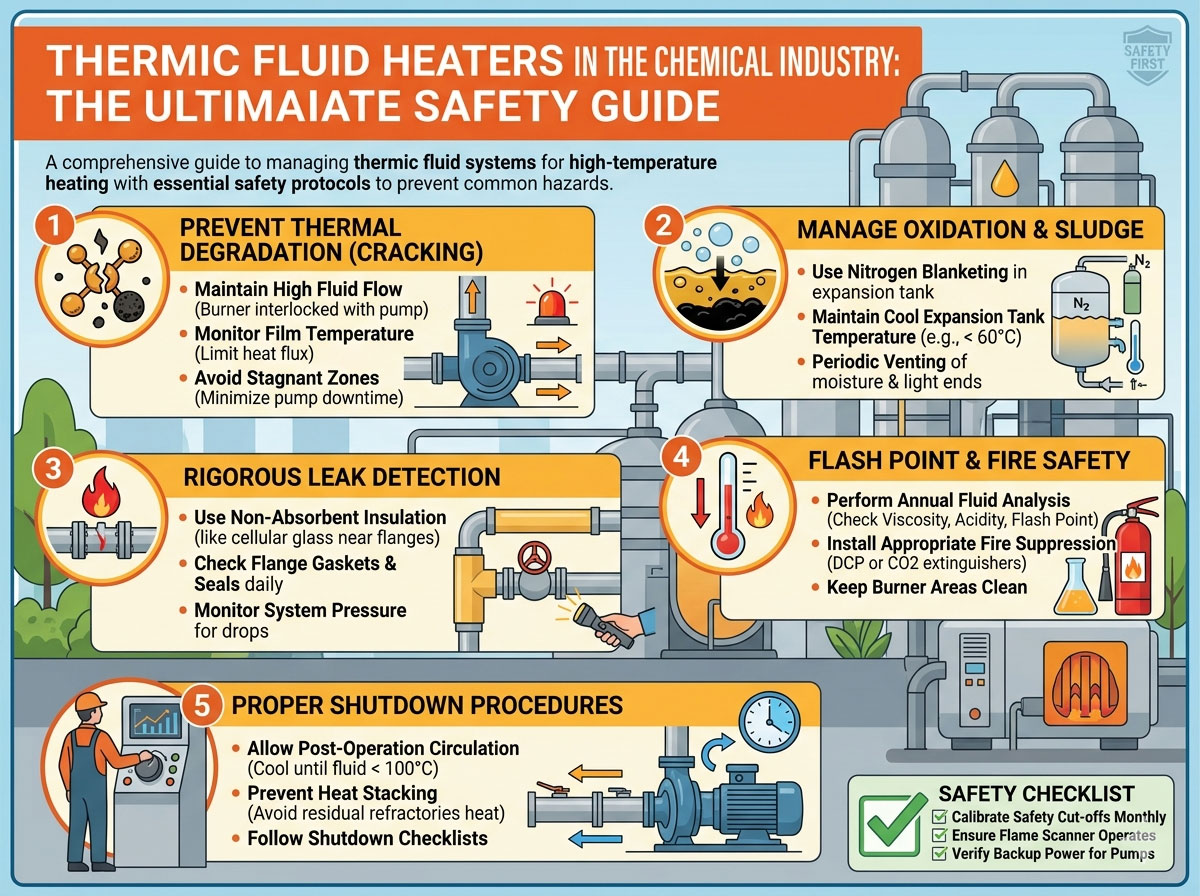
1. Preventing Thermal Degradation (Cracking)
Thermal cracking occurs when thermic fluid is overheated beyond its stable operating range, breaking down into volatile fractions and carbon deposits — commonly called coking — that accumulate on the heater coil’s interior surface.
Why flow rate is the critical variable: the pump circulating fluid through the heater coil must be running before the burner ever fires, and must maintain adequate flow throughout operation. Low flow velocity through the coil lets the fluid film directly in contact with the hot coil surface rise to a dangerously high temperature relative to the bulk fluid temperature, even if overall system temperature readings look normal — this localized film overheating is precisely what initiates cracking, often before it shows up in a standard bulk-temperature reading.
The engineering safeguard: a flow-differential pressure switch, wired into the burner’s safety interlock, should automatically shut down the burner if fluid flow drops below the safe threshold. This isn’t a redundant nice-to-have — it’s the primary defense against the specific failure mode that causes the most common form of thermic fluid degradation.
2. Managing Oxidation and Sludge Formation
When hot thermic fluid comes into contact with atmospheric oxygen — which happens most readily at the expansion tank, where the fluid’s natural thermal expansion is accommodated — it oxidizes, forming organic acids and sludge that degrade fluid quality and can contribute to fouling elsewhere in the system.
Nitrogen blanketing addresses this directly: for systems operating at meaningfully high temperatures, a nitrogen atmosphere sealing the expansion tank displaces oxygen, preventing the oxidation reaction from occurring in the first place rather than trying to manage its consequences after the fact.
Expansion tank temperature control matters as a complementary measure — keeping the expansion tank itself relatively cool, commonly targeted below roughly 60°C, meaningfully slows oxidation kinetics even where nitrogen blanketing is in place, providing a second layer of protection against fluid degradation.
3. Rigorous Leak Detection: Why It’s Different in a Chemical Plant Specifically
Chemical plants frequently handle volatile solvents and reactive chemistries, which makes a hot-oil leak a meaningfully different hazard here than in a general industrial setting — the combination of hot thermic fluid and a solvent-rich atmosphere raises the stakes of any leak considerably.
Insulation material choice matters more than it might seem: using genuinely non-absorbent insulation — cellular glass is the standard recommendation — around valves and flanges specifically prevents a subtle but serious hazard. Traditional mineral wool insulation can act as a wick, soaking up leaked thermic fluid and holding it in intimate contact with a hot surface over an extended area — conditions that can lead to spontaneous combustion of the soaked insulation itself, a genuinely more dangerous failure mode than the original leak alone would have been.
Daily mechanical inspection of pump seals and flange gaskets for any sign of weeping — even minor, seemingly insignificant seepage — should be a standing daily task, not an occasional check, precisely because catching a developing seal failure early prevents it from becoming a more significant leak later.
4. Flash Point Management and Fire Safety
Every thermic fluid has a specific flash point rating when new — but that rating isn’t static over the fluid’s service life. As fluid degrades through thermal cracking and oxidation, its flash point can drop meaningfully, which directly increases fire risk even at what would otherwise be considered normal operating temperature for fresh fluid.
Annual fluid analysis, sending a representative sample to a qualified lab at least once a year to check viscosity, acidity, and flash point specifically, is the practical way to track this degradation before it becomes a genuine safety issue rather than discovering it only after an incident.
Fire suppression infrastructure appropriate to hot-oil fires specifically — dry chemical powder (DCP) or CO2 extinguishers positioned in the heater room — should be confirmed as adequate and properly maintained, since water-based suppression is generally inappropriate for a hot-oil fire and can actively worsen the situation.
5. Proper Shutdown Procedures: The Step Most Often Rushed
Stopping a thermic fluid heater abruptly is a genuinely common, and genuinely damaging, operational mistake.
The cooling cycle matters mechanically: never stop the circulating pump immediately after shutting off the burner. The furnace refractory lining retains substantial residual heat after the flame is extinguished, and without continued fluid circulation to carry that residual heat away, the fluid still in the coil can overheat and crack even though the burner itself is off. Proper procedure keeps the pump running until fluid temperature drops below a safe threshold — commonly cited around 100°C — allowing the refractory’s stored heat to dissipate safely into circulating fluid rather than concentrating in stationary fluid within the coil.
6. Beyond the Core Five: Additional Safety Practice Worth Building In
Permit-to-work systems for any maintenance touching the thermic fluid circuit — isolating the specific section being worked on, confirming fluid has drained or cooled sufficiently, and formally documenting the work — are standard practice in well-run chemical plants and worth extending explicitly to TFH maintenance rather than treating it informally.
Operator training specific to hot-oil systems matters because the failure modes here genuinely differ from steam system failures that many operators may be more familiar with — recognizing early signs of cracking (unusual odor, discoloration in the sight glass, gradually rising DP readings) requires training specific to thermal fluid behavior, not general boiler operation experience alone.
Documentation and traceability — maintaining records of fluid analysis results, maintenance history, and any incident near-misses over the system’s operating life both supports genuine continuous improvement and provides the documentation trail expected in a properly audited safety management system.
7. Safety Checklist Summary
| Feature | Safety Requirement |
|---|---|
| High-temperature cutoff | Calibrated on a regular schedule to prevent overheating from drift |
| Flame scanner | Shuts down the burner automatically if flame detection fails |
| Deaerator tank | Removes moisture and entrained air during system startup |
| Backup power | Keeps circulation pumps running through a power interruption — critical given the shutdown cooling cycle requirement covered above |
| Flow-differential switch | Automatically shuts down the burner if fluid flow drops below safe threshold |
| Nitrogen blanketing | Prevents oxidation at the expansion tank |
| Non-absorbent insulation | Cellular glass around valves and flanges, avoiding the mineral-wool wicking hazard |
| Annual fluid analysis | Tracks flash point, viscosity, and acidity degradation over time |
For facilities wanting continuous, automated monitoring of several of these parameters rather than relying purely on scheduled manual checks, our smart sensors in thermic fluid heaters guide covers the specific sensor technology — DP monitoring, inline fluid degradation sensing, vibration analysis — that supports exactly this kind of proactive safety practice.
Conclusion: Low Pressure Doesn’t Mean Low Risk — It Means a Different Risk Profile
Thermic fluid heating’s core advantage — high temperature without high pressure — genuinely removes the structural failure risk that steam systems carry at equivalent temperatures. But it introduces its own specific failure modes: thermal cracking from inadequate flow, oxidation from air contact at the expansion tank, and a fire hazard profile that chemical plant environments make genuinely more serious than in a general industrial setting. Proper safety practice means understanding and engineering against these specific mechanisms, not assuming low pressure alone makes the system inherently safe.
Balkrishna Boilers Pvt Ltd engineers multi-level safety interlocks into every thermic fluid heater we supply, matched specifically to the demands of chemical industry applications. Explore our range of biomass, gas, and oil-fired thermic fluid heaters, including our electric ELECTROPAC range, on IndianBoilers.com or Balkrishn.com.
Operating a thermic fluid system and want a safety practice review? Contact our engineering team for an assessment of your current safety systems and maintenance protocols.