
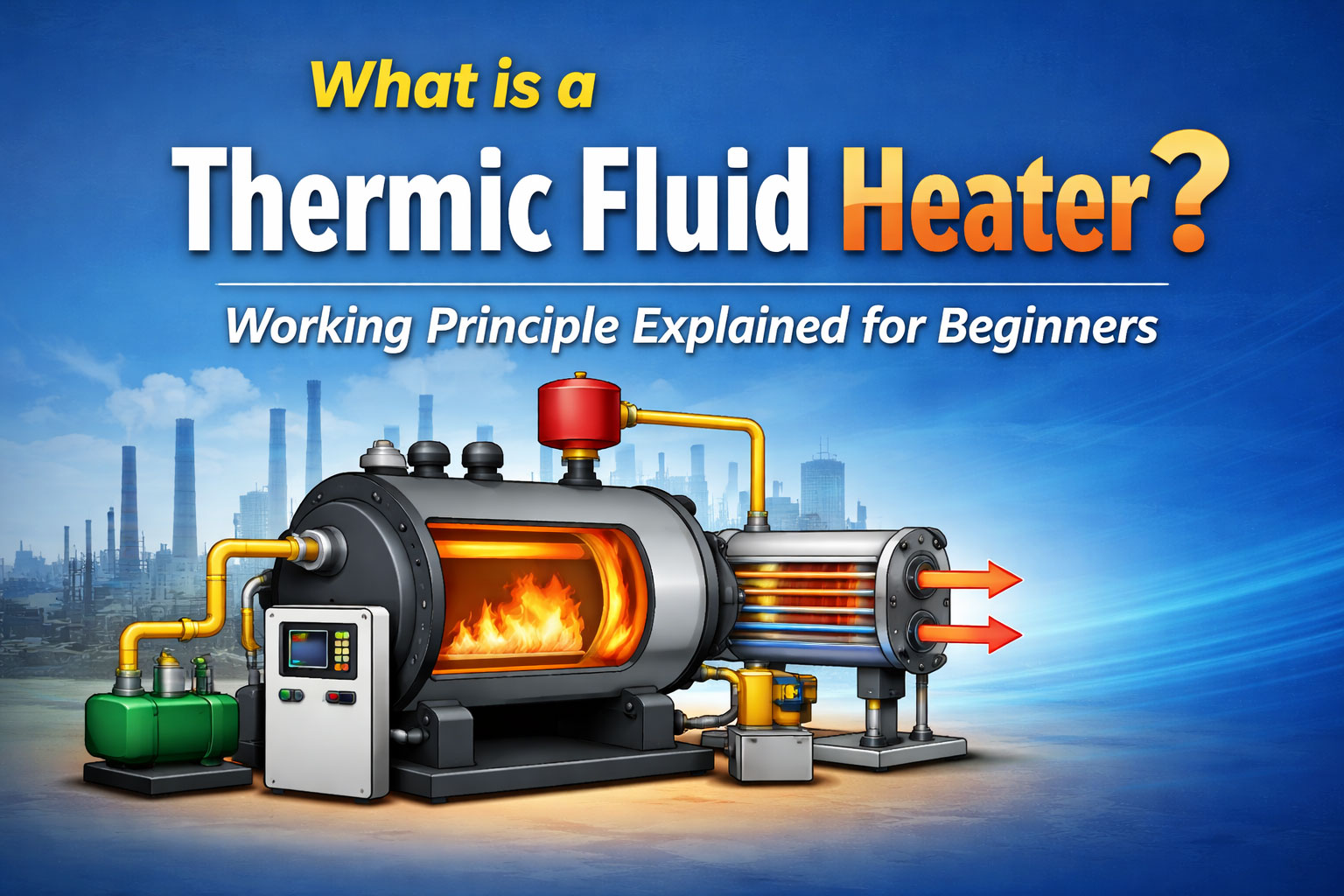
What Is a Thermic Fluid Heater? A Complete Beginner’s Guide
If you’ve spent your career around steam boilers, a thermic fluid heater can look deceptively similar from the outside — a fired vessel, a pump, pipework running out to the plant floor. But the engineering underneath is genuinely different, and understanding that difference matters if you’re deciding between the two for a new project. This guide walks through what a thermic fluid heater actually is, how it works step by step, and where it makes more sense than steam — written for someone encountering the technology for the first time.
The Simplest Way to Think About It
Picture your home’s central heating system, but scaled up for industrial process temperatures and using oil instead of water as the circulating medium. A thermic fluid heater — also called a hot oil heater — burns fuel to heat a specialised heat-transfer oil, then pumps that hot oil through a closed loop of insulated pipework out to wherever the factory needs heat, and back again to be reheated. Nothing boils, nothing turns to vapor, and the system never needs to build up steam pressure to deliver high process temperatures. That’s the core distinction from a steam boiler: a thermic fluid heater delivers high temperature at low pressure, because the fluid stays liquid throughout its entire working range rather than converting to a pressurised vapor phase.
Why This Matters: Temperature Without Pressure
Water, to deliver process heat at high temperature, has to be converted to high-pressure steam — and pressure is where most of the engineering complexity, safety margin, and regulatory oversight in a steam system comes from. Thermic fluid, engineered specifically to remain liquid at high temperatures, can deliver 250°C, 300°C, or higher to a process while the system itself operates at pressures only modestly above atmospheric — typically just enough to keep the fluid circulating and prevent localised boiling at hot spots. This single distinction is why thermic fluid heaters have become the preferred choice for processes that need precise, stable high-temperature heat without the pressure-vessel complexity that comes with high-pressure steam.
The Core Components, Explained Simply
- Heater coil — where fuel combustion actually happens, and where the thermic fluid picks up heat as it flows through tubing surrounding or passing through the combustion zone
- Circulation pump — keeps the fluid moving continuously through the closed loop; unlike a steam system where pressure itself can drive flow to some degree, a thermic fluid system depends entirely on forced circulation
- Expansion tank — thermic fluid expands meaningfully as it heats, and this tank accommodates that expansion while also allowing dissolved moisture and light compounds to vent off, often under a nitrogen blanket to limit oxidation of the fluid
- Fuel system — supplies whatever fuel the heater is designed around, whether gas, oil, or solid biomass fuel
- Control panel — monitors flow rate, inlet and outlet temperature, and safety interlocks, and shuts the system down automatically if flow drops or temperature exceeds safe limits
- Process heat exchangers — where the hot fluid actually transfers its heat to whatever machine, tank, or process needs it, before returning to the heater to be reheated
How It Actually Works, Step by Step
- Combustion. Fuel — gas, oil, or biomass depending on system design — burns inside the heater, generating hot combustion gases.
- Heat transfer to the fluid. Those combustion gases pass across tubing carrying the thermic fluid, transferring heat directly to the oil as it flows through the coil. Well-designed coils are engineered with a specific flow velocity to avoid localised overheating — a genuine failure risk if the fluid sits stagnant against a hot surface for too long.
- Forced circulation. A dedicated pump pushes the now-hot fluid out through insulated pipework to wherever the plant needs heat.
- Heat delivery. At each process point — a jacketed reactor, a drying oven, a calendar roll — the hot fluid passes through a heat exchanger, releasing heat to the process without the fluid itself boiling or changing phase.
- Return and reheating. The now-cooler fluid returns to the heater to pick up more heat, completing a continuous closed loop that runs for as long as the process demands.
This closed-loop, continuous-circulation design is what delivers the consistent, stable temperature control thermic fluid systems are known for — there’s no pressure fluctuation to manage the way there is in a steam system responding to load changes.
Thermic Fluid vs Steam: A Direct Comparison
| Factor | Thermic Fluid Heater | Steam Boiler |
|---|---|---|
| Operating pressure at high temperature | Low — near atmospheric | High — pressure rises directly with temperature |
| Water treatment required | None — closed oil loop | Yes — feedwater treatment, softening, blowdown |
| Temperature uniformity | Very stable, precise control | Can vary with load and pressure swings |
| Regulatory complexity | Generally simpler given lower pressure | IBR registration and inspection for qualifying capacity/pressure |
| Startup time | Relatively quick, no pressure build-up needed | Slower — pressure must build before use |
| Best suited for | Precise, high-temperature process heating (drying, reaction, calendaring) | Direct steam-consuming processes, sterilization, power generation |
Neither system is universally “better” — a process that genuinely needs steam itself (sterilization, humidification, direct steam injection) isn’t a candidate for thermic fluid at all, since thermic fluid delivers heat indirectly through exchangers rather than as a consumable process medium. Our detailed comparison of Thermic Fluid Heater vs Steam Boiler: Which Is Better for Your Industry goes deeper into this decision if you’re weighing the two directly.
Fuel Options for Thermic Fluid Heaters
Thermic fluid heaters aren’t locked to a single fuel type — the heater coil and combustion chamber can be engineered around gas, oil, or solid biomass fuel depending on what’s most cost-effective and available in your region. Biomass-fired thermic fluid systems have become increasingly common as fuel economics shift, following the same combustion engineering principles covered in our Complete Guide to Biomass Boilers for Steam Generation, and our overview of multi-fuel boilers as the future of industrial heating in India applies equally to thermic fluid systems designed for fuel flexibility.
Where Thermic Fluid Heaters Are Actually Used
Textile processing — drying, stentering, and calendaring operations that need precise, stable temperature across a wide fabric width benefit from thermic fluid’s steady heat delivery compared to steam’s pressure-dependent temperature variation.
Chemical and pharmaceutical manufacturing — reaction vessels requiring tight temperature control at high process temperatures are a classic thermic fluid application, since the closed loop avoids the water-quality and scaling concerns that come with steam-jacketed alternatives. Our safety guide to thermic fluid heaters in the chemical industry covers the specific safety protocols this sector requires.
Food processing — frying, cooking, and drying applications where indirect heat transfer avoids any risk of process contamination from steam-side water quality issues.
Paper and pulp, plastics and rubber processing — calendaring and molding operations needing sustained, uniform high-temperature heat across large surface areas.
Safety: A More Balanced View Than “Automatically Safer”
It’s genuinely true that operating at low pressure removes the specific catastrophic-failure risk profile associated with high-pressure steam. But thermic fluid systems carry their own distinct hazard that shouldn’t be glossed over: thermic fluid is combustible, and a leak onto a hot surface or exposed flame presents a real fire risk — historically one of the more serious incident categories in thermic fluid system operation when maintenance lapses. This is exactly why properly engineered systems include:
- Flow and temperature interlocks that shut down combustion immediately if fluid flow drops or coil temperature exceeds safe limits
- Regular fluid quality testing to catch thermal degradation before it produces excess sludge, reduced flash point, or increased fire risk
- Leak detection and proper gasket/flange maintenance, since even small leaks onto hot surfaces are the primary fire-risk pathway
Framing thermic fluid as simply “safer than steam” oversimplifies the real picture — it trades one risk profile for a different one, and both require disciplined engineering and maintenance to manage properly. Our thermic fluid heater safety guide for the chemical industry covers this in the depth it deserves.
Digital Monitoring: Catching Problems Before They Escalate
Modern thermic fluid systems increasingly use real-time sensors to track fluid temperature, flow rate, and degradation indicators continuously rather than relying solely on periodic manual sampling. Our piece on smart sensors in thermic fluid heaters — what actually matters covers which sensor investments genuinely improve safety and efficiency versus which are marketing add-ons with limited real operational value.
Sizing Considerations for a New System
Sizing a thermic fluid heater correctly comes down to your process’s actual heat demand — measured in kcal/hr or a similar thermal load unit — combined with the required temperature differential (delta-T) between supply and return fluid, and the flow rate needed to deliver that heat without exceeding safe fluid velocity in the coil. Getting this sizing right, rather than defaulting to a rounded-up estimate, is the single biggest factor in whether a new system runs efficiently at typical loads or ends up oversized and cycling inefficiently.
A Practical Maintenance Routine
Like any industrial heating system, a thermic fluid heater’s long-term reliability depends on consistent upkeep rather than a one-time installation quality. A reasonable baseline routine includes daily checks of flow rate and outlet temperature against normal operating range, monthly fluid sampling to track degradation indicators like acidity and viscosity change, periodic coil inspection for carbon buildup (which reduces heat transfer efficiency and can create hot spots), and annual full system inspection including safety interlock testing. Skipping fluid quality monitoring specifically is one of the more common ways a well-installed system gradually drifts toward the fire-risk scenario described above — degraded fluid with a lowered flash point is far more dangerous in the event of a leak than fresh, properly maintained fluid.
Our Product Range
Balkrishna Boilers Pvt Ltd — IndianBoilers.com and Balkrishn.com — manufactures thermic fluid heaters across a range of capacities and fuel types, including THERMPAC, DELTAPAC, and the VTF Series, all within our broader Thermic Fluid Heater category.
Frequently Asked Questions
Is a thermic fluid heater cheaper to run than a steam boiler? It depends on your process. Thermic fluid systems avoid water treatment costs and can offer strong thermal efficiency, but the comparison against steam depends on your specific process temperature, load pattern, and fuel type — there’s no universal answer independent of your application.
Do thermic fluid heaters need IBR registration like steam boilers? Regulatory requirements depend on your specific system’s design pressure and capacity — thermic fluid systems generally operate at lower pressure than comparable steam systems, which often simplifies compliance, but you should confirm your specific system’s classification with your state Boiler Inspectorate rather than assuming no registration applies.
How often does the thermic fluid itself need to be replaced? This depends on operating temperature, how well flow and temperature are controlled, and ongoing fluid quality testing — degraded fluid shows reduced flash point and increased sludge content, both of which should be monitored regularly rather than assuming the fluid lasts indefinitely.
Can a thermic fluid heater run on biomass? Yes — the combustion chamber and coil can be engineered around biomass fuel following similar combustion principles to biomass steam boilers, making it a viable option for plants prioritising local, cost-effective fuel over gas or oil.
Talk to Our Engineering Team
If you’re weighing thermic fluid against steam for a new project, or need a system sized to your specific process temperature and load, get in touch with our engineering team or browse our complete product range.
Further reading: Thermic Fluid Heater vs Steam Boiler: Which Is Better for Your Industry? · Thermic Fluid Heaters in the Chemical Industry: The Ultimate Safety Guide · Smart Sensors in Thermic Fluid Heaters: What Actually Matters? · Water Tube vs Fire Tube Steam Boilers