
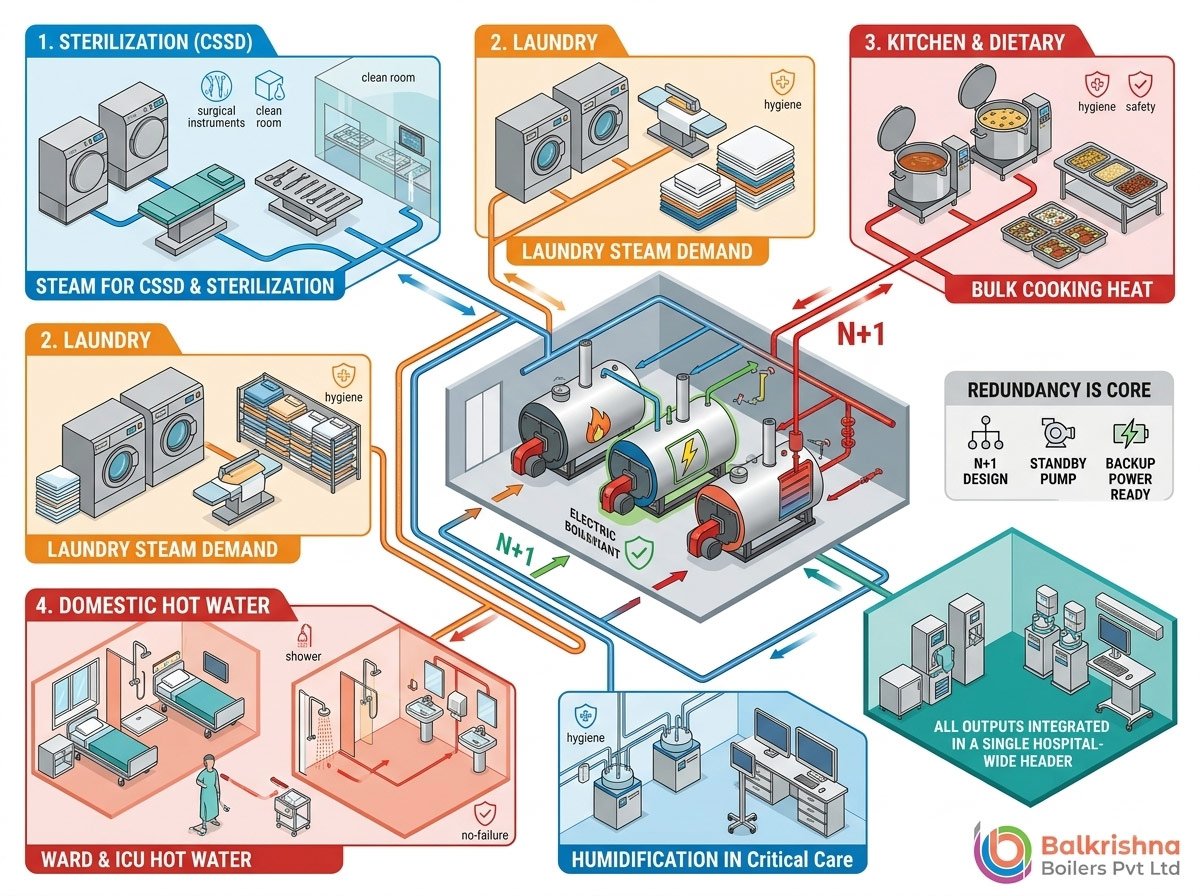
A hospital cannot afford a boiler that goes down. Not for a shift, not for an hour. Sterilization schedules for surgical instruments, hot water for wards and ICUs, steam for humidification in critical care areas, laundry for thousands of linens a day, and kitchen operations feeding patients and staff around the clock — all of it depends on a thermal system that simply does not fail. Unlike a factory that can pause a production line for a few hours, a hospital’s demand for steam and hot water never stops, which makes boiler selection here less about efficiency alone and more about reliability, redundancy, and hygiene.
Healthcare facilities also sit under a level of scrutiny that most industrial plants don’t face. Boilers are often installed close to patient areas, sometimes within dense urban campuses, which puts real weight on emissions, noise, and space. This guide walks through what hospitals and healthcare facilities actually need from their thermal systems, which boiler types fit which application, and the redundancy planning that separates a hospital boiler room from an industrial one.
Why Hospital Boiler Rooms Are a Different Category Altogether
Most industrial facilities run one or two dominant thermal processes. A hospital runs several, continuously, with almost no tolerance for interruption:
- Sterilization (CSSD/autoclaves) — surgical instruments require clean, dry, saturated steam at precise pressure and quality; anything less compromises sterility assurance.
- Space heating and domestic hot water — wards, ICUs, operation theatres, and patient washrooms need consistent hot water and, in colder regions, space heating around the clock.
- Humidification — operation theatres and certain critical care units maintain tightly controlled humidity, often steam-based, as part of infection control.
- Laundry — hospital linen volumes are high, and laundry steam demand runs in scheduled batches that spike sharply.
- Kitchen and dietary services — large-volume cooking for patients and staff, often running multiple shifts a day.
Because none of these can simply wait for the boiler to catch up, hospitals almost always design their thermal systems around redundancy — two or more boilers sized so that if one goes down for maintenance or fails unexpectedly, the facility keeps running on the others. That single design principle shapes almost every boiler decision that follows.
Steam Boilers: The Backbone of Sterilization and Laundry
Central Sterile Supply Departments (CSSD) depend on clean, consistent steam more than almost any other hospital utility. Instrument autoclaves need steam that is properly saturated and free of contaminants that could leave residue on sterilized equipment — which makes boiler water treatment and steam quality just as important as raw output capacity.
A steam boiler remains the standard choice for CSSD, laundry, and larger kitchen operations because steam distributes easily across multiple departments through a single header, and pressure can be regulated separately for each application. Compact, fast-recovery ranges such as STEAMAX and STEAMGEN suit mid-sized hospitals where sterilization and laundry loads run in scheduled batches rather than continuously, while higher-capacity ranges like COMBIPOWER fit larger multi-specialty hospitals running CSSD, laundry, and kitchen steam simultaneously across a bigger campus.
Most hospitals install at least two steam boilers of adequate individual capacity rather than one large unit, specifically so sterilization and laundry can continue uninterrupted during routine maintenance or an unplanned shutdown of either unit.
Electric Boilers: Increasingly the First Choice for Hospital Campuses
Of all the industries we work with, hospitals are among the strongest fits for electric boilers — and for reasons that go beyond running cost. Electric boilers produce no combustion emissions, no flue gas, and require no on-site fuel storage, which matters directly on a hospital campus where air quality near patient wards and emergency access routes is a genuine safety concern, not just a compliance checkbox.
Ranges such as ELECTROMAX, ELECTROPAC, and ELECTRON give hospitals precise, near-instant steam or hot water without a fuel-handling boiler room, which also simplifies fire-safety planning — an important factor in any healthcare facility’s compliance review. Compact models like INDUCTRON and hot water-focused ranges like ELECTROAQUA suit smaller nursing homes, diagnostic centers, and day-care surgical units where space is limited and a full fuel-fired boiler room isn’t practical.
The emissions argument is significant enough that we’ve covered it in detail in <a href=”https://www.indianboilers.com/how-electric-boilers-help-meet-pollution-control-norms/”>How Electric Boilers Help Meet Pollution Control Norms</a> — a post worth reading in full if your facility is located in a designated air-quality-sensitive zone, which many hospital campuses in Indian cities now are. Water quality still matters for electric systems, since scale on immersed elements affects both efficiency and steam purity for sterilization use; our post <a href=”https://www.indianboilers.com/electric-boiler-water-quality-requirements-explained/”>Electric Boiler Water Quality Requirements Explained</a> covers what to check before commissioning. For hospitals weighing the switch from fuel-fired to electric, <a href=”https://www.indianboilers.com/electric-boiler-roi-when-does-it-pay-off/”>Electric Boiler ROI: When Does It Pay Off?</a> and <a href=”https://www.indianboilers.com/electric-boiler-power-consumption-formulas-and-examples/”>Electric Boiler Power Consumption: Formulas and Examples</a> are useful starting points for the cost comparison, and <a href=”https://www.indianboilers.com/electric-boiler-installation-what-to-expect/”>Electric Boiler Installation: What to Expect</a> outlines the practical steps once a decision is made.
Given how closely hospital hygiene requirements mirror those of controlled manufacturing environments, our earlier post on <a href=”https://www.indianboilers.com/electric-boilers-in-the-pharmaceutical-industry-why-theyre-preferred/”>Electric Boilers in the Pharmaceutical Industry: Why They’re Preferred</a> makes many of the same arguments that apply directly to a hospital CSSD or ICU utility room.
Hot Water Boilers: Wards, ICUs, and Domestic Supply
Hospital hot water demand is constant and unglamorous — but a shortfall in ward or ICU hot water supply becomes a patient-care issue almost immediately. A dedicated hot water boiler, separate from the steam system serving CSSD and laundry, keeps domestic hot water flowing to wards, washrooms, and staff facilities without competing for capacity during a sterilization or laundry peak.
Models such as AQUAJET and AQUAMAX are commonly specified for this continuous domestic hot water duty, while the compact VST Series suits facilities with limited utility space, such as smaller nursing homes or diagnostic centers retrofitting an existing building. In colder regions, this same hot water loop often doubles as the source for space heating in wards and common areas, which is worth factoring into sizing from the start rather than adding capacity later.
Thermic Fluid Heaters: Large-Scale Kitchen and Dietary Operations
Hospitals running their own in-house kitchens — feeding patients across multiple diet categories plus staff and visitor cafeterias — often benefit from a thermic fluid heater for large-volume jacketed cooking. Indirect heating through a thermic fluid loop gives kitchen staff steadier, more controllable heat for bulk cooking than direct steam injection, with less risk of scorching large batches during peak meal-service hours.
Ranges like DELTAPAC and THERMPAC are well suited to hospital dietary departments running multiple large cooking vessels through tight meal-service windows, three times a day, every day, without exception. For a deeper comparison between thermic fluid and steam for this kind of application, see <a href=”https://www.indianboilers.com/thermic-fluid-heater-vs-steam-boiler-which-suits-your-process/”>Thermic Fluid Heater vs Steam Boiler: Which Suits Your Process?</a>
Redundancy: The Non-Negotiable Design Principle
In almost every other industry, a boiler shutdown for maintenance is an inconvenience. In a hospital, it can mean cancelled surgeries, delayed sterilization turnaround, and wards without hot water. This is why hospital boiler rooms are built around redundancy rather than a single large unit:
- N+1 sizing — installing enough boiler capacity that any one unit can go offline for maintenance while the remaining units still cover full facility demand.
- Segregated systems — running CSSD/laundry steam, kitchen heat, and ward hot water on separate boilers or loops, so a fault in one system doesn’t cascade into another.
- Standby power compatibility — ensuring electric boilers and pumps are wired into the hospital’s backup generator system, since a power outage cannot be allowed to also take down sterilization capacity.
- Scheduled rotation — running boilers on a rotation schedule so maintenance happens predictably rather than reactively, keeping every unit in good working condition when it’s actually needed.
This is also where the choice between electric and fuel-fired systems becomes a genuine engineering decision rather than a cost one — a hospital campus with reliable grid power and generator backup can lean more heavily on electric boilers for redundancy, while a facility in an area with less reliable power supply may need a fuel-fired system as the primary, with electric as a supplementary or backup unit.
Compliance and Water Quality: Non-Negotiable in Healthcare
Beyond capacity and redundancy, hospital boiler systems face compliance requirements that go further than most industrial plants:
- Steam purity for sterilization — CSSD steam must meet specific quality standards to avoid leaving residue on sterilized instruments, which means boiler feedwater treatment isn’t optional.
- Emission norms near patient care areas — many state pollution control boards apply stricter scrutiny to combustion equipment sited close to hospital wards, ICUs, and residential neighborhoods.
- Fire and life-safety codes — boiler room design, fuel storage, and ventilation must meet hospital-specific fire codes, which are typically stricter than standard industrial norms.
- Noise limits — boiler rooms near ICUs and patient wards often have tighter noise constraints than a typical factory setting.
These requirements are exactly why so many hospitals now specify electric boilers wherever the application allows — fewer compliance boxes to manage, and one less variable in an already tightly regulated facility.
Sizing: Build Around Peak Demand, Not Averages
Hospital thermal demand doesn’t run at a flat average — it spikes sharply around specific windows: morning and evening meal service, scheduled surgery blocks that drive CSSD demand, and laundry batch cycles. Sizing a system around average daily demand almost always leads to a shortfall exactly when it matters most. A realistic sizing exercise for a hospital boiler system accounts for:
- Peak CSSD steam demand during scheduled surgery blocks
- Laundry batch cycles and how they overlap with kitchen and CSSD peaks
- Simultaneous ward hot water demand during morning and evening patient care routines
- Future expansion — hospitals rarely stay the same size, and boiler capacity is expensive to retrofit later
This kind of sizing exercise is best done with an engineering team reviewing actual department-level demand data, rather than applying general industry rules of thumb to a facility where downtime has direct patient-care consequences.
Why Hospitals and Healthcare Facilities Work With Balkrishna Boilers
Balkrishna Boilers Pvt Ltd has spent over two decades engineering thermal systems for hygiene-sensitive, uptime-critical industries, including pharmaceutical manufacturing where the sterility and reliability standards closely mirror what a hospital CSSD or ICU utility system demands. Our <a href=”https://www.indianboilers.com/industries/”>industries page</a> covers the broader range of sectors we serve, and our <a href=”https://balkrishn.com/client.php”>client list</a> reflects the same standards for reliability and compliance that healthcare facilities require.
Whether your facility needs a redundant steam system for CSSD and laundry, a fully electric boiler room to meet emissions and space constraints, or a combination of steam, electric, and hot water systems across a multi-department campus, our team can help design the right configuration rather than sizing a single unit in isolation.
Frequently Asked Questions
Why do hospitals need more than one boiler? Hospitals run on redundant boiler systems so that sterilization, laundry, and hot water supply continue uninterrupted if one unit needs maintenance or fails unexpectedly — a single-boiler setup isn’t considered acceptable for continuous patient care operations.
Are electric boilers reliable enough for hospital sterilization? Yes, when properly sized and connected to the hospital’s backup power system, electric boilers deliver steam of the quality CSSD sterilization requires, with the added benefit of no combustion emissions near patient care areas.
What steam quality is required for hospital sterilization? Autoclave sterilization requires clean, properly saturated steam free of contaminants that could leave residue on instruments, which depends heavily on correct boiler feedwater treatment, not just boiler capacity.
How often should hospital boilers be serviced? Given continuous operation and the patient-safety stakes involved, hospital boilers should be inspected monthly at minimum, with a full annual service, water-quality testing, and a documented maintenance rotation to avoid any single point of failure.
Planning a new hospital boiler room, or reviewing your facility’s sterilization, laundry, and hot water capacity? <a href=”https://www.indianboilers.com/contact-us/”>Get in touch with our engineering team</a> or explore our full <a href=”https://balkrishn.com/ourProduct.php”>product range</a> to find the right fit for your facility.