
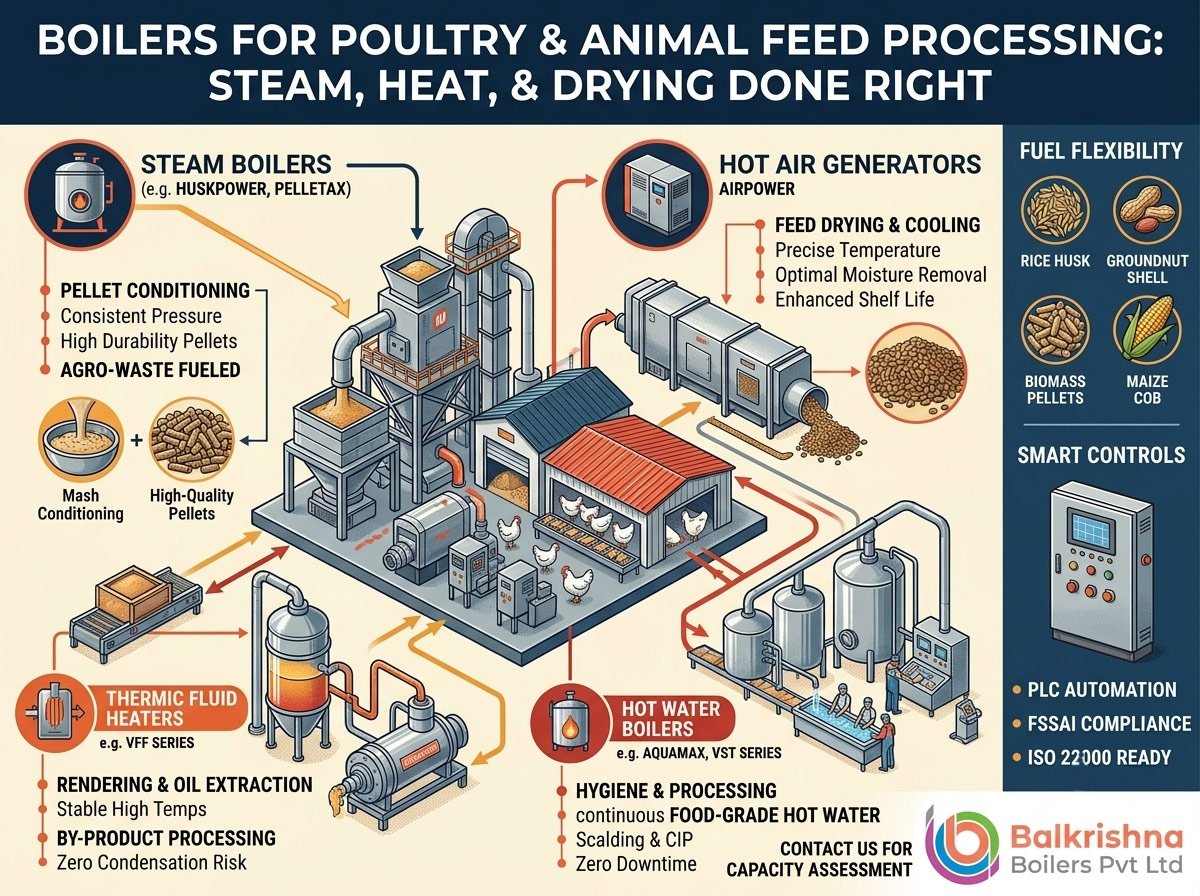
Walk through any compound feed mill or poultry processing unit in India, and you’ll find heat doing far more work than most visitors expect. It isn’t just about warming a room or generating power — heat is a raw material here, as essential as maize, soya, or bone meal. It conditions mash before pelleting, drives moisture out of finished feed, sterilizes equipment, keeps hatcheries at a stable temperature, and provides hot water for cleaning lines that must meet strict hygiene standards. When that heat source is undersized, poorly matched to the fuel available, or simply unreliable, the effects show up immediately — in pellet durability, in feed conversion ratios, and in flock health.
This is why feed millers and poultry integrators across Gujarat, Maharashtra, Punjab, and beyond are increasingly particular about the boilers and heaters they install. It isn’t a generic utility purchase; it’s a decision that touches product quality, biosecurity, and operating cost all at once.
Why Heat Is Central to Feed and Poultry Operations
Animal feed and poultry processing sit at an interesting intersection of agriculture and industrial manufacturing. A few examples make this clear:
- Pellet conditioning requires injecting controlled steam into mash before it enters the pellet mill. This softens starches, activates natural binders, and allows the pellet die to form dense, durable pellets with minimal fines.
- Feed drying and cooling after pelleting removes excess moisture so the feed doesn’t spoil in storage or transit — this is typically where hot air generators come in.
- Rendering and by-product processing, where feather meal, bone meal, or blood meal is produced, needs sustained thermal energy for cooking and sterilization.
- Hatchery and broiler house heating depends on stable hot water or hot air systems, especially in the first weeks of a chick’s life.
- Processing plant hygiene — carcass scalding, equipment washdown, and CIP (clean-in-place) systems — needs a dependable, food-grade hot water supply.
Each of these functions has different pressure, temperature, and moisture requirements, which is why a feed or poultry operation rarely needs just one type of heat source. It needs the right combination.
Steam Boilers: The Backbone of Pellet Quality
In a compound feed plant, steam quality directly determines pellet quality. Under-conditioned mash produces crumbly, dusty pellets with high fines percentage — a problem that shows up as wasted feed and unhappy customers. Over-wet conditioning, on the other hand, can clog the die and slow throughput.
What feed millers need from a boiler is consistency: steady pressure, minimal fluctuation even as load demand changes between conditioning cycles, and quick response when the pellet mill calls for more steam. Indian Boilers’ Steam Boiler range is built around exactly this kind of responsiveness, with designs suited to both small-capacity feed units and large integrated poultry-feed operations.
Fuel flexibility matters just as much here. Most feed mills sit close to agricultural belts, which means rice husk, groundnut shells, and other agro-residues are often the cheapest fuel available — sometimes cheaper than the raw material moving through the plant itself. A husk-fired boiler like HUSKPOWER turns that local biomass into steam economically, while a briquette or pellet-fired unit such as PELLETAX offers cleaner combustion and easier automation for plants that prefer densified fuel over loose husk. For operations wanting a fully packaged, quick-to-commission steam solution, models like STEAMAX and STEAMPOWER are common choices among mid-sized feed manufacturers.
The sugar and rice-milling sectors have long relied on similar biomass-fired steam systems for the same reason — abundant local residue and predictable steam demand. Our articles on boilers for sugar mills and cotton ginning and spinning mills go deeper into how agro-residue-fired boilers are engineered for fuels with variable moisture and calorific value — the same engineering logic applies directly to feed mills running on husk or straw.
Thermic Fluid Heaters: Indirect Heat Where Steam Isn’t Ideal
Not every heating requirement in a feed plant calls for steam. Rendering plants, oil extraction lines feeding into feed premixes, and certain drying applications often work better with thermic fluid (hot oil) systems, which deliver high-temperature heat at near-atmospheric pressure — a real safety and maintenance advantage over high-pressure steam circuits.
The Thermic Fluid Heater range covers exactly this need, and within Balkrishna Boilers’ lineup, models such as PELLEPAC (pellet-fired) and VFF SERIES or VTF SERIES (multi-fuel vertical designs) are frequently specified for feed plants that also run edible oil or solvent extraction lines alongside their compound feed operations — a combination that’s more common than it might seem, since many integrated agro-processing groups produce both feed and edible oil from the same oilseed intake.
If your plant runs both operations, it’s worth reading our detailed piece on boilers for edible oil and solvent extraction plants, which covers how thermic fluid systems handle the high, stable temperatures that extraction and refining need.
Hot Air Generators: Where Feed Drying Actually Happens
If steam conditions the mash, it’s hot air that finishes the job. After pelleting, feed typically leaves the die at 70–90°C and carries residual moisture that must be brought down before bagging or bulk storage. Insufficient cooling and drying leads to mold growth, caking, and a shortened shelf life — a costly problem once the product is already in the distribution chain.
A dedicated Hot Air Generator supplies clean, controllable hot air directly to dryers and coolers without the complexity of a steam-to-air heat exchange loop. Balkrishna Boilers offers this in several configurations — AIRPAC and AIRFORCE for compact, skid-mounted installations, and AIRPOWER or AIRTHERM for higher air-volume requirements typical of larger feed mills and rendering units. Because hot air generators can usually run on the same agro-waste fuel as the plant’s steam boiler, many feed mills pair the two systems and draw on a single fuel yard for both — a meaningful saving on fuel logistics and storage.
Grain and agro-processing sectors with similar drying-heavy operations have arrived at comparable setups. It’s a pattern worth exploring further if your plant also handles bulk grain intake or oilseed drying ahead of feed formulation.
Hot Water Boilers and Hygiene in Poultry Processing
Once you move from the feed mill into a poultry processing unit — scalding, defeathering, evisceration, chilling, and packing — the thermal requirements shift toward hot water rather than steam or hot air. Scald tanks need water held at a consistent, food-safe temperature, and washdown and CIP systems demand a reliable hot water supply that can keep pace with shift changes without temperature dips.
The Hot Water Boiler category is designed for exactly this kind of continuous-duty, food-grade hot water application. Within it, AQUAJET and AQUAMAX are compact options well suited to mid-sized poultry processing lines, while the VST SERIES scales up for larger integrated poultry plants that also run hatcheries and further-processing (cut, marinate, or ready-to-cook) lines on-site.
Hygiene-driven heat demand isn’t unique to poultry — hospitals, hotels, and food-processing units all share the same non-negotiable need for dependable hot water. If hygiene compliance is a priority alongside processing capacity, our articles on boilers for hospitals and healthcare facilities and boilers for hotels, resorts, and commercial kitchens illustrate how continuous hot water systems are engineered for zero-downtime, food-safe operation — the same principles apply directly to a poultry processing floor.
Electric Boilers for Smaller, Cleaner Operations
Not every feed or poultry unit runs at a scale that justifies a biomass fuel yard. Smaller specialty feed producers, pilot plants, R&D kitchens for feed formulation trials, or poultry units located where biomass fuel logistics are difficult, often do better with an Electric Boiler. Electric steam generation offers instant start-up, precise temperature control, and zero on-site combustion — useful where space is tight or emissions compliance is strict. Models like ELECTROMAX and ELECTROPAC are commonly specified for exactly this kind of compact, low-maintenance installation.
Fuel Flexibility: Turning Local Agro-Waste Into an Advantage
One of the quieter advantages available to feed and poultry processors is proximity to agricultural residue. Rice husk, groundnut shell, mustard husk, maize cob, and even feed-mill screenings can all serve as boiler fuel, and in many regions this residue costs a fraction of coal, diesel, or LPG. A well-designed multi-fuel boiler can switch between these residues depending on seasonal availability without a major efficiency penalty — something worth discussing at the specification stage rather than after installation.
This is also where boiler sizing discipline pays off. A boiler oversized for the plant’s actual steam draw cycles inefficiently and burns more fuel per unit of useful steam; one that’s undersized becomes the bottleneck the moment production scales up. Working from actual conditioning steam demand (kg of steam per tonne of feed), drying air volume, and hot water draw profiles — rather than round, “safe” capacity numbers — is the difference between a boiler system that pays for itself and one that quietly inflates operating cost for years.
Automation and Compliance
Feed safety standards (FSSAI, ISO 22000, and increasingly export-market certifications like GMP+ for feed) are pushing plants toward better-documented, better-controlled thermal processes. Modern boiler and heater packages with PLC-based controls, automated fuel feeding, and steam pressure logging make it far easier to demonstrate consistent conditioning temperatures and hygiene-critical hot water temperatures during audits — a growing requirement as more Indian feed and poultry producers target export markets.
Choosing the Right Partner
Feed and poultry processing plants rarely need a single boiler — they need a thermal system: steam for conditioning, hot air for drying, hot water for hygiene, and often a thermic fluid loop for allied processing. Getting the combination and sizing right requires a manufacturer who understands both the mechanical side of boiler design and the practical realities of running a feed mill or processing plant on a tight production schedule.
With more than 25 years of experience and installations across the food, feed, pharmaceutical, and agro-processing sectors, Balkrishna Boilers Pvt Ltd designs and manufactures the complete range covered in this article — steam boilers, thermic fluid heaters, hot air generators, hot water boilers, and electric boilers — engineered for multi-fuel operation and built to Indian agro-industrial conditions. Our team works directly with feed millers and poultry integrators to size systems around actual steam, air, and hot water demand rather than generic capacity charts.
If you’re setting up a new feed mill, expanding an existing poultry processing line, or simply replacing an aging, fuel-inefficient boiler, get in touch through our Contact Us page for a capacity assessment suited to your production volume and available fuel.
Explore related reading: Boilers for Edible Oil and Solvent Extraction Plants | Boilers for Sugar Mills | Boilers for Cotton Ginning and Spinning Mills | Boilers for Hospitals and Healthcare Facilities