
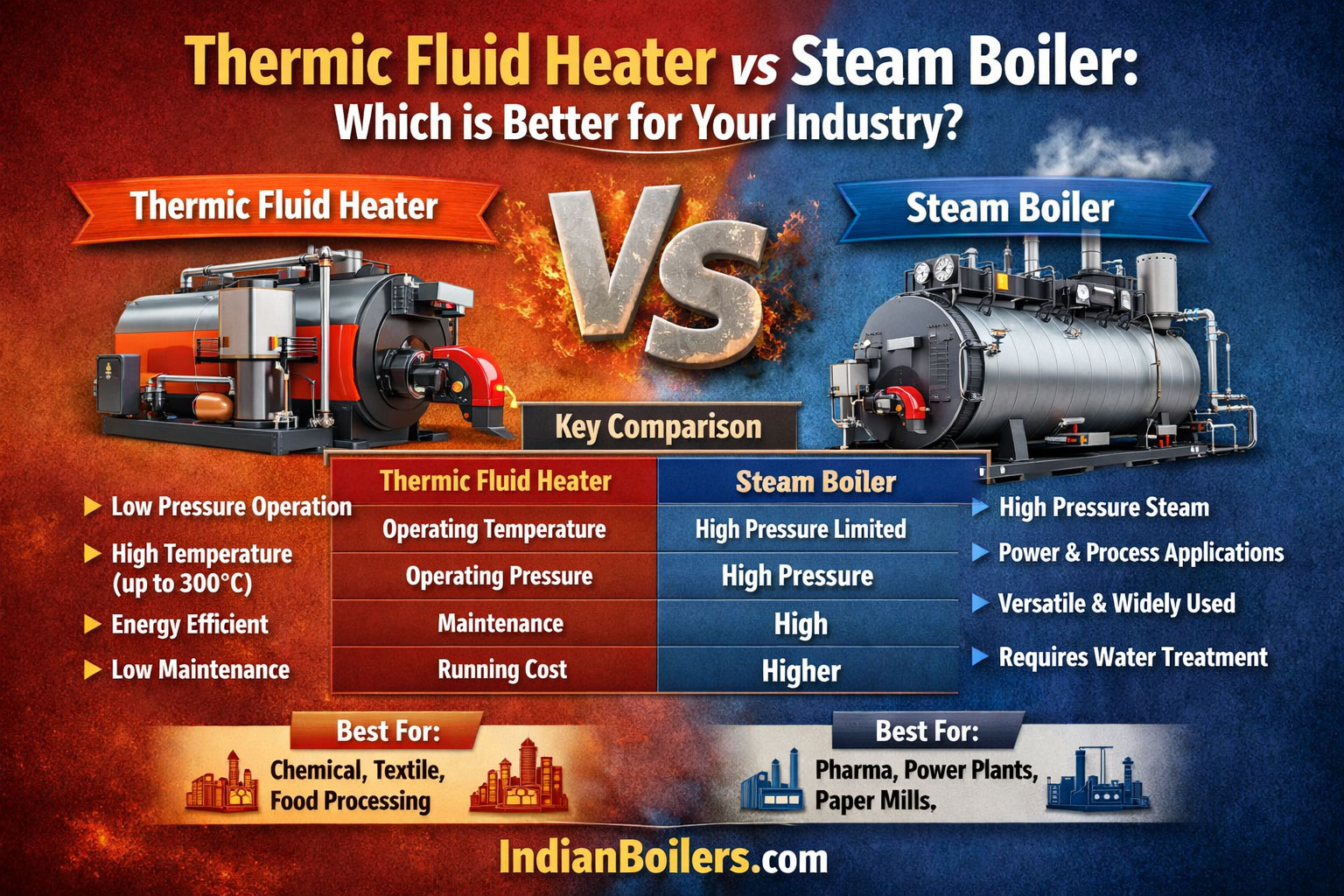
Thermic Fluid Heater vs Steam Boiler: A Decision Framework, Not a Verdict
This comparison gets asked constantly, and it deserves a more honest answer than “thermic fluid is safer and more efficient, steam is just for legacy processes.” That framing oversimplifies both technologies. The real answer depends entirely on what your process actually needs from the heat — and in a lot of plants, the honest answer is both systems, serving different parts of the same facility. This guide walks through the genuine trade-offs so you can make the call for your specific process, not a generic one.
The Fundamental Difference, Briefly
A thermic fluid heater heats a specialised oil in a closed loop and circulates it to deliver high process temperatures at low pressure — the fluid never boils or changes phase. A steam boiler heats water to the point of vaporisation, producing pressurised steam that can be used directly in a process or piped to heat exchangers. Our beginner’s guide to how thermic fluid heaters actually work covers the underlying mechanics in more depth if you need the fundamentals first.
A More Honest Comparison
| Parameter | Thermic Fluid Heater | Steam Boiler |
|---|---|---|
| Operating temperature | High (up to 300°C+) achievable at low pressure | High temperature requires correspondingly high pressure |
| Operating pressure | Low — near atmospheric | Rises directly with temperature |
| Achievable efficiency | High, when properly insulated and maintained | Also high, when paired with economizers, proper insulation, and combustion control — steam efficiency is often understated when auxiliaries are ignored |
| Water treatment | None — closed oil loop | Required — softening, deaeration, blowdown |
| Startup time | Generally faster — no pressure to build | Slower — pressure must build before use |
| Risk profile | Low pressure risk, but genuine fire risk from combustible fluid, especially if degraded | Pressure-related risk, well-understood and managed through IBR design margins and inspection |
| Heat control precision | Very precise, stable temperature | Can be precise too, but more sensitive to load swings affecting pressure |
| Direct process use | Cannot be consumed by the process — heat transfer only, via exchangers | Can be directly consumed (sterilization, humidification, direct injection) |
| Typical installation cost | Moderate | Often higher, due to water treatment and pressure-vessel auxiliary equipment |
| Regulatory complexity | Generally simpler given lower pressure | IBR registration and periodic inspection for qualifying capacity/pressure |
A few of these deserve more nuance than the table alone can carry, because oversimplifying them is where a lot of comparison content — including versions of this exact page — goes wrong.
Efficiency: Not a Clear Win for Either Technology
It’s a common claim that thermic fluid is simply “more efficient” than steam. That’s not really accurate as a blanket statement. Steam systems paired with economizers, air preheaters, and proper insulation routinely achieve efficiency in the mid-to-high 80s or better — our efficiency-focused guide with proven retrofit tips covers exactly how. What’s true is that thermic fluid systems avoid a specific category of loss steam systems carry — blowdown loss and the energy cost of feedwater treatment — which does give thermic fluid a structural efficiency advantage in that specific dimension. But an unmaintained, poorly insulated thermic fluid system can easily run less efficiently than a well-maintained steam boiler with modern auxiliaries. The honest comparison is process-specific, not a category-wide efficiency ranking.
Safety: Two Different Risk Profiles, Not “Safer vs Less Safe”
This is the claim most worth correcting. Thermic fluid heaters genuinely eliminate the specific catastrophic-failure risk associated with high-pressure steam vessel rupture — that’s real and meaningful. But thermic fluid itself is a combustible substance, and a leak onto a hot surface or ignition source presents a distinct, serious fire risk, particularly if the fluid has degraded through thermal breakdown and its flash point has dropped. Steam systems, meanwhile, operate under a mature, well-understood regulatory framework — IBR design margins, mandatory periodic inspection, and trained-operator requirements — specifically because the pressure risk is well characterised and managed.
Calling one system categorically “safer” glosses over the fact that both require rigorous, disciplined maintenance to manage their respective risks — steam through inspection and water treatment discipline, thermic fluid through fluid-quality monitoring and leak prevention. Our thermic fluid heater safety guide for the chemical industry goes into this balance in more depth.
The Real Decision Factor: Does Your Process Actually Need Steam?
This is the single most important question, and it’s more decisive than efficiency or safety comparisons. If your process needs to physically contact steam — sterilization in an autoclave, humidification, direct steam injection into a food product, or driving a turbine for cogeneration — thermic fluid isn’t a substitute, full stop, because it delivers heat only indirectly through exchangers and can never itself be consumed by the process. If your process only needs indirect, stable, high-temperature heat delivered to a jacket, coil, or drying chamber — with nothing about the process specifically requiring water vapor — thermic fluid becomes a genuine contender, and often the more efficient choice given its avoidance of water-treatment losses.
Matching Technology to Industry — With More Nuance Than a Simple List
Thermic fluid heater is typically the stronger fit for:
- Chemical processing reactions requiring precise, stable jacket temperature
- Textile drying, stentering, and calendaring where uniform heat across a wide surface matters more than moisture content
- Plywood, laminate, and press operations needing consistent high-temperature platens
- Bitumen and asphalt heating, where indirect, stable high-temperature heat is exactly what’s needed
Steam boiler is typically necessary, not just preferred, for:
- Pharmaceutical sterilization and autoclave processes, where steam contact is the actual sterilizing mechanism, not an incidental heat source
- Dairy and food processes requiring direct steam injection or humidification
- Sugar mills and cogeneration facilities, where steam drives a turbine for power as well as providing process heat
- Paper and pulp processes with steam-based drying cylinders
It’s worth noting pharmaceutical and food plants often run both systems side by side — steam for sterilization and direct-contact needs, thermic fluid for drying or reaction-vessel heating elsewhere in the same facility. Our industry-wise guide to the best boiler for textile, pharma, and food industries covers this dual-system reality in more depth than a simple either/or list allows.
Cost: A More Complete Picture
Steam boiler installations often carry higher upfront capital cost once you factor in water treatment plant, blowdown recovery, and pressure-vessel auxiliary equipment — that part of the original comparison generally holds. Operating cost is genuinely lower for thermic fluid in many applications, given the absence of water treatment chemicals and blowdown energy loss, though thermic fluid itself requires periodic replacement as it thermally degrades, which is its own recurring cost that shouldn’t be ignored in a full lifecycle comparison. The honest answer, again, is to model your specific process load and duty cycle rather than accepting a blanket “thermic fluid is cheaper” claim — for high-utilisation, continuous-load applications, the gap narrows considerably, and for processes genuinely requiring steam, the comparison is moot since thermic fluid isn’t a substitute at all.
Can Fuel Type Influence the Decision?
Both technologies can be engineered around gas, oil, or biomass combustion, so fuel flexibility itself isn’t usually the deciding factor between thermic fluid and steam — it’s a separate decision layered on top of whichever heat-transfer medium fits your process. If biomass is your target fuel for cost or emissions reasons, our Complete Guide to Biomass Boilers for Steam Generation and our overview of multi-fuel boilers as the future of industrial heating in India apply to both steam and thermic fluid system designs.
Digital Monitoring Applies Equally to Both
Modern control systems — flow, temperature, and (for thermic fluid) fluid-degradation sensing — have become standard on both technologies rather than a thermic-fluid-specific advantage. Our pieces on smart sensors in thermic fluid heaters — what actually matters and digital twin technology for boiler efficiency and reliability cover this monitoring layer across both technologies.
A Practical Decision Checklist
- Does your process require direct steam contact? If yes, thermic fluid is not an option for that specific application — steam is required.
- Is the requirement purely indirect heat delivery at a stable high temperature? Thermic fluid is a strong candidate, particularly where water-treatment avoidance and precise temperature control matter.
- Does your facility have processes on both sides of this line? Many plants genuinely need both systems, serving different areas — don’t force a single-technology decision across a whole facility if your process mix doesn’t support it.
- What’s your actual load pattern? High-utilisation, continuous operation narrows the operating-cost gap between the two; intermittent, batch-style operation tends to favour thermic fluid’s faster startup and lower water-treatment overhead.
Sizing and Specification Matters as Much as the Technology Choice
Whichever system fits your process, the second decision — sizing and specification — determines whether you actually capture the theoretical advantages described above. An oversized system of either type runs inefficiently at typical partial load; an undersized one chokes production during peak demand. For thermic fluid specifically, correct coil velocity and residence time are critical to avoiding localised overheating and premature fluid degradation. For steam, correct turndown ratio and proper auxiliary sizing (economizer, deaerator) determine whether the system holds efficiency across your actual load pattern rather than only at rated capacity. A generic size recommendation based on nameplate demand, without a genuine load audit, is one of the most common ways either technology underperforms its potential regardless of which one you choose.
Our Product Range Across Both Technologies
Balkrishna Boilers Pvt Ltd — IndianBoilers.com and Balkrishn.com — manufactures across both technologies, so the recommendation you get is based on your process, not on which product line we happen to be pushing. Our Thermic Fluid Heater range includes THERMPAC, DELTAPAC, and the VTF Series, while our Steam Boiler range includes STEAMPOWER, STEAMGEN, and STEAMJET.
Frequently Asked Questions
Is thermic fluid really safer than steam overall? Not categorically — thermic fluid removes the specific pressure-related risk of steam but introduces a genuine fire risk from the combustible fluid itself. Both require disciplined maintenance to manage their respective risk profiles safely.
Can I replace my steam system with thermic fluid to cut costs? Only if your process doesn’t require direct steam contact. If any part of your process needs sterilization, humidification, or direct steam injection, thermic fluid cannot substitute for that specific need, regardless of potential cost savings elsewhere.
Which is truly more energy efficient? Neither has a blanket advantage — a well-maintained steam system with modern auxiliaries and a well-maintained thermic fluid system can both achieve strong efficiency. Thermic fluid does structurally avoid blowdown and water-treatment losses, which is a genuine, specific advantage in that dimension.
Do I need to choose one system for my whole plant? Not necessarily — many facilities, particularly in pharma and food processing, run both systems for different process areas. Don’t assume a facility-wide single-technology decision is required if your process mix genuinely needs both.
Talk to Our Engineering Team
If you’re weighing thermic fluid against steam for a specific process — or suspect your plant genuinely needs both — get in touch with our engineering team for a process-specific recommendation, or browse our complete product range.
Further reading: What Is a Thermic Fluid Heater? Working Principle Explained for Beginners · Water Tube vs Fire Tube Steam Boilers · Thermic Fluid Heaters in the Chemical Industry: The Ultimate Safety Guide · Steam Boiler Efficiency: Boost Savings by 30% with Proven Tips