
7 Genuine Advantages of Thermic Fluid Heaters — And What to Know Before You Rely on Them
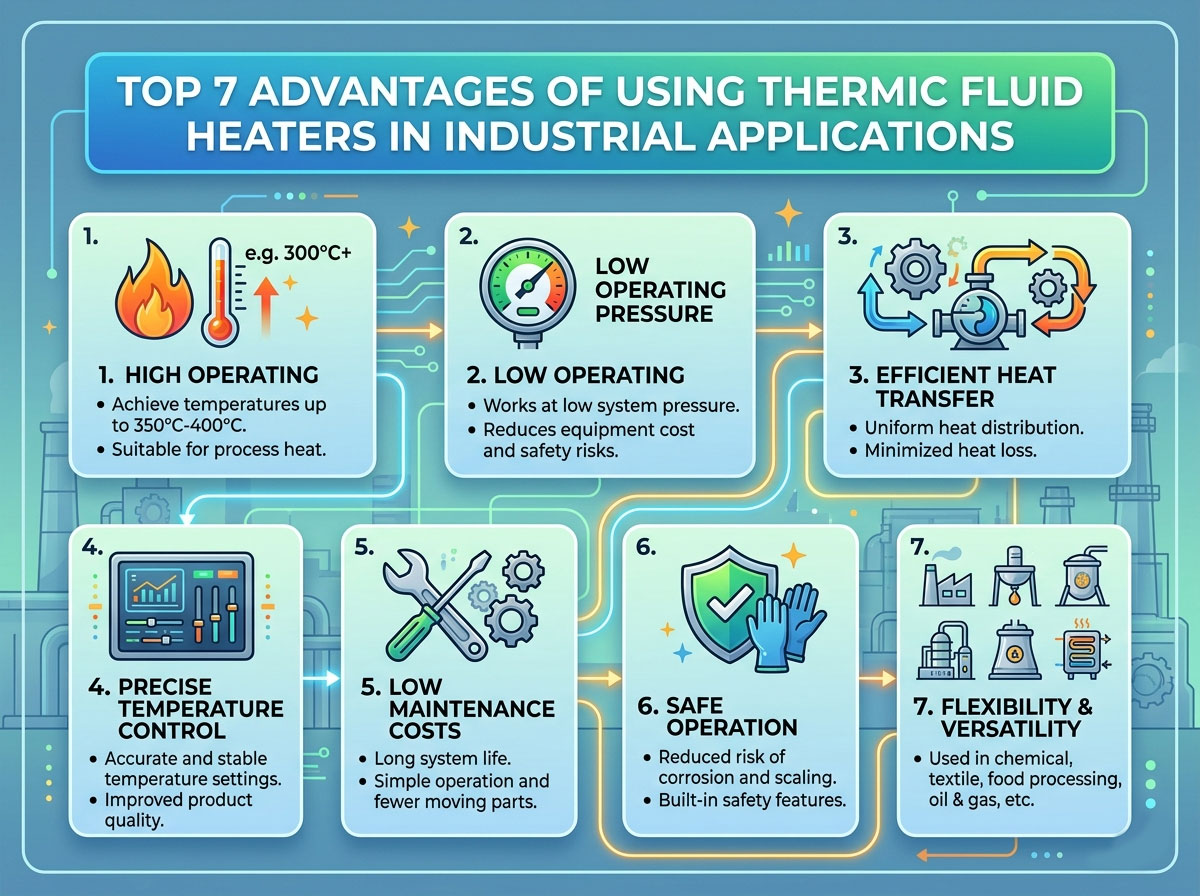
Thermic fluid heaters have earned their reputation across chemical, textile, food, and pharma manufacturing for good reason — the underlying engineering genuinely solves problems that steam systems don’t handle as elegantly. But a marketing-style list of advantages without any caveats does readers a disservice, because every one of these benefits comes with a condition attached: proper installation, correct sizing, and disciplined maintenance. Here are the seven advantages that actually hold up, along with what needs to be true for each one to apply to your plant.
1. High Thermal Efficiency — Achievable, Not Automatic
Well-designed thermic fluid systems can achieve efficiency in the high 80s to low 90s percent range, driven by minimal heat loss in a closed loop and the complete absence of blowdown loss — a real, structural advantage over steam. But that efficiency depends on proper insulation across the entire pipework run, a furnace design matched to the fuel being burned, and consistent maintenance of the heater coil to prevent carbon buildup, which degrades heat transfer over time. A poorly insulated or badly maintained thermic fluid system won’t automatically hit these numbers just because the technology is capable of it — see our efficiency-focused guide with proven retrofit tips for the underlying principles, most of which apply to thermic fluid systems as much as steam.
2. High Temperature Without High Pressure — A Real Advantage, With a Real Trade-Off
This is thermic fluid’s most genuine structural advantage: delivering 250–300°C or higher process heat while the system itself operates near atmospheric pressure. This does eliminate the specific catastrophic-failure risk profile associated with high-pressure steam vessels. What it doesn’t do is eliminate risk entirely — thermic fluid is a combustible substance, and a leak onto a hot surface or ignition source is a genuine fire hazard, particularly once the fluid has thermally degraded and its flash point has dropped. Presenting this advantage without that caveat oversells the safety story; our thermic fluid heater safety guide for the chemical industry covers the balanced picture, and our Thermic Fluid Heater vs Steam Boiler comparison goes deeper into how the two risk profiles actually compare.
3. Lower Maintenance Complexity — Different, Not Absent
It’s accurate that thermic fluid systems avoid an entire category of maintenance steam systems require — no steam traps, no condensate return system, no feedwater softening or deaeration plant. That’s a genuine simplification. What replaces it is a different maintenance discipline specific to the fluid itself: periodic sampling to track thermal degradation, acidity, and flash point; coil inspection for carbon deposits; and leak-prevention maintenance on gaskets and flanges given the fire-risk consequences of a leak. “Lower maintenance” is fair; “no maintenance” or “maintenance-free” — sometimes implied in marketing copy — isn’t, and skipping fluid-quality monitoring specifically is one of the more common ways a well-installed system drifts toward a real safety issue over time.
4. Uniform, Precise Temperature Control — Genuinely Valuable for Sensitive Processes
Because the fluid never changes phase, thermic fluid systems avoid the pressure-dependent temperature fluctuation that steam systems can experience under variable load. For processes where product quality depends on tight temperature consistency — chemical reaction control, precision drying, calendaring — this is a real, meaningful advantage. It’s worth noting this precision depends on proper flow control and circulation pump sizing; an undersized pump or poorly balanced distribution loop can undermine the uniform heat delivery that’s the whole point of the technology.
5. Longer Equipment Life — With the Right Fluid Management
The absence of water-related scaling and corrosion issues does contribute to longer service life for the heater coil and associated equipment compared to a poorly water-treated steam system. But thermic fluid systems have their own degradation pathway to manage: the fluid itself breaks down over time from thermal stress, oxidation, and localised overheating, producing sludge and reduced heat-transfer performance if not monitored and replaced on schedule. “Longer equipment life” is a fair claim for the hardware; it assumes the fluid itself is properly maintained and replaced when degradation indicators warrant it, not left in service indefinitely.
6. Energy and Cost Efficiency Over Time — Real, But Process-Dependent
Reduced heat losses, avoided water-treatment costs, and generally lower ongoing operational overhead do add up to genuine cost savings for many applications compared to an equivalent steam system. Whether this translates into a clear cost advantage for your specific plant depends on your process load pattern, utilisation hours, and fuel type — a high-utilisation, continuous-load application will realise these savings more reliably than an intermittent, low-utilisation one. As with any efficiency claim, the honest approach is to model your specific situation rather than accept a blanket percentage.
7. Versatility Across Industries — True, With Process-Specific Limits
Thermic fluid heaters are genuinely used across chemical processing, food and beverage, textiles, pharmaceuticals, rubber and plastics, and wood and laminate manufacturing — this breadth is real and reflects the technology’s fit for any process needing indirect, stable, high-temperature heat. The important caveat: versatility here means versatility across processes that don’t require direct steam contact. Any application needing sterilization, humidification, or direct steam injection — common in parts of pharma and food processing — sits outside what thermic fluid can do, regardless of how many other industries successfully use it elsewhere in their operations.
Where the Technology Genuinely Excels
Bringing these seven advantages together, thermic fluid heaters are the strongest fit for:
- Chemical reaction vessels needing precise, stable jacket temperature control — see our chemical industry safety guide for the specific engineering and safety considerations this sector demands
- Textile drying, stentering, and calendaring where uniform heat across a wide fabric width matters more than moisture-based processing
- Plywood, laminate, and press operations requiring consistent high-temperature platens
- Bitumen and asphalt heating, where stable indirect heat is exactly the requirement
- Rubber and plastics molding, where precise, uniform mold temperature affects product consistency directly
Fuel Flexibility: An Advantage Independent of the Core Technology
Thermic fluid heaters, like steam boilers, can be engineered around gas, oil, or biomass combustion — fuel choice is a separate decision layered on top of the heat-transfer medium itself. Plants prioritising cost-effective, locally available fuel increasingly pair thermic fluid systems with biomass combustion, following the same engineering principles covered in our Complete Guide to Biomass Boilers for Steam Generation and our overview of multi-fuel boilers as the future of industrial heating in India.
Digital Monitoring: Turning Fluid-Quality Maintenance Into a Data-Driven Discipline
Given that fluid degradation is the main ongoing maintenance concern specific to this technology, real-time monitoring of temperature, flow, and fluid condition indicators has become genuinely valuable rather than a nice-to-have add-on. Our piece on smart sensors in thermic fluid heaters — what actually matters covers which specific sensor investments meaningfully improve safety and efficiency versus which are marketing extras with limited real operational value.
Sizing: Where Theoretical Advantages Meet Reality
None of the seven advantages above are guaranteed just by choosing thermic fluid over steam — correct sizing to your actual process heat demand, appropriate coil velocity to avoid localised overheating, and a flow rate matched to your required temperature differential all determine whether you actually realise these benefits or end up with an oversized, inefficient system cycling below its rated capacity. A proper technical proposal, sized to your genuine load rather than a rounded-up estimate, is worth requesting before finalising any thermic fluid installation.
What “Superior Performance” Actually Requires in Practice
It’s worth being explicit about the gap between a technology’s theoretical capability and what a specific installation actually delivers, since this is where a lot of buying decisions go wrong. A thermic fluid heater’s headline efficiency and reliability figures assume: correct furnace and coil design matched to your chosen fuel, proper pipework insulation across the full distribution run (not just near the heater itself, where heat loss is most visible but often least significant), a circulation pump correctly sized for your actual flow and pressure-drop requirements, and a maintenance team trained specifically on fluid-quality monitoring rather than simply extending steam-system maintenance habits to a fundamentally different technology. Skipping any of these doesn’t necessarily cause an immediate failure — it shows up gradually as underperformance against the numbers you were quoted, which is a much harder problem to diagnose after the fact than getting the specification right at the outset.
Installation and Commissioning Considerations
Thermic fluid systems require careful commissioning procedures that differ meaningfully from steam boiler startup — initial fluid charging must account for expansion tank sizing and nitrogen blanketing where used, and the system typically needs a controlled initial heat-up cycle to drive off any residual moisture in the fluid before reaching full operating temperature, since moisture flashing to steam within the closed loop can cause pressure spikes and pump cavitation. A commissioning process rushed to meet a production deadline is one of the more common ways a new thermic fluid installation experiences early operational issues that a properly sequenced startup would have avoided.
Our Product Range
Balkrishna Boilers Pvt Ltd — IndianBoilers.com and Balkrishn.com — manufactures thermic fluid heaters engineered around the fluid-management and sizing principles described above, including THERMPAC, DELTAPAC, and the VTF Series, within our broader Thermic Fluid Heater category.
Frequently Asked Questions
Is a thermic fluid heater really maintenance-free? No — it avoids the water-treatment-related maintenance steam systems require, but introduces its own discipline around fluid-quality monitoring and coil inspection. “Lower maintenance” is accurate; “maintenance-free” isn’t.
Can thermic fluid heaters really eliminate all safety risk? No — they eliminate the specific high-pressure rupture risk of steam systems but introduce a genuine fire risk from the combustible fluid itself, especially when degraded. Both technologies require disciplined operation and maintenance to manage their respective risks.
How do I know if my process is a genuine fit for thermic fluid? The key test is whether your process needs direct steam contact (sterilization, humidification, direct injection) or purely indirect heat delivery. If it’s the latter, thermic fluid is a strong candidate; if the former, it isn’t a substitute regardless of its other advantages.
How often does thermic fluid need to be replaced? This depends on operating temperature, flow control quality, and how consistently fluid condition is monitored — degraded fluid shows reduced flash point and increased sludge content and should be tracked through regular sampling rather than assumed to last indefinitely.
Is thermic fluid always the more cost-effective long-term choice? Not universally — it depends on your utilisation pattern and process needs. High-utilisation, continuous applications tend to realise thermic fluid’s operating-cost advantages most reliably; for processes genuinely requiring steam contact, the cost comparison is moot since thermic fluid can’t substitute regardless of price.
Talk to Our Engineering Team
If you’d like a technical proposal sized to your specific process temperature and load — or want an honest assessment of whether thermic fluid genuinely fits your application — get in touch with our engineering team or browse our complete product range.
Further reading: What Is a Thermic Fluid Heater? Working Principle Explained for Beginners · Thermic Fluid Heater vs Steam Boiler: Which Is Better for Your Industry? · Thermic Fluid Heaters in the Chemical Industry: The Ultimate Safety Guide · Smart Sensors in Thermic Fluid Heaters: What Actually Matters?