
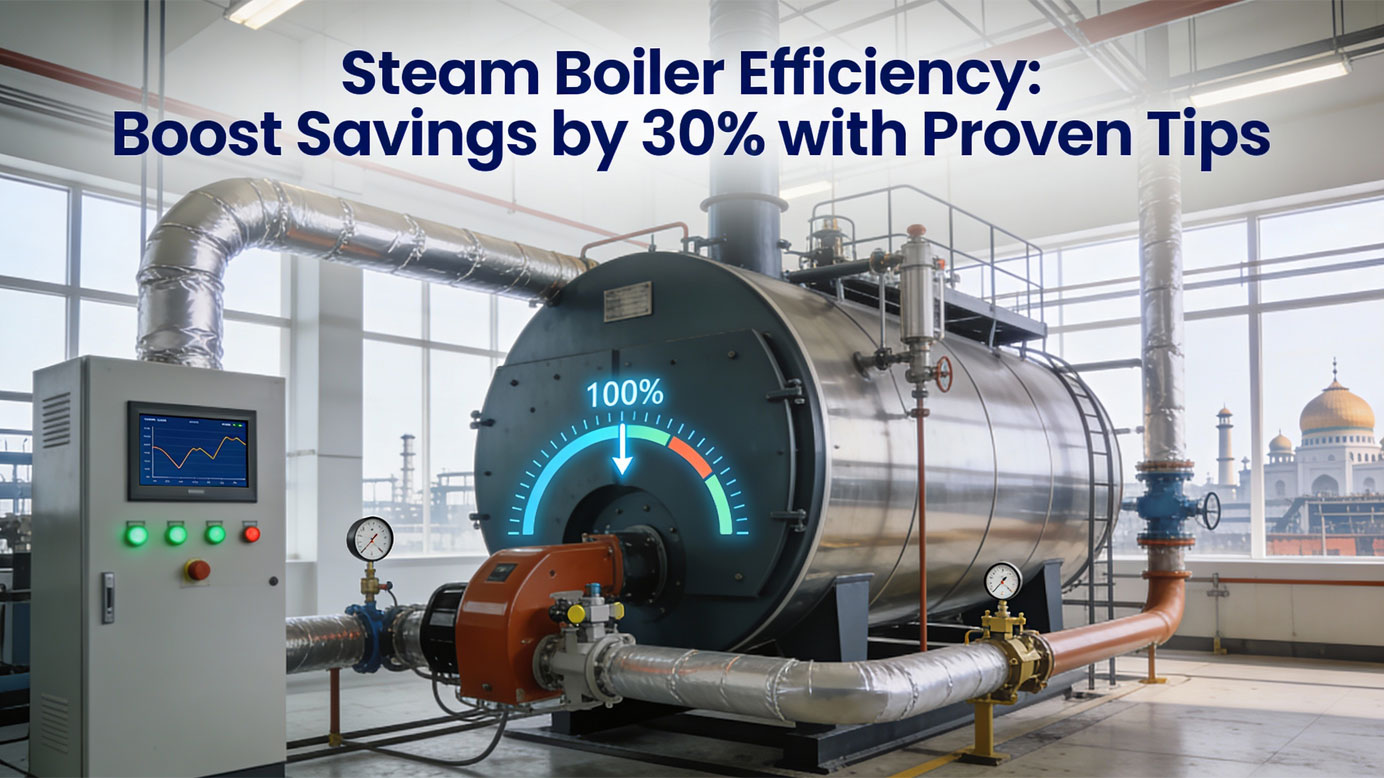
Fuel is the single largest recurring cost in running a steam system — for most Indian plants it accounts for 60–75% of total boiler operating expense over its working life. Which means efficiency isn’t a housekeeping issue, it’s the biggest lever a plant manager has over the P&L. A boiler running at 65% efficiency instead of 85% isn’t just “a bit worse” — on a 10 TPH unit running two shifts, that gap alone can mean lakhs of rupees burned every month for exactly the same steam output. This guide walks through where efficiency actually leaks away in a typical Indian industrial boiler, and the proven, sequenced fixes that get you back that lost margin.
Start With Measurement, Not Guesswork
Before touching a single valve, establish your baseline. Boiler efficiency is calculated either by the direct method — steam output energy divided by fuel input energy — or the indirect (heat-loss) method, which totals up individual losses (stack gas, blowdown, radiation, unburnt fuel) and subtracts them from 100%. The indirect method is more useful operationally because it tells you where the losses are, not just that they exist.
A properly instrumented steam boiler should be audited at least annually, and ideally continuously through digital monitoring — more on that below. Indian Boiler Regulations require periodic inspection regardless, so pairing your statutory inspection with a full efficiency audit is the most cost-effective way to get both done. If you’re not sure your unit is even IBR-registered correctly, it’s worth reviewing The Boilers Act, 2025 and the original Indian Boilers Act, 1923 downloads first.
Where Efficiency Actually Disappears
In a typical Indian industrial boiler running on coal, biomass, or agro-waste, losses break down roughly as follows:
| Loss Category | Typical Share of Total Loss | Root Cause |
|---|---|---|
| Dry flue gas (stack loss) | 15–25% | High exit gas temperature, excess air |
| Incomplete combustion | 3–10% | Poor air-fuel mixing, wet or inconsistent fuel |
| Blowdown | 2–8% | Poor feedwater quality, high TDS |
| Radiation & convection | 1–3% | Inadequate insulation |
| Unburnt fuel in ash/clinker | 2–8% | Grate design, fuel moisture, poor combustion control |
Notice that flue gas loss alone often accounts for more than half of total inefficiency — which is why the first three fixes below focus almost entirely on the combustion and flue-gas side of the system.
Fix 1: Bring Down Stack Temperature
Every 20°C reduction in flue gas exit temperature typically recovers roughly 1% in boiler efficiency. If your stack is running above 220–250°C, you’re leaving fuel on the table. An economizer preheats feedwater using otherwise-wasted flue heat, commonly pulling stack temperature down to 130–160°C and lifting efficiency by 5–7 percentage points on its own. For coal and biomass-fired boilers common across Indian industry, non-condensing economizer designs handle local fuel ash content without excessive fouling, provided fins are cleaned on a quarterly cycle.
Fix 2: Tighten Combustion Control
Excess combustion air is one of the most common — and most fixable — sources of waste. Every 5% of excess air above the optimum band costs roughly 1–2% in efficiency, because you’re heating nitrogen you didn’t need to burn. Target 2–4% oxygen in flue gas via an oxygen-trim system that automatically adjusts the air-fuel ratio as load changes, rather than relying on a fixed damper setting tuned for one operating point.
Variable Frequency Drives (VFDs) on FD/ID fans are one of the fastest-payback retrofits available — matching blower speed to actual load rather than running fans at full speed with a throttled damper typically cuts fan electricity 15–20% and smooths combustion control at the same time. Pair this with quarterly flue-gas analyzer checks (a one-time instrument cost that pays for itself within a few audit cycles) to keep the air-fuel ratio honest over time.
Fix 3: Preheat Combustion Air
Cold intake air steals flame energy just to reach ignition temperature — roughly 1% efficiency lost for every 40°C the incoming air needs to be heated by the flame itself rather than externally. An air preheater (APH) uses flue gas to raise intake air to 150–200°C before it reaches the burner or grate, typically adding another 3–5% efficiency on top of economizer gains. For solid-fuel and biomass systems, a regenerative APH design tends to handle particulate-laden flue gas better than tubular designs — worth discussing with your combustion engineer if you’re running husk, agro-waste, or coal.
If your operation is grate-fired biomass specifically, the combustion-side gains here interact closely with grate design and fuel moisture — our detailed guides on grate speed and its effect on steam production and fuel consumption, Vibrating Grate vs Reciprocating Grate performance, and improving vibrating grate efficiency without increasing fuel consumption are worth reading alongside this section.
Fix 4: Insulation and Steam Distribution Losses
Bare or poorly insulated pipework, valves, and flanges routinely lose 5–10% of generated steam energy as radiated heat and condensate loss before steam even reaches your process. Calcium silicate or rockwool insulation at 100–150mm thickness on the boiler shell, headers, and distribution piping typically brings surface losses below 1%.
Steam traps deserve specific attention — a single failed-open trap can waste 20–30% of the steam passing through it, silently, for months. Ultrasonic leak detection during a routine steam-trap survey is one of the highest-ROI maintenance activities available, often paying back the survey cost within weeks. Infrared thermography surveys of the full distribution network are a useful complement, pinpointing insulation gaps and trap failures that aren’t otherwise visible.
Fix 5: Feedwater Quality and Blowdown Optimisation
Scale buildup on heat-transfer surfaces is deceptively expensive: even 1mm of scale can cut heat transfer efficiency by 10–20%, forcing the boiler to fire harder for the same steam output — and left unchecked, it accelerates tube failure. Maintaining total dissolved solids (TDS) below roughly 2,000 ppm through proper deaerators and softening equipment prevents scale, pitting, and corrosion simultaneously.
Blowdown itself is a necessary loss, but an over-blown boiler wastes heat needlessly. Conductivity-controlled automatic blowdown, targeting a concentration ratio of roughly 10–15 cycles, keeps TDS in check without excess venting. Where feedwater is hard — common across much of India — RO pre-treatment can cut blowdown requirements by up to half. Flash steam recovery vessels on the blowdown line reclaim a further 10–15% of that heat rather than venting it to atmosphere.
Combining Fixes for Compounding Gains
None of these fixes work in isolation to their full potential — they compound. An economizer plus oxygen-trim combustion control plus an air preheater together commonly deliver 15–20% efficiency improvement, and adding waste heat recovery or a superheater on top can push overall gains into the 25–30% range on older, poorly maintained systems. This is exactly the kind of full-system retrofit our ENERPOWER waste heat recovery range is engineered around — recovering flue and process waste heat that would otherwise be vented. We documented a recent field deployment in Successful Installation: Enerpower Waste Heat Recovery Boiler at Bluecraft Agro, and our broader overview of top industries that benefit from waste heat recovery boilers and the cement-specific waste heat recovery engineering guide are worth a read if your process generates significant secondary heat.
Fuel Choice and Moisture: The Efficiency Variable Most Plants Ignore
Combustion equipment can only work with the fuel it’s given — and fuel moisture is one of the biggest, most controllable variables in achievable efficiency. Wet biomass forces the boiler to spend energy driving off moisture before combustion even begins, directly lowering achievable efficiency and increasing unburnt fuel loss. Our guide on fuel moisture vs boiler efficiency — finding the ideal range for reciprocating grate boilers sets out target moisture bands to negotiate with your fuel supplier, and our comparison of how reciprocating grate boilers handle high-moisture biomass better than conventional designs is useful if moisture variability is unavoidable given your local supply chain.
Fuel selection itself matters just as much: our comparisons of Rice Husk vs Mustard Straw ROI for Indian factories and Biomass Pellet vs Biomass Briquette performance walk through calorific value, ash content, and delivered cost differences that directly affect the efficiency ceiling you can realistically hit. If your plant runs on more than one fuel depending on availability, our piece on multi-fuel boilers as the future of industrial heating in India is a useful primer on managing efficiency across fuel switches.
Digital Monitoring: Turning One-Time Audits Into Continuous Gains
A manual annual audit only tells you where things stood on the day of the test — combustion drifts, fouling builds up, and trap failures happen silently in between. IoT-based continuous monitoring of stack temperature, oxygen levels, TDS, and steam flow lets plant engineers catch drift before it compounds into real fuel waste. We’ve covered this shift in depth in how AI and IoT are transforming biomass boiler operations in 2026 and digital twin technology for boiler efficiency and reliability, both of which are increasingly standard even on mid-sized Indian installations, not just large power plants.
A Practical Maintenance Cadence
- Daily: water level, operating pressure, blowdown valve function
- Weekly: burner inspection, sight-glass cleaning
- Monthly: flue-gas analysis, steam-trap testing
- Quarterly: economizer/APH fin cleaning, combustion calibration
- Annually: full IBR inspection, internal tube cleaning, soot-blower servicing
Skipping this cadence is the single most common reason a well-designed efficiency retrofit degrades back toward its old baseline within a year or two. Training operating staff on basic combustion tuning is a small, one-time cost against the much larger cost of unplanned downtime from a neglected system — and it also reduces the common operational problems that tend to resurface once monitoring lapses.
Emission Compliance Comes Along for the Ride
Nearly every efficiency improvement described here also reduces emissions — better combustion control means less unburnt fuel and particulate output, and lower excess air means lower NOx formation. If your plant needs to formally address CPCB emission norms alongside efficiency work, our biomass boiler emission control systems guide and our Pollution Control Equipment range — including bag filters, ESPs, and wet scrubbers — cover what’s typically needed to stay compliant as norms tighten further.
Estimating Your Own Savings
A simple working formula: Annual Fuel Savings = Current Fuel Spend × (1 − Old Efficiency / New Efficiency). So a plant spending ₹5 crore annually on fuel, improving from 70% to 88% efficiency, would save roughly ₹1 crore a year — before even accounting for reduced maintenance and downtime costs from a better-controlled system. The exact number depends heavily on your fuel type, load pattern, and how much of the fix list above you implement, so treat any percentage figure as directional until your own audit confirms it.
Where to Start
If you’re planning a phased efficiency retrofit, the general priority order by payback speed is: steam-trap and insulation survey first (cheapest, fastest payback), followed by combustion control tuning and VFD installation, then economizer/APH addition, and finally waste heat recovery or full system automation for plants chasing the top end of the 20–30% range.
Balkrishna Boilers Pvt Ltd — operating as IndianBoilers.com and Balkrishn.com — offers efficiency audits alongside our Steam Boiler, Thermic Fluid Heater, and Hot Air Generator ranges, with retrofit-ready models including STEAMPOWER, HUSKPOWER, and the waste-heat-focused ENERPOWER series engineered specifically for the kind of compounding efficiency gains described above. Get in touch with our team for a plant-specific efficiency assessment, or browse our full product range to see what fits your current setup.
Frequently Asked Questions
How much can I realistically save by improving boiler efficiency? Most Indian plants running an older, unmonitored boiler have 15–20% efficiency improvement available through basics alone (insulation, steam traps, combustion tuning), with the full 25–30% range achievable when economizers, air preheaters, and waste heat recovery are added. Your own audit against the loss table above will tell you where your plant sits.
What’s the fastest-payback efficiency fix? A steam-trap and insulation survey is almost always the cheapest and fastest-paying fix, often recovering its cost within weeks. VFD installation on FD/ID fans is a close second.
Does fuel type affect how much efficiency I can gain? Yes, significantly — biomass and agro-waste fuels are more sensitive to moisture and grate design than gas or oil, so the ceiling on achievable efficiency depends partly on fuel consistency. See our comparisons on Rice Husk vs Mustard Straw ROI and fuel moisture vs boiler efficiency for specifics.
Is an efficiency retrofit compliant with IBR requirements, or does it trigger re-registration? Retrofits like economizers, APHs, and insulation generally don’t change the boiler’s IBR classification, but any change affecting pressure parts or design should be checked against your registration — refer to The Boilers Act, 2025 or consult your state Boiler Inspectorate before major structural retrofits.
Further reading: Ultimate Buyer’s Guide: Choosing Steam Boilers in India · What Are The Types of Boiler Grates? · Best Boiler for Textile, Pharma, and Food Industry · Hydrogen-Ready Boilers: Are They Practical for Indian Industries?