
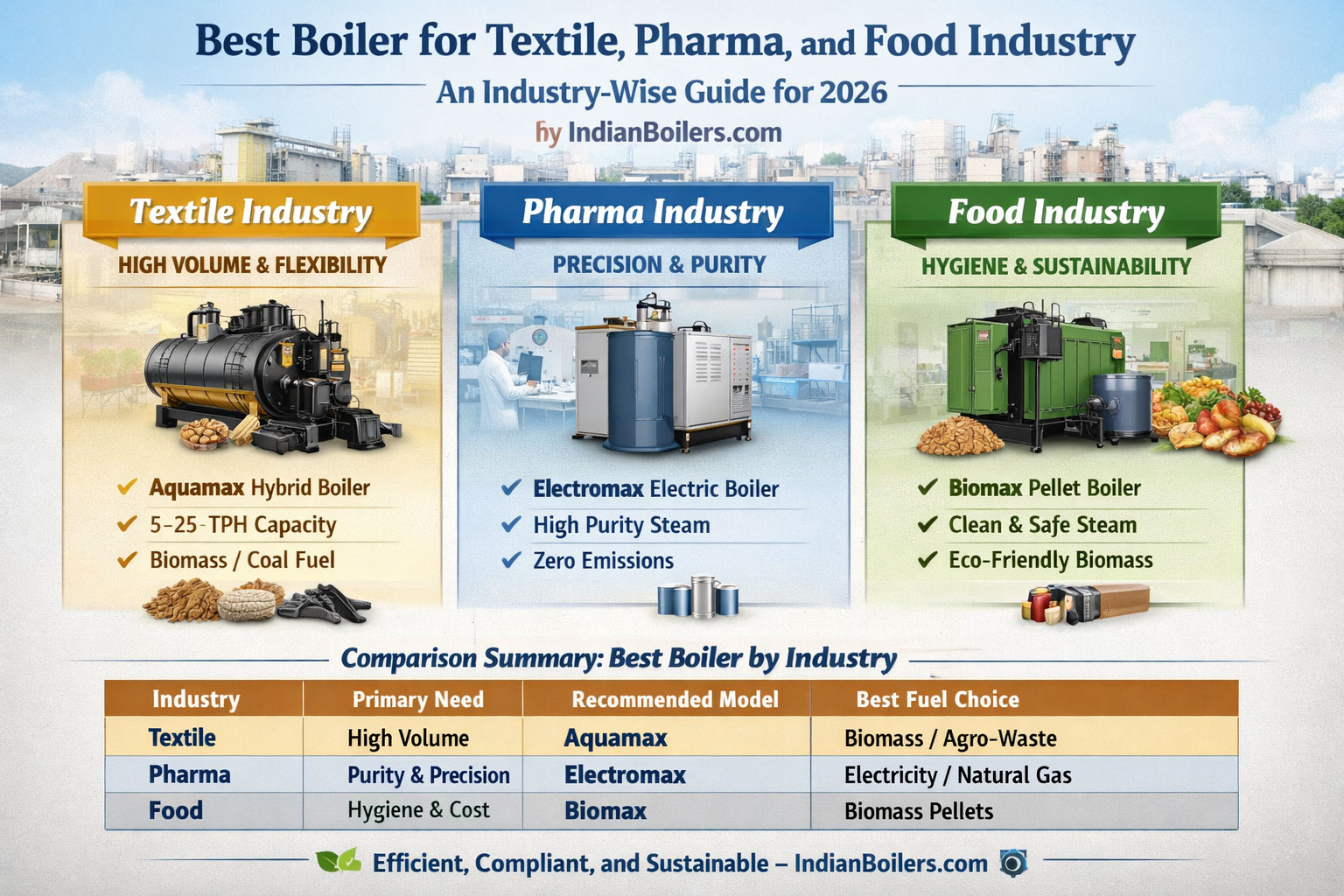
Textile, Pharma, or Food: A Quick-Reference Guide to Matching Your Boiler
A “one-size-fits-all” boiler stopped being a sensible strategy years ago. What a textile dye house in Surat needs from a boiler has almost nothing in common with what a pharmaceutical clean room in Ahmedabad needs, even though both are technically buying “a steam boiler.” This guide is a fast, practical reference for matching the right technology to each of these three sectors — a starting point before diving into the fuller sector-specific guides linked throughout.
If you already know which industry you’re in and want the full depth, jump straight to our dedicated guides: steam boilers for textile mills, electric boilers for food, pharma & dairy, and boiler selection for food processing units. This piece is the quick map across all three.
1. Textile: High Volume, Cyclical Demand
Textile processing — dyeing, printing, finishing, sizing — is genuinely one of the most steam-intensive industrial sectors, with capacity requirements commonly running from a few TPH up to 25 TPH or more depending on mill scale.
What actually matters here:
- Rapid load response — dye baths create sharp demand spikes as they heat, then taper off during soaking, repeating across dozens of machines on staggered cycles.
- Fuel economy — since fuel is typically the largest single OPEX line item, multi-fuel flexibility genuinely matters for cost control.
The practical recommendation: For large-scale mills, our STEAMGEN – Wood/Briquette Fired Steam Boiler water-tube design handles high-volume, cyclical demand at scale, particularly where regional biomass or agro-waste fuel access supports meaningful cost savings versus coal — the exact savings depend heavily on your local fuel pricing, so build that comparison with current local quotes rather than a fixed percentage. For smaller garment processing or boutique dyeing operations, our STEAMJET – Oil/Gas Fired Steam Boiler offers a compact, horizontal fire-tube design that’s straightforward to maintain at lower-to-medium pressure requirements.
Our full textile mills guide breaks down the dyeing-versus-sizing-versus-stentering load pattern distinction in much more depth than this summary can.
2. Pharmaceutical: Precision, Purity, and Compliance
In pharma, the boiler isn’t a background utility — steam is a critical process input directly tied to sterilization validation, granulation, and reactor temperature control, which means the boiler’s behavior genuinely affects product quality and regulatory standing.
What actually matters here:
- Steam purity — zero tolerance for contamination or moisture carryover that could compromise a validated process.
- Precise, stable control — validated processes need pressure and temperature held within tight tolerances, since drift risks a failed validation batch.
- Full compliance with current Boilers Act, 2025 requirements and environmental norms.
The practical recommendation: For high-purity, clean-room-adjacent applications, our ELECTROMAX – Electric IBR Steam Boiler is genuinely well suited — zero on-site emissions eliminate any risk of combustion byproducts reaching a validated environment, and fully automated PLC control supports the precise, responsive temperature control drug formulation processes need. For large-scale bulk drug manufacturing where electricity cost is a genuine concern relative to gas pricing, a gas-fired STEAMJET system, particularly in a 3-pass wet-back configuration, delivers the steam dryness pharmaceutical hygiene standards require at lower per-unit energy cost — our 3-pass wet-back design guide covers exactly why that construction principle suits this application. Our electric boilers for food, pharma & dairy guide covers this decision in full sector-specific depth.
3. Food and Beverage: Hygiene, Reliability, and Increasing Sustainability Expectations
From milk pasteurization to vegetable dehydration, food processing needs steam that’s reliably safe for indirect heating, with breakdown risk carrying real financial consequences given the perishable nature of most food inputs.
What actually matters here:
- Hygiene — clean exhaust and appropriate water treatment discipline throughout.
- Reliability — an unplanned boiler outage risks genuine product loss with perishable goods in process.
- Sustainability positioning — a growing number of global food and beverage brands increasingly scrutinize supplier energy sourcing as part of procurement decisions.
The practical recommendation: For standardized biomass-fired operation, our COMCUBE Series delivers the consistent heat output modern food processing needs with the cost profile of biomass fuel, paired with integrated dust collection to keep the factory floor environment clean — a genuine food-safety-audit consideration, not just an environmental one. For small bakeries or craft operations with modest steam demand, a compact ELECTRON – Electric Steam Boiler below the IBR threshold offers a cost-effective, space-saving solution without the need for a fully certified boiler house. Our boiler selection for food processing units and biomass heat for food processing guides go much deeper into matching specific processes — pasteurization, CIP, drying — to the right system.
4. Quick Comparison Table
| Industry | Primary Need | Recommended Starting Point | Best Fuel Consideration |
|---|---|---|---|
| Textile (large scale) | High volume, cyclical load | STEAMGEN | Biomass/agro-waste where locally available |
| Textile (small/medium) | Compact, easy maintenance | STEAMJET | Oil/gas |
| Pharma (clean-room adjacent) | Purity & precision | ELECTROMAX | Electricity |
| Pharma (bulk drugs) | Cost-efficient high volume | STEAMJET (3-pass wet-back) | Oil/gas |
| Food (standard processing) | Hygiene & cost balance | COMCUBE | Biomass pellets/briquettes |
| Food (small-scale) | Compact, non-IBR | ELECTRON | Electricity |
This table is a starting orientation, not a final specification — actual capacity, pressure, and fuel choice should always be confirmed against your specific plant’s load profile.
5. Selection Factors That Apply Across All Three Sectors
IBR vs. Non-IBR
Under the current Boilers Act, 2025, any boiler with a capacity over 25 litres operating at or above the regulation’s pressure threshold requires IBR registration and inspection. For most industrial-scale textile and pharma applications, this is effectively mandatory — IBR-registered equipment reflects verified safety standards, and it also tends to hold better resale value than non-registered equipment.
Automation Level
Modern specification across all three sectors should genuinely include SCADA or PLC integration for remote monitoring, automated blowdown to maintain water quality without relying on manual discipline, and VFDs on fans and pumps to reduce electrical parasitic load — the exact electricity savings from VFD adoption vary by application and current fan loading, so confirm expected savings with your specific equipment configuration rather than a general figure.
Local Fuel Availability
Before finalizing a boiler choice in any of these three sectors, map your actual local fuel access. Facilities in gas-grid-connected areas often find gas-fired systems genuinely efficient and convenient; facilities in strong agricultural regions frequently find biomass the more cost-effective long-term choice. This mapping exercise should happen before, not after, you commit to a specific technology.
6. Why This Matters Beyond the Spec Sheet
Across all three sectors, the underlying theme is the same: the “best” boiler is never a universal answer, it’s the one matched to your specific pressure requirement, load pattern, hygiene or purity standard, and local fuel access. A textile mill chasing pharma-grade purity requirements would be over-engineering and overpaying; a pharma facility settling for textile-grade steam quality would be risking validation failures. Getting the match right the first time avoids both outcomes.
Conclusion: Start With Your Sector, Then Go Deep
This guide is intentionally a starting map, not the final word — each of the three sectors covered here has a dedicated, much deeper guide on this site covering the specific engineering and application detail your actual purchasing decision deserves. Use this page to orient yourself, then follow the relevant link above for the depth you need.
Balkrishna Boilers Pvt Ltd designs and manufactures across the full range referenced here — fuel-fired, biomass, and electric — matched to your specific sector’s requirements. Explore the complete range on IndianBoilers.com or Balkrishn.com.
Not sure which category your specific application falls into? Contact our engineering team for a consultation matched to your industry and process.
Related Reading
- Steam Boilers for Textile Mills: Matching the Machine to the Mill
- Electric Boilers for Food, Pharma & Dairy: Safe, Clean Steam Solutions
- Biomass Heat for Food Processing: Matching the Right System to Steam, Water, and Air Needs
- Why 3-Pass Wet-Back Design Is the Standard for Pharmaceutical Steam
- The Boilers Act, 2025 – Download PDF