
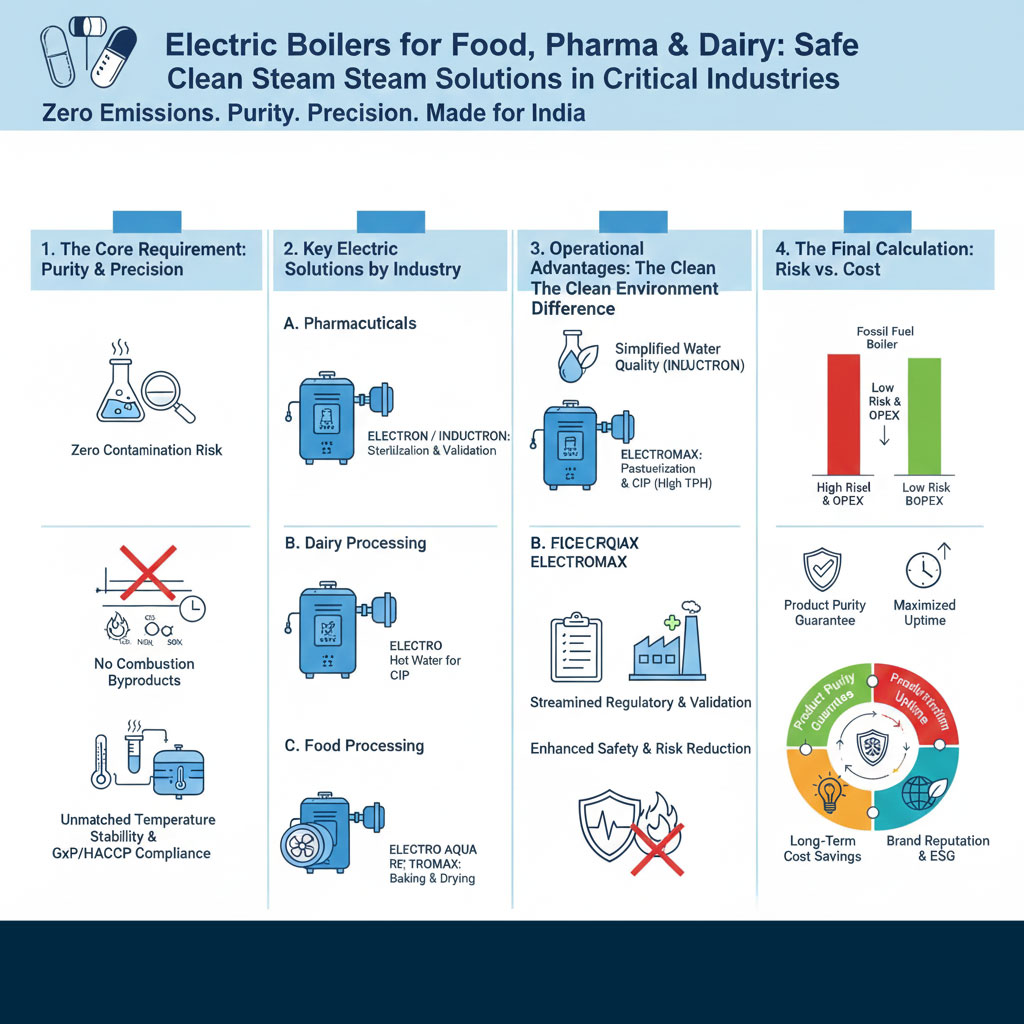
In most industries, boiler selection starts with a cost-per-tonne-of-steam conversation. In food, pharma, and dairy, that conversation happens second — the first question is always “can this contaminate the product, and can we prove it won’t?”
That single shift in priority is why electric boilers have become the default recommendation for GMP-regulated pharma plants, HACCP-certified food units, and FSSAI-compliant dairies across India. A combustion boiler doesn’t have to actually contaminate anything to become a liability — the mere presence of fuel storage, flue gas, and combustion particulates near a clean processing area creates a validation and audit risk that’s often reason enough to rule it out.
This piece walks through where electric heating fits in each of these three sectors, which product matches which application, and why the economics work out differently here than in general industrial heating. For the underlying technology fundamentals, our complete guide to industrial electric steam boilers is a useful starting point, and our electric boiler sizing guide covers how to size correctly for these applications’ specific demand curves.
1. Why “Zero Emissions” Means Something Different Here
In most industrial contexts, zero emissions is a sustainability and compliance story. In food, pharma, and dairy, it’s a product-safety story, and that changes how much weight it carries in a purchasing decision.
The contamination pathway isn’t hypothetical. Stored fuel oil or diesel can leak or off-gas odor. Flue exhaust has to be vented carefully to avoid drawing back into air intakes near clean areas. Even well-filtered combustion systems produce trace particulate matter, and in a facility where a single contamination event can trigger a product recall, “even trace” isn’t a risk most quality teams are willing to carry.
Electric boilers remove that pathway entirely — there’s no flame, no fuel, no flue gas, which means there’s no combustion byproduct to manage in the first place. That’s what allows electric units to be installed directly adjacent to, or even within, clean processing zones in a way combustion equipment generally can’t be.
The second driver is control precision. Sterilization, pasteurization, and retort cooking all depend on holding an exact temperature for an exact duration — the kind of tolerance that regulatory validation protocols are built around. Combustion burners cycle on and off with some lag; electric heating elements or induction fields respond almost instantly, holding pressure and temperature within a much narrower band. For a process where the difference between “validated” and “failed batch” can be a fraction of a degree sustained a few seconds too short, that responsiveness isn’t a nice-to-have.
2. Pharmaceutical Manufacturing: Purity First, Cost Second
Pharma steam demand centers on sterilization, thermal-fluid-driven reactions, and clean room humidification — each with a distinct load profile and product fit.
Autoclave sterilization needs rapid, high-pressure steam availability with minimal delay between demand and delivery — validation protocols (like holding 121°C for 15 minutes) leave no room for pressure drift. The ELECTRON – Electric Steam Boiler fits smaller sterilization loads well, with fast ramp-up and a compact footprint that allows placement close to the autoclave itself. For applications where absolute steam purity matters even more — no risk of scale particulates entering the line — the INDUCTRON – Induction Boiler is the stronger fit, since its non-contact heating core avoids the scaling issues that resistance elements are prone to over time.
Distillation and reactor heating is a different problem entirely — it needs high, precise temperature without the complexity of a pressurized steam system. The ELECTROPAC – Electric Thermic Fluid Heater delivers flameless, tightly controlled heat suited to sensitive chemical reactions where localized overheating could compromise a batch.
Clean room humidification is a low-pressure, continuous load where the priority is steam cleanliness over volume — a smaller ELECTRON unit, sized for steady low-kW output, avoids introducing any combustion particulate into a highly filtered air system.
Our post on pharma manufacturing and precision steam solutions covers more of the operational detail relevant to this sector.
3. Dairy Processing: Volume, Consistency, and CIP Cycles
Dairy plants run two very different heat demands side by side — continuous high-volume pasteurization, and the intermittent hot-water-and-steam cycles of Clean-in-Place sanitation.
HTST pasteurization requires large, stable steam volumes at consistent pressure to guarantee every batch of milk is heated correctly for microbial safety — this is a continuous-flow application where any pressure instability directly threatens product safety compliance. The ELECTROMAX – Electric IBR Steam Boiler is built for exactly this scale, delivering the TPH capacity and IBR-rated pressure stability continuous pasteurization lines depend on.
CIP sanitation loops need something different again: high-volume hot water around 85°C paired with lower-pressure steam. Rather than oversizing a single steam system to cover both jobs inefficiently, the ELECTRO AQUA – Electric Hot Water Boiler paired with a smaller ELECTRON unit for the steam side is typically the more efficient combination — each system sized to what it actually needs to do.
Deodorization and drying — stabilizing fat content, drying milk powder — needs consistent indirect heat transfer without any risk of exhaust contamination reaching the product. ELECTROPAC or a properly sized ELECTROMAX both serve this depending on temperature and volume requirements.
4. Food Processing: Retorts, Ovens, and Decentralized Utility Steam
Food manufacturing spans a wider range of heat applications than dairy or pharma, from high-pressure preservation to dry heat baking.
Retort sterilization for canned and packaged foods needs high-pressure, high-volume steam with precise control over the entire sterilization curve — this is a regulatory requirement under FSSAI standards for preserved food safety, not just a quality preference. ELECTROMAX covers the volume and pressure requirement; INDUCTRON is often favored where long-term reliability and consistent capacity (without scale-related degradation) matter more than raw throughput.
Baking and oven applications don’t need steam at all — they need clean, high-temperature hot air with zero risk of combustion byproducts affecting flavor. The ELECTROAIR – Electric Hot Air Generator delivers exactly that, without a flame anywhere near the product.
General plant utility steam — jacketed kettles, melting, forming — is where decentralization pays off. Instead of one large central boiler feeding steam across long pipe runs, smaller ELECTRON units placed near each processing station reduce distribution losses and improve steam quality at the point of use. Our boiler selection guide for food processing units goes deeper into matching capacity to these varied station-level needs.
5. What Changes Operationally Once You Switch
Water treatment becomes more predictable, not less important
Every boiler needs water treatment, electric or otherwise — but the two heating approaches respond differently to imperfect water chemistry. Resistance elements in ELECTRON and ELECTROMAX are more sensitive to scaling and need vigilant treatment discipline. The INDUCTRON’s non-contact induction core is significantly more scale-resistant, which is part of why it’s often favored in continuous, validated operations where sustained efficiency and minimal downtime for descaling both matter.
Audits get simpler, not just cleaner
In a heavily audited environment, the physical inspection itself gets easier. There’s no fuel train, no burner assembly, no emissions control system to walk an auditor through — which shortens both the paperwork and the plant-floor portion of a compliance review.
Fo values and holding times become easier to hit consistently
For retort sterilization specifically, meeting the Fo value (the standard measure of sterilization lethality) depends on holding precise temperature for a precise duration. The tighter control band electric heating provides makes it meaningfully easier to hit this consistently, batch after batch, without the pressure drift that combustion cycling can introduce.
Safety risk drops in a way that matters more in dense industrial zones
Removing combustible fuel storage from a plant located in a crowded GIDC estate or urban industrial cluster reduces fire and explosion risk in a way that’s often significant enough on its own to justify the switch, independent of any efficiency argument.
6. The Real Cost Comparison: Risk-Adjusted, Not Just Rupee-Adjusted
| Factor | Fossil Fuel Boiler | Electric Boiler | Why It Matters Here |
|---|---|---|---|
| Contamination risk | Medium–High (fuel storage, flue gas) | Effectively zero | Direct product-safety and recall exposure |
| Process control | Good, but burner cycling introduces lag | Tight, near-instant response | Determines whether GxP/HACCP holding times are met reliably |
| Maintenance load | High (burner service, soot blowing, fuel handling) | Low (element/core checks, water treatment) | Less downtime on validated equipment that’s costly to requalify |
| Footprint | Large (boiler + fuel storage + stack) | Compact, no stack or storage | Fits constrained utility rooms in built-up plants |
The higher per-unit cost of electricity versus raw fuel is, in these sectors, consistently outweighed by three things: fewer high-risk operational failures, less maintenance downtime on equipment that’s expensive to requalify after service, and a stronger, simpler compliance position. In food, pharma, and dairy, the purchasing question genuinely shifts from cheapest heat to most reliably pure heat — and that reframing is what makes electric boilers the default rather than the premium option in these sectors.
Conclusion: Clean Processes Need Clean Heat
Food, pharma, and dairy operate under standards that leave very little room for compromise on contamination risk or temperature control. Electric boilers meet both requirements directly — zero on-site emissions, near-99.5% thermal efficiency, and the kind of precision control that regulatory validation protocols are built around.
Whether your plant needs the IBR-rated volume of ELECTROMAX for continuous pasteurization, the scale-resistant purity of INDUCTRON for pharmaceutical sterilization, or the specialized high-temperature control of ELECTROPAC, Balkrishna Boilers Pvt Ltd designs and installs systems matched to your specific regulatory and process requirements. Browse the full electric range on IndianBoilers.com or view the complete catalogue on Balkrishn.com.
Ready to eliminate contamination risk from your process heating? Talk to our engineering team for an application-specific consultation for your food, pharma, or dairy facility.