
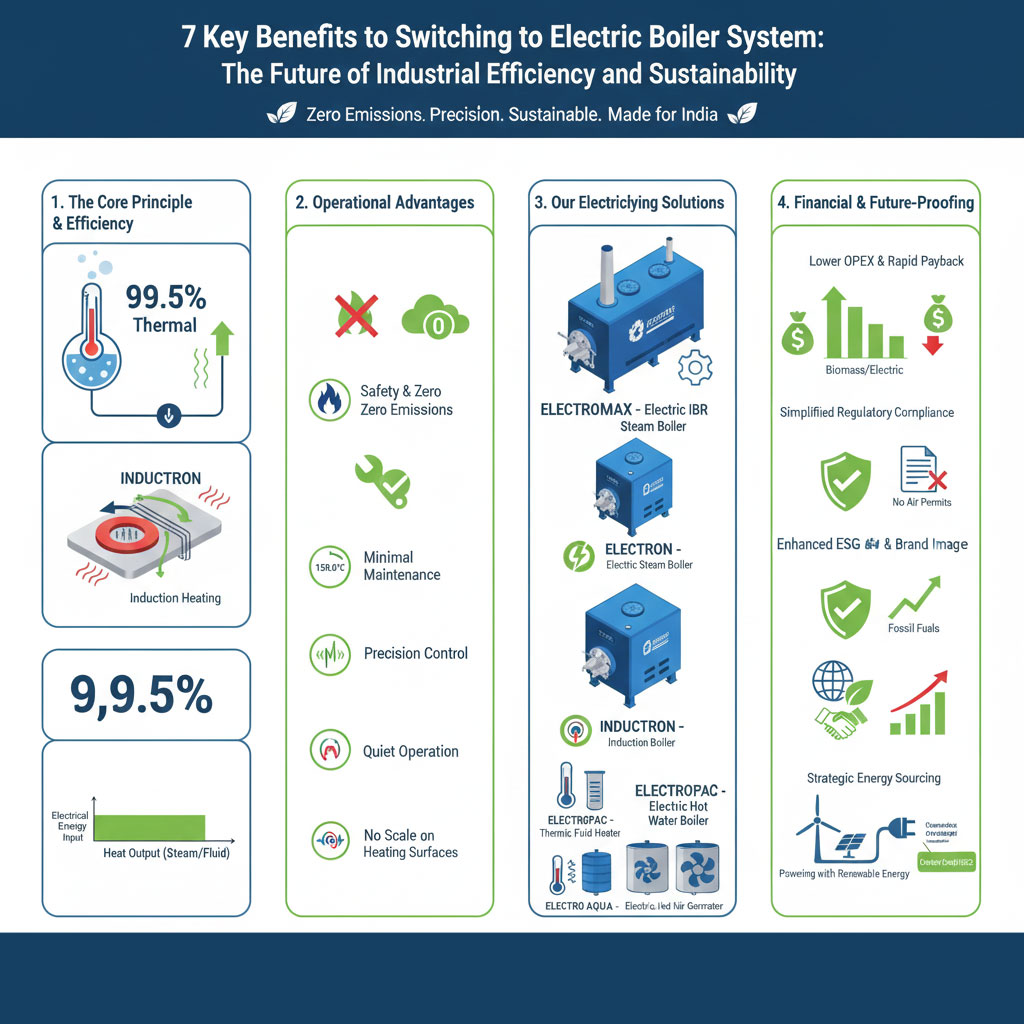
Ask a plant manager who switched from a fuel-fired boiler to an electric boiler what changed first, and it’s rarely “our energy bill.” It’s usually something more immediate — the maintenance team stopped filing weekly complaints, the pollution board inspection took twenty minutes instead of two hours, or the sterilizer finally holds pressure steady enough to pass validation on the first try.
Electrification of process heat isn’t a future trend in Indian manufacturing anymore — it’s an active shift happening across pharma, food processing, textiles, and chemical plants right now. Below are seven benefits that genuinely change how a plant operates, not just marketing points, along with where each technology — ELECTRON, ELECTROMAX, INDUCTRON, ELECTROPAC, ELECTRO AQUA, and ELECTROAIR — fits best.
If you haven’t yet read the fundamentals of how this technology works, our complete guide to industrial electric steam boilers is a good companion piece to this one.
1. The Pollution Board Stops Being a Recurring Headache
Combustion boilers generate CO₂, NOx, SOx, and particulate matter as a direct by-product of burning fuel. Every one of those emissions is regulated, monitored, and periodically inspected — which means paperwork, stack testing, and the ever-present risk of a compliance notice if something drifts out of spec.
An electric boiler doesn’t burn anything, so there’s no flue gas to test, no stack emissions to log, and no air quality permit renewal tied to the boiler itself. For plants in industrial zones near residential areas — increasingly common as cities expand toward GIDC estates — this alone can resolve years of friction with local pollution control authorities.
There’s a second-order benefit too: as India’s grid mix shifts further toward renewables, a boiler that was “zero-emission at point of use” the day it was installed becomes progressively lower-carbon over its operating life, with no equipment changes required. Pairing this with captive solar is where the numbers get genuinely attractive — something we cover in more detail in our piece on waste heat recovery and industries that benefit from it, since the same logic of “capture free energy where it already exists” applies to both waste heat and renewable power.
2. Efficiency Numbers That Combustion Simply Can’t Match
A well-maintained fuel-fired boiler still loses 10–25% of its fuel’s energy value up the chimney as hot exhaust gas. That’s not a maintenance failure — it’s a physical limit of combustion heat transfer.
Electric boilers don’t have that loss path. Whether the heat is generated by:
- Resistance elements submerged directly in the fluid (as in ELECTRON and ELECTROMAX), or
- Induction heating, where an electromagnetic field creates eddy currents in a metallic core that never touches the water (as in INDUCTRON),
…nearly all of the input electrical energy converts to usable heat, typically 98–99.5% thermal efficiency. That’s not a marginal improvement over combustion — it’s a different category of performance entirely.
The INDUCTRON‘s non-contact design carries an added advantage worth calling out separately: because the heating surface never touches the fluid directly, scale buildup — the single biggest cause of efficiency drop-off in resistance systems over time — is dramatically reduced. That means the efficiency you get on day one is closer to the efficiency you’re still getting three years in.
3. Maintenance Shrinks From a Weekly Job to an Occasional One
Ask any boiler operator what eats their week, and combustion-related upkeep tops the list: soot blowing, burner nozzle cleaning, refractory inspection, fuel line checks, and periodic chimney maintenance.
Remove combustion, and most of that list disappears:
- No fuel storage tanks or transfer pumps to inspect
- No burner assemblies to service or replace
- No refractory lining to repair from thermal cycling
- No chimney or flue system to clean or certify
What’s left is largely water-side maintenance — the same water treatment discipline any boiler needs — plus periodic inspection of heating elements or the induction core. Plants switching from fossil-fuel systems typically report maintenance time and cost dropping substantially, freeing up technical staff for higher-value work.
For plants that run thermic fluid systems specifically, our safety guide to thermic fluid heaters in the chemical industry covers how electric options like ELECTROPAC change this maintenance equation for high-temperature applications too.
4. No Flame Means a Fundamentally Different Risk Profile
This is the benefit that safety officers and insurance assessors care about most.
A combustion boiler carries inherent risks: fuel leaks, burner flashback, explosion potential from unburned gas accumulation, and carbon monoxide exposure if flue gas isn’t properly vented. None of these risks exist in an electric system, because there’s no flame, no fuel storage, and no combustion by-product to manage.
This isn’t just a safety talking point — it has real financial weight. Lower fire and explosion risk often translates directly into reduced insurance premiums, and a plant that can demonstrate a flame-free heating system has an easier time during safety audits and ISO certification reviews.
The ELECTROMAX – Electric IBR Steam Boiler still meets full Indian Boiler Regulations pressure-vessel standards where high-pressure steam is legally required, but with the fire-side risk removed entirely — you get regulatory compliance without the combustion hazard that compliance was originally designed to manage.
5. Steam Quality Tight Enough for Regulated Manufacturing
Combustion-based steam generation has an inherent lag — burners ramp up and down, and pressure recovery after a demand spike takes time. For general utility steam, that’s a manageable trade-off. For pharmaceutical sterilization, food-grade processing, or precision chemical reactions, it isn’t.
Electric systems respond almost instantly. Staged heating elements in ELECTRON and ELECTROMAX switch on and off in sequence to track demand tightly, and induction-based systems modulate the electromagnetic field directly — both approaches hold pressure within a much narrower band than combustion allows.
This matters most in exactly the sectors where Balkrishna Boilers has deep installation experience. We cover this in more depth in our post on empowering pharmaceutical manufacturing with precision steam, and for facilities weighing options across their whole product line, our boiler selection guide for food processing units covers where precision control changes the selection calculus.
6. A Smaller Footprint Opens Up Decentralized Heating
Combustion boilers need space for fuel trains, burner assemblies, air intake ducting, and chimney stacks. Electric units need none of that, which makes them dramatically more compact for equivalent output.
That compactness enables a strategy larger plants often overlook: instead of one large central boiler feeding steam through long distribution piping (where heat loss adds up fast), a facility can install smaller units like ELECTRON or ELECTRO AQUA closer to individual process lines. The benefits compound:
- Shorter piping runs mean less distribution heat loss
- Built-in redundancy — if one unit needs maintenance, other lines keep running
- Faster response since generation happens right where steam or hot air is used, which is exactly the principle behind ELECTROAIR – Electric Hot Air Generator installations for drying and curing lines
7. The Long-Term Cost Picture Often Beats the Sticker Price
Electric boilers, particularly higher-capacity units like ELECTROMAX, typically cost more upfront than an equivalent fossil-fuel system. Judging the investment on CAPEX alone misses where the real savings show up.
Where the savings accumulate:
- Maintenance costs commonly run 30–50% lower than combustion equivalents, since there’s no burner servicing, refractory repair, or stack cleaning
- No fuel procurement, storage, or ash/waste disposal costs
- Compliance overhead tied to air permits and emissions monitoring disappears
Where the strategy gets sharper:
- Time-of-day electricity tariffs — running harder during off-peak hours and using the vessel’s thermal mass to coast through peak pricing windows changes the effective cost per tonne of steam significantly
- Captive renewable pairing — a plant running its electric boiler substantially on rooftop solar or a wind PPA can push effective heating costs close to zero during generation hours
- Service life — electric systems, properly maintained on the water side, often outlast combustion boilers over a 20–30 year horizon, changing the total cost of ownership math considerably
If you’re planning this transition, load monitoring and predictive maintenance play a growing role in getting the ROI case right — our articles on digital twin technology for boiler reliability and how AI and IoT are transforming boiler operations in 2026 go into how real-time data is shortening payback periods across similar installations.
Which Electric System Fits Which Plant?
| Plant Need | Best-Fit System |
|---|---|
| High-volume, IBR-compliant continuous steam | ELECTROMAX (indianboilers.com / balkrishn.com) |
| Compact, fast-start steam for labs, hospitals, small units | ELECTRON (indianboilers.com / balkrishn.com) |
| Hard water, scale-prone conditions | INDUCTRON (indianboilers.com / balkrishn.com) |
| High-temperature, non-pressurized process heat | ELECTROPAC (indianboilers.com / balkrishn.com) |
| Utility hot water — laundry, washdown | ELECTRO AQUA (indianboilers.com / balkrishn.com) |
| Flameless hot air for drying/curing | ELECTROAIR (indianboilers.com / balkrishn.com) |
Conclusion: The Case Is Bigger Than “Clean Energy”
The move to electric boilers isn’t just an environmental upgrade — it’s an operational one. Lower maintenance load, tighter process control, a fundamentally safer risk profile, simplified compliance, and a total cost of ownership that frequently beats combustion over the equipment’s lifetime: these are the reasons plants across textiles, pharma, food processing, and chemicals are making the switch now rather than waiting.
Balkrishna Boilers Pvt Ltd designs, manufactures, and installs the complete electric heating range covered here, alongside our broader steam boiler, thermic fluid heater, hot water boiler, and hot air generator catalogue — also viewable in full on Balkrishn.com.
Ready to see what an electric boiler would actually save your plant? Talk to our engineering team for a load assessment and cost comparison specific to your steam and process heat requirements.
Related Reading
- The Complete Guide to Industrial Electric Steam Boilers
- Multi-Fuel Boilers: The Future of Industrial Heating in India
- Thermic Fluid Heaters in the Chemical Industry: The Ultimate Safety Guide
- Boiler Selection for Food Processing Units
- Digital Twin Technology: Revolutionizing Boiler Efficiency and Reliability