
For most of the last century, Indian industry made steam the same way: burn coal, husk, diesel, or gas, and boil water over an open flame. It worked, but it came at a price — smoke stacks, fuel yards, pollution board inspections, and a maintenance team permanently busy with soot blowers and burner nozzles.
That equation is changing fast. Electricity-driven steam generation has moved from a niche technology to a mainstream decarbonization strategy for pharma units, food plants, textile mills, and chemical processors across India. No flame. No flue gas. No fuel storage. Just a plug, a control panel, and clean steam on demand.
This guide breaks down how electric boilers actually work, where they fit best, what they cost to run, and how to plan a transition without disrupting production. If you’re also exploring solid-fuel alternatives, our companion piece on what a biomass boiler is covers the other side of the clean-heating spectrum.
1. Why Electricity Beats Combustion for Process Heat
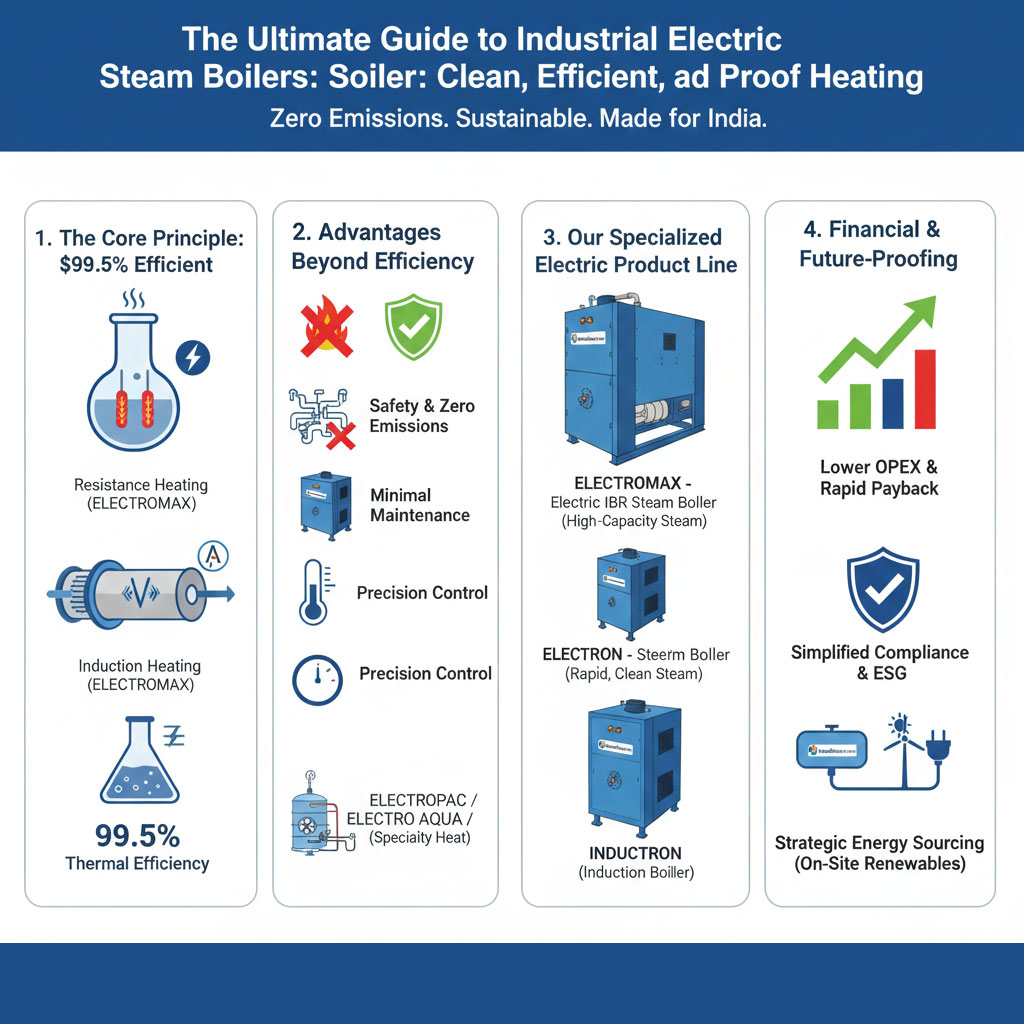
A conventional fuel-fired boiler loses a meaningful share of its input energy the moment hot flue gas exits the chimney — commonly 15–25%, depending on fuel quality and maintenance condition. An electric boiler doesn’t have that exhaust path at all. The energy goes into the water (or thermic fluid, or air) and essentially nowhere else, which is why thermal efficiencies of 98–99.5% are routine rather than exceptional.
There are two distinct ways manufacturers achieve this today:
Resistance Heating
Submerged or immersion-type heating elements carry current directly, and resistance in the element converts that current into heat via the Joule effect. It’s simple, proven, and fast to respond to load changes — the approach used in compact non-IBR units like the ELECTRON – Electric Steam Boiler and higher-capacity IBR-rated systems like the ELECTROMAX – Electric IBR Steam Boiler.
Induction Heating
Instead of touching the water, an induction coil creates an alternating magnetic field around a metallic core. Eddy currents inside that core generate the heat, which then transfers to the fluid — the element itself never contacts the water. This is the principle behind the INDUCTRON – Induction Boiler, and it matters because scaling on a heating surface is usually what shortens element life in hard-water regions. Remove the direct contact, and you remove most of that problem.
If you want the engineering detail on how induction and coil-based heating scales in industrial settings more broadly, our post on smart sensors in thermic fluid heaters is a useful adjacent read.
2. What Actually Changes on the Plant Floor
Efficiency numbers matter, but plant managers usually care more about what disappears from their daily checklist.
| Parameter | Electric Boiler | Combustion Boiler |
|---|---|---|
| Fire/explosion risk | Effectively eliminated — no flame, no fuel storage | Present — fuel handling, burner faults, flashback risk |
| On-site emissions | Zero CO₂, NOx, SOx at the stack | Continuous pollutant discharge |
| Daily maintenance | Water-side care + periodic element/core check | Soot blowing, burner tuning, refractory repair |
| Startup time | Minutes | Often 30–60+ minutes for a cold start |
| Noise | Low | Burner, fan, and combustion noise |
| Load response | Near-instant, staged | Slower, governed by combustion dynamics |
That last row — load response — is often the deciding factor for regulated industries. Pharmaceutical sterilization, precision drying, and lab-scale processes need steam pressure to sit inside a narrow band, and staged electric elements or modulated induction fields hold that band far more tightly than a burner ramping up and down.
For a look at how this precision plays out in regulated manufacturing environments specifically, see our note on visiting pharma and lab-tech exhibitions with Balkrishna Boilers.
3. Matching the Right Electric System to the Right Job
Not every plant needs the same electric solution, and this is where a lot of first-time buyers overpay or under-spec. Here’s how the range typically splits by application:
High-volume, IBR-compliant steam — Large textile processing houses, breweries, and chemical batch plants with continuous, heavy steam draw need a system built to Indian Boiler Regulations pressure and safety standards. The ELECTROMAX line (also listed on Balkrishna’s product pages as ELECTROMAX) is built for exactly this — sustained output without a flue system to manage.
Compact, on-demand steam — Labs, hospitals running sterilizers, small bakeries, and standby applications rarely need a large IBR unit sitting idle. A smaller, fast-start unit like ELECTRON (also on Balkrishn.com as ELECTRON) fits better: minimal footprint, steam within minutes, and it can sit close to the point of use so you’re not losing heat over long distribution runs.
Scale-prone water conditions — Where hardness or mineral content is a known problem, the non-contact heating in INDUCTRON (see INDUCTRON) extends element life and cuts the frequency of descaling work.
Beyond steam — Not every process needs steam specifically:
- ELECTROPAC – Electric Thermic Fluid Heater (also ELECTROPAC) delivers high-temperature heat — up to roughly 350°C — without high system pressure, which suits reactor jacketing and specialty chemical processes.
- ELECTRO AQUA – Electric Hot Water Boiler (also ELECTRO AQUA) handles laundry, washing, and general hot-water utility loads.
- ELECTROAIR – Electric Hot Air Generator (also ELECTROAIR) produces flameless hot air for drying and curing where combustion by-products can’t touch the product.
If your plant runs mixed fuel today and you’re weighing electrification against other options, our guide on multi-fuel boilers and the future of industrial heating in India is worth reading alongside this one — and for food and beverage operations specifically, boiler selection for food processing units walks through the sector-specific trade-offs.
4. The Money Question: Is Electric Actually Cheaper?
Upfront capital cost for a comparable-capacity electric unit is usually higher than a basic combustion boiler. So the honest answer is: it depends on how you run it, not just what you buy.
Where electric wins on OPEX:
- No fuel procurement, storage, transport, or ash/waste disposal
- Maintenance visits drop sharply — no burner servicing, no soot blowing, no refractory repair
- No pollution-control compliance overhead tied to combustion emissions
- Fewer unplanned shutdowns tied to fuel quality inconsistency
Where the electricity bill becomes the real lever:
- Time-of-day tariffs — running the boiler harder during off-peak hours and using the vessel’s thermal mass to coast through peak-rate windows can materially change the cost per tonne of steam.
- Captive renewables — plants pairing an electric boiler with rooftop solar or a wind PPA can push effective heating cost toward near-zero during generation hours, which is where the ROI case gets genuinely compelling rather than marginal.
- Longevity — electric systems with proper water treatment commonly outlast combustion units in service life, which changes the total-cost-of-ownership math over 20–30 years.
For plants also exploring recovered or recycled thermal energy as a complementary cost lever, our piece on waste heat recovery boilers for cement plants and the broader top 10 industries that benefit from waste heat recovery are directly relevant — pairing waste-heat pre-treatment with an electric boiler can shave load further.
5. The One Real Obstacle: Electrical Infrastructure
Ask any plant engineer why they haven’t switched yet, and the answer is rarely “I don’t believe the efficiency numbers.” It’s almost always: can our transformer and switchgear actually carry this load?
This is a legitimate concern and needs a proper answer before signing off on a large unit:
- Get an electrical load audit done first. A qualified electrical contractor or your boiler supplier’s technical team should confirm existing transformer capacity, switchgear rating, and available headroom before you commit to an ELECTROMAX-class installation.
- Understand staged loading. Most industrial electric boilers don’t pull full-rated power the instant they switch on. Heating elements or induction stages activate progressively based on real-time steam demand, which smooths the draw instead of creating a single massive spike.
- Phase the rollout. A common and low-risk approach: start by replacing a small utility boiler with an ELECTRON unit, or convert a hot-water load to ELECTRO AQUA, prove out the electrical assumptions in practice, then scale to a full ELECTROMAX installation for the main steam header.
Digital monitoring is making this transition easier to plan and manage in real time — our article on digital twin technology for boiler efficiency and reliability and how AI and IoT are transforming boiler operations in 2026 both cover how load prediction and remote monitoring reduce the guesswork in exactly this kind of infrastructure planning.
6. A Quick Decision Checklist
Before you request a quote, it helps to have rough answers to these:
- Peak and average steam demand — in kg/hr, not just boiler HP, since electric sizing is driven by actual thermal load.
- Available electrical capacity — confirmed by an audit, not an assumption.
- Water quality — hardness levels influence whether resistance or induction technology makes more sense.
- Tariff structure — flat-rate vs. time-of-day, since this changes payback period significantly.
- Compliance requirement — does the application legally require IBR certification (ELECTROMAX) or is a non-IBR compact unit (ELECTRON) sufficient?
- Growth plan — sizing for today’s load only, versus leaving headroom for a planned expansion.
Conclusion: Electrification Is a Plant Strategy, Not Just an Equipment Swap
Choosing an electric boiler isn’t simply picking a different box to bolt into the same steam line. It’s a decision that touches emissions compliance, maintenance headcount, safety insurance premiums, and long-term energy strategy all at once. Whether that means the IBR-rated output of ELECTROMAX, the compact responsiveness of ELECTRON, or the scale-resistant design of INDUCTRON, the right fit depends on your steam profile, water chemistry, and electrical capacity — not just the sticker price.
Balkrishna Boilers Pvt Ltd designs, manufactures, and installs the full range of electric boilers, steam boilers, thermic fluid heaters, hot water boilers, and hot air generators discussed here — you can browse the complete catalogue on Balkrishn.com as well.
Ready to size an electric boiler for your plant? Get in touch with our engineering team for a load assessment and ROI breakdown specific to your steam demand and tariff structure.