
Hydrogen-Ready Boilers: A Realistic Look at Where India Actually Stands in 2026
Every conversation about industrial decarbonization eventually reaches hydrogen — it’s clean-burning, it’s been called the fuel of the future for over a decade, and it genuinely could replace natural gas in combustion applications with the right equipment. The honest question for an Indian factory owner in 2026 isn’t whether hydrogen works technically — it’s whether it makes sense to invest in it now, versus continuing with biomass or electric technology that’s already commercially mature. This piece gives you the real picture, not the marketing version.
If you haven’t yet explored the alternatives that are commercially ready today, our complete guide to industrial electric steam boilers and biomass vs. coal comparison cover technologies you can actually deploy today, at scale, without waiting on infrastructure that’s still developing.
1. What “Hydrogen-Ready” Actually Means
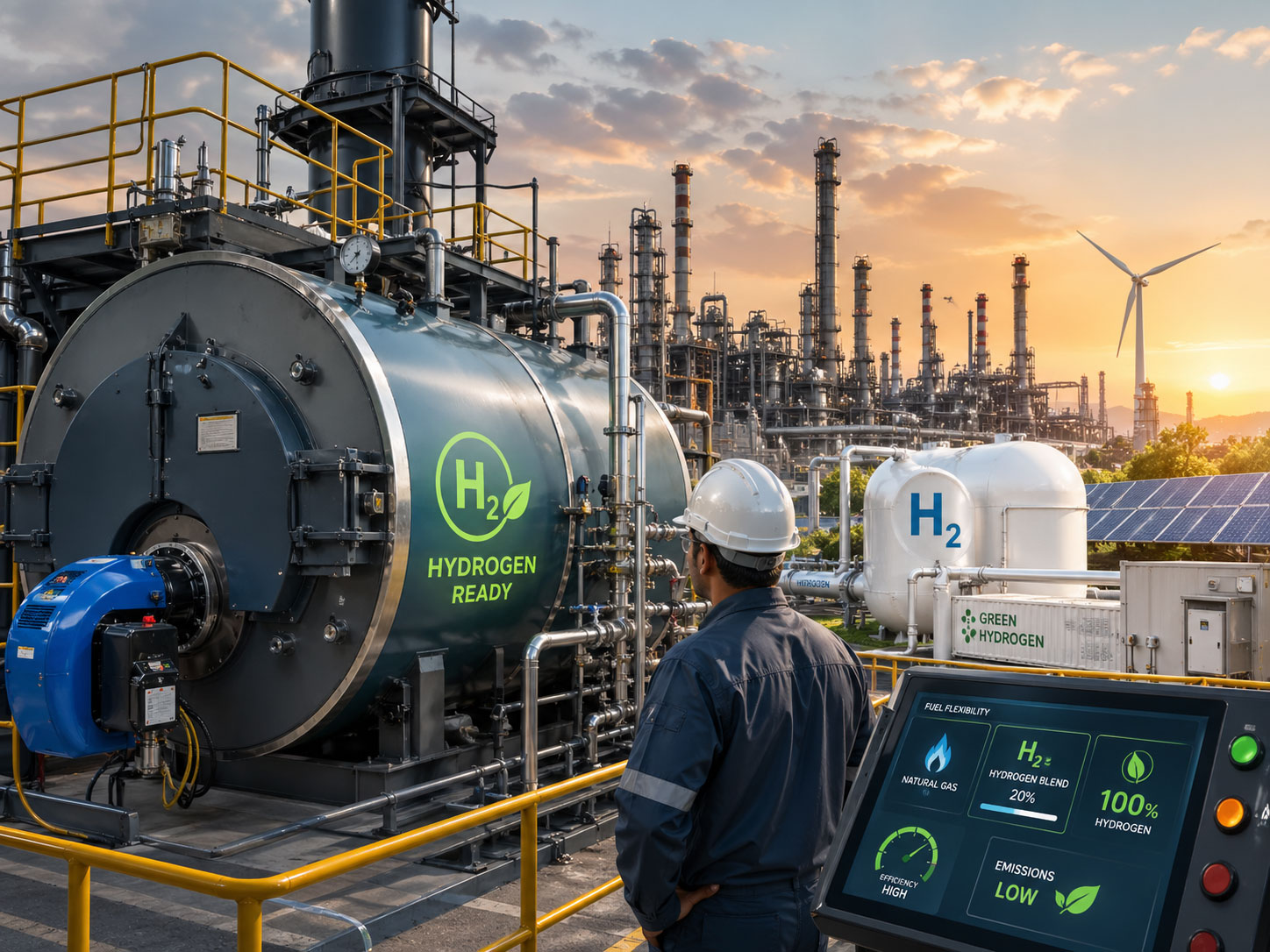
A hydrogen-ready boiler is designed to run on a blend of natural gas and hydrogen — commonly up to around 20% hydrogen by volume in current blending demonstrations — or to be converted to run on 100% hydrogen combustion with relatively modest component changes, typically to burner design and certain seals and gaskets that need hydrogen-compatible materials.
This is meaningfully different from a boiler that simply “could theoretically burn hydrogen” — hydrogen-readiness is a specific design commitment made at the time of manufacture, affecting burner design, materials selection, and safety system configuration, even if the unit runs on conventional gas or oil for years before hydrogen supply becomes practical at your location.
2. Where India’s Hydrogen Infrastructure Actually Stands
This is the section worth reading most carefully, because the gap between hydrogen’s long-term promise and its current practical availability is significant.
As of February 2026, India has commissioned approximately 8,000 tonnes per annum of green hydrogen production capacity under the National Green Hydrogen Mission — measured against the mission’s own target of 5 million metric tonnes per annum by 2030. That’s a meaningful early step, but it puts current capacity at roughly 0.16% of the 2030 target, which tells you how early-stage this infrastructure genuinely still is.
Most of this early capacity is committed to specific offtake agreements — competitive bidding has already allocated supply to major refineries, including Indian Oil Corporation and the Bharat Petroleum/Hindustan Petroleum refineries, at negotiated prices. For a standalone industrial SME not party to one of these large offtake agreements, sourcing hydrogen at any meaningful volume remains a genuine logistical challenge today, not a solved problem.
3. The Real Cost Picture
Green hydrogen pricing has moved meaningfully in recent competitive bidding, and it’s worth using current, sourced figures rather than a rough estimate:
Recent competitive bidding for supply to major Indian refineries discovered prices of ₹387–397 per kg (inclusive of 18% GST). A more recent tender linked to a specific refinery supply agreement achieved a notably lower price around ₹279 per kg — signaling genuine downward cost movement as more capacity comes online, though this remains an early, project-specific price rather than a broadly available market rate.
Grey hydrogen (produced from natural gas without carbon capture) remains meaningfully cheaper, commonly estimated in the ₹150–200 per kg range depending on natural gas pricing at the time.
The practical reality: even at the lower end of recent green hydrogen bidding, it remains several times more expensive than grey hydrogen, and meaningfully more expensive per unit of delivered heat than biomass fuel in most Indian regions. Until green hydrogen production costs decline substantially further — the stated national ambition is closer to $2/kg (roughly ₹170/kg), a target most analysts don’t expect to be reliably achieved before 2030, and some project not until 2032–2035 — hydrogen remains a future-proofing investment rather than a current cost-saving decision for most industrial applications.
4. The Technical Hurdles Worth Understanding
Beyond cost and supply, hydrogen combustion introduces genuine engineering challenges that don’t apply to natural gas or biomass systems.
Metal embrittlement — hydrogen is an unusually small, reactive molecule, and standard carbon steel piping used across many existing Indian boiler installations can become brittle when exposed to high-pressure hydrogen over time — a genuine material science concern that limits which existing infrastructure can simply be “converted” to hydrogen without material upgrades.
Storage complexity — hydrogen’s low volumetric energy density (even compressed) means storing meaningful quantities on-site requires either specialized high-pressure tanks or cryogenic cooling, both of which add substantial capital cost to any installation compared to storing an equivalent energy content of natural gas or biomass fuel.
Combustion characteristics — hydrogen burns with a different flame speed and temperature profile than natural gas, requiring burner design specifically engineered for hydrogen or hydrogen-blend combustion rather than a simple fuel substitution in an unmodified burner.
5. A Practical Framework by Situation
Rather than a single universal recommendation, here’s how this genuinely plays out depending on where your plant stands:
If you’re planning a new installation: specifying hydrogen-ready burners is a genuinely low-cost, forward-looking decision — you continue running on gas or oil today while ensuring the asset isn’t obsolete a decade from now as hydrogen infrastructure matures. This is a reasonable insurance-style investment for equipment with a multi-decade service life, even without an immediate hydrogen cost advantage.
If you’re running existing operations with equipment nearing end of life: the more immediately practical path is high-efficiency biomass or hybrid systems, which deliver the fastest realistic ROI under current Indian fuel pricing — our STEAMGEN and COMCUBE ranges are commercially mature technology available today, not a multi-year infrastructure bet.
If you’re a heavy emitter in steel, refining, or similarly hydrogen-adjacent sectors: piloting 10–20% hydrogen blending, where you have credible access to supply, is a genuinely sensible way to test system integrity and build operational experience ahead of wider hydrogen availability — this is where India’s early commissioned capacity is already being directed in practice.
6. Where Hydrogen Fits Relative to Biomass and Electric Right Now
It’s worth being direct about the honest comparison: for the vast majority of Indian industrial facilities today, biomass and electric technology deliver genuine, immediate decarbonization and cost benefits that hydrogen simply can’t match yet, given current pricing and infrastructure maturity.
Biomass offers carbon-neutral combustion at a genuinely competitive fuel cost in most regions, using commercially mature, widely deployed technology — our biomass vs. coal comparison and biomass ROI framework cover this in depth.
Electric technology offers zero on-site emissions and near-99% efficiency using equipment that’s fully commercial today, with a cost position that improves automatically as India’s grid continues decarbonizing — our complete guide to industrial electric steam boilers covers this option in full.
Hydrogen is genuinely the right long-term answer for certain hard-to-electrify, very high-temperature industrial processes — but for most process heat and steam generation applications today, it remains a future-proofing consideration layered onto a decision that should still be driven by biomass or electric technology in the near term.
7. The SIGHT Programme: What’s Actually Driving Progress
India’s hydrogen cost trajectory is being driven by the SIGHT (Strategic Interventions for Green Hydrogen Transition) programme, the financial backbone of the National Green Hydrogen Mission, carrying a total outlay in the tens of thousands of crores — split between incentivizing domestic electrolyser manufacturing and directly incentivizing green hydrogen production costs. As electrolyser manufacturing scales domestically and renewable power costs continue falling (renewable electricity currently represents roughly 50–70% of green hydrogen’s total production cost), the economics are expected to improve meaningfully over the coming years — but the timeline runs in years, not months, which is the central point worth internalizing for near-term purchasing decisions.
Conclusion: Future-Proof Where It’s Cheap, Deploy What’s Ready Today
Hydrogen-ready boilers are a genuinely sound future-proofing investment, particularly for new installations with long service lives ahead of them — specifying hydrogen-ready burners today costs relatively little and protects against obsolescence as infrastructure matures over the coming decade. But treating hydrogen as a near-term cost-saving decarbonization strategy for most Indian industrial applications isn’t supported by the current pricing and infrastructure reality. For immediate impact, biomass and electric technology remain the commercially proven, cost-effective paths available today.
Balkrishna Boilers Pvt Ltd designs equipment with this full spectrum in mind — commercially mature biomass and electric systems for today’s decision, and hydrogen-ready design options for new installations planning for tomorrow’s infrastructure. Explore our full range on IndianBoilers.com or Balkrishn.com.
Planning a new installation and want to future-proof it properly? Contact our engineering team to discuss hydrogen-ready specification alongside your current fuel strategy.
Related Reading
- The Complete Guide to Industrial Electric Steam Boilers
- Biomass Boilers vs. Coal: Which Wins for Indian Businesses
- Multi-Fuel Boilers: The Future of Industrial Heating in India
- How Your Boiler Determines Your Plant’s Carbon Footprint
- The Biomass Boiler ROI Calculation: A Framework, Not Just a Percentage