
Walk into any dye house that’s struggling with output, and the boiler room is usually where the real story starts. Uneven shades, longer batch cycles, higher rejection rates, and fuel bills that keep climbing rarely trace back to the dyeing machine itself — they trace back to inconsistent steam pressure, slow heat-up times, or a boiler that was sized for yesterday’s production, not today’s.
Dye house efficiency isn’t just about the dyeing recipe or the machine brand. It’s about whether the boiler can deliver the right heat, at the right pressure, at the exact moment the process calls for it — batch after batch, shift after shift. This guide breaks down exactly how boiler selection affects dye house performance, and what to check before you assume a slow dye house is a machine problem rather than a heat-source problem.
Why the Boiler Is the Real Engine Room of a Dye House
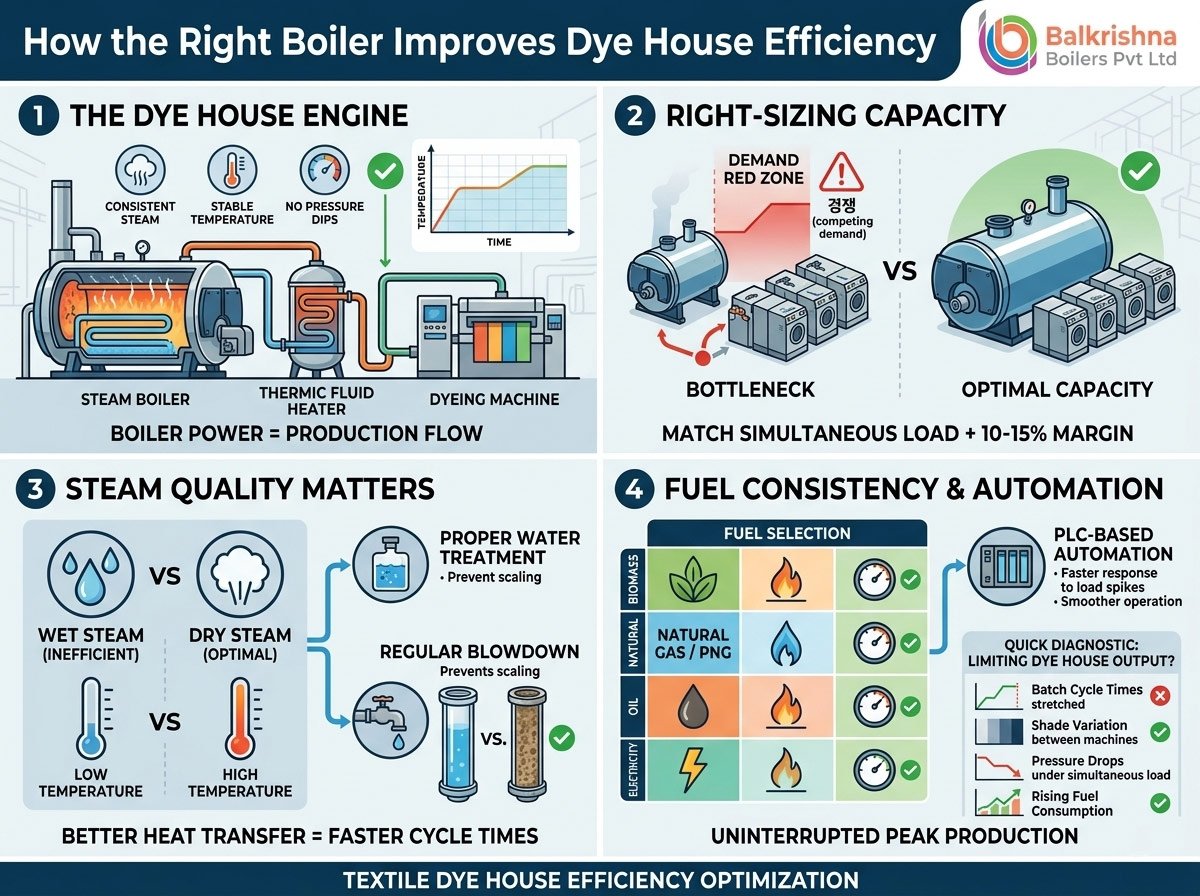
Every dyeing cycle — jet, jigger, package, or beam — follows a temperature profile: ramp up, hold, sometimes step up again, then cool. That profile isn’t a suggestion; it’s what fixes the dye molecule into the fibre correctly. If steam pressure dips even slightly during the ramp or hold phase, the temperature curve flattens or dips, and that inconsistency shows up later as shade variation, poor fastness, or batches that need re-dyeing.
A boiler working properly to spec should be invisible to the dyeing floor. When it isn’t sized or maintained correctly, its fingerprints show up everywhere: extended cycle times because the boiler can’t keep pace with multiple machines heating simultaneously, higher reject and re-dye rates because temperature holds aren’t stable, and rising fuel costs because the system is working harder than it should to deliver the same output. If you want the underlying mechanics of how a boiler actually converts fuel into that steam curve, this is a useful primer: Steam Boiler Working Principle Explained Simply.
How Boiler Capacity Directly Affects Cycle Time
The most common bottleneck in a growing dye house isn’t the dyeing machine — it’s a boiler that was right-sized for the plant’s original capacity and never re-evaluated as more machines were added. When steam demand exceeds what the boiler can deliver, every machine on the floor competes for the same limited supply. Ramp-up times stretch, hold temperatures wobble, and dye house managers start scheduling around the boiler instead of around orders.
Correct sizing means totalling the simultaneous demand of every machine likely to be heating at once — not just the average load — and building in a 10–15% margin for expansion. You can review the full steam boiler range to compare capacities from a few hundred kg/hr up to multiple TPH, including the Biomass Fired Steam Boiler – 1 Ton to 6 Ton, well suited to mid-sized dye houses running several jet or jigger machines together.
For dye houses debating between a fire-tube and water-tube design — a decision that directly affects how fast the boiler responds to sudden load changes between batches — this comparison walks through the trade-offs: Water Tube vs Fire Tube Boilers: Which Is Better for Your Plant?.
Steam Quality: The Overlooked Efficiency Factor
Capacity gets most of the attention, but steam quality is just as decisive for dye house output. Wet, low-quality steam carries less usable heat energy per kg, which means longer heat-up times and inconsistent temperature control at the dyeing machine — even when the boiler is technically rated for the load.
Two things drive steam quality more than anything else: proper water treatment and consistent blowdown practice. Scale buildup from hard or poorly treated feedwater insulates the heat transfer surface, forcing the boiler to burn more fuel for the same steam output — and just a thin layer of scale can raise fuel consumption noticeably while shortening the life of the tubes. Regular blowdown, typically at least once per shift, clears sludge and dissolved solids that would otherwise concentrate and degrade steam purity over time.
If you’re speccing an electric boiler for a dyeing line, water quality tolerances are even tighter than for fuel-fired units — worth reviewing in detail here: Electric Boiler Water Quality Requirements Explained.
Choosing the Right Boiler Type for Dyeing Operations
Steam Boilers for High-Volume Dyeing
For continuous, multi-machine dye houses, a dedicated steam boiler remains the standard choice — it delivers the pressure and volume that jet and package dyeing machines are engineered around. Fuel-fired options range from biomass and agro-waste to oil and gas, and the Cotton Stalk Fired Boiler is a particularly efficient fit for dye houses near cotton-processing belts where the fuel is locally abundant. On the Balkrishna Boilers line, the STEAMPOWER and HUSKPOWER series are commonly specified for exactly this kind of continuous dyeing load, and STEAMGEN is frequently paired with high-batch-frequency dye houses that need fast recovery between cycles.
Electric Boilers for Precision and Compliance
Smaller batch-dyeing units and export-oriented dye houses chasing tighter emission compliance have increasingly moved toward electric boilers, largely because they offer more precise, instant-response heat control and eliminate on-site combustion entirely. We’ve covered the fit in detail here: Are Electric Boilers a Good Fit for Textile Dyeing Units?. Before switching, it’s worth running the numbers on payback: Electric Boiler ROI: When Does It Pay Off? and Electric Boiler Power Consumption: Formulas and Examples.
Explore the electric boiler range, including the Electric Steam Boiler 100 Kg/hr to 400 Kg/hr for smaller dye houses, or the ELECTROMAX and ELECTROPAC series from Balkrishna Boilers, both built for the frequent cycling that batch dyeing demands.
Thermic Fluid Heaters for Downstream Drying and Stentering
Dye house efficiency doesn’t end at the dyeing machine — fabric still needs to move through drying and stentering, where a thermic fluid heater often outperforms steam because it delivers stable high temperatures at atmospheric pressure. If you’re weighing steam against thermic fluid for a downstream line, this comparison covers the decision points: Thermic Fluid Heater vs Steam Boiler: Which Suits Your Process?. Browse the thermic fluid heater range, or the DELTAPAC and THERMPAC models on Balkrishna Boilers.
Fuel Choice and Its Impact on Running Efficiency
Fuel selection affects more than the monthly bill — it affects how consistently the boiler can hold pressure across a full production shift.
- Biomass and agro-waste remain the lowest-running-cost option, and dye houses in agricultural belts often see full ROI within 12–24 months through fuel savings alone.
- Natural gas or PNG offers the cleanest, most consistent combustion, which translates into steadier steam pressure and fewer manual adjustments during a shift.
- Oil-fired systems are compact and low-maintenance, useful where floor space is tight, though running costs are higher.
- Electricity removes combustion variability entirely — useful where precision temperature holds matter more than raw running cost.
If pollution compliance is part of your fuel decision, this covers what’s driving the shift toward cleaner options in dyeing units specifically: How Electric Boilers Help Meet Pollution Control Norms. For solid-fuel-fired dye houses, it’s worth pairing the boiler decision with the right pollution control equipment, including bag filters and wet scrubbers, specified at the same time rather than retrofitted later.
Maintenance Practices That Protect Dye House Output
A well-sized boiler can still under-deliver if maintenance slips. The practices that matter most for dye house consistency:
- Daily blowdown to prevent sludge accumulation that degrades steam quality
- Scheduled soot blowing on fuel-fired units to keep heat transfer surfaces clean
- Economizer checks, since a functioning economizer pre-heats feedwater using waste flue gas, cutting fuel use and stabilizing recovery time between batches
- Water softener performance checks, since even a well-designed treatment plant drifts out of calibration over time
- AMC coverage, so a minor fault doesn’t turn into an unplanned multi-shift shutdown
Automation and Its Role in Consistency
PLC-based automation increasingly separates efficient dye houses from ones still fighting temperature swings. Automated firing and pressure control respond to load changes far faster than manual adjustment, which matters most exactly when it’s needed — during the simultaneous heat-up spike at shift start, when several machines draw steam together. For dye houses evaluating a new installation, it’s worth understanding what the process and timeline actually look like before committing: Electric Boiler Installation: What to Expect (the sequencing principles apply broadly, with IBR inspection layered in for pressure-fired steam units).
A Quick Diagnostic: Is Your Boiler Limiting Dye House Output?
Before assuming a slow dye house is a scheduling or machine issue, check whether these symptoms line up with boiler performance:
- Batches taking noticeably longer to reach dyeing temperature than they used to
- Shade inconsistency between machines running at the same time
- Pressure drops whenever more than one or two machines heat up together
- Rising fuel consumption without a corresponding rise in output
- Frequent unplanned maintenance stops during peak shifts
If two or more of these sound familiar, the boiler — not the dyeing recipe — is very likely the constraint.
Why Textile Manufacturers Choose Balkrishna Boilers
Balkrishna Boilers Pvt Ltd has spent over 25 years engineering steam boilers, thermic fluid heaters, electric boilers, and hot air generators for heat-intensive industries, with dye houses among our most consistently served sectors. Our steam boiler, thermic fluid heater, and electric boiler ranges are engineered specifically for the cyclical, high-frequency loads dyeing floors demand, and every IBR-rated unit is inspected and tested before it leaves the factory.
If your dye house is running into any of the symptoms above, our engineering team can review your current load profile and recommend the right capacity, pressure, and fuel combination — reach out through the contact page or browse the full product range to compare specifications directly.
Frequently Asked Questions
How much can a poorly sized boiler slow down a dye house? It varies by plant, but undersized boilers commonly add 20–40% to cycle times during peak shifts, since machines end up competing for limited steam and heat-up ramps flatten out.
Does switching to an electric boiler improve dyeing consistency? Often yes, particularly for smaller batch operations, since electric heating responds faster and more precisely to load changes than most fuel-fired systems, though the running-cost comparison depends on your local tariff.
How often should a dye house boiler be inspected? Beyond daily blowdown and shift-level checks, a full inspection — tubes, safety valves, water treatment plant, and economizer — is generally recommended at least quarterly for boilers running continuous multi-shift dyeing loads.
Can one boiler serve both dyeing and stentering lines efficiently? Technically yes, but most efficient dye houses separate the two — a steam boiler for dyeing and a thermic fluid heater for stentering — since the pressure and temperature profiles are quite different.
What’s the fastest way to check if the boiler is the bottleneck? Track cycle times and shade consistency against boiler steam pressure logs during peak-load shifts; a correlation between pressure dips and quality issues is usually the clearest signal.
If cycle times or shade consistency in your dye house have been slipping, get in touch with our engineering team for a load assessment and capacity recommendation.