
Introduction: The Unsung Workhorse of Industry
If you’ve ever used a sterilized pharmaceutical product, worn a vibrantly dyed textile, or felt the warmth of a large commercial building, you’ve experienced the power of the industrial steam boiler. These machines are the unsung workhorses of manufacturing — transforming plain water into a versatile, high-energy source: steam.
For over two decades, Balkrishna Boilers (based in Vatva GIDC, Ahmedabad, Gujarat) has designed and manufactured robust steam boilers, thermic fluid heaters, and hot air generators for industries ranging from pharma to food processing. With over 5,000 installations and experience handling more than 100 fuel types, we understand that a successful industrial operation starts with reliable heat generation.
But how exactly does a modern steam boiler turn raw fuel into pressurized steam? The principle is simple — the engineering behind it is precise. Let’s break down the working of a steam boiler into 7 easy-to-understand steps.
(If you’re deciding between boiler designs rather than just how they work, our guide on Fire-Tube vs Water-Tube Boilers: Which is Right for Your Business? is a natural next read.)
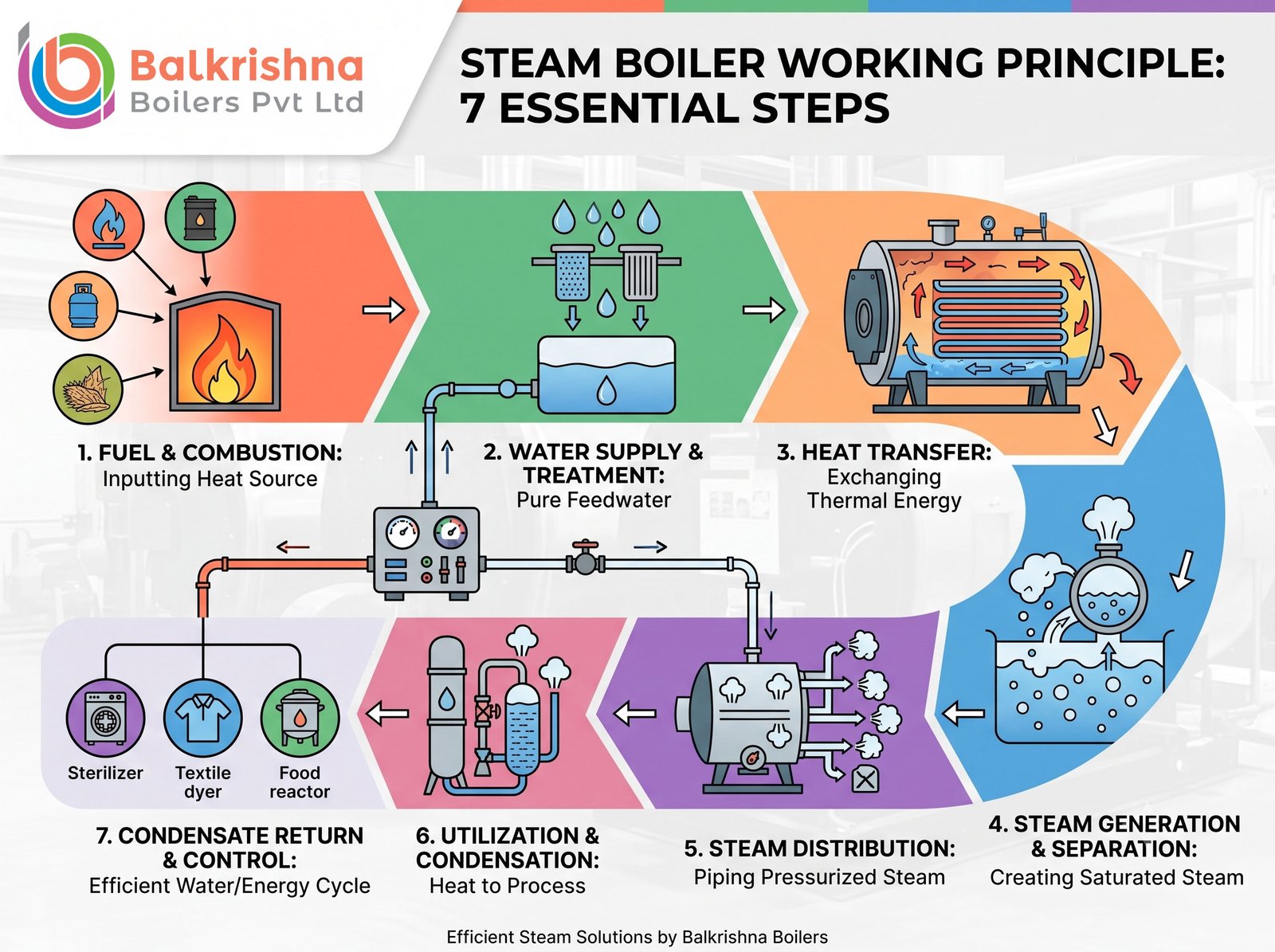
The 7 Essential Steps: How a Steam Boiler Creates Power
Steam generation is a continuous, cyclic process governed by the precise transfer of heat energy. Here’s how it unfolds inside a boiler.
1. Fuel and Combustion: The Start of the Heat
Every boiler needs a heat source. Boilers from Balkrishna Boilers can run on traditional fuels like natural gas, oil, coal, wood, or lignite, or on biomass and agro-waste fuels such as rice husk, groundnut shell, and cotton stalk — or even electricity, as used in our Electric Boiler range.
- Process: The chosen fuel enters the combustion chamber (firebox) through a burner, where it’s ignited and mixed with a controlled amount of air for complete combustion.
- Result: This controlled burning converts the fuel’s chemical energy into high-temperature thermal energy in the form of hot combustion gases.
Explore our multi-fuel options: Oil/Gas Fired Steam Boiler, Biomass Fired Steam Boiler, or Agro Waste Fired Steam Boiler.
2. Water Supply and Treatment: The Lifeblood
A boiler needs a continuous supply of high-quality feedwater, which is converted to steam and often returned as condensate.
- Process: Water is stored in a feedwater tank, pumped into the boiler, and treated beforehand to remove impurities like minerals and dissolved oxygen.
- Why it matters: Untreated water causes scaling (mineral buildup) and corrosion inside boiler tubes, cutting efficiency and lifespan. Proper treatment is non-negotiable for long-term reliability — a topic we cover in detail in Rice Husk vs. Mustard Straw: Which Biomass Fuel Offers Better ROI and other efficiency-focused guides on our blog.
3. Heat Transfer: The Core Principle
This is where engineering does the heavy lifting — transferring heat from combustion gases to water. The transfer method depends on boiler type:
- Fire-Tube Boilers (ideal for smaller applications, lower pressures): Hot gases flow through tubes submerged in water; heat passes through the tube walls into the surrounding water.
- Water-Tube Boilers (ideal for high pressure/high capacity): Water flows inside the tubes while hot gases circulate outside, allowing higher pressures and faster steam generation.
Many Balkrishna models — including our STEAMGEN and STEAMPOWER series — use three-pass or wet-back designs to extract maximum energy from the hot gases. For a deeper side-by-side comparison, see Fire-Tube vs Water-Tube Boiler: Which is Right for Your Business?
4. Steam Generation and Separation: The Boiling Point
As water absorbs heat, its temperature rises rapidly.
- Process: At its boiling point (well above 100°C due to high pressure), water vaporizes into steam bubbles, which rise into the steam drum or steam chest.
- Result: The boiler produces saturated steam — steam at the boiling temperature for its pressure. In advanced systems, this can pass through a superheater to create superheated steam for power-generation applications.
5. Steam Distribution: Delivering the Power
The high-pressure steam, now the energy carrier, is ready for work.
- Process: Steam exits through the main steam stop valve and travels via a piping network to the processes that need heating, power, or sterilization — see our guide on Best Boiler for Textile, Pharma, and Food Industry for how different sectors use this steam.
6. Utilization and Condensation: The Energy Exchange
Steam releases its stored latent heat to the application — heating a jacketed reactor, sterilizing equipment, or driving a turbine.
- Process: Once it releases its heat, steam cools and condenses back into liquid form: condensate.
- Benefit: This condensate is clean and already hot, making it valuable to return to the boiler rather than waste.
7. Condensate Return & Control: Completing the Cycle
The cycle closes with the collection and reuse of condensate.
- Process: Steam traps capture condensate and prevent live steam from escaping. A condensate return system pumps this clean, hot water back to the feedwater tank — reducing makeup water, fuel consumption, and chemical treatment costs.
- Control systems: Modern boilers, including those from Balkrishna Boilers, use advanced sensors, gauges, and safety valves that continuously monitor pressure, temperature, and water level, keeping the boiler safe and efficient 24/7. Our post on Digital Twin Technology: Revolutionizing Boiler Efficiency and Reliability explores how this monitoring is evolving with smart sensors and AI.
Fire-Tube vs Water-Tube: Which Design Fits Your Plant?
| Boiler Type | How It Works | Best For |
|---|---|---|
| Fire-Tube | Hot gases pass through tubes submerged in water | Smaller systems, lower pressure, quick response |
| Water-Tube | Water passes through tubes surrounded by hot gases | High pressure, high capacity, power plants |
For the full breakdown, read Fire-Tube vs Water-Tube Boiler: Which is Right for Your Business? Browse our complete Steam Boiler range — from the Gas Fired Steam Boiler (200 Kg – 850 Kg) to the 1-10 TPH Solid Fuel Fired FBC Steam Boiler, or view the same lineup on balkrishn.com/steam-boiler.php, including models like COMBIPOWER, ENERPOWER, and HUSKPOWER.
Partner with Balkrishna Boilers for Efficient Heat
Understanding how a steam boiler works is the first step toward optimizing your industrial process. At Indian Boilers.com, we design, manufacture, and install systems that are efficient, robust, and customized to your fuel and capacity requirements — from compact Electric Steam Boilers and IBR Electric Steam Boilers to large multi-fuel-fired systems.
Whether you need the clean, instant steam of an Electric Boiler or the fuel flexibility of a multi-solid-fuel-fired system, explore our full product range or the equivalent lineup on balkrishn.com.
Ready to discuss an energy-efficient steam boiler solution for your facility? Contact our engineers today for a free technical consultation.