
Introduction: Why Boiler Type Is the First Decision You Make
Every industrial plant that runs on steam — whether it’s a textile unit, a food processing line, or a chemical plant — eventually asks the same question: fire-tube or water-tube? It sounds like a technical detail, but it’s actually the decision that shapes your fuel cost, your safety protocols, your maintenance schedule, and how quickly your plant can respond to a sudden spike in steam demand.
At Indian Boilers.com, part of Balkrishna Boilers Pvt Ltd, we’ve spent over two decades designing and manufacturing both boiler types from our Ahmedabad facility, working with over 100 fuel types across industries. Before we dive into fire-tube vs water-tube, if you’re new to how boilers work at all, our guide on the Steam Boiler Working Principle is a good starting point, and our breakdown of Core Boiler Components explains the parts we’ll be referencing below.
The Core Difference: Where the Fire Goes vs Where the Water Goes
Both boiler types do the same job — turn water into steam — but they go about it in opposite ways.
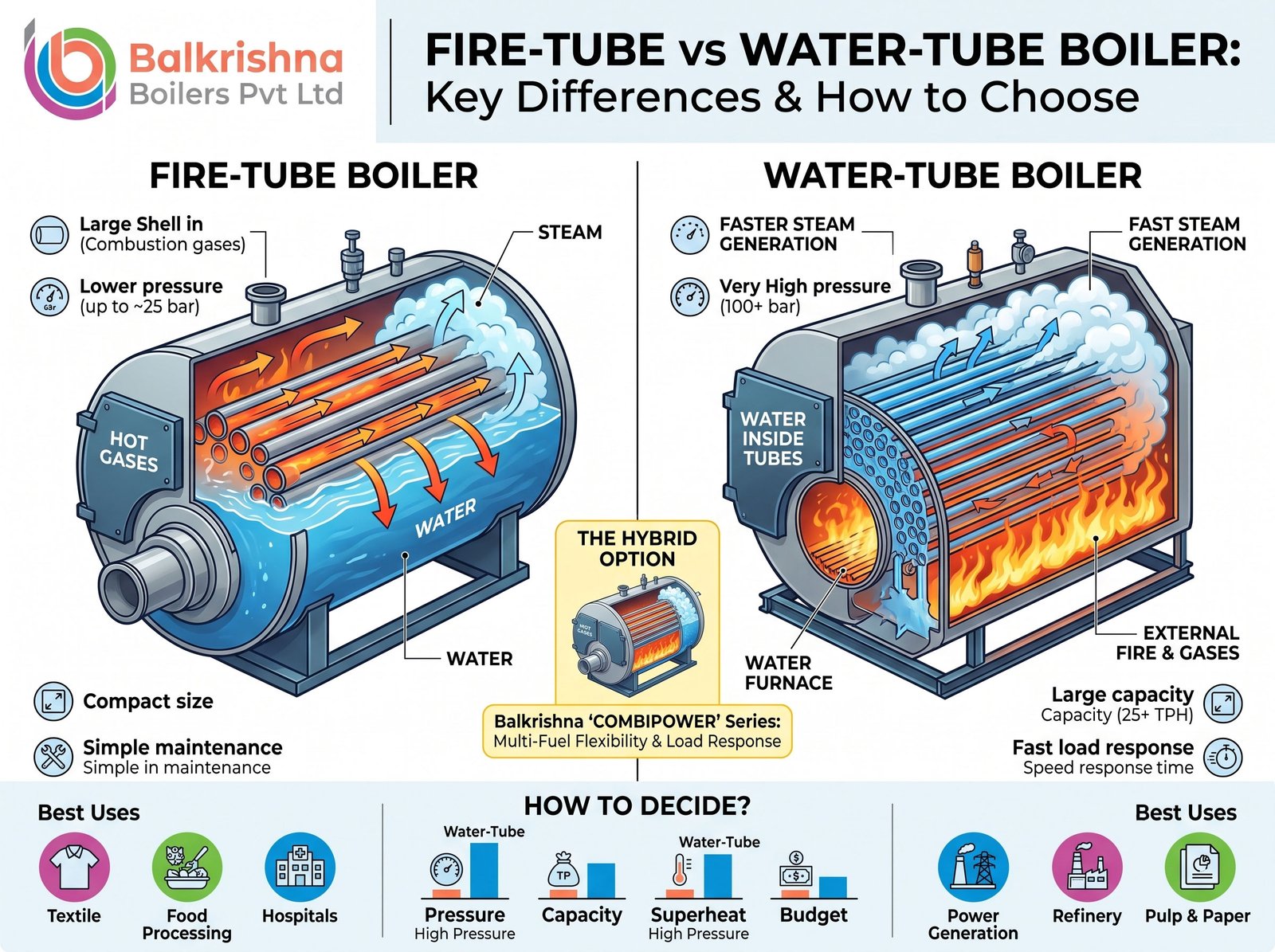
Fire-Tube Boilers: Heat Travels Inside, Water Sits Outside
In a fire-tube design, hot combustion gases pass through a bundle of tubes that sit submerged in a shell of water. Heat transfers outward through the tube walls into the surrounding water.
Why plants choose fire-tube:
- Simpler construction and lower upfront cost
- Large water volume acts as a buffer, absorbing sudden load swings without a big pressure drop
- Tolerant of moderate water quality variation
- Compact for small-to-mid capacity requirements
- Easier to inspect and clean on the water side
Typical range: up to ~20–25 bar pressure and ~25 TPH capacity Best suited for: textile units, food processing plants, laundries, hospitals, hotels, and small cogeneration setups
On Indianboilers.com, this category is represented by models like the Oil/Gas Fired Steam Boiler (500 Kg/hr to 10 TPH) and our smaller Industrial Boiler range. If you’d rather browse the full lineup, our Steam Boiler category page lists all fire-tube and packaged options together. The same range is also documented in more detail on our sister site, under Balkrishn.com’s Steam Boiler section — including compact models like STEAMAX and SIB for smaller-capacity, plug-and-play requirements.
Water-Tube Boilers: Water Travels Inside, Fire Surrounds It
Flip the design around and you get a water-tube boiler: water flows inside a network of tubes while hot combustion gases pass over and around the outside.
Why plants choose water-tube:
- Much faster steam generation due to lower water volume and higher heat-transfer surface
- Handles significantly higher pressures — often 100+ bar — and very large steam volumes
- Smaller tube diameter means a tube failure is far less catastrophic than in a large single-shell vessel
- Easily adapted for superheated steam, which turbines require
- Responds quickly to changing load
Typical range: 25 TPH and above, high-pressure applications Best suited for: power generation, petrochemical plants, pulp & paper mills, steel plants, and large refineries
For this category, Indianboilers.com manufactures the Water Wall Membrane Panel FBC Steam Boiler, engineered for high-capacity, high-pressure operations. If your plant is exploring waste-heat-driven steam generation on this scale, it’s worth reading our guide on Waste Heat Recovery Boilers for Cement Plants, and checking Balkrishn.com’s ENERPOWER series, built for exactly this kind of high-output requirement.
The Hybrid Option Most Comparisons Leave Out
Fire-tube vs water-tube isn’t always an either/or choice anymore. Balkrishna Boilers’ own COMBIPOWER series combines a water-cooled membrane furnace (for fast radiant heat transfer) with a smoke-tube shell (for efficient convective heat transfer) in a single unit. It’s a practical middle ground for plants that need multi-fuel flexibility — rice husk, coal, wood chips, biomass pellets — along with better load response than a pure fire-tube design, without stepping up to full water-tube complexity. Worth considering if your requirement sits right at that 20–25 TPH crossover point.
Side-by-Side Comparison
| Factor | Fire-Tube Boiler | Water-Tube Boiler |
|---|---|---|
| Heat/water path | Gases inside tubes, water outside | Water inside tubes, gases outside |
| Pressure range | Up to ~20–25 bar | 100+ bar |
| Capacity | Up to ~25 TPH | 25 TPH and above |
| Start-up time | Slower (large water volume) | Faster |
| Load response | Moderate | Fast |
| Initial cost | Lower | Higher |
| Safety on tube failure | Larger vessel, higher stored energy | Smaller tubes, less catastrophic failure |
| Typical use | Textile, food, hospitality, small process industries | Power plants, refineries, paper mills, steel plants |
How to Actually Decide
Run through these questions before you commit:
- What’s your steam demand (TPH)? Under 25 TPH generally favors fire-tube; above it, water-tube starts making more sense.
- What pressure does your process need? Low-to-medium pressure processes rarely justify the cost of a water-tube system.
- Is your demand steady or spiky? Fire-tube’s water buffer helps with fluctuating, moderate loads.
- Do you need superheated steam? That points to water-tube, almost by default.
- What’s your fuel source? If you’re planning to switch between biomass, coal, and husk depending on availability, look at multi-fuel options — our article on Multi-Fuel Boilers: The Future of Industrial Heating in India covers this in depth.
- What’s your budget and floor space? Fire-tube systems are typically cheaper and more compact for equivalent smaller capacities.
If you’re selecting for a specific sector, our industry-wise breakdown — Best Boiler for Textile, Pharma, and Food Industry — walks through which boiler type and fuel combination tends to work best for each.
Talk to Our Engineers Before You Decide
Choosing between fire-tube, water-tube, and hybrid isn’t something to get wrong — it affects your operating cost for the next 20+ years. Our team at Indian Boilers.com reviews your fuel type, steam demand, pressure requirement, and plant layout before recommending a system.
Browse our full range across Steam Boilers, Thermic Fluid Heaters, and Electric Boilers, or explore the extended product catalogue on Balkrishn.com. When you’re ready, get in touch with our team for a personalized recommendation.
Frequently Asked Questions
Q: Can a single plant use both fire-tube and water-tube boilers? Yes — many facilities run a fire-tube system for baseline, steady demand and add water-tube or hybrid capacity for peak loads or high-pressure processes.
Q: Is a water-tube boiler always more efficient than a fire-tube boiler? Not necessarily. Water-tube boilers generate steam faster and handle higher pressure, but a well-designed fire-tube boiler with an economizer can be highly efficient for small-to-mid capacity needs. Efficiency depends more on design quality, fuel, and maintenance than tube type alone.
Q: How do I know if my current boiler is undersized? If you’re frequently running at maximum load, seeing frequent pressure drops during peak demand, or have added machinery since installation, it’s worth getting a fresh capacity assessment.
Q: Do fire-tube boilers need less maintenance than water-tube boilers? Generally yes — the water side is more accessible for cleaning and inspection in a fire-tube design, which is part of why smaller plants prefer them.
Q: Which one is IBR certified? Both fire-tube and water-tube boilers require IBR (Indian Boiler Regulations) certification once they cross the specified capacity/pressure threshold. Our team handles this certification as part of every installation.