
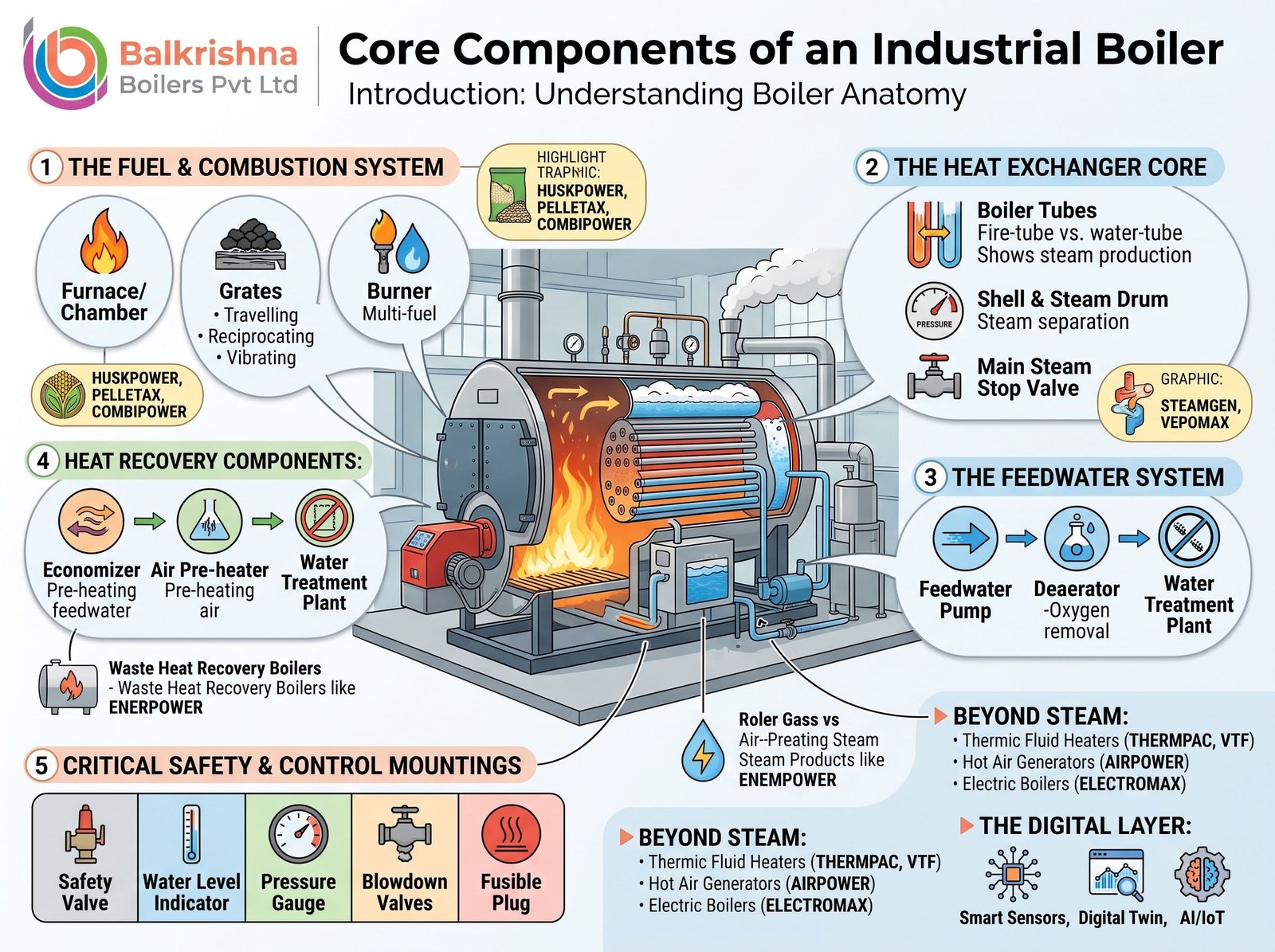
Introduction: Understanding the Anatomy of a Boiler
Ask any plant manager what keeps a factory running, and steam is almost always part of the answer. Yet very few people outside the engineering team ever stop to ask what actually happens inside that large steel vessel humming away in the boiler house. An industrial boiler is not a single machine — it is an integrated system of dozens of components, each performing a precise mechanical or safety function, working together to convert raw fuel into usable thermal energy.
At Balkrishna Boilers Pvt Ltd, we have spent more than two decades designing, manufacturing, and commissioning multi-fuel boilers, thermic fluid heaters, and hot air generators for industries across India and overseas. In this guide, we break down every major component of a modern industrial boiler system — the fuel and combustion assembly, the heat-transfer core, the feedwater circuit, the heat-recovery accessories, and the safety mountings that keep the entire system protected.
Whether you are evaluating a Steam Boiler, comparing a Thermic Fluid Heater against a conventional design, or simply want to understand your existing plant equipment better, this article will give you a component-by-component reference you can return to.
1. The Fuel and Combustion System
Every boiler begins with fuel. The choice of fuel — coal, husk, biomass briquettes, furnace oil, natural gas, or even electricity — determines the design of everything downstream, from the furnace geometry to the type of grate or burner fitted.
Furnace or Combustion Chamber
This is the enclosed refractory-lined space where fuel is burned. A well-designed furnace ensures complete combustion, which directly affects thermal efficiency, ash generation, and emission levels. Furnace design differs significantly between solid-fuel boilers and oil/gas-fired units.
Grates (for Solid Fuel Boilers)
For biomass, husk, and coal-fired systems, the grate is one of the most critical components, since it controls how fuel is fed, spread, and burned. Depending on the application, manufacturers use different grate technologies:
- A Travelling Grate Boiler is widely used in sugar mills for bagasse firing.
- A Reciprocating Grate Boiler handles high-moisture biomass fuels more effectively than conventional designs, as explained in our detailed reciprocating grate combustion guide.
- A Vibrating Grate Boiler is preferred where uniform ash discharge and lower maintenance are priorities.
If you are unsure which grate technology fits your fuel and load profile, our guide on choosing the right fuel for a travelling grate boiler and our comparison of best biomass fuels for reciprocating grate boilers are good starting points.
Burner (for Oil, Gas, and Multi-Fuel Systems)
The burner mixes fuel and combustion air in precise proportions and ignites the mixture to create a stable, controllable flame. Multi-fuel burner systems give plants the flexibility to switch between fuels based on cost and availability — a growing priority as covered in our article on multi-fuel boilers as the future of industrial heating in India.
Our HUSKPOWER and PELLETAX series are purpose-built for husk and pellet firing, while COMBIPOWER offers multi-fuel flexibility within a single vessel design.
2. The Heat Exchanger Core: Where Steam Is Actually Made
This is the heart of the boiler — the assembly responsible for transferring combustion heat into water to generate steam.
Boiler Tubes
- In Fire-Tube Boilers, hot flue gases travel through tubes that are surrounded by water inside a shell. These are compact, easier to operate, and well suited to small and medium steam demands.
- In Water-Tube Boilers, water circulates inside the tubes while hot gases surround them. These designs handle higher pressures and larger capacities, making them the preferred choice for continuous, heavy-duty process industries.
If you are still deciding between the two, our detailed comparison — Fire-Tube vs Water-Tube Boiler: Key Differences & How to Choose — walks through capacity, footprint, and maintenance trade-offs in depth.
Shell and Steam Drum
The Shell (fire-tube design) holds both the water and steam space in one cylindrical pressure vessel. In water-tube designs, the Steam Drum sits at the top of the boiler, collecting the steam-water mixture and separating dry steam from moisture before it is sent downstream — an essential step to protect turbines, process equipment, and piping from wet steam damage.
Main Steam Stop Valve
This valve isolates steam flow between the boiler and the plant’s main distribution header, allowing safe, controlled start-up and shutdown sequences.
For high-capacity continuous operations, our STEAMGEN and VEPOMAX ranges are engineered specifically around this heat-exchanger efficiency principle. Browse the full Steam Boiler range to compare capacities and configurations.
3. The Feedwater System: Protecting the Boiler From the Inside
A boiler is only as reliable as the water feeding it. Poor feedwater quality is responsible for the majority of premature tube failures in the field.
Feedwater Pump
Delivers water into the boiler at a pressure higher than the internal operating pressure, ensuring a constant, uninterrupted supply regardless of steam demand fluctuations.
Deaerator
Removes dissolved oxygen and carbon dioxide from feedwater before it enters the boiler. Left untreated, these gases cause aggressive pitting corrosion inside tubes and headers, shortening equipment life dramatically.
Water Treatment Plant
Treats raw make-up water to remove hardness, dissolved solids, and alkalinity — the primary causes of scale formation on tube surfaces. Even a thin layer of scale acts as an insulator, forcing the boiler to burn significantly more fuel to produce the same amount of steam, and in severe cases leading to localized overheating and tube rupture.
Boilers running on treated, properly deaerated feedwater consistently show longer service life and lower fuel bills — one of the most cost-effective upgrades any plant can make.
4. Heat Recovery Components: Free Efficiency Gains
Flue gases leaving a boiler still carry significant residual heat. Capturing that heat before it exits the chimney is one of the simplest ways to cut fuel costs.
Economizer
An economizer uses waste heat from outgoing flue gases to pre-heat incoming feedwater. This single addition can improve overall boiler efficiency by roughly 5–10%, translating into meaningful annual fuel savings for continuously operating plants.
Air Pre-heater
Similar in principle, an air pre-heater uses residual flue gas heat to warm the combustion air before it enters the burner or furnace, improving combustion quality and further reducing fuel consumption.
Waste Heat Recovery Boilers
For process industries generating large volumes of hot exhaust gases — cement kilns, incinerators, and similar operations — a dedicated Waste Heat Recovery Boiler can convert what would otherwise be wasted energy into usable steam. Our ENERPOWER series has been successfully deployed for exactly this purpose, including a recent waste heat recovery boiler installation at Bluecraft Agro. For a broader view of where this technology applies, see our roundup of top 10 industries that benefit from waste heat recovery boilers.
5. Critical Safety and Control Mountings
These components exist for one reason: to keep operators, equipment, and the surrounding facility safe under every operating condition.
| Component | Function | Why It Is Non-Negotiable |
|---|---|---|
| Safety Valve | Automatically vents steam when internal pressure exceeds a set safe limit | Prevents catastrophic overpressure and vessel failure |
| Water Level Indicator (Gauge Glass) | Displays the real-time water level inside the drum or shell | Prevents low-water conditions that cause tube overheating and rupture |
| Pressure Gauge | Continuously measures internal steam pressure | Allows operators to keep the boiler within its safe operating envelope |
| Blowdown Valves | Periodically drain sludge (bottom blowdown) or dissolved solids (surface blowdown) | Prevents scaling and fouling, preserving efficiency and tube life |
| Fusible Plug | A low-melting-point alloy plug in the furnace crown | Melts under severe low-water conditions, venting steam to extinguish the fire before damage occurs |
Every boiler we manufacture is built in accordance with IBR (Indian Boilers Regulation) standards, and every safety mounting is factory-tested before dispatch. For the regulatory backdrop governing these requirements, you can also refer to our downloadable summaries of The Boilers Act, 2025 and The Indian Boilers Act, 1923.
6. Beyond the Steam Boiler: Related Thermal Systems
Not every process needs steam. Many industries — particularly chemical, textile, and food processing plants — rely on Thermic Fluid Heaters instead, which circulate a heat transfer fluid at high temperature but low pressure, reducing statutory compliance burden while still delivering precise process heat. Our in-depth safety guide to thermic fluid heaters in the chemical industry covers the specific mountings and controls unique to these systems. Popular models in this range include THERMPAC, DELTAPAC, and the VTF Series.
For facilities needing direct hot-air process heat rather than steam or thermic fluid — common in drying and curing applications — our Hot Air Generator range, including AIRPOWER and AIRTHERM, offers a compact alternative built on many of the same combustion and safety principles described above.
And where electrification or low-emission zones are a priority, our Electric Boiler range — including ELECTROMAX and INDUCTRON — eliminates the combustion system entirely while retaining the same steam-drum and safety-mounting logic covered in this guide.
7. The Digital Layer: Modern Additions to Traditional Components
Traditional mountings and mechanical components remain the backbone of any boiler, but modern plants are increasingly layering digital monitoring on top of them. Smart pressure and temperature sensors, automated blowdown timers, and predictive maintenance alerts are now common additions, as we explored in Smart Sensors in Thermic Fluid Heaters – What Actually Matters? and Digital Twin Technology: Revolutionizing Boiler Efficiency and Reliability. Looking further ahead, our article on how AI and IoT are transforming biomass boiler operations in 2026 explores where this technology is headed next.
8. Choosing the Right Combination for Your Industry
No two plants need the exact same combination of components. A textile unit’s steam quality requirements differ sharply from a pharmaceutical clean-steam application, and a food processing plant has hygiene considerations a cement kiln never will. Our industry-specific guide — Best Boiler for Textile, Pharma, and Food Industry — is a useful next read if you are matching components and capacity to a specific sector, alongside our broader Boiler Selection Guide for Food Processing Units.
You can also explore the full range of industries we serve on our Industries page, or see how our systems have performed in the field on our Clients page.
Conclusion: Engineering Reliability, Component by Component
A boiler’s reliability is never the result of one part — it is the sum of a fuel and combustion system tuned to the right feedstock, a heat exchanger sized correctly for the load, a feedwater circuit that protects the metal from the inside, heat-recovery accessories that keep fuel bills in check, and a set of safety mountings that never get a second chance to fail.
At Balkrishna Boilers Pvt Ltd, this component-level thinking is at the core of every unit we manufacture — from compact fire-tube packages to large water-tube and waste-heat-recovery systems. Whether you’re specifying a new installation or auditing an existing plant, understanding these fundamentals is the first step toward a safer, more efficient boiler house.
Looking to install a new boiler or upgrade your existing system? Contact our engineering team for a site assessment and a precisely engineered recommendation, or explore our complete product range on Balkrishn.com.