
Traveling Grate Fuel Selection: What Belongs Here vs. What Belongs on a Reciprocating Grate
If you’ve read our guides on traveling grate mechanics for sugar mills and the best biomass fuels for reciprocating grates, you already know the mechanics of each grate type and a fuel-by-fuel breakdown for reciprocating grates specifically. What’s genuinely useful to add here is the question those two pieces don’t directly answer: given a specific fuel, which of the two grate technologies should it actually go on?
That’s the real gap this piece fills — a fuel-to-technology matching guide, plus coverage of coal, which the reciprocating grate fuel guide didn’t include and which plays a genuinely important role in traveling grate operation specifically.
1. The Core Distinction That Drives Fuel Suitability
Both grate types move fuel through a furnace and manage combustion — but the mechanism differs in a way that directly determines which fuels each one handles well.
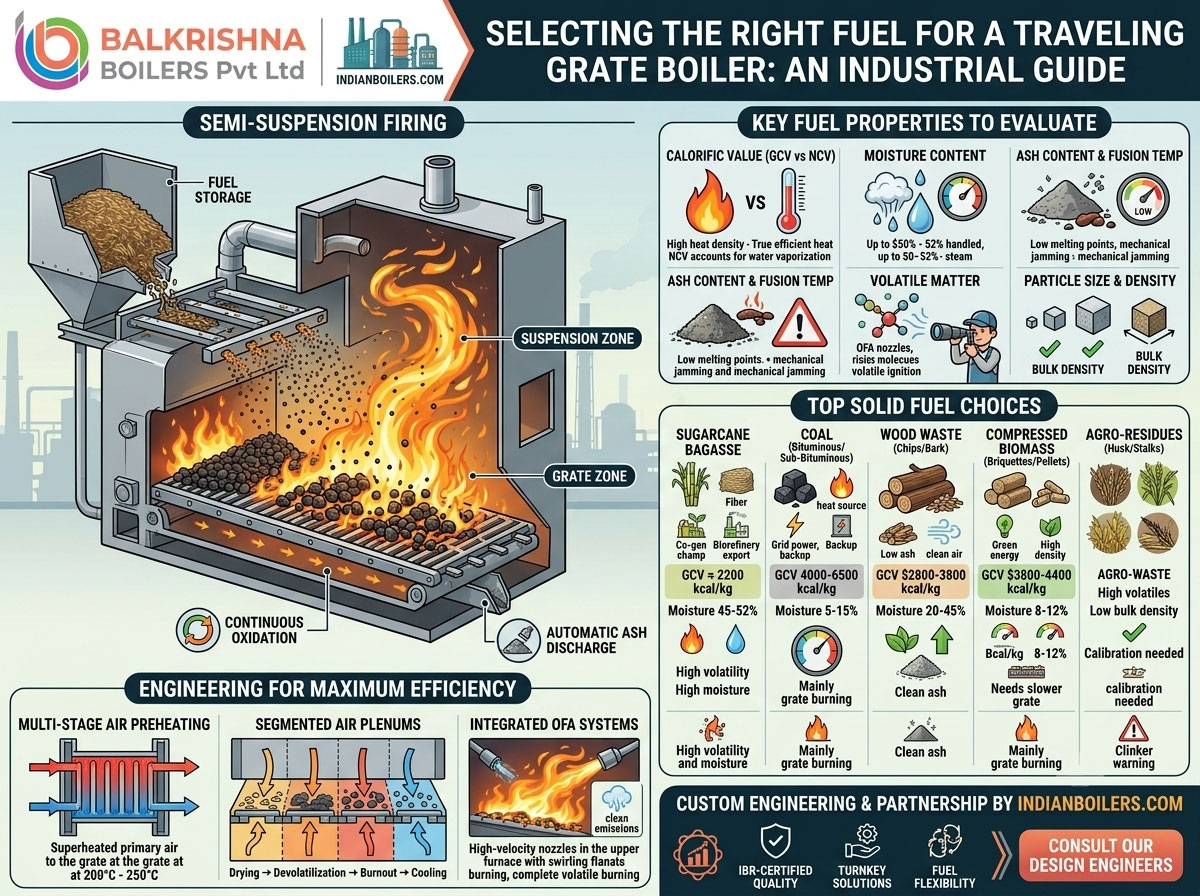
Traveling grates rely primarily on semi-suspension firing — pneumatic spreaders throw fuel into the furnace, with fine particles burning in mid-air suspension and heavier particles landing on a continuously moving (but not actively agitated) grate surface. The grate itself doesn’t tumble or shear the fuel bed the way a reciprocating grate does; it simply conveys fuel forward while combustion proceeds.
Reciprocating grates, covered in our dedicated mechanics guide, actively agitate the fuel bed through the mechanical shearing action of alternating fixed and movable bars — a mechanism specifically built to fracture clinkers as they form.
This single difference — passive conveying with suspension firing versus active mechanical agitation — is what determines fuel suitability more than almost any other factor.
2. Why Paddy Straw and Rice Husk Belong on Reciprocating Grates, Not Traveling Grates
This is the clearest example of the distinction actually mattering in practice, and worth stating plainly: paddy straw and rice husk’s extremely high silica content and severe slagging tendency generally make them a poor match for standard traveling grates, unless the system is specifically over-engineered for high-ash handling.
The reason traces directly back to the mechanical difference above — a traveling grate has no active shearing mechanism to break apart clinkers as they form on the grate surface, which means paddy straw’s genuinely severe slagging tendency (ash fusion temperatures often below 900–1000°C) can choke air passages and cause mechanical jamming without the self-cleaning action a reciprocating grate provides. Our reciprocating grate fuel guide covers exactly why reciprocating grates are one of the few mechanically robust answers to this specific fuel’s ash chemistry.
3. Why Bagasse and Coal Genuinely Suit Traveling Grates Well
Traveling grates aren’t a lesser option — they’re the right choice for specific fuel characteristics, and understanding why matters as much as understanding paddy straw’s mismatch.
Bagasse’s mixed particle size — a blend of fine pith and heavier fiber chunks — pairs naturally with semi-suspension firing: fine particles burn immediately in suspension while heavier pieces land on the grate for slower burnout, extracting energy from the full range of particle sizes without needing active bed agitation to do so. Our traveling grate for sugar mills guide covers this pairing in full engineering depth.
Coal, historically the baseline fuel for high-pressure industrial boilers, pairs well with traveling grates for a related reason: sized coal (typically 10–40mm) has meaningfully lower volatile matter than biomass, meaning a larger share of the fuel burns directly on the grate bed rather than in suspension — a combustion pattern traveling grates handle naturally without needing the active agitation reciprocating grates provide for more clinker-prone fuels. High bed temperatures from coal combustion do require careful under-grate air cooling to protect cast-iron grate keys, but the fundamental combustion pattern suits the traveling grate mechanism well.
| Fuel | Moisture | GCV (kcal/kg) | Why It Suits Traveling Grates |
|---|---|---|---|
| Sugarcane bagasse | 45–52% | ~2,200 (at 50% M) | Mixed particle size matches semi-suspension firing naturally |
| Coal (bituminous/sub-bituminous) | 5–15% | 4,000–6,500 | Lower volatile matter, burns predominantly on-grate |
While the industry is genuinely shifting away from 100% coal firing given carbon footprint priorities, coal remains a practical backup or co-firing fuel during biomass supply shortages — a role covered further in section 5 below.
4. Fuel Properties Worth Evaluating Regardless of Grate Type
A few fuel characteristics matter for combustion performance on either grate technology, and are worth understanding before making any fuel decision:
Net vs. gross calorific value — Gross Calorific Value measures total heat released by complete combustion, but Net Calorific Value is the more practically useful figure, since it accounts for the latent heat lost when water vapor (from fuel moisture and hydrogen combustion) evaporates and exits through the chimney. High-moisture fuels show a meaningfully lower NCV than their GCV alone would suggest — a distinction worth confirming with any fuel supplier’s quoted figures.
Particle size and bulk density — this matters specifically for traveling grates given their reliance on semi-suspension firing: fuel that’s too fine (like pure sawdust) may burn entirely in suspension or get carried out with flue gases before combusting, driving up particulate emissions. Fuel that’s too coarse or dense drops immediately to the grate, starving the suspension zone of heat and risking unburnt cores reaching the ash pit.
Volatile matter — biomass fuels commonly release up to 80% of dry weight as volatile gases, requiring robust over-fire air systems to ensure those gases combust completely above the grate rather than escaping partially unburnt.
5. Co-Firing: Where Traveling Grates Genuinely Excel
This is arguably the most practically valuable content in this piece, and it’s specific to how traveling grates handle blended or switched fuel streams.
Sugar mills exemplify the underlying problem: bagasse is abundant for roughly 150 days during crushing season, but many mills need to maintain cogeneration grid exports year-round, requiring a fallback fuel — commonly coal or purchased wood chips — during the off-season.
Traveling grates handle this kind of dynamic fuel blending genuinely well. Co-firing a high-moisture biomass (wet bark, for instance) with a high-calorific, low-moisture fuel (coal or biomass briquettes) stabilizes furnace temperature and maintains consistent steam pressure through the transition. Making this work in practice requires an adaptable control system — PLC and SCADA integration monitoring flue gas oxygen levels and steam demand, adjusting pneumatic spreader air pressure, grate travel speed, and under-grate air dampers in real time as the fuel blend shifts. Our multi-fuel boilers guide covers the broader engineering and economic case for this kind of fuel flexibility.
6. Engineering Features That Extract Maximum Efficiency Regardless of Fuel
Multi-stage air preheating — superheating primary under-grate air to roughly 200–250°C using recovered flue gas heat creates an instant drying effect as fuel enters the furnace, critical for handling high-moisture fuels like mill-wet bagasse.
Segmented under-grate air plenums — partitioning air supply into zones matching the drying, devolatilization, and burnout stages a fuel bed moves through, directing oxygen where it’s actually needed rather than applying uniform air flow across the whole grate.
Over-fire air systems — high-velocity secondary air injection above the grate ensures volatile gases combust completely rather than escaping partially unburnt, directly relevant given how much of a typical biomass fuel’s energy releases as volatiles.
Our reciprocating grate mechanics guide covers these same principles applied to that grate technology’s specific design.
7. Fuel-Driven Maintenance Considerations
Fuel choice genuinely shapes your preventative maintenance schedule, regardless of which grate technology you’re running:
High-ash fuels (agro-waste, coal) need more frequent convective tube bank inspection for soot buildup — automated, sequential soot blowers are worth treating as standard equipment rather than optional.
High-silica fuels accelerate wear on rotary fuel feeders and pneumatic spreader distribution plates specifically — weekly inspection and off-season replacement scheduling matters more with these fuels than with cleaner-burning alternatives.
Dense fuels like briquettes create intense, localized bed temperatures — ensuring under-grate air cooling is never restricted, and regularly inspecting grate components for warping, protects against the specific wear pattern dense fuel combustion creates.
Conclusion: The Question Isn’t “What’s the Best Fuel” — It’s “What’s the Best Fuel-Technology Match”
There’s no universally best biomass fuel, and there’s no universally best grate technology — there’s only the right match between a specific fuel’s combustion behavior and a grate mechanism built to handle it. Bagasse and coal’s combustion patterns suit traveling grates well; paddy straw’s severe slagging tendency needs the active shearing action only a reciprocating grate provides. Getting this match right at the specification stage avoids the operational headaches of forcing a difficult fuel onto the wrong mechanical system.
Balkrishna Boilers Pvt Ltd engineers both traveling grate and reciprocating grate systems, and helps match your specific regional fuel access to the right technology rather than defaulting to one. Explore the full range on IndianBoilers.com or Balkrishn.com.
Not sure which grate technology fits your specific fuel source? Contact our combustion design engineers for a fuel-specific technology recommendation.
Related Reading
- Traveling Grate Boilers for Sugar Mills: The Ultimate Engineering Guide
- Which Biomass Fuel Actually Suits Your Reciprocating Grate? A Fuel-by-Fuel Breakdown
- Reciprocating Grates: The Mechanical Engineering Behind Clinker-Proof Biomass Combustion
- Vibrating Grate Boiler vs Reciprocating Grate Boiler: Which Technology Delivers Better Performance?
- Multi-Fuel Boilers: Engineering Flexibility Into Your Fuel Strategy