
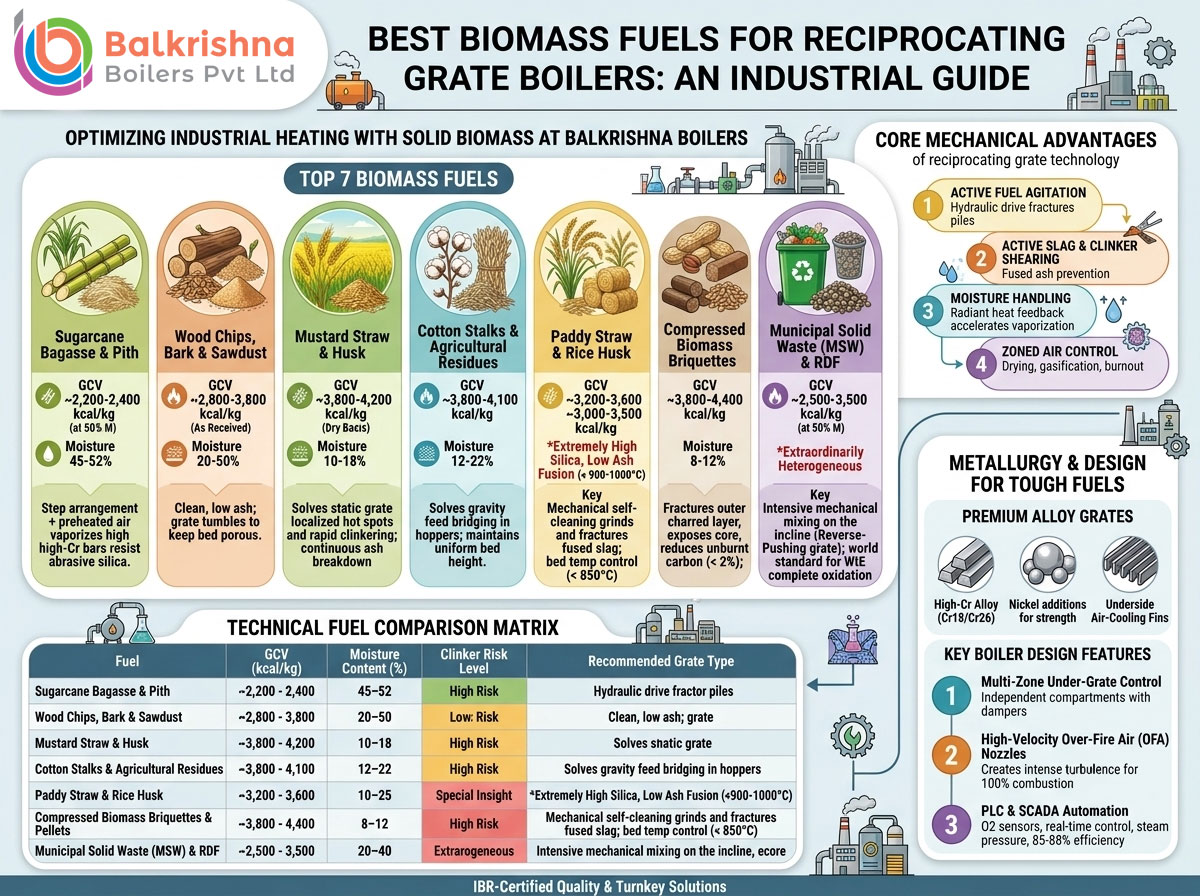
Which Biomass Fuel Actually Suits Your Reciprocating Grate? A Fuel-by-Fuel Breakdown
Coal’s biggest practical advantage over biomass was never its energy content — it was its predictability. Uniform calorific value, consistent moisture, stable ash behavior. Solid biomass fuel offers none of that consistency by default, which is exactly why the reciprocating grate exists as a mechanical answer to fuel variability rather than a single-fuel-optimized design.
This guide profiles the specific fuels that pair well with reciprocating grate technology — their combustion characteristics, their specific challenges, and what furnace configuration each one needs. For sugarcane bagasse specifically, our bagasse and pellets guide and traveling grate boilers for sugar mills already cover the fuel chemistry and dedicated combustion engineering in depth — we’ll touch it briefly here and focus this piece on the six other fuel profiles that pair with reciprocating grate technology.
1. A Quick Note on Bagasse
Fresh sugarcane bagasse (45–52% moisture, roughly 2,200–2,400 kcal/kg gross calorific value at that moisture content, 1.5–4.5% ash) genuinely works well on reciprocating grates, particularly when paired with preheated primary air. But it’s sugar-mill-specific enough, and covered thoroughly enough elsewhere on this site, that repeating that detail here would be redundant. See our dedicated posts above for the full engineering picture.
2. Wood Chips, Bark, and Sawdust Waste
| Parameter | Typical Range |
|---|---|
| Gross calorific value | ~2,800–3,800 kcal/kg (as received) |
| Moisture content | 20–50%, depending on storage |
| Ash content | 1.0–3.5% |
| Volatile matter | 70–80% |
Why it suits reciprocating grates: wood bark and coarse chips vary considerably in size and moisture, and fine sawdust in particular tends to pack tightly on a flat, undisturbed bed — choking off the combustion air that needs to reach it. Continuous grate agitation keeps the fuel bed genuinely porous, ensuring under-grate primary air reaches every particle rather than channeling around dense pockets.
Operational note: wood waste’s low ash content is a real practical advantage — it generates clean bottom ash, minimizes soot buildup on boiler tubes, and simplifies ash handling logistics compared to higher-ash agro-residues. For larger, high-moisture timber chips, slowing the hydraulic stroke frequency extends residence time in the high-temperature zone, giving thorough burnout time before the fuel reaches ash discharge.
3. Mustard Straw and Mustard Husk
| Parameter | Typical Range |
|---|---|
| Gross calorific value | ~3,800–4,200 kcal/kg (dry basis) |
| Moisture content | 10–18% |
| Ash content | 4–8% |
| Volatile matter | ~70% |
Why it suits reciprocating grates: mustard crop residue’s low bulk density and rapid ignition behavior create a genuine problem on a static grate — localized hot spots and rapid clinker formation driven by the fuel’s potassium content. Continuous grate motion breaks up fused ash as it forms, letting loose material drop cleanly into the ash hopper rather than accumulating into blockages.
Operational note: because mustard husk releases volatile gases very rapidly upon entering the furnace, this fuel specifically demands robust over-fire air systems injecting secondary oxygen above the bed — without adequate OFA capacity, this rapid volatile release translates directly into unburnt gas losses and visible smoke.
4. Cotton Stalks and Similar Crop Residues
| Parameter | Typical Range |
|---|---|
| Gross calorific value | ~3,800–4,100 kcal/kg |
| Moisture content | 12–22% |
| Ash content | 5–9% |
| Volatile matter | ~68–74% |
Why it suits reciprocating grates: shredded cotton stalks carry stringy fibers and irregular stick geometries that tend to interlock and form “bridges” in standard gravity hoppers or passive conveyor systems — a genuine handling problem before combustion even begins. The pulsating forward push of a reciprocating grate’s movable steps physically breaks these structural bridges, maintaining uniform bed height across the full furnace width.
Operational note: pre-shredding to a coarse particle size, roughly 25–75mm, before feeding is genuinely important for this fuel — it ensures consistent hydraulic pushing behavior and even air distribution that unshredded or poorly-sized stalks wouldn’t allow.
5. Paddy Straw and Rice Husk: The Most Technically Demanding Fuel on This List
| Parameter | Typical Range |
|---|---|
| Gross calorific value | ~3,200–3,600 kcal/kg (paddy straw) / ~3,000–3,500 kcal/kg (rice husk) |
| Moisture content | 10–25% |
| Ash content | 12–20% (extremely high silica) |
| Ash fusion temperature | Low — commonly below 900–1000°C |
Why this fuel is genuinely difficult: paddy straw carries very high potassium oxide and silica content, giving it an unusually low ash-fusion temperature. In conventional combustion systems, burning paddy straw can lead to catastrophic slagging within hours — melted ash coating furnace walls and choking air grates entirely, a failure mode severe enough that many boiler operators avoid this fuel despite its abundance and low cost.
Why reciprocating grates are one of the few viable answers: the sliding shearing action between overlapping grate bars continuously grinds and fractures fragile slag sheets before they can fuse into solid masses — genuine mechanical self-cleaning that makes reciprocating grate technology one of the few mechanically robust systems capable of direct paddy straw combustion at all, rather than requiring extensive fuel blending to dilute its problematic ash chemistry.
Operational note: flue gas recirculation or staged air injection, used alongside the reciprocating grate itself, can help keep bed temperature below roughly 850°C — below paddy straw’s ash melting point — as an additional layer of protection beyond the mechanical shearing action alone.
6. Compressed Biomass Briquettes and Pellets
| Parameter | Typical Range |
|---|---|
| Gross calorific value | ~3,800–4,400 kcal/kg |
| Moisture content | 8–12% |
| Ash content | 3–8%, depending on raw feedstock |
| Density | High, over 1,000 kg/m³ |
Why it suits reciprocating grates: dense briquettes burn slowly from the outside in, and if a fuel bed moves too quickly across a passive grate, unburnt fuel cores can drop straight into the ash pit without ever fully combusting. Continuous tumbling on a reciprocating grate fractures the briquette’s outer charred layer, exposing the inner unburnt core to primary oxygen — a mechanism that drives reported unburnt carbon-in-ash losses below roughly 2% on well-configured systems.
Operational note: because briquettes carry genuinely high heat density, reducing grate speed to extend residence time allows maximum radiant heat transfer to the boiler’s water walls rather than pushing partially-combusted material toward discharge prematurely.
7. Municipal Solid Waste and Refuse-Derived Fuel
| Parameter | Typical Range |
|---|---|
| Gross calorific value | ~2,500–3,500 kcal/kg |
| Moisture content | 20–40% |
| Ash content | 15–25% |
| Heterogeneity | Very high |
Why it suits reciprocating grates: MSW and processed RDF are genuinely unpredictable — mixed paper, textiles, plastics, and organic waste with wildly varying moisture and density from load to load. Reciprocating step grates, particularly reverse-pushing configurations, are the global standard for waste-to-energy applications specifically because their intensive mechanical mixing action homogenizes an inherently inconsistent fuel bed on the incline, ensuring complete oxidation despite the input material’s unpredictability.
8. Fuel Comparison at a Glance
| Fuel Type | Calorific Value (kcal/kg) | Moisture | Clinker Risk | Recommended Configuration |
|---|---|---|---|---|
| Sugarcane bagasse | 2,200–2,400 (at 50% M) | 45–52% | Moderate (silica) | Forward-feeding step grate |
| Wood chips/bark | 2,800–3,800 | 20–50% | Low | Standard reciprocating grate |
| Mustard husk/straw | 3,800–4,200 | 10–18% | Moderate-high | Step grate with high OFA capacity |
| Cotton stalks | 3,800–4,100 | 12–22% | Moderate | Heavy-duty step grate, pre-shredded fuel |
| Paddy straw/rice husk | 3,000–3,600 | 10–25% | Very high | High-alloy self-cleaning grate |
| Biomass briquettes | 3,800–4,400 | 8–12% | Low-moderate | Speed-controlled step grate |
| RDF/processed MSW | 2,500–3,500 | 20–40% | High | Reverse-pushing step grate |
9. Metallurgy: What Grate Bars Actually Need to Survive
Burning this range of fuels subjects grate bars to genuinely severe conditions — thermal loads in the 850–1,100°C range, abrasive ash wear (particularly from silica-rich fuels like bagasse and rice husk), and chemical attack from chlorine and sulfur compounds present in some fuel streams.
High-chromium alloys (commonly Cr18 or Cr26 grade) form a protective chromium-oxide layer on the grate bar surface, resisting thermal scaling and oxidation at furnace operating temperatures.
Nickel content enhances structural ductility and high-temperature tensile strength, preventing the warping or cracking that sudden thermal shocks — common during startup and fuel transitions — would otherwise cause.
Air-cooling fins cast into the underside of grate bars let incoming primary combustion air draw heat away from the alloy metal before it enters the fuel bed, meaningfully extending grate bar operating life.
Worth noting the distinction in service life expectations here: main structural components — the drive chain and frame — commonly last 15–20 years with proper maintenance, while individual grate bars, treated as expected wear items given their direct fuel-bed exposure, typically need replacement every 3–5 years under continuous industrial operation with high-chromium alloy construction.
10. Key Design Features for Multi-Fuel Reciprocating Grate Systems
Multi-zone under-grate air control — motorized dampers partitioning air supply into drying, gasification, and burnout zones, since different fuels release volatiles at meaningfully different rates.
High-velocity over-fire air nozzles — since biomass fuels commonly release 70–80% of their mass as volatile gases, secondary and tertiary air injection above the grate ensures those gases combust completely before reaching the boiler tube bank.
PLC/SCADA automation — modern systems tie hydraulic stroke frequency, fuel feeder speed, and fan damper position to real-time flue gas oxygen sensors and steam pressure transmitters, automatically adjusting combustion parameters as fuel characteristics or demand shift, rather than relying on fixed manual settings appropriate for only one fuel type.
Conclusion: Match the Grate Configuration to the Fuel’s Specific Problem
Every fuel profiled here creates a genuinely different combustion challenge — wood waste’s bed-packing tendency, mustard husk’s rapid volatile release, cotton stalk’s bridging behavior, paddy straw’s severe slagging risk, briquettes’ slow-burning dense core, and MSW’s sheer unpredictability. A well-specified reciprocating grate system addresses the specific problem your actual fuel presents, rather than applying a single generic configuration across genuinely different fuel chemistries.
Balkrishna Boilers Pvt Ltd analyzes your regional biomass fuel supply and engineers grate slope, hydraulic stroke profile, and air distribution specifically around it. Explore the full range on IndianBoilers.com or Balkrishn.com.
Have a specific local fuel source you want matched to the right grate configuration? Contact our combustion design engineers for a fuel-specific technical proposal.
Related Reading
- Reciprocating Grates: The Mechanical Engineering Behind Clinker-Proof Biomass Combustion
- Bagasse and Pellets: The Engineering Behind India’s Two Biggest Biomass Fuels
- Traveling Grate Boilers for Sugar Mills: The Ultimate Engineering Guide
- Vibrating Grate Boiler vs Reciprocating Grate Boiler: Which Technology Delivers Better Performance?
- Fuel Moisture vs Boiler Efficiency: Finding the Ideal Range for Reciprocating Grate Boilers