
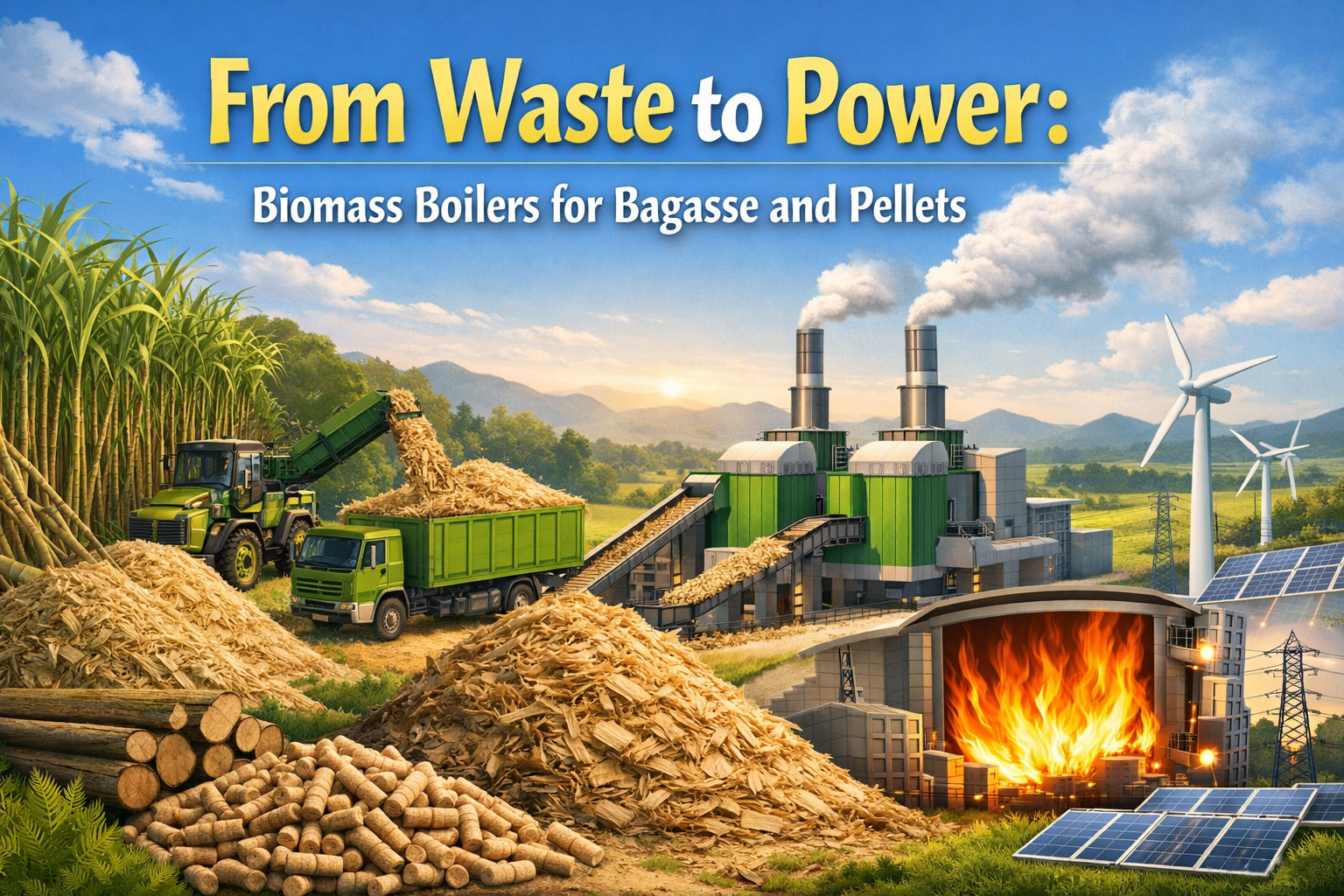
Bagasse and Pellets: The Engineering Behind India’s Two Biggest Biomass Fuels
Two very different waste streams power a growing share of Indian industrial heat: the fibrous residue left behind when sugarcane is crushed, and the compressed sawdust and agricultural residue pressed into dense fuel pellets. Neither was originally seen as a resource — bagasse was historically a disposal problem for sugar mills, and loose biomass waste was often burned in open fields or simply discarded. Modern boiler engineering has turned both into legitimate industrial fuel sources, but they behave very differently in a furnace, and treating them identically is a common mistake in fuel-conversion planning.
This guide covers what actually differentiates bagasse and pellet combustion — the chemistry, the mechanical handling challenges, and the engineering solutions each one demands. If you’re comparing biomass fuel options more broadly, our posts on biomass pellet vs. briquette performance and rice husk vs. mustard straw cover the wider fuel comparison.
1. Bagasse: Sugar Milling’s Built-In Fuel Source
India is one of the world’s largest sugar producers, and sugarcane crushing generates a substantial volume of fibrous residue — bagasse — as an unavoidable by-product of extracting cane juice. What was once a genuine disposal headache for sugar mills has become the backbone of cogeneration in the sugar belt across Uttar Pradesh, Maharashtra, and Karnataka, where mills increasingly generate their own process steam and, in many cases, export surplus power to the grid.
The Chemistry That Determines Its Fuel Value
Bagasse is composed primarily of cellulose, hemicellulose, and lignin, and its usable heating value depends heavily on moisture content — which varies significantly depending on how the bagasse was handled after crushing. Fresh, wet bagasse straight from the crushing process carries very high moisture content and a correspondingly modest gross calorific value. Once dried, that same bagasse yields a meaningfully higher calorific value, because far less of the combustion energy is spent evaporating water before any useful heat transfer can occur. This is the single biggest lever available for improving bagasse combustion efficiency — moisture management matters more than almost any other variable.
Why Bagasse Needs Purpose-Built Combustion Equipment
Bagasse is bulky and fibrous in a way that standard coal-handling equipment simply isn’t built for — conventional feeders clog quickly when fed bagasse rather than a granular fuel. Purpose-built bagasse combustion systems address this with two specific design solutions:
- Spreader stokers, which distribute bagasse across the furnace rather than dumping it in a pile, allowing finer particles to combust in suspension while larger fibrous pieces burn on the grate below — extracting energy from the full range of particle sizes rather than just the easily-combustible fraction.
- Traveling or vibrating grate designs, which keep the fuel bed moving to prevent bagasse from matting together into a dense layer that blocks air penetration — since incomplete air penetration is what causes incomplete, inefficient combustion in fibrous fuels specifically.
2. Biomass Pellets: The Standardized, Portable Alternative
While bagasse is geographically tied to sugar-producing regions, biomass pellets solve a different problem: they make agricultural and wood-processing residue — sawdust, groundnut shells, cotton stalks, and similar biomass — usable as a standardized, transportable fuel anywhere in the country, independent of local crop type.
What Pelleting Actually Does
Pelleting compresses loose biomass residue under high mechanical pressure into dense, uniform cylinders. This dramatically increases the fuel’s bulk density compared to loose biomass — a meaningful practical advantage, since transporting and storing a given amount of energy content takes far less volume and cost as pellets than as loose residue.
Why Pellets Handle Differently Than Bagasse
Pellets carry two structural advantages that make them mechanically easier to work with than bagasse: consistently low moisture content, meaning less combustion energy is wasted evaporating water before useful heat transfer begins, and genuine flowability — pellets behave close to a granular fluid, which means they can be stored in silos and moved through narrow screw conveyors for precise, automated feeding in a way loose or fibrous biomass simply can’t match.
3. Bagasse vs. Pellets: Matching Fuel to Facility
| Factor | Bagasse | Pellets |
|---|---|---|
| Best suited to | Sugar mills and large cogeneration plants with in-house bagasse supply | Textiles, pharma, food processing, and any facility without direct sugar-milling access |
| Storage requirement | Large open yards, with real fire-risk considerations for bulk storage | Compact, weatherproof silos |
| Combustion approach | Spreader stoker or fluidized bed design | Step-grate or automated small-scale burner systems |
| Ash behavior | Generally low ash content | Variable, depends significantly on source material |
| Fuel cost position | Often lowest cost where self-generated on-site | Moderate — typically above rice husk, below imported oil, but varies regionally |
The practical takeaway: bagasse makes the most sense where you’re already generating it as a by-product of your own process (sugar milling specifically), while pellets are the more practical, portable choice for any facility sourcing biomass fuel externally.
4. The Combustion Engineering That Actually Determines Efficiency
Turning either fuel into usable steam efficiently and cleanly comes down to three combustion fundamentals, sometimes referred to as the “3 T’s”:
Temperature — the furnace needs to be maintained within a sufficiently high operating range to sustain complete combustion, since insufficient temperature leaves unburned fuel and excess particulate matter in the exhaust.
Turbulence — high-velocity secondary air injection mixes combustion gases thoroughly, ensuring oxygen actually reaches unburned fuel particles rather than gases passing through the furnace without full mixing.
Time — combustion gases need to remain in the hot zone of the furnace long enough for oxidation to complete before exiting toward the heat exchange surfaces, otherwise partially combusted gases simply carry unused energy — and unwanted emissions — straight out the stack.
The Alkali Fouling Problem Specific to Agro-Waste
Agro-waste fuels like bagasse contain potassium and sodium compounds that, at high combustion temperatures, can form sticky deposits on boiler tube surfaces — a phenomenon known as fouling, which reduces heat transfer efficiency over time and requires active management. Well-engineered biomass systems address this with automated soot blowers — high-pressure steam or air jets that clean tube surfaces during operation — and wider tube spacing specifically designed to prevent ash bridging between adjacent tubes, a design consideration that matters more for agro-waste fuels than for cleaner-burning fuels like wood pellets.
5. Building Your Own Economic Case
Rather than quoting a specific case study’s numbers, which won’t reflect your actual fuel access or current costs, here’s the framework worth applying to your own situation: compare your current fuel cost per unit of delivered heat against your regional bagasse or pellet pricing, factoring in the calorific value and moisture differences covered above, and weigh that against the additional capital cost of purpose-built combustion equipment versus a generic biomass conversion. Our biomass boiler ROI calculation framework walks through this calculation in full detail — the payback period for any specific facility depends too heavily on local fuel access and current fuel costs to state as a general figure here.
6. The Broader Environmental Case, Stated Accurately
Beyond direct cost savings, biomass fuel use — particularly pellets sourced from agricultural residue — connects to a genuine environmental and social benefit worth understanding accurately: when pelleting operations purchase crop residue from farmers rather than leaving it for open-field burning, it creates an economic incentive against a practice that significantly worsens air quality in North India during burning season, alongside providing farmers an additional income stream from what would otherwise be waste material.
On the carbon side, biomass combustion is generally treated as carbon-neutral in sustainability accounting, since the CO2 released roughly matches what the source plant material absorbed during its growth cycle — a genuine structural advantage over fossil fuels, which release long-sequestered carbon with no equivalent offsetting absorption.
One clarification worth making accurately: India’s PAT (Perform, Achieve, Trade) scheme, administered by the Bureau of Energy Efficiency, does allow designated large energy consumers in specific sectors to earn and trade Energy Saving Certificates for verified efficiency improvements — but this applies to formally designated consumers under the scheme, not automatically to any industry switching fuel types. Whether your facility qualifies is worth confirming directly with the Bureau of Energy Efficiency or a qualified energy consultant rather than assuming eligibility.
7. Handling and Storage Considerations Specific to Each Fuel
For bagasse: pre-drying using the boiler’s own exhaust gas heat is a genuinely effective efficiency measure, since reducing incoming moisture content directly improves how much of the fuel’s combustion energy converts to usable steam rather than evaporating water first. Open-yard storage, common for bulk bagasse, does carry real fire-risk considerations that need proper management.
For pellets: because biomass dust is genuinely combustible, well-designed installations include spark arrestors and appropriate fire suppression measures in fuel feed galleries — a standard safety consideration for any facility handling pelletized biomass at scale, not an optional add-on.
8. A Practical Approach to Specifying the Right System
- Test your actual fuel source — calorific value and ash behavior vary meaningfully even within the same general fuel category, so a proper fuel analysis matters more than a generic spec sheet assumption.
- Match grate design to fuel characteristics — a design suited to high-ash agro-waste differs from one optimized for lower-ash, drier pellet fuel.
- Plan for alkali management if using agro-waste — soot blowing and tube spacing decisions should be made with your specific fuel’s fouling tendency in mind, not as an afterthought.
- Build your own cost calculation using your actual local fuel access and current energy costs, rather than relying on a case study from a different region and facility.
Conclusion: Two Fuels, Two Distinct Engineering Problems
Bagasse and pellets both represent genuine progress in turning agricultural waste into usable industrial energy, but they demand different combustion engineering to do it efficiently and cleanly. Bagasse’s bulk and fiber structure need spreader stokers and moving grates; pellets’ density and flowability enable automated, precise feeding that bagasse handling simply can’t match. Getting this match right — not just switching to “biomass” generically — is what actually determines whether a conversion delivers on its promised efficiency and cost benefits.
Balkrishna Boilers Pvt Ltd designs combustion systems matched to your specific fuel source, including bagasse-specific and pellet-optimized configurations. Explore the full range on IndianBoilers.com or Balkrishn.com.
Have a specific bagasse or pellet fuel source to evaluate? Contact our engineering team — we can test your specific fuel sample for calorific value and ash behavior before recommending a configuration.
Related Reading
- Biomass Pellet vs. Biomass Briquette: Which Fuel Gives Better Boiler Performance?
- Rice Husk vs. Mustard Straw: Which Biomass Fuel Offers Better ROI for Indian Factories?
- The Biomass Boiler ROI Calculation: A Framework, Not Just a Percentage
- Traveling Grate Boilers for Sugar Mills: The Ultimate Engineering Guide
- Biomass Boiler Emission Control Systems: A Complete Guide