
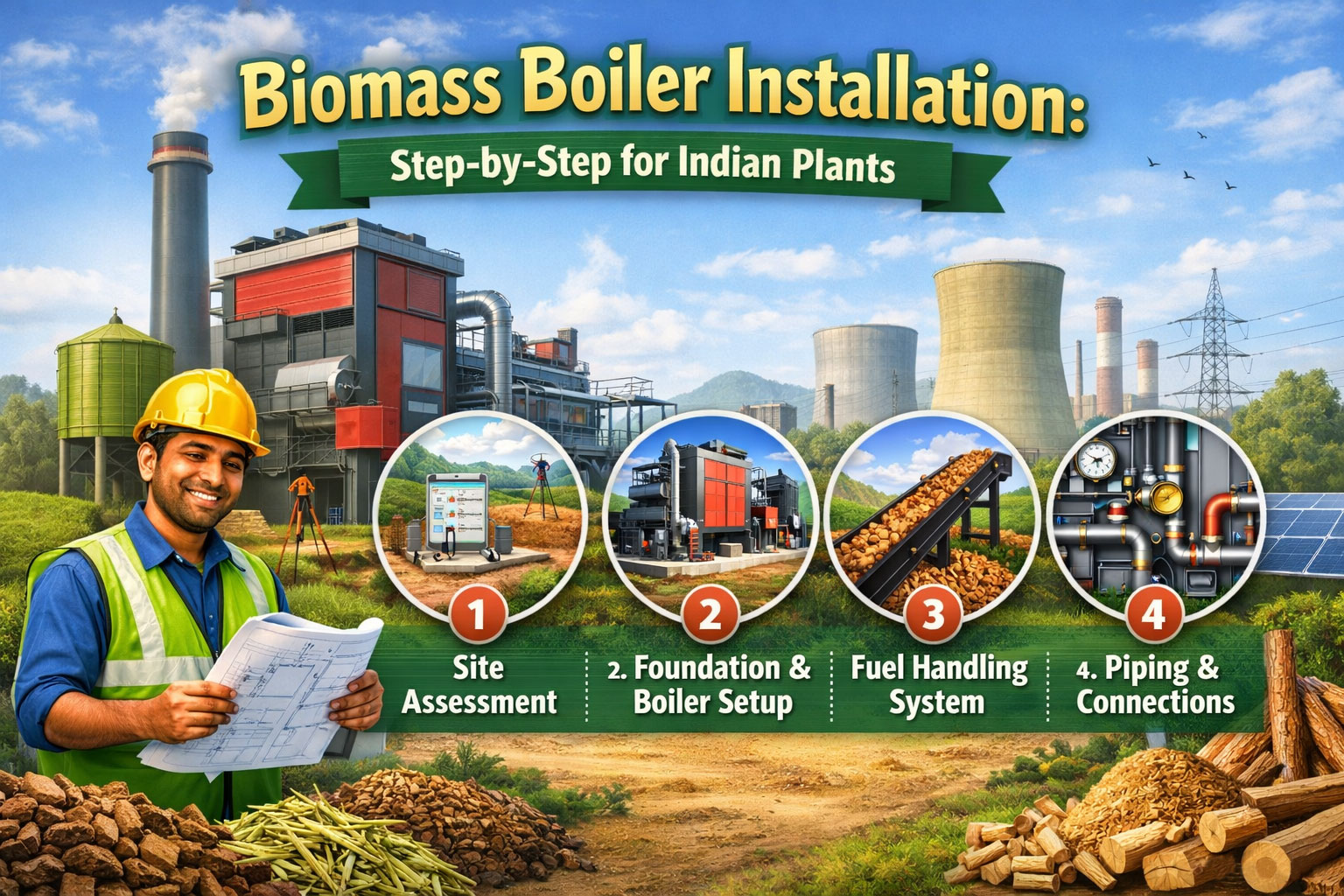
Installing a Biomass Boiler in India: The Phase-by-Phase Reality
Deciding to switch to biomass is the strategic decision. Installing it correctly is what actually determines whether that decision pays off. Unlike a relatively compact oil or gas-fired unit, a biomass boiler installation is a genuinely heavier engineering undertaking — fuel logistics, ash handling, refractory work, and emission control systems all need to come together correctly before the first steam is ever raised.
This guide walks through what a proper biomass installation actually involves, phase by phase, so you know what to expect and what to hold your installer accountable for. If you’re still deciding whether biomass is the right direction, our biomass vs. coal comparison and biomass ROI framework cover that decision first.
Phase 1: Pre-Installation and Site Readiness
Before any equipment arrives on site, the ground it’s going onto — literally and logistically — needs proper preparation.
Civil Foundation and Structural Assessment
Biomass boilers tend to be significantly heavier than comparable-capacity oil-fired units, largely due to the refractory-lined furnace and fuel-feeding machinery involved. This makes a proper structural assessment a genuine first step, not a formality:
- Soil bearing capacity testing confirms the ground can handle the localized load of the boiler shell and chimney foundation.
- Foundation curing time matters more than it might seem — concrete foundations generally need several weeks of proper curing before the boiler is mounted, since inadequate curing time risks structural cracking once vibration and thermal cycling begin during operation.
Fuel Storage Planning
Biomass fuel is genuinely bulky compared to the equivalent energy content in liquid fuel — a boiler burning rice husk or wood waste needs meaningfully more storage footprint than the same-capacity unit running on LDO.
- Moisture protection for the storage yard isn’t optional — biomass fuel that gets rained on loses meaningful combustion efficiency, since wet fuel wastes energy evaporating water before any useful heat transfer happens.
- Fire safety infrastructure — fire hydrants positioned near the storage yard and spark arrestors integrated into fuel conveyors are standard requirements given biomass dust’s genuine combustibility, not optional upgrades.
Phase 2: Mechanical Installation
Once the site is prepared, the heavy mechanical work begins — this phase demands precision alignment and properly certified welding throughout.
Positioning the Furnace and Pressure Vessel
Most industrial biomass boilers arrive as two major components — the furnace (combustion chamber) and the pressure part (shell and tubes) — that need to be positioned and aligned together on site. Getting this alignment right matters specifically to prevent “gas bypassing,” where hot combustion gases escape through gaps rather than transferring heat through the intended path — a direct efficiency loss if alignment is off.
Integrating the Combustion System
Whether the design uses Fluidized Bed Combustion or a reciprocating/traveling grate, the fuel feeding mechanism is one of the most consequential installation details:
- Fuel feeders — screw conveyors or rotary feeders need careful alignment to prevent “back-firing,” where flame travels backward into the fuel hopper, a genuine safety concern if feeder design or alignment is inadequate.
- Refractory lining — high-alumina brick or castable refractory lines the furnace interior, and this work genuinely needs specialist installation. Expansion joints have to be placed correctly, because incorrectly placed joints are a common cause of refractory cracking during the boiler’s first heat-up cycle.
Phase 3: Auxiliary Equipment and Piping
A boiler’s core vessel is only as good as the supporting systems around it — the draft system that manages air and flue gas flow, and the feedwater system that determines long-term tube health.
Draft System: Fans and Ducting
Biomass combustion generally requires higher air-to-fuel ratios than liquid or gaseous fuel combustion, making the draft system genuinely important to get right:
- Forced Draft (FD) fans push combustion air into the furnace.
- Induced Draft (ID) fans pull flue gases out through the exhaust path.
- Insulated ducting matters for two reasons — preventing heat loss that would otherwise reduce overall system efficiency, and protecting personnel working near hot ducting from burn risk.
Feedwater System
Groundwater across much of India runs hard, which makes proper feedwater treatment a genuine priority rather than an afterthought:
- Water treatment plant (RO or softener) should be commissioned and verified before the boiler is first filled — starting operation on untreated water risks scale formation from day one.
- Deaerator systems, standard on larger installations, remove dissolved oxygen from feedwater, directly preventing the internal tube corrosion that dissolved oxygen would otherwise cause over the equipment’s service life.
Phase 4: Compliance and Safety
In India, boiler compliance isn’t a paperwork formality — it’s a legal requirement with real operational consequences for non-compliance. As of 2025, the governing framework is The Boilers Act, 2025, which replaced the earlier 1923-era regulatory structure.
Boiler Registration and Inspection
- Registration with the relevant State Boiler Inspectorate is a mandatory step before the unit can legally operate.
- Hydraulic testing — before commissioning, an inspector pressurizes the boiler to a level above its normal working pressure specifically to verify structural integrity and check for leaks before any fuel is ever introduced.
- Pipeline inspection — all high-pressure steam piping must be welded by certified welders and typically undergoes radiographic (X-ray) inspection to verify weld integrity before the system is approved for operation.
Pollution Control Board Clearances
Current SPM (Suspended Particulate Matter) emission norms are genuinely stringent, and biomass installations need proper air pollution control equipment integrated from the start:
- Air pollution control devices — cyclones, multi-cyclones, or bag filters integrated directly into the flue gas path, sized appropriately for your specific fuel type and combustion volume.
- Stack height requirements — chimney height is determined by CPCB emission-dispersion formulas that account for your specific stack emission load and local conditions, rather than a single fixed minimum height across all installations. Confirm the exact requirement for your specific plant with your regional pollution control board or your installer’s compliance team, since it varies by case.
Phase 5: Commissioning and Optimization
The final phase is what actually turns installed equipment into a working, reliable system.
Refractory Dry-Out
New refractory brickwork contains residual moisture, and a biomass boiler genuinely cannot be started at full capacity from cold — doing so risks the refractory cracking or spalling from trapped moisture converting rapidly to steam. Proper commissioning involves a slow, controlled temperature rise over several days using a small initial fire, gradually baking out moisture from the brickwork before the system is brought to full operating pressure.
Performance Trial and Operator Training
Once the system reaches full operating pressure, a proper commissioning process includes a performance trial — measuring the evaporation ratio (kilograms of steam produced per kilogram of fuel consumed) to confirm the system is meeting its designed efficiency. Equally important, and often under-prioritized, is thorough operator training: modern biomass systems run on PLC-based automation, and your operating staff need genuine competency in routine handling, emergency shutdown procedures, and blowdown scheduling before the installer’s team leaves site.
A Practical Checklist for Plant Managers
| Step | Focus Area | Common Pitfall to Avoid |
|---|---|---|
| Foundation | Structural integrity | Insufficient curing time before boiler mounting |
| Refractory | Heat retention and durability | Low-quality brick or incorrectly placed expansion joints |
| Piping | Pressure safety | Non-certified welding on high-pressure lines |
| Pollution control | Regulatory compliance | Undersizing filtration equipment for your specific fuel type |
| Storage | Fuel logistics | Placing the fuel yard too far from the boiler, adding unnecessary handling |
| Commissioning | Refractory integrity | Rushing the dry-out process instead of following a proper slow-burn schedule |
Conclusion: The Installation Determines Whether the ROI Actually Materializes
A biomass conversion’s return on investment lives or dies on installation quality — a boiler that’s technically well-specified but poorly installed, with rushed refractory dry-out, undersized pollution control, or inadequate feedwater treatment, will underperform its design efficiency regardless of how good the underlying equipment is. Getting each phase right — foundation, mechanical installation, auxiliary systems, compliance, and commissioning — is what actually converts a capital investment into the operational savings it was meant to deliver.
Balkrishna Boilers Pvt Ltd manages this full lifecycle, from initial civil drawings through final regulatory certification. Explore our biomass range on IndianBoilers.com or Balkrishn.com.
Planning a biomass installation and want a proper phase-by-phase project plan? Contact our engineering team for a site assessment and installation roadmap.
Related Reading
- The Boilers Act, 2025 – Download PDF
- The Biomass Boiler ROI Calculation: A Framework, Not Just a Percentage
- Bagasse and Pellets: The Engineering Behind India’s Two Biggest Biomass Fuels
- Biomass Boiler Emission Control Systems: A Complete Guide
- The Steam Boiler Maintenance Checklist Every Indian Plant Actually Needs