
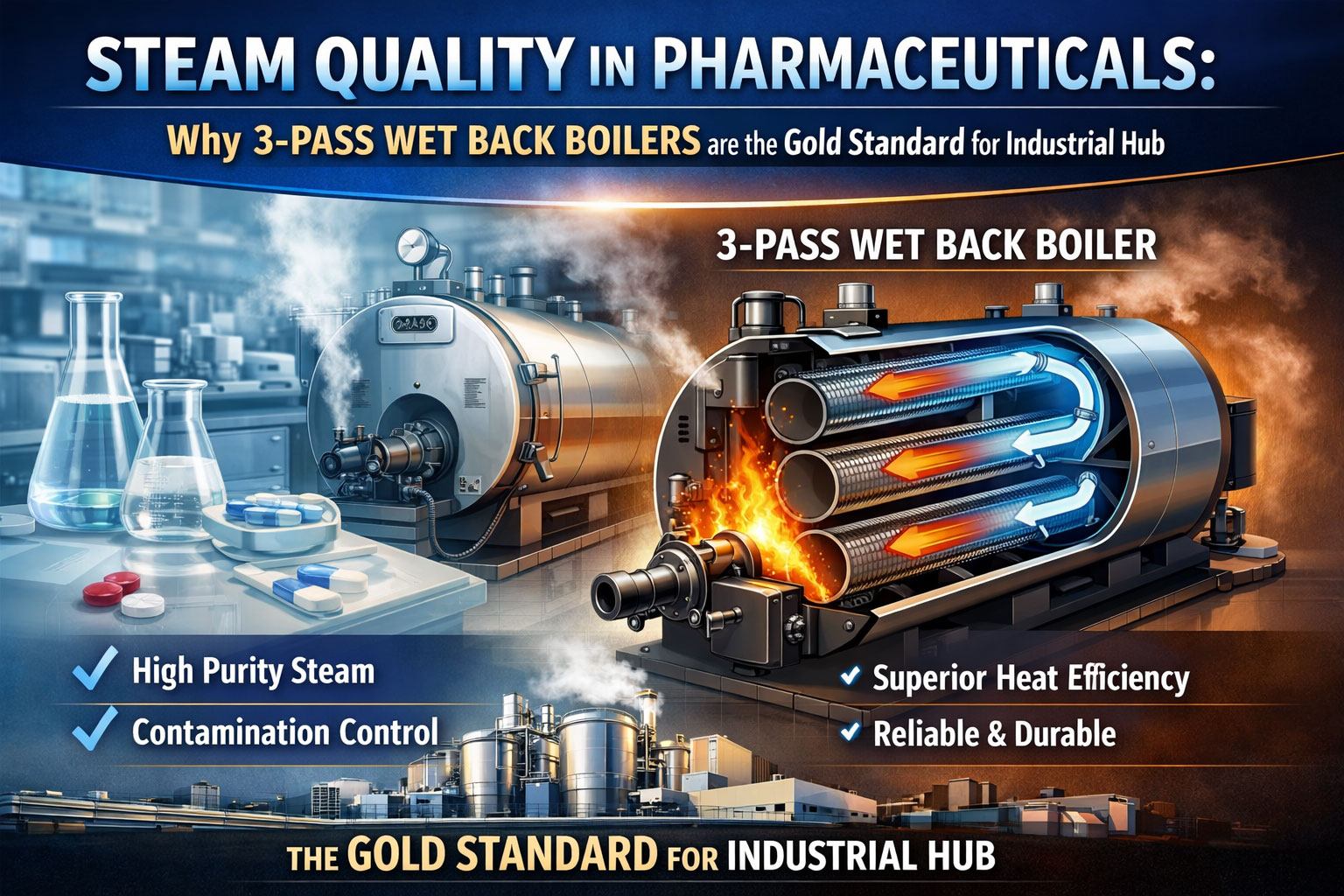
Why 3-Pass Wet-Back Design Is the Standard for Pharmaceutical Steam
In pharmaceutical manufacturing, steam isn’t just a heating utility — it’s a critical process input that directly touches product safety, efficacy, and regulatory standing. Whether it’s sterilizing equipment, driving an autoclave cycle, or maintaining precise reactor temperature, the quality of that steam can’t be an afterthought. As pharma manufacturing hubs across India — Ahmedabad, Baddi, Sikkim, and others — continue expanding, one fire-tube design has become the clear standard for this level of demand: the 3-pass wet-back boiler.
This guide explains what that design actually is, why its specific engineering choices matter so much for pharmaceutical steam quality, and where it fits alongside electric alternatives. If you’re weighing electric technology for pharma applications specifically, our post on electric boilers for food, pharma & dairy covers that comparison directly.
1. Understanding the Design: What “3-Pass Wet-Back” Actually Means
Every part of this term describes a specific engineering choice, and understanding each one explains why the design performs the way it does.
“3-pass” refers to how many times combustion gases travel through the water-filled shell before exiting via the chimney:
- First pass — through the furnace itself (the primary fire tube).
- Second pass — through a set of smoke tubes running back through the shell.
- Third pass — through a further set of smoke tubes, extracting additional residual heat before the gases finally exit.
“Wet-back” describes the rear reversal chamber — the point where combustion gases turn direction between the first and second pass. In a wet-back design, this chamber is fully surrounded by water on all sides. This stands in contrast to “dry-back” designs, which use heavy refractory brick lining at the rear instead — brickwork that’s genuinely prone to cracking over repeated thermal cycling and requires periodic repair that a wet-back chamber simply doesn’t.
This design principle is most commonly applied in oil and gas-fired fire-tube boilers — our STEAMJET – Oil/Gas Fired Steam Boiler range is built on this proven 3-pass wet-back construction.
2. Why This Design Delivers Genuinely Better Steam Quality
Pharmaceutical processes need what’s typically called “clean steam” or “pure steam” — steam free of moisture carryover and chemical contamination, since either compromises the sterility and consistency validated processes depend on.
High Steam Dryness Fraction
Wet-back boilers are engineered with a large water surface area and substantial steam-holding capacity within the shell. That larger surface area allows for a lower steam release rate — meaning steam bubbles form and rise to the surface more gently rather than violently, which reduces the water droplets that get carried along with the steam as it exits. The practical result is a high dryness fraction, commonly in the 0.98+ range for well-designed units. Dry steam matters concretely in pharma applications: it prevents water hammer in piping, and it ensures sensitive equipment like sterilizers and reactor jackets receive consistent, moisture-free heat rather than steam carrying unpredictable water content that could affect process consistency.
Stability Under Fluctuating Load
Pharmaceutical batch processes often demand sudden, sharp bursts of steam demand — an autoclave cycle starting, a reactor beginning a heating phase. The 3-pass wet-back design’s substantial water volume acts as a genuine thermal buffer: when demand spikes suddenly, the stored thermal energy in that water mass helps absorb the surge without the sharp pressure drop a lower-volume system might show, keeping steam quality and pressure more stable through exactly the moments when consistency matters most.
3. Why It’s Become the Standard for Regulated Pharma Manufacturing
Strong Thermal Efficiency
3-pass wet-back boilers commonly achieve efficiency in the high-80s percentage range on their own, and when paired with an economizer for waste heat recovery, that figure can push into the mid-90s. The mechanism is straightforward: extracting usable heat across three separate gas passes, rather than one, means significantly less combustion energy escapes unused up the chimney — a direct, meaningful reduction in fuel consumption over the equipment’s operating life.
Reduced Thermal Stress and Longer Service Life
Pharma plants frequently run continuous, round-the-clock operation, which puts sustained thermal cycling stress on any boiler. The water-cooled rear reversal chamber in a wet-back design keeps that chamber at a meaningfully lower, more uniform temperature compared to a refractory-lined dry-back alternative. That uniform cooling reduces the “ligament cracking” and thermal shock that repeated heating and cooling cycles can otherwise cause — a genuine factor in extending service life with lower ongoing maintenance burden, since there’s no refractory brickwork at the rear needing periodic repair.
Compliance-Ready Safety Features
In an industry governed by strict FDA and WHO-GMP standards, equipment reliability isn’t negotiable. Boilers built to this design and manufactured to current Boilers Act, 2025 requirements typically include fully automatic PLC/SCADA-compatible control panels with:
- Low-water cutoffs preventing dry-firing damage
- Dual safety valves for redundant over-pressure protection
- Flame sensors enabling instantaneous fuel shutoff on any combustion anomaly
Confirm exact certification and safety feature specifications for your specific unit and application directly with our engineering team, since exact configuration varies by capacity and model.
4. Space Efficiency: A Real Practical Advantage in Established Industrial Hubs
Industrial zones in established pharma hubs often face genuine space constraints, particularly for plants operating within existing GIDC or industrial estate footprints. The compact, typically skid-mounted construction of modern 3-pass wet-back boilers supports faster, simpler installation than older field-erected designs required. And because there’s no rear refractory brickwork to maintain, these systems avoid the periodic shutdowns that dry-back designs need for masonry repair — a genuine advantage for time-sensitive, continuous pharmaceutical production where unplanned downtime carries real cost.
5. Where This Sits Relative to Electric Technology
It’s worth being direct about the comparison rather than presenting 3-pass wet-back as the only answer: combustion-based systems like this achieve excellent steam dryness and strong efficiency, but they still involve fuel combustion, flue gas, and the associated maintenance and emissions considerations that come with it. For applications where absolute zero combustion risk matters more than marginal efficiency gains — particularly clean-room adjacent processes or GxP-validated sterile manufacturing — electric systems like ELECTROMAX or INDUCTRON remove combustion from the equation entirely, at the cost of running on electricity rather than fuel.
The right choice genuinely depends on your specific facility’s priorities — fuel access and raw efficiency favor a well-engineered 3-pass wet-back system like STEAMJET; absolute zero on-site combustion risk favors electric. Our electric boilers for food, pharma & dairy guide covers that side of the decision in full.
6. What to Confirm Before You Buy
- Actual dryness fraction and efficiency figures for your specific model and capacity, verified against manufacturer test data rather than a general industry range.
- IBR/Boilers Act 2025 certification status for your required pressure and capacity — confirm this is current, not referencing outdated 1923-era terminology.
- Economizer compatibility, if you want to push efficiency from the high-80s into the mid-90s range over the equipment’s operating life.
- Capacity range fit — 3-pass wet-back designs scale across a wide range, from smaller lab-scale units up through large industrial capacity, so confirm the specific range matches your actual steam demand rather than assuming a standard size fits.
Conclusion: The Engineering Choice Behind Reliable Pharma Steam
The 3-pass wet-back design didn’t become standard in pharmaceutical manufacturing by accident — every element of it, from the water-surrounded reversal chamber to the three-pass heat extraction path, directly serves the steam dryness, stability, and reliability that regulated manufacturing genuinely requires. Understanding why the design works, not just that it’s recommended, is what lets you evaluate a specific vendor’s claims properly rather than taking “gold standard” at face value.
Balkrishna Boilers Pvt Ltd manufactures 3-pass wet-back systems within our STEAMJET range, alongside the electric alternatives covered above for applications where zero combustion is the priority. Explore the full range on IndianBoilers.com or Balkrishn.com.
Specifying steam equipment for a pharmaceutical or GxP-validated application? Contact our engineering team for a consultation matched to your validation and capacity requirements.