
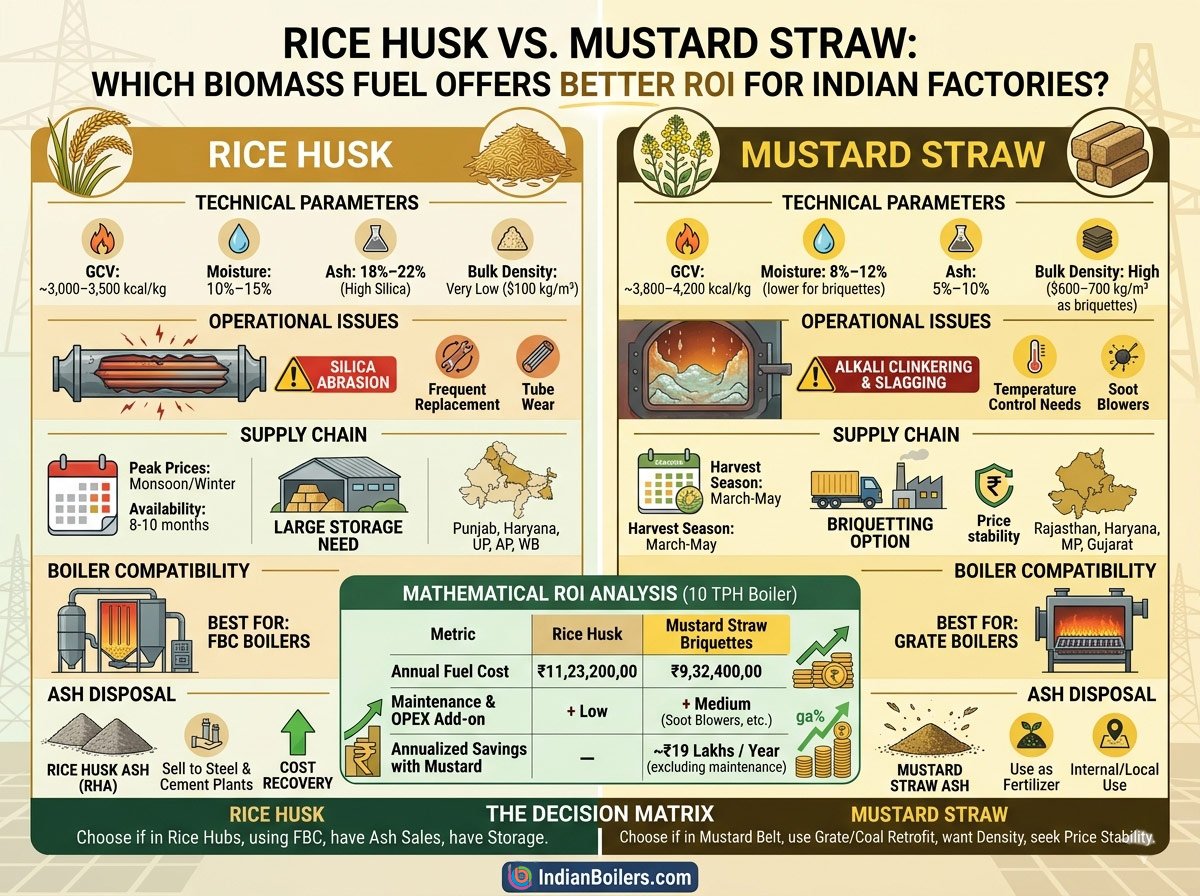
Rice Husk vs. Mustard Straw: A Real ROI Comparison for Indian Factories
Coal and LDO pricing keep drifting in directions plant managers can’t control, which is exactly why biomass fuel selection has become a genuine strategic decision rather than a procurement afterthought. Among India’s most widely available agricultural residues, rice husk and mustard straw dominate the conversation — both abundant, both renewable, both capable of generating industrial-grade steam. But they behave very differently once they’re actually inside a furnace, and the fuel that looks cheaper on a per-tonne invoice isn’t always the one that delivers the better return. This guide breaks down the physics, the supply chain reality, and — worked correctly — the actual math.
The Resource Base: Two Different Residue Streams
India generates upward of 500 million tonnes of agricultural residue annually, a substantial share of which has historically been burned in open fields, contributing to serious seasonal air quality problems, particularly across North India. Rice husk and mustard straw represent two of the largest organised streams within that total, but they come from genuinely different points in the agricultural supply chain.
Rice husk is the outer covering separated during rice milling, generated in bulk across Punjab, Haryana, Uttar Pradesh, Andhra Pradesh, and West Bengal — and because milling is a centralized, organized industry, husk supply is correspondingly easier to source commercially than field-collected residue.
Mustard straw (sarson stalk) comes from the mustard-growing belts of Rajasthan, Haryana, Madhya Pradesh, and parts of Uttar Pradesh, harvested as a rabi crop primarily between March and May — but unlike husk, it’s left scattered across open fields rather than concentrated at a single processing point, which shapes its supply chain economics substantially.
Technical Comparison: What the Physics Actually Says
| Parameter | Rice Husk | Mustard Straw (Briquettes/Pellets) |
|---|---|---|
| Gross calorific value (GCV) | ~3,000–3,500 kcal/kg | ~3,800–4,200 kcal/kg |
| Moisture content (as received) | 10–15% | 8–12% (lower if briquetted) |
| Ash content | 18–22% | 5–10% |
| Silica content in ash | Extremely high (~90% of ash) | Low to medium |
| Bulk density | Very low (~100 kg/m³) | High (~600–700 kg/m³ as briquettes) |
| Volatile matter | ~60% | ~70% |
Mustard straw’s higher calorific value means you technically need fewer tonnes of it than rice husk to hit the same steam output. But calorific value alone is a trap — the ash chemistry tells a more important operational story.
The Real Operational Trade-Off: Two Different Engineering Problems
Rice Husk: The Silica-Erosion Challenge
Rice husk’s ash — up to 22% of the fuel by weight — is nearly 90% silica, which burns well and uniformly in a properly designed Bubbling Fluidized Bed Combustion (FBC) boiler, but is genuinely abrasive at high velocity, gradually eroding boiler tubes, bends, and ID fan runners over time. This translates directly into a real, budgetable maintenance line: regular tube-thickness testing and more frequent component replacement than a low-ash fuel would require.
Mustard Straw: The Clinkering and Corrosion Trap
Mustard straw’s lower ash content sounds like a straightforward advantage, but agricultural residues rich in potassium, sodium, and chlorine — mustard straw included — lower the ash fusion temperature, meaning the ash can melt at normal combustion temperatures and form hard, glassy clinker deposits on the grate and furnace walls. Chlorine content also raises the risk of high-temperature corrosion on superheater tubes. Managing this requires careful bed-temperature control (commonly keeping temperatures below roughly 850°C) and automated soot-blowing to prevent efficiency drift from slagging buildup.
Neither challenge disqualifies either fuel — both are widely and successfully used across Indian industry — but both require furnace and grate engineering specifically matched to the fuel’s ash chemistry, not a generic “biomass boiler” design. Our guides on grate speed’s effect on steam production and fuel consumption and Vibrating Grate vs Reciprocating Grate performance go deeper into matching grate mechanism to fuel type.
Boiler Compatibility: Matching Technology to Fuel
Fluidized Bed Combustion (FBC) boilers are the natural fit for rice husk — the fluidizing sand bed handles high ash content and irregular particle size well, while loose mustard straw is genuinely difficult to feed into an FBC system due to its irregular shape.
Grate-fired boilers (reciprocating or travelling grate) suit mustard straw briquettes well, since briquettes behave similarly to coal, burning steadily on the grate. Loose rice husk, by contrast, is too light for standard grates and tends to blow into the flue gas path unburned, causing high unburnt-carbon losses.
If you’re retrofitting an existing coal-fired grate boiler, switching to mustard straw briquettes generally requires more modest capital modification, since fuel handling is broadly similar to coal. Switching to loose rice husk typically requires new pneumatic feeding systems, specialized fuel bunkers, and more substantial ash handling capacity to manage the silica volume.
The Financial Math — Worked Correctly
Consider a mid-sized textile processing unit in North India requiring 10 TPH of saturated steam, operating 24 hours a day, 300 days a year (a 6,000,000 kcal/hr energy requirement). Using the standard formula — fuel consumption (kg/hr) = heat output required ÷ (GCV × boiler efficiency) — and reasonable assumptions of 78% efficiency on rice husk and 81% on mustard straw briquettes (given its lower moisture and more controlled combustion), with GCV of 3,200 kcal/kg for rice husk and 4,000 kcal/kg for mustard briquettes:
Rice husk: effective heat per kg = 3,200 × 0.78 = 2,496 kcal/kg → hourly consumption = 6,000,000 ÷ 2,496 ≈ 2,404 kg/hr (≈57.7 tonnes/day)
Mustard straw briquettes: effective heat per kg = 4,000 × 0.81 = 3,240 kcal/kg → hourly consumption = 6,000,000 ÷ 3,240 ≈ 1,852 kg/hr (≈44.4 tonnes/day)
At a delivered cost of roughly ₹6,500/tonne for rice husk and ₹7,000/tonne for mustard straw briquettes, daily fuel cost works out to approximately ₹3.75 lakh for rice husk and ₹3.11 lakh for mustard briquettes. Annualised over 300 operating days, that’s roughly ₹11.25 crore for rice husk versus ₹9.33 crore for mustard straw briquettes — an annual saving in the range of ₹1.9 crore, not ₹19 lakh. This is worth being precise about: a tenfold arithmetic error of exactly this kind has circulated in versions of this comparison before, and getting the decimal placement right matters when a plant manager is using this figure to justify a capital decision.
From that ₹1.9 crore gross saving, a realistic deduction of roughly ₹2–3 lakh annually for specialised soot-blowing maintenance and periodic grate cleaning (to manage mustard straw’s clinkering tendency) still leaves a decisive financial advantage for mustard straw briquettes in this specific scenario — driven almost entirely by its higher energy density and better achievable combustion efficiency, despite its higher per-tonne purchase price.
Important caveat: this is a worked illustration using stated assumptions, not a universal result. Your actual GCV, moisture, delivered pricing, and achievable efficiency will differ by region and supplier — always run this same formula against your own fuel quotes and boiler specifications rather than applying this specific outcome to your plant.
Supply Chain and Price Stability
Rice husk pricing swings meaningfully with season — commonly ranging from roughly ₹4,500/tonne at harvest to over ₹8,000/tonne during lean periods — given the centralized milling supply chain but seasonal demand pressure. Mustard straw briquettes, because the briquetting process itself smooths out raw-material seasonality, tend to offer more stable pricing, commonly in the ₹6,000–7,500/tonne range depending on region, though the briquetting conversion cost is part of what you’re paying for that stability. Our comparison of Biomass Pellet vs Biomass Briquette performance covers this densification trade-off in more depth.
Environmental Compliance and Ash Value Recovery
Rice husk produces fine, light fly ash that requires an Electrostatic Precipitator (ESP) or high-efficiency bag filter to meet tightening CPCB particulate limits in critically polluted zones; mustard straw ash is heavier and generally easier to capture with a standard cyclonic separator paired with a smaller bag filter. Our biomass boiler emission control systems guide and Pollution Control Equipment range cover what a compliant setup for either fuel requires.
One genuine ROI upside worth factoring in: Rice Husk Ash (RHA), rich in amorphous silica, is commercially sought after by steel plants, cement manufacturers, and brick makers, and many factories recover a meaningful share of fuel cost by selling it — commonly cited in the range of 5–10% of fuel cost, though this depends entirely on securing a genuine local buyer relationship. Mustard straw ash, being potassium-rich, is more useful as farm fertiliser than as a commercial product with meaningful market value.
A Practical Decision Checklist
Rice husk tends to make sense if: your plant sits within practical delivery range of major rice-milling hubs (Punjab, Haryana, Bihar, UP, Andhra Pradesh), you already operate or are installing an FBC boiler, you have a genuine buyer relationship for high-silica fly ash, and you have adequate covered storage for a low-density fuel.
Mustard straw briquettes tend to make sense if: your plant is in Rajasthan, Madhya Pradesh, Gujarat, or Western NCR near mustard cultivation, you run or are retrofitting a grate-fired boiler, storage space is limited (briquettes’ higher bulk density means more energy per square metre), and price stability matters more to your planning than the lowest possible per-tonne cost.
Our Multi-Fuel Approach
There’s no universal winner here — the right fuel depends on your location, existing boiler configuration, and storage capacity. Balkrishna Boilers Pvt Ltd — IndianBoilers.com and Balkrishn.com — designs multi-fuel biomass systems engineered to handle both high-silica rice husk and high-alkali mustard briquettes, so your plant isn’t locked into a single fuel source as regional pricing and availability shift. Our Steam Boiler range includes the husk-specific HUSKPOWER, and our overview of multi-fuel boilers as the future of industrial heating in India covers this flexibility approach in more depth.
Frequently Asked Questions
Is mustard straw always cheaper to run than rice husk? Not on a per-tonne basis — mustard straw briquettes typically cost more per tonne to purchase, but their higher calorific value and combustion efficiency often mean lower fuel cost per tonne of steam produced. Run the formula against your specific delivered prices and boiler efficiency rather than assuming either fuel is universally cheaper.
Can my existing coal boiler burn either fuel without modification? Retrofitting for mustard straw briquettes is generally more modest in capital cost, since fuel handling resembles coal. Switching to loose rice husk typically requires more substantial modification — pneumatic feeding, dedicated bunkers, and enhanced ash handling.
Which fuel is better for emission compliance? Both can meet current CPCB norms with correctly specified filtration — ESP or high-efficiency bag filters for rice husk’s fine fly ash, cyclonic separation plus bag filtration for mustard straw’s heavier ash — but neither is inherently non-compliant if properly equipped.
Can I switch between the two fuels seasonally? Yes, with the right combustion technology — multi-fuel boiler designs specifically engineered to handle both fuel types let you respond to seasonal pricing and availability shifts rather than being locked to one supply chain.
Why does the annual savings figure matter so much to get right? Because a factory sizing a capital investment or negotiating a fuel supply contract around this number needs an accurate order of magnitude — the difference between ₹19 lakh and ₹1.9 crore in projected annual savings would materially change how a plant manager justifies the investment internally, so it’s worth double-checking any such figure against the underlying formula rather than accepting a headline number at face value.
Talk to Our Engineering Team
Ready to calculate the exact payback period for a fuel switch at your factory? Get in touch with our engineering team for a customised fuel audit and boiler performance simulation, or browse our complete product range.
Further reading: Biomass Pellet vs. Biomass Briquette: Which Fuel Gives Better Boiler Performance? · Fuel Moisture vs Boiler Efficiency · Multi-Fuel Boilers: The Future of Industrial Heating in India · Biomass Boilers in India: Fueling Growth with Rice Husk Power