
Improving Vibrating Grate Boiler Efficiency Without Burning More Fuel
When steam demand climbs or fuel prices spike, the instinctive response is to feed more fuel into the furnace. That’s almost always the wrong move — it raises operating cost, increases thermal strain on boiler tubes, and pushes stack emissions higher without addressing the actual problem. Vibrating grate boilers offer genuine fuel flexibility, but fluctuating biomass quality, air leakage, and accumulating thermal losses quietly erode efficiency over time if left unmanaged. This guide walks through four engineering levers — combustion tuning, grate dynamics, heat recovery, and loss prevention — that extract meaningfully more steam from the same fuel input.
1. Optimize Combustion and Air Staging
Combustion efficiency is the foundation everything else builds on. In a vibrating grate boiler, biomass burns in two distinct phases: char combustion on the grate bed itself, and volatile gas combustion in the furnace space above it — which is why air delivery needs to be managed as two separate streams, not one.
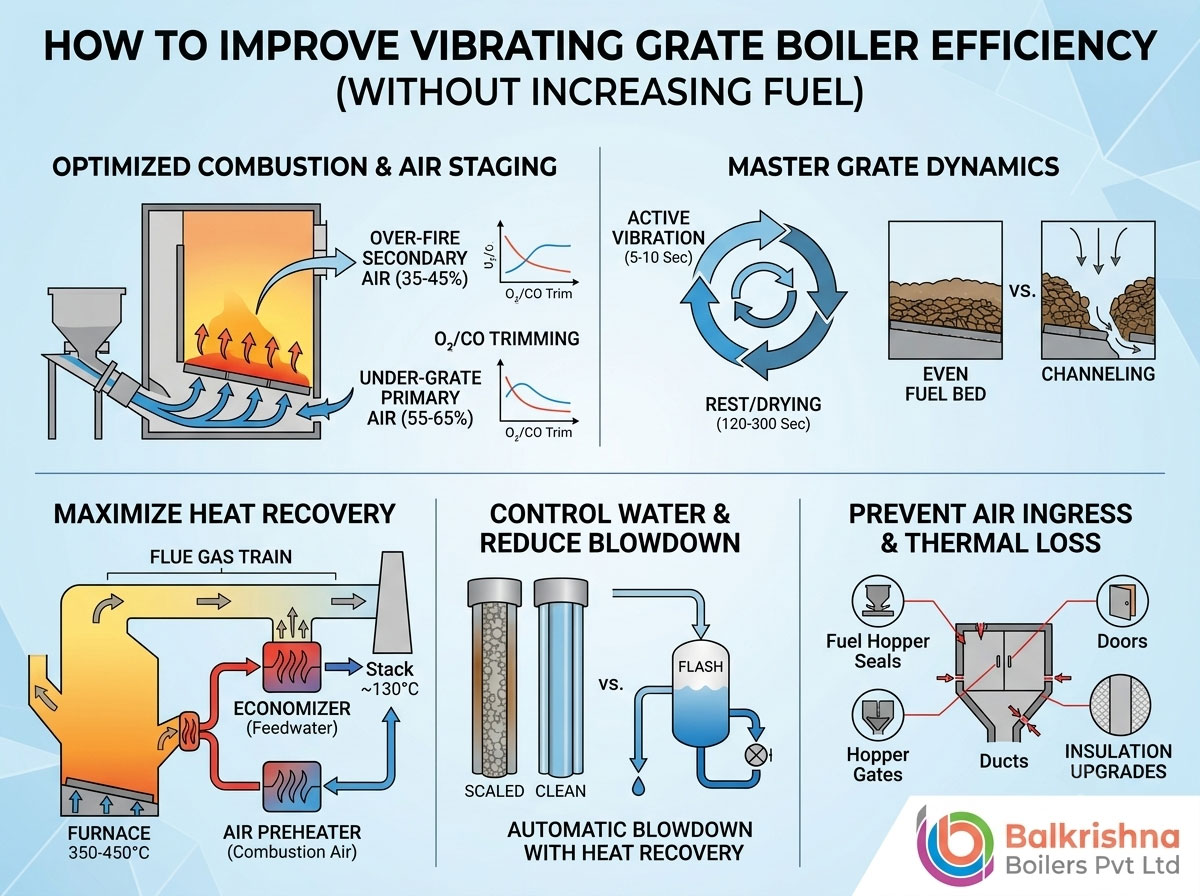
Trimming excess air to cut dry gas losses. Excess air is genuinely necessary for complete combustion, but feeding too much cold air into the furnace absorbs useful heat and carries it straight out the stack. Target 3.5–5.0% O₂ in the flue gas, measured at the economizer or air preheater outlet — as a rule of thumb, every 1% reduction in excess O₂ improves overall boiler efficiency by roughly 0.5%. An online flue gas analyzer (O₂ and CO) linked to VFDs on the FD and ID fans automates this trimming continuously rather than depending on periodic manual spot checks.
Balancing primary versus secondary air. Biomass fuels typically carry 65–80% volatile matter, and poor secondary air mixing leaves unburned volatile gases and elevated CO emissions. Set primary (under-grate) air to roughly 55–65% of total combustion air — enough for bed char oxidation without blowing fine ash off the grate prematurely — and secondary (over-fire) air to 35–45%, injected through staggered, high-velocity nozzles above the bed to create the turbulence needed to burn off volatiles rapidly in the lower furnace.
Our overview of grate speed’s effect on steam production and fuel consumption covers how this air-staging logic interacts with grate mechanism more broadly.
2. Master Grate Vibration Dynamics and Bed Uniformity
The vibrating grate’s core job is transporting fuel, maintaining even bed thickness, and continuously breaking up clinker formations without disrupting heat transfer.
Eliminating fuel bed channeling. When the fuel layer becomes uneven across the grate, primary air naturally follows the path of least resistance — rushing through thin or bare spots while thicker zones stay starved of oxygen. Adjust feed rate across individual fuel throwers or screw feeders to ensure biomass spreads evenly across the grate’s full width. Consistent bed resistance forces primary air to pass uniformly through the entire fuel mass, accelerating both drying and char oxidation.
Tuning vibration and rest cycles. Vibrating too frequently moves unburned fuel into the ash hopper prematurely, raising unburned carbon losses. Rest intervals that run too long let ash fuse into large clinkers that block air distribution slots. A practical operating check: sample bottom ash regularly, and if unburned carbon exceeds roughly 3–5%, extend the rest cycle by 15–30 seconds to increase residence time. If large fused clinkers instead appear in the discharge hopper, shorten the rest interval slightly and increase vibration intensity to break up ash beds before they sinter. Typical cycles run 5–10 seconds of active vibration followed by 120–300 seconds of rest, though the exact balance depends on your specific fuel’s ash chemistry and moisture.
Our comparison of Vibrating Grate vs Reciprocating Grate technology and our guide to the best biomass fuels for vibrating grate boilers go deeper into matching fuel characteristics to this specific grate mechanism.
3. Maximize Heat Recovery from Flue Gases
The single largest thermal loss in any industrial boiler is sensible heat carried away in flue gas leaving the system. Recovering this waste heat directly increases steam generation without consuming an extra gram of fuel — arguably the highest-leverage set of improvements available.
Optimizing economizer performance. The economizer uses hot flue gas exiting the convective bank to preheat boiler feedwater before it enters the steam drum. Every 6°C increase in feedwater temperature entering the boiler yields roughly a 1% gain in thermal efficiency. Keeping economizer tubes clean via soot blowers matters more than it might seem — a thin 1mm layer of soot acts as an effective insulator, driving up flue gas exit temperature and degrading heat transfer meaningfully.
Harnessing combustion air preheating. Preheating primary and secondary air is particularly valuable for biomass boilers firing high-moisture fuels — 30–50% moisture content, common with green wood chips or bagasse. Every 20°C drop in final stack gas temperature increases boiler efficiency by roughly 1%. Inspect air preheater tubes during shutdowns for fly ash erosion or cold-end corrosion, and keep final stack temperatures around 130–140°C — high enough to avoid acid dew-point corrosion, but low enough to capture the maximum practical sensible heat.
4. Control Water Chemistry and Reduce Blowdown Losses
Water quality has a direct, sometimes underappreciated impact on fuel economy. Mineral scale buildup inside boiler tubes acts as a thermal barrier, forcing the boiler to burn more fuel for the same steam output — and the relationship isn’t linear, it compounds quickly. Roughly 0.8mm of scale costs about 2% in fuel efficiency; 1.6mm costs roughly 4%; 3.2mm costs roughly 8.5%. Left unmanaged, scale buildup quietly erodes efficiency well before it becomes an obvious mechanical problem.
Transitioning to automatic continuous blowdown (CBD). Manual bottom blowdown often results in excessive warm water discharge or inadequate TDS control. An automatic surface blowdown controller with a conductivity sensor manages this precisely rather than on a fixed schedule. Passing hot CBD water through a flash vessel and heat exchanger to preheat cold boiler makeup water can recover up to roughly 80% of the heat energy that would otherwise be lost through blowdown entirely.
Implementing proper water deaeration. Dissolved oxygen and carbon dioxide in feedwater cause pitting corrosion on boiler tubes and steam lines. Maintaining deaerator (DA) tank temperature at 103–105°C with constant operating pressure of 0.2–0.35 bar drives off non-condensable gases naturally, minimising chemical oxygen scavenger dosing and protecting internal heating surfaces from corrosion.
5. Prevent Cold Air Ingress and Thermal Losses
Air entering the furnace from unsealed inspection doors, ash hopper gates, or cracked ductwork — known as tramp air — cools the combustion zone, reduces furnace temperature, and forces ID fans to work harder than necessary.
Conducting regular furnace leakage tests. Smoke tests or thermal imaging scans along expansion joints, access doors, soot blower openings, and flue gas ducting during operation reveal leak points that aren’t visible during a static walkthrough. Replacing degraded fiberglass rope gaskets and applying high-temperature sealant around door frames and hopper flanges stabilises furnace draft, prevents localized cooling, and reduces ID fan electrical consumption as a direct result.
Inspecting and upgrading thermal insulation. Uninsulated or under-insulated steam pipes, valve bodies, and boiler side-walls continuously radiate heat into the boiler house. A thermographic insulation survey should show insulated boiler walls and steam pipelines running no more than roughly 15–20°C above ambient temperature — removable insulation jackets over steam valves, strainers, and flanges eliminate localized radiation losses that fixed insulation often misses around these irregular shapes.
A Practical Weekly and Monthly Checklist
| Parameter/Area | Ideal Target | Operational Action |
|---|---|---|
| Flue gas O₂ | 3.5–5.0% | Trim FD fan dampers/VFD to match fuel feed rate |
| Flue gas stack temperature | 130–140°C | Clean economizer and APH tubes via soot blowers |
| Unburned carbon in ash | Below ~3.0% | Increase grate rest time; optimise over-fire air velocity |
| Blowdown TDS | 2,000–3,500 ppm | Automate blowdown using continuous TDS controllers |
| Feedwater temperature | ~103°C at DA outlet | Ensure adequate low-pressure steam supply to deaerator |
| Furnace draft pressure | −2 to −5 mm WC | Balance FD/ID fans to maintain slight negative pressure |
Sequencing These Improvements for Maximum Impact
Tackling all five areas simultaneously isn’t necessary or even practical for most plants — a more effective approach is sequencing by cost and complexity. Start with combustion trimming and grate timing adjustments, since these typically require only sensor and control tuning rather than capital equipment. Move next to water chemistry and blowdown automation, which usually involves moderate-cost controller upgrades. Address air leakage and insulation gaps as they’re identified through leak testing and thermal imaging surveys. Reserve larger capital investments — new economizers, air preheaters, or blowdown heat recovery systems — for after the lower-cost operational fixes are in place, since a poorly tuned combustion system will undermine the returns from a new heat-recovery investment regardless of how well that equipment itself is engineered.
How This Connects to Your Broader Fuel Strategy
These operational improvements deliver their full value when paired with the right fuel choice for your grate technology in the first place — our guides on the best biomass fuels for vibrating grate boilers and fuel moisture vs boiler efficiency cover the fuel-selection side of this same efficiency equation. If you’re troubleshooting recurring clinkering or bed instability beyond what routine tuning resolves, our Common Biomass Boiler Problems and Their Solutions guide covers the underlying combustion chemistry in more depth.
Digital Monitoring Sustains These Gains
A one-time tuning exercise tends to drift back toward baseline within a year or two without ongoing monitoring — continuous tracking of O₂ levels, stack temperature, and unburned carbon trends catches drift early rather than only during a scheduled audit. Our piece on how AI and IoT are transforming biomass boiler operations covers how this monitoring layer applies directly to the parameters in the checklist above.
Our Engineering Support
Balkrishna Boilers Pvt Ltd — IndianBoilers.com and Balkrishn.com — helps industrial plants maximise steam generation while keeping fuel consumption under control, through full thermal efficiency audits, grate and air-system retrofits (upgraded distribution manifolds, high-efficiency over-fire air nozzles, VFD control tuning), and customised waste heat recovery retrofits — economizers, air preheaters, and blowdown heat recovery units — engineered specifically for high-ash biomass operation. Our Steam Boiler range includes multi-fuel systems built around these same principles.
Frequently Asked Questions
How much efficiency gain is realistically achievable from these changes combined? It depends heavily on how far your current operation sits from these targets — a plant with significant existing air leakage, scale buildup, and untrimmed combustion could see a meaningful multi-percentage-point gain, while a well-maintained system will see more incremental improvement. A thermal audit against your actual baseline gives the real number.
Which of these five areas delivers the fastest payback? Combustion air trimming (excess O₂ reduction via flue gas analyzer and VFD control) typically offers the fastest, lowest-cost payback, since it often requires only sensor and control upgrades rather than major mechanical retrofit.
How often should bottom ash be checked for unburned carbon? Regularly as part of routine operational monitoring — daily or per-shift sampling during normal operation lets you catch grate timing drift before it compounds into a significant efficiency loss.
Does scale buildup happen gradually or suddenly? Gradually, which is exactly why it’s easy to miss without dedicated water chemistry monitoring — the compounding fuel-loss relationship (roughly doubling per doubling of scale thickness) means catching it early, before it reaches even 1.6mm, meaningfully limits the cumulative cost.
Talk to Our Engineering Team
Ready to schedule an efficiency evaluation for your vibrating grate boiler? Contact our technical team or browse our complete product range.
Further reading: Vibrating Grate Boiler vs Reciprocating Grate Boiler: Which Technology Delivers Better Performance? · Best Biomass Fuels for Vibrating Grate Boilers · Steam Boiler Efficiency: Boost Savings by 30% with Proven Tips · Common Biomass Boiler Problems and Their Solutions