
Vibrating Grate vs. Reciprocating Grate: Which One Actually Fits Your Fuel Profile?
Choosing between vibrating and reciprocating grate technology is one of the most consequential decisions in a solid-fuel boiler specification — get it wrong, and you’re looking at years of unplanned downtime, or a maintenance bill considerably higher than it needed to be. Both technologies represent a genuine leap forward from hand-fired or basic chain grate systems, but they solve the combustion problem through fundamentally different mechanics, which is exactly why one isn’t universally “better” than the other.
This guide compares the two head-to-head across the metrics that actually determine plant performance. For the full mechanical detail on reciprocating grates specifically, our dedicated reciprocating grate mechanics guide covers the shearing action and clinker-breaking mechanism in depth — this piece introduces vibrating grate technology alongside it and focuses on the comparative decision.
1. What a Vibrating Grate Boiler Actually Is
A vibrating grate is a fundamentally different mechanical approach to solid fuel combustion — genuinely elegant in its simplicity compared to the hydraulic complexity of a reciprocating system.
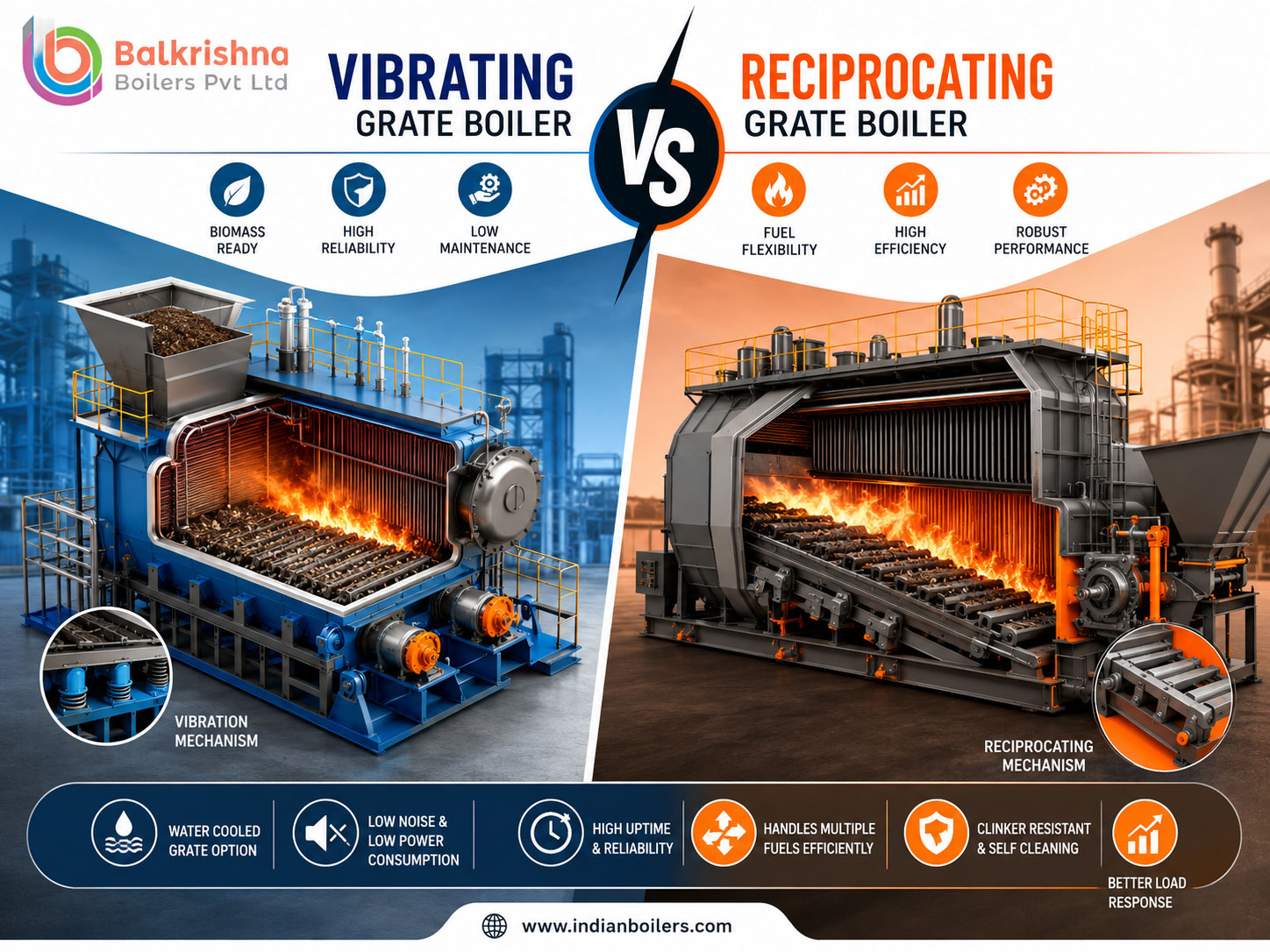
The core mechanism: a large, inclined grate surface sits on a specialized spring-based suspension system. Rather than moving parts inside the hot furnace zone pushing fuel forward, external vibration generators drive the entire assembly. Fuel enters via a hopper at the top of the incline, and precisely timed high-frequency, low-amplitude vibration causes the fuel bed to fluidize and advance slowly down the grate, passing through drying, gasification, burning, and ash discharge zones along the way.
The distinctive design choice: vibrating grates manufactured for demanding applications are commonly water-cooled — grate bar tubes integrated directly into the boiler’s natural water circulation system, rather than relying on air cooling alone.
2. Why Water Cooling Changes the Fuel Suitability Picture
This is the mechanical detail that explains most of vibrating grate technology’s genuine strengths and limitations.
Because the grate bars themselves are water-cooled rather than air-cooled, they can tolerate the high furnace temperatures generated by high-volatility, high-moisture fuels without the grate metal itself overheating and warping — a genuine advantage for fuels like sugarcane bagasse, wood chips, and palm kernel shells, all of which combine high moisture with rapid volatile release.
This same water-cooling design is what enables vibrating grates’ most significant practical advantage: because there are virtually no moving mechanical parts inside the hot furnace zone itself — the vibration mechanisms sit outside the casing — mechanical wear and tear drops considerably compared to a system with heavy moving parts directly exposed to combustion heat and abrasive ash.
3. Where Vibrating Grates Genuinely Struggle
Clinker vulnerability is the single biggest limitation, and it traces directly back to the gentle nature of vibration itself. Many Indian agro-wastes — rice husk and mustard stalk particularly — have ash that fuses into glass-like clinkers at relatively low temperatures. Because vibration is inherently a gentle agitation method rather than an active mechanical shearing action, it genuinely cannot break up these clinker masses once they form. Blocked air holes, uneven combustion air distribution, and grate trips are the practical consequence.
Particle size sensitivity — maintaining a uniform, properly-fluidizing fuel bed via vibration requires reasonably consistent fuel sizing. A mix of large chunks and fine dust can cause air channeling that vibration alone can’t correct.
Incline height requirement — the inclined surface needed to facilitate fuel movement adds to overall boiler house height requirements, a genuine site-planning consideration.
4. Reciprocating Grates: The Brief Version
Our dedicated reciprocating grate guide covers this technology’s mechanics in full — alternating fixed and movable bars, hydraulically driven to actively tumble and shear the fuel bed, specifically engineered to fracture clinkers before they can merge into blockages. The short version relevant to this comparison: where vibrating grates gently fluidize fuel, reciprocating grates aggressively agitate it — a fundamentally more forceful combustion process that trades mechanical simplicity for genuine fuel flexibility.
5. Head-to-Head: Six Performance Metrics
Fuel Flexibility — Reciprocating Grate Wins
If you know precisely what you’re burning — a sugar mill running 100% bagasse, for instance — vibrating grate technology performs excellently. But if fuel procurement depends on market availability, switching between coal, wood chips, mustard stalk, and rice husk as pricing and seasonal supply shift, reciprocating grate technology is genuinely the safer choice. It handles high-ash, abrasive, and clinker-prone fuels that would cause a vibrating grate to fail within hours.
Combustion Efficiency and Burnout — Reciprocating Grate Wins, Marginally
The active tumbling action of a reciprocating grate typically ensures better fuel-air mixing, translating to lower unburnt carbon in ash. Vibrating grates can match this for well-suited, reactive biomass fuels with careful over-fire air system setup, but for coal specifically, reciprocating grates generally hold a meaningful efficiency edge.
Maintenance and Reliability — Vibrating Grate Wins
This is vibrating grate technology’s single strongest selling point. Moving all wear components outside the furnace vastly simplifies maintenance and meaningfully improves plant uptime. With air-cooled reciprocating grates specifically, a bar jammed by a foreign object can force a complete shutdown lasting days — cooling the furnace, entering it safely, and completing repairs before restart.
Load Response and Control — Reciprocating Grate Wins
Reciprocating grates offer precise mechanical control over fuel flow — if steam demand drops suddenly, a common occurrence in textile or chemical batch processing, grate speed can be adjusted almost instantly. Vibrating grates, relying on gravity and gentle agitation rather than positive mechanical pushing, respond somewhat more slowly by comparison.
High Moisture Handling — Water-Cooled Vibrating Grate Wins
For extremely wet fuels — bagasse at 50%+ moisture, or green wood chips — the water-cooled vibrating grate genuinely excels. Water cooling prevents grate overheating while radiant heat from the furnace refractory arch dries fuel as it moves down the incline, a combination purpose-built for exactly this fuel challenge.
Capital vs. Operating Cost — A Genuine Trade-off
Vibrating grates typically carry higher upfront capital cost, driven by the specialized water-cooled tube integration and suspension system — but lower ongoing operating cost through reduced maintenance and power consumption. Reciprocating grates (air-cooled versions specifically) generally carry lower capital cost, but higher operating cost from grate bar wear, unburnt carbon losses, and hydraulic system power draw. Neither is universally cheaper over the equipment’s full lifecycle — it depends on your specific fuel profile and how heavily that profile plays to each technology’s strengths.
6. The Practical Verdict: Match the Technology to Your Fuel Reality
Choose a water-cooled vibrating grate if:
- Your primary fuel is uniform, high-volatility, high-moisture biomass — sugarcane bagasse in a sugar mill, wood chips in a paper mill, or certain palm kernel shell applications.
- Maximum uptime and lowest maintenance cost is your top priority.
- You have consistent, reliable supply of the same fuel type, without significant seasonal switching.
- Your application involves high-pressure requirements where water-cooled grate integration contributes usefully to overall steaming capacity.
Choose a reciprocating grate if:
- You’re burning challenging, clinker-prone agro-waste — rice husk, cotton stalk, mustard stalk — where a vibrating grate’s gentle agitation genuinely can’t manage the ash chemistry. Our reciprocating grate fuel guide covers exactly which fuels fall into this category and why.
- You need genuine fuel flexibility to switch between coal, MSW, and various biomass types depending on current market pricing.
- Your fuel sizing is inconsistent, or you’re burning low-grade, high-ash coal.
- Your operation needs rapid response to sharp, fluctuating steam demand.
7. Why the Grate Is Only One Piece of the Engineering Puzzle
Grate technology alone doesn’t determine boiler performance — furnace volume, combustion air distribution across primary, secondary, and tertiary stages, over-fire air nozzle placement, fuel feeding system design, and air preheating all need to be engineered specifically around whichever grate technology and fuel profile you’ve settled on. A vibrating grate needs an over-fire air system properly tuned to ensure complete volatile burnout given its gentler primary combustion action; a reciprocating grate needs heavy-duty grate bar metallurgy genuinely capable of handling the abrasive reality of Indian solid fuels. Getting one element right without the others undermines the whole system’s performance.
Conclusion: There’s No Universal Winner, Only a Better Fit
The question was never really “which technology is better” — it’s “which technology is better matched to your specific fuel profile and operational structure.” Vibrating grates deliver genuinely exceptional uptime and low maintenance for consistent, high-moisture biomass fuel; reciprocating grates deliver genuine flexibility and clinker resistance for challenging, variable, or clinker-prone fuel streams. Neither wins outright — the right choice depends entirely on what you’re actually burning and how consistently you’re burning it.
Balkrishna Boilers Pvt Ltd engineers both technologies to current Boilers Act, 2025 compliance standards, matched to your specific fuel profile through proper thermal modeling rather than a default recommendation. Explore the full range on IndianBoilers.com or Balkrishn.com.
Not sure which grate technology fits your fuel and operational reality? Contact our engineering team for a technical consultation matched to your specific fuel profile and steam demand.
Related Reading
- Reciprocating Grates: The Mechanical Engineering Behind Clinker-Proof Biomass Combustion
- Which Biomass Fuel Actually Suits Your Reciprocating Grate? A Fuel-by-Fuel Breakdown
- Traveling Grate Fuel Selection: What Belongs Here vs. What Belongs on a Reciprocating Grate
- Traveling Grate Boilers for Sugar Mills: The Ultimate Engineering Guide
- The Boilers Act, 2025 – Download PDF