
Understanding Boiler Grates: The Ultimate Guide to Industrial Combustion Systems
In any solid-fuel boiler — whether it runs on coal, biomass briquettes, agro-waste, rice husk, or municipal solid waste — the boiler grate is the single most important component inside the combustion chamber. It is the mechanical platform that holds burning fuel in place while letting combustion air pass through from below, and it directly decides your plant’s thermal efficiency, fuel flexibility, running cost, and emission levels.
Get the grate selection wrong, and you end up fighting slagging, unburnt fuel loss, or premature grate-bar failure for years. Get it right, and your boiler runs smoothly for a decade or more.
At IndianBoilers.com — the boiler division of Balkrishna Boilers Pvt Ltd — we design and manufacture industrial boilers engineered around the fuel our customers actually burn, not a one-size-fits-all combustion system. This guide walks through every major type of boiler grate, how each one works, and how to choose the right one for your fuel and capacity requirement.
What Is a Boiler Grate and Why Does It Matter?
A boiler grate is a porous or slotted mechanical bed inside the furnace on which solid fuel rests and burns. It performs three jobs at once:
- Fuel Support — holds the fuel bed at a uniform depth during ignition and combustion.
- Air Distribution — lets primary (under-grate) air pass through the fuel bed to supply oxygen for complete combustion.
- Ash Discharge — removes accumulated ash and clinker from the combustion zone, continuously or in cycles.
A poorly specified grate shows up quickly as high carbon-in-ash loss, uneven air-to-fuel ratios, clinker build-up, and early grate-bar wear — all of which push up fuel cost and maintenance downtime.
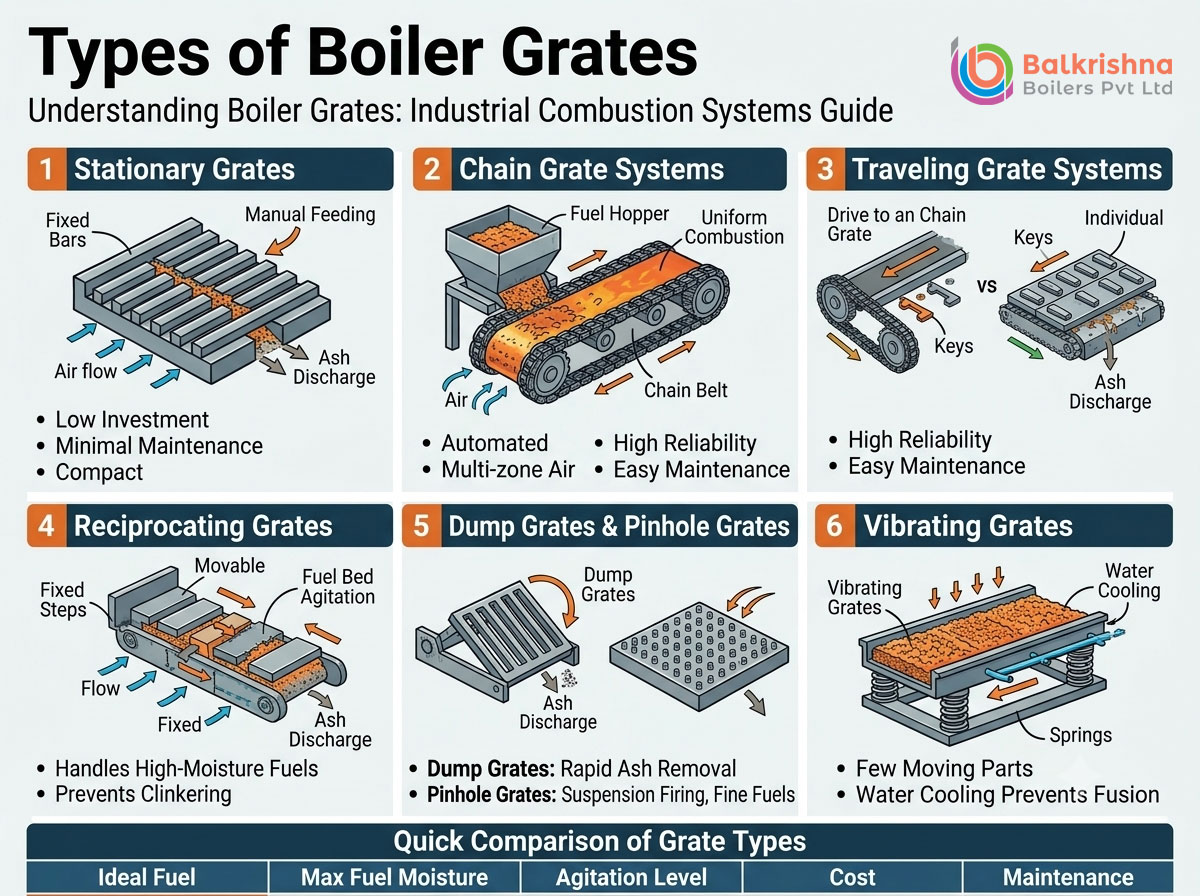
1. Stationary Grates (Fixed / Hand-Fired Grates)
The simplest and oldest grate design. Static, heat-resistant cast-iron bars are arranged flat or at a slight incline inside the furnace. Fuel is fed manually or through gravity chutes; primary air rises through the gaps between bars; ash is removed by hand during cleaning cycles.
Advantages: low capital cost, no moving parts, minimal maintenance, compact footprint.
Limitations: labour-intensive, lower thermal efficiency due to cold-air ingress during manual stoking, and a practical capacity ceiling of around 1–2 TPH — suited only to very small boiler houses.
2. Chain Grate Boiler
The most widely used mechanical stoker for uniform coal and dry biomass pellets. The grate is essentially a continuous conveyor belt made of heat-resistant alloy steel or high-chromium cast-iron links.
Fuel enters from a hopper, regulated by a levelling curtain for uniform bed depth. As the belt moves forward, the fuel passes through drying, volatilization, ignition, and full combustion before dropping off as ash at the far end. Because the chain completes a full loop, half the grate surface is always cooling outside the combustion zone — which extends component life significantly.
Best suited to: bituminous coal (6–25 mm), low-moisture biomass pellets and wood chips, groundnut shells and agro-pellets.
Grate travel speed has a direct bearing on both steam output and fuel consumption — we’ve covered the engineering detail in Chain Grate Boiler Speed: How It Affects Steam Production and Fuel Consumption. For a ready-built chain-grate steam boiler, our STEAMPOWER series on Balkrishna Boilers is a common starting point for 2–15 TPH coal and biomass-fired applications.
3. Traveling Grate Boiler
Traveling grates look similar to chain grates but differ structurally: heavy steel chains carry transverse bars holding independent grate “keys,” so individual keys can be swapped without touching the drive chains.
| Feature | Chain Grate | Traveling Grate |
|---|---|---|
| Bar replacement | Section disassembly often needed | Individual keys replaced easily |
| Thermal expansion | Absorbed by the chain itself | Isolated to the grate keys |
| Typical scale | 1–15 TPH | 10–100+ TPH |
Traveling grates handle larger, more demanding installations with less downtime for maintenance. This is the standard choice for high-capacity plants — see our detailed breakdown in Travelling Grate Boilers for Sugar Mills: The Ultimate Engineering Guide and How to Select the Right Fuel for a Travelling Grate Boiler.
4. Reciprocating Grate Boiler (Step Grate)
High-moisture, variable-size, low-density biomass tends to sit stagnant on a moving belt-type grate — which is where reciprocating grates take over. Alternating rows of fixed and movable heat-resistant bars, set on a 15°–25° incline, are driven by hydraulic cylinders or eccentric shafts in a pulsating 50–100 mm stroke. This both pushes fuel down the hearth and continuously tumbles the bed, breaking up clinkers and exposing unburnt fuel to oxygen.
Sub-types:
- Pushing (Forward-Feeding) Grates — fuel and grate move together, speeding up fuel travel.
- Reverse-Feeding Grates — movable bars work against gravity flow, maximizing residence time — ideal for very high-moisture biomass and MSW.
Reciprocating grates handle loose straw, mustard stalks, bagasse, MSW, and wood waste at up to 40–50% moisture, with excellent carbon burnout. We go deeper into retrofits, fuel-moisture limits, and combustion efficiency in:
- Reciprocating Grate Boiler Retrofit Guide for Existing Plants
- Fuel Moisture vs Boiler Efficiency: Finding the Ideal Range for Reciprocating Grate Boilers
- How Reciprocating Grate Boilers Handle High-Moisture Biomass Better Than Conventional Boilers
- Best Biomass Fuels for Reciprocating Grate Boilers: An Industrial Guide
- How Reciprocating Grate Technology Improves Biomass Combustion Efficiency
For a factory-fit reciprocating/husk-fired steam boiler, see the HUSKPOWER series on Balkrishna Boilers.
5. Dump Grates and Pinhole Grates
Used in suspension and semi-suspension biomass firing, where fine particles burn mid-air while heavier particles land on a floor-level grate.
- Pinhole Grates — stationary, water- or air-cooled cast alloy plates with hundreds of small high-velocity air nozzles. Best for fine fuels: rice husk, sawdust, shredded bagasse.
- Dump Grates — grate sections mounted on pivoting trunnions; the operator triggers a pneumatic or hydraulic actuator to tip the grate 90° and dump the ash bed. Common in bagasse-fired sugar mill boilers.
If rice husk or similar fine biomass is your primary fuel, our comparison of husk against other agro-residues may help with fuel sourcing decisions: Rice Husk vs. Mustard Straw: Which Biomass Fuel Offers Better ROI for Indian Factories?
6. Vibrating & Pulsating Grates
A water- or air-cooled grate structure suspended on spring mounts, driven by an eccentric motor or hydraulic pulse generator to vibrate periodically (5–10 seconds every few minutes). Because the vibration motors and springs sit outside the hot zone, and boiler feedwater tubes are integrated into the grate surface itself, this design keeps metal temperatures low — extending grate life to 10–15+ years with very low maintenance.
Related reading:
- How to Improve Efficiency of a Vibrating Grate Boiler Without Increasing Fuel Consumption
- Best Biomass Fuels for Vibrating Grate Boilers
- Vibrating Grate Boiler vs Reciprocating Grate Boiler: Which Technology Delivers Better Performance?
For clean-biomass and pellet-fired applications, our PELLETAX series on Balkrishna Boilers is engineered around this same low-maintenance philosophy.
Comparing All Boiler Grate Types
| Grate Type | Ideal Fuel Types | Max Fuel Moisture | Agitation Level | Relative Cost | Maintenance Need |
|---|---|---|---|---|---|
| Stationary Grate | Sized Coal, Wood Logs | < 15% | None (Manual) | Low | Low (Labour High) |
| Chain Grate | Bituminous Coal, Sized Pellets | < 20% | Low | Moderate | Moderate |
| Traveling Grate | Coal, Agro-Briquettes, Pellets | < 25% | Low | Moderate–High | Moderate |
| Reciprocating Grate | Loose Biomass, MSW, Bark, Straw | Up to 50% | High | High | Moderate–High |
| Pinhole Grate | Rice Husk, Sawdust, Fine Bagasse | < 30% | Low–Moderate | Moderate | Low |
| Dump Grate | Sugarcane Bagasse, Wood Chips | < 45% | Low (Periodic Dump) | Moderate | Low |
| Vibrating Grate | Clean Biomass, Shredded Wood | Up to 40% | Moderate (Controlled) | High | Very Low |
How to Choose the Right Grate for Your Boiler
1. Fuel Characteristics (Moisture & Ash):
- High-volatile, dry fuels (pellets, sized coal) → Chain Grate or Traveling Grate.
- High-moisture, high-ash agro-waste (paddy straw, cotton stalks, MSW) → Reciprocating Grate.
- Fine dusty biomass (rice husk, sawdust) → Pinhole Grate or combustion air nozzle array.
2. Boiler Capacity & Operating Pressure: small units under 2 TPH can run on fixed or dump grates; process plants needing 5–50+ TPH need automated chain, traveling, or reciprocating step grates to hold steam output steady.
3. Material Metallurgy: grate bars face 800°C–1100°C thermal stress plus abrasion and chemical corrosion from fuel sulfur/alkali content. Insist on high-chromium cast-iron alloys (Cr18, Cr26, Ni-Hard) or water-cooled membrane structures for high-heat zones.
Why Choose Balkrishna Boilers / IndianBoilers.com
We engineer and manufacture a full line of IBR-certified steam boilers, thermic fluid heaters, and hot water generators built for Indian and export operating conditions:
- Custom Combustion Engineering — we match your local fuel supply (biomass briquettes, coal, bagasse, agro-waste) to the right grate configuration: chain, reciprocating, pinhole, or fluidized bed.
- Maximum Heat Recovery — built-in economizers and air preheaters push thermal efficiency to 88–92%.
- Robust Metallurgy — high-grade, heat-resistant alloy castings on every grate link and step bar.
- Turnkey Support — from design approval and fabrication to installation, testing, and CPCB emission compliance.
Browse our complete range of grate-fired boilers under Steam Boiler on Balkrishna Boilers, including WILLSTEAM and ENERPOWER models for multi-fuel and waste-heat applications.
Frequently Asked Questions
What is the difference between a chain grate boiler and a fluidized bed boiler (AFBC/CFBC)? A chain grate boiler is a layer-burning system where fuel sits on a moving metal belt. An FBC boiler suspends fuel particles in a boiling bed of hot sand or alumina using high-pressure air. FBC suits very fine or low-grade coal/biomass better, while grate boilers need lower fan auxiliary power and lower capital cost for medium-sized installations.
How do you prevent clinker formation on boiler grates? Maintain the correct primary-to-secondary air ratio to avoid hot spots, use a reciprocating grate to keep disturbing the ash bed, and blend high-silica agro-waste with fuels that have a higher ash-fusion temperature.
How long do boiler grate bars typically last? With correct cooling and material selection (high-chromium cast iron), grate bars typically last 3–5 years under continuous operation. Water-cooled vibrating grates can last well beyond 10 years.
Optimize Your Furnace Performance Today
Choosing the right boiler grate is a long-term investment in efficiency, fuel cost, and uptime. Whether you’re installing a new multi-fuel boiler or retrofitting an existing furnace, IndianBoilers.com and Balkrishna Boilers bring decades of combustion engineering experience to the table.
Ready to find the right grate system for your plant? Get in touch with our process heating engineers for a customized technical recommendation.