
Boiler Efficiency vs. Fuel Cost: You’re Asking the Wrong Question
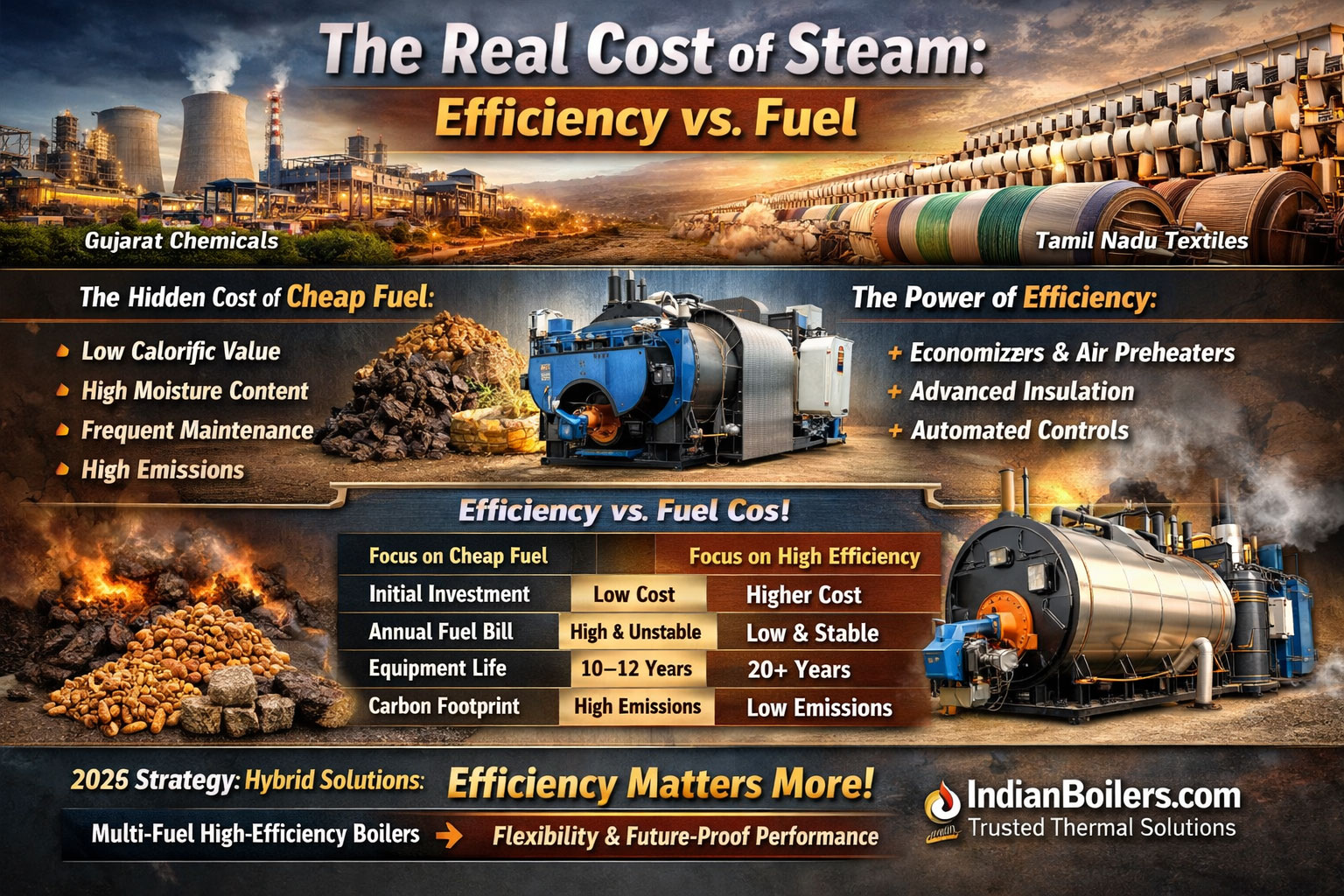
Plant managers across India’s industrial belts — chemical hubs in Gujarat, textile clusters in Tamil Nadu, agro-processing units in Punjab — tend to frame this as a binary choice: chase the cheapest fuel, or invest in the most efficient boiler. That framing misses the actual decision. The number that matters is neither fuel price nor efficiency percentage in isolation — it’s your Total Cost of Steam (TCS): what it genuinely costs you to produce one tonne of usable steam, all factors combined. This guide breaks down both variables honestly, gives you a real formula to calculate your own number, and explains why efficiency is usually — but not always — the more powerful lever to pull.
The Real Cost of “Cheap” Fuel
Chasing the lowest price per kilogram of fuel is an understandable instinct, but low-grade fuel — whether unrefined coal, wet biomass, or poorly sourced agricultural waste — routinely costs more than it appears to on the procurement invoice.
Lower calorific value. Cheap fuel often carries less usable energy per kilogram, meaning you burn more volume to hit the same steam output — which increases not just fuel cost but handling, storage, and transport cost too.
High moisture content. Wet biomass or low-grade coal wastes a meaningful share of combustion energy simply evaporating internal moisture before any useful heat transfer happens, directly reducing achievable thermal efficiency. Our detailed breakdown of fuel moisture vs boiler efficiency — finding the ideal range sets out target moisture bands worth negotiating into any fuel supply contract.
Accelerated maintenance cost. Low-cost fuels with high impurity, sulfur, or ash content cause clinkering on grates and soot buildup on heat-transfer surfaces, leading to more frequent shutdowns and shorter component life — costs that don’t show up on the fuel invoice but absolutely show up in your annual maintenance budget.
Emission compliance risk. Cheap, poorly-controlled fuels are more likely to generate excess particulate matter and SOx/NOx emissions, and as CPCB and state pollution control norms continue tightening, the cost of non-compliance — fines, forced downtime, reputational risk with export buyers — can outweigh whatever was saved on fuel procurement.
Where Efficiency Actually Gets Won or Lost
Boiler efficiency is the ratio of heat delivered as useful steam versus heat provided by the fuel burned. A 1–2 percentage point efficiency gain sounds marginal in isolation, but projected across an annual operating cycle of several thousand hours, the cumulative fuel-consumption difference is genuinely significant — the exact rupee figure depends entirely on your boiler size, fuel type, and utilisation, which is why a specific universal savings number should always be treated skeptically until you’ve run your own calculation (more on that below).
Stack losses — heat escaping through the chimney — are typically the largest single efficiency loss in any boiler. Economizers and air preheaters (APH) recover a meaningful share of this otherwise-wasted heat and feed it back into the system; our efficiency-focused guide with proven retrofit tips covers exactly how these work and what gains they realistically deliver.
Radiation and convection losses come from heat bleeding through poorly insulated boiler shells and pipework — addressed through proper refractory material and adequate insulation thickness on the boiler and full distribution run, not just the sections nearest the boiler.
Blowdown losses result from poor feedwater treatment forcing more frequent blowdown to manage scale-forming solids, each cycle releasing hot water (and its embedded energy) that has to be replaced and reheated. Automated, conductivity-controlled blowdown systems minimise this loss compared to fixed manual-schedule blowdown.
Calculating Your Own Number — Not a Borrowed One
Rather than quoting a single flat savings figure that may not reflect your plant’s actual scale, fuel type, or utilisation, use this formula to calculate your own:
Annual Fuel Savings from Efficiency Gain = (Current Annual Fuel Spend) × [1 − (Old Efficiency ÷ New Efficiency)]
For example, a plant currently spending a given amount annually on fuel, improving efficiency from 80% to 82%, would see the fuel required to produce the same steam output drop by roughly 2.4% — apply that percentage to your actual current fuel spend to get your genuine expected saving, rather than relying on a generic industry figure. Larger boilers, higher fuel costs, and higher utilisation hours all scale this number up substantially; smaller, lower-utilisation systems will see a proportionally smaller absolute saving even at the same percentage efficiency gain. Over a boiler’s typical multi-decade working life, even a modest annual saving compounds into a substantial cumulative figure — but the honest approach is calculating your specific number, not borrowing someone else’s.
A More Honest Comparison
| Factor | Prioritising Cheapest Fuel | Prioritising High Efficiency |
|---|---|---|
| Initial investment | Generally lower | Generally higher, given advanced combustion and auxiliary equipment |
| Annual fuel bill | More exposed to fuel price volatility and higher consumption volume | More insulated from price swings, given lower consumption for the same output |
| Equipment wear | Typically higher, given impurity and moisture-related stress on components | Typically lower, given cleaner, more complete combustion |
| Emission profile | Higher risk of non-compliance with tightening norms | Generally better positioned for compliance |
| Operational complexity | Often more manual, labour-intensive combustion management | More automated, predictive maintenance-friendly |
This table simplifies a genuinely more nuanced picture — see the caveat below on when the “cheapest fuel” side of the table can still be the smarter play.
Strategic Flexibility: The Multi-Fuel, Automated Approach
The most resilient Indian industrial plants aren’t purely optimising for either efficiency or fuel cost in isolation — they’re building flexibility into their combustion system so they can respond to whichever variable moves against them in a given season. Multi-fuel-capable combustion systems, engineered to maintain reasonably consistent efficiency across rice husk, mustard stalk, wood pellets, and other regionally available fuels, let a plant manager shift fuel sourcing based on seasonal pricing without sacrificing the performance benefits of a well-designed combustion system. Our overview of multi-fuel boilers as the future of industrial heating in India covers this approach in more depth.
Digital monitoring reinforces this flexibility in practice — real-time oxygen trimming and automated fuel-to-air ratio control keep combustion in its efficient operating band automatically, even as fuel quality varies batch to batch, rather than depending on manual operator adjustment. Our pieces on how AI and IoT are transforming biomass boiler operations and digital twin technology for boiler efficiency and reliability cover this monitoring layer in more depth.
So Which Actually Matters More?
Efficiency is usually the more powerful lever, for one structural reason: fuel price is a market variable you don’t control, while your boiler’s efficiency is an engineering variable you do. A more efficient system genuinely dampens the impact of fuel price volatility — if your fuel cost rises 20%, an efficient plant absorbs that shock proportionally less than an inefficient one burning more fuel to begin with.
That said, this isn’t an absolute rule, and it’s worth stating the honest exception: if you’re currently on a genuinely expensive fossil fuel — furnace oil or LDO — and haven’t yet made a fuel-type switch to a fundamentally cheaper option like biomass, that switch typically delivers a larger cost impact than an efficiency upgrade on your existing fossil-fuel system would. In other words, fuel type selection and efficiency improvement aren’t actually competing priorities — for many plants still on expensive fossil fuels, the biggest single lever is switching fuel type first, then optimising efficiency on the new system. Our Complete Guide to Biomass Boilers for Steam Generation and detailed efficiency retrofit guide work together as sequential steps, not competing strategies.
A Practical Sequence for Reducing Total Cost of Steam
- Confirm your current baseline. Get a genuine efficiency audit — direct or indirect method — rather than relying on nameplate ratings.
- Evaluate your fuel type first. If you’re on furnace oil, LDO, or high-cost coal, a fuel-switch to biomass is typically the single largest lever available before considering efficiency retrofits on the existing system.
- Then optimise efficiency on whatever fuel you land on. Economizers, air preheaters, insulation, and combustion automation compound with your fuel choice rather than substituting for it.
- Build in monitoring to sustain the gains. A one-time efficiency upgrade without ongoing combustion monitoring tends to drift back toward baseline over a year or two as maintenance discipline lapses.
A Worked Illustration (Not a Universal Number)
To make the formula concrete: imagine a mid-sized biomass-fired steam system with an annual fuel spend in the range of a few crore rupees, running most days across two or three shifts. Moving efficiency from 80% to 82% through an economizer and combustion tuning reduces the fuel needed for the same steam output by roughly 2.4%, which — applied against that fuel spend — can plausibly land anywhere from several lakhs to well over a crore in annual savings, depending entirely on the plant’s actual scale. This wide range is exactly why a single flat number (“₹X lakhs saved”) circulated as a general industry claim is more misleading than useful — the formula is universal, but the rupee output is entirely plant-specific. Request a calculation using your actual fuel invoice and consumption data before treating any efficiency-savings figure as a decision input.
What Balkrishna Boilers Brings to This Decision
Balkrishna Boilers Pvt Ltd — IndianBoilers.com and Balkrishn.com — engineers combustion systems and auxiliary equipment around your actual Total Cost of Steam, not a single variable in isolation. Our Steam Boiler range includes STEAMJET, STEAMPOWER, and husk-specific HUSKPOWER, alongside custom economizer specification, fuel-source analysis matched to your regional options, and combustion automation upgrades that bring real-time efficiency tracking to your boiler house.
Frequently Asked Questions
Is a 2% efficiency improvement really worth pursuing? Yes, but the actual rupee value depends entirely on your boiler size, fuel cost, and utilisation hours — use the formula above with your own numbers rather than assuming a fixed savings figure applies universally.
Should I switch fuel type or upgrade efficiency first? If you’re currently on an expensive fossil fuel like furnace oil, a fuel-type switch to biomass typically delivers a bigger cost impact than an efficiency retrofit on the existing fossil-fuel system — do that first, then optimise efficiency on the new fuel.
Does cheap fuel always mean higher total cost? Not always — a cheap fuel with genuinely good calorific value, low moisture, and low impurity content can be a sound choice. The trap is specifically low-quality, high-moisture, high-ash fuel priced cheaply, not low fuel price itself.
How often should I audit my boiler’s actual efficiency? At minimum annually, ideally paired with continuous digital monitoring so drift is caught between formal audits rather than only discovered a year later.
Can automation alone fix an inherently inefficient boiler design? No — automation optimises combustion within whatever efficiency ceiling the underlying furnace, heat-transfer surface, and insulation design allows. It’s a powerful tool for sustaining efficiency gains and handling fuel variability, but it can’t substitute for correct base equipment specification.
Talk to Our Engineering Team
If you’d like a genuine Total Cost of Steam assessment for your plant — covering fuel type, efficiency, and automation together rather than as separate decisions — get in touch with our engineering team or browse our complete product range.
Further reading: Steam Boiler Efficiency: Boost Savings by 30% with Proven Tips · The Complete Guide to Biomass Boilers for Steam Generation · Multi-Fuel Boilers: The Future of Industrial Heating in India · How AI and IoT Are Transforming Biomass Boiler Operations