
Fuel Moisture vs. Boiler Efficiency: Finding the Ideal Range for Reciprocating Grate Boilers
Biomass boilers earn their reputation for low operating cost and reduced carbon footprint — but plant managers running them quickly discover a quieter, less-discussed variable that determines whether that reputation actually holds up in practice: fuel moisture. Whether your plant burns sugarcane bagasse, wood chips, mustard straw, rice husk, or palm oil empty fruit bunches, incoming moisture content directly governs thermal efficiency, achievable steam output, and maintenance frequency. Conventional travelling grates struggle as soon as moisture crosses roughly 35%; reciprocating grate boilers are mechanically engineered to handle far higher moisture — but even they have a genuine sweet spot. This guide breaks down the thermodynamics, maps the efficiency curve across moisture ranges, and covers the engineering strategies that keep performance stable as fuel quality shifts.
The Thermodynamics of Moisture as a Heat Sink
Moisture in solid fuel behaves as a thermal heat sink — before any energy can be released as usable steam, the boiler has to spend its own radiant heat driving off that liquid water. This happens in stages: sensible heating raises the water from ambient temperature to 100°C, latent heat of vaporization (roughly 2,260 kJ/kg, or 540 kcal/kg) then converts it from liquid to vapor, and that resulting steam continues absorbing heat as it travels through the superheater, convective bank, economizer, and air preheater before exiting as sensible heat loss at the stack.
Latent heat loss is the biggest single penalty. When burning fuel at 50% moisture, literally half of every tonne fed into the boiler is water — a substantial share of the fuel’s gross calorific value gets consumed simply converting that water to vapor rather than generating steam in the boiler tubes.
Flame temperature suppression compounds the problem. Excess moisture dilutes combustible volatile gases and lowers achievable flame temperature meaningfully — dry biomass (10–15% moisture) commonly reaches furnace temperatures of 1,100–1,200°C, while high-moisture biomass (50–55%) drops to roughly 750–850°C. Lower flame temperature reduces radiant heat transfer to furnace water walls, forcing the boiler to burn more fuel to hold the same steam pressure and output.
How Moisture Erodes Usable Heat Energy
The relationship between Gross Calorific Value (GCV) and Net Calorific Value (NCV) — the heat actually available for steam generation once moisture is accounted for — is commonly approximated using a standard latent-heat correction applied to GCV, factoring in both moisture content and the hydrogen content of the fuel (since combustion of hydrogen also generates water that must be vaporized). The precise coefficients vary slightly between reference standards, but the underlying relationship is consistent and worth understanding directionally:
| Moisture Content | Approximate NCV (illustrative) |
|---|---|
| 10% | ~3,800 kcal/kg |
| 25% | ~3,100 kcal/kg |
| 40% | ~2,300 kcal/kg |
| 50% | ~1,750 kcal/kg |
| 60% | ~1,100 kcal/kg |
These figures are illustrative for a biomass fuel with GCV in the 4,200–4,400 kcal/kg dry range — your specific fuel’s actual NCV should be lab-tested rather than read directly off this table, since ash content, hydrogen content, and dry-basis calorific value all vary by fuel type. What matters most is the shape of the curve: as moisture climbs past roughly 50%, usable NCV drops sharply, and at 65–70% moisture, NCV approaches zero — meaning the fuel consumes nearly as much energy drying itself as it produces during combustion, making self-sustained combustion impractical without auxiliary fuel support.
Mapping the Efficiency Curve Across Moisture Zones
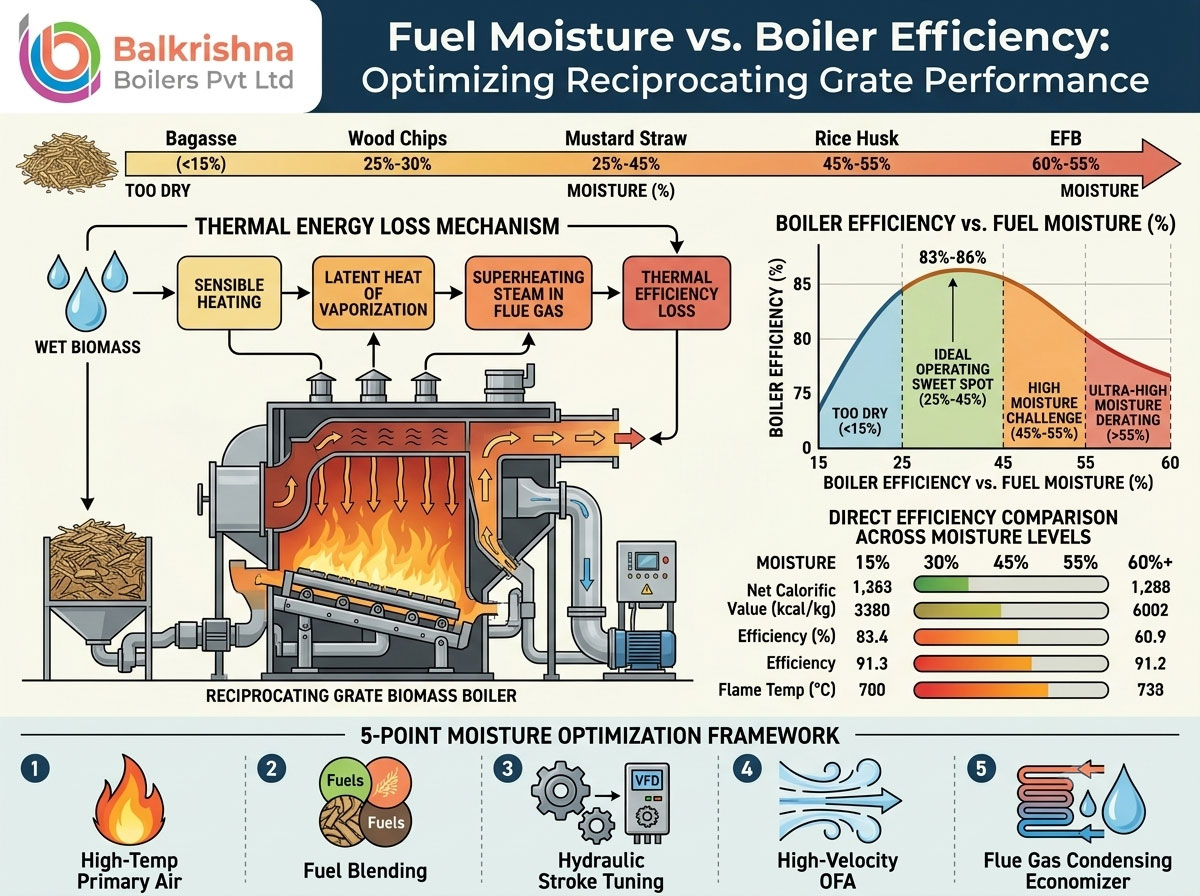
A reciprocating grate’s alternating fixed and movable high-alloy bars continuously tumble, shear, and back-mix the fuel bed, enabling stable operation across a much wider moisture range than static or travelling grates. But thermal efficiency still varies meaningfully across different moisture bands — it isn’t a flat performance regardless of fuel quality.
Zone 1: Ultra-Low Moisture (Below 15%) — The Overheating Zone
Processed pellets, dry sawdust, and kiln-dried wood waste fall here, delivering thermal efficiency in the 80–83% range. Counterintuitively, this isn’t the peak-performance zone: ultra-dry fuel burns too fast at the front of the grate, driving extreme local furnace temperatures above 1,250°C that cause severe ash fusion, clinkering, and refractory damage. Standard air-cooled grate elements can overheat and warp under this stress, and the high excess air needed to keep furnace temperature safe drives up dry gas stack losses — a real efficiency penalty from fuel that seems, on paper, like the “best” option.
Zone 2: The Ideal Operating Range (25–45%)
Air-dried agro-waste, aged bagasse, blended wood chips, and mixed husk typically fall here, delivering the highest achievable thermal efficiency — commonly 83–86%. This range works because moisture is high enough to moderate peak flame temperature, preventing clinker formation and protecting grate metallurgy, while staying low enough that the reciprocating grate’s back-mixing action rapidly evaporates surface moisture without suppressing core flame stability. Flue gas volumes stay balanced, letting fans run within their high-efficiency design window rather than being pushed to extremes.
Zone 3: High Moisture (45–55%) — The Operational Challenge Zone
Fresh green wood chips, wet sugarcane bagasse, and outdoor-stored agricultural straw commonly fall here, with thermal efficiency dropping to roughly 76–81%. This is exactly where reciprocating grate technology earns its advantage — moving grate bars pushing glowing char back into incoming wet raw fuel maintains a steady drying rate through direct conduction rather than relying on slower radiant heat alone. The genuine penalty: increased moisture carries higher latent heat losses out the chimney, and overall steam generation commonly drops 10–15% unless grate stroke speed and primary air preheat temperature are actively increased to compensate.
Zone 4: Ultra-High Moisture (Above 55%) — The Derating Limit
Fresh palm oil EFB, monsoon-soaked biomass, and fresh mill waste fall here, with thermal efficiency dropping below roughly 75%. The drying zone extends across more than half the grate length, confining char oxidation to a small strip near discharge — leading to high unburned carbon in ash, flame instability, potential boiler trips, and elevated auxiliary fan power consumption. This is genuinely the limit of practical operation without blending or supplemental drying, not just a performance dip.
A Direct Efficiency Comparison Across Moisture Levels
For a typical 20 TPH reciprocating grate boiler, key parameters shift meaningfully across moisture levels:
| Parameter | 15% Moisture | 30% Moisture | 45% Moisture | 55% Moisture | 60%+ Moisture |
|---|---|---|---|---|---|
| Net Calorific Value | ~3,600 kcal/kg | ~2,900 kcal/kg | ~2,000 kcal/kg | ~1,500 kcal/kg | Below ~1,100 kcal/kg |
| Overall efficiency | 81.5% | 85.5% (peak) | 83.0% | 77.5% | 71.0% |
| Furnace temperature | ~1,200°C | ~1,050°C | ~920°C | ~800°C | Below ~700°C |
| Unburned carbon in ash | Below 1.5% | Below 2.0% | Below 3.0% | 5.0–8.0% | Above 12.0% |
| Clinkering risk | Severe | Low | Minimal | Zero | Zero |
| Auxiliary power draw | Baseline | Baseline | +5% | +15% | +30% |
Five Strategies to Hold Efficiency as Moisture Varies
Fuel quality shifts daily with weather and supplier variation — these five engineering practices maintain performance despite that variability rather than treating it as unavoidable.
Preheat primary under-grate air (180–250°C). Never feed ambient air beneath a wet fuel bed. A multi-pass tubular air preheater raising under-grate air to this range supplies thermal energy directly into the fuel layer, pre-evaporating surface moisture without depleting radiant energy from the core flame.
Blend fuel strategically toward the target range. If moisture spikes seasonally — commonly during monsoon — blending ultra-wet biomass (55–60%) with dry industrial residue (12–18% moisture) stabilises incoming fuel within the 30–40% target window, protecting furnace temperature and eliminating flame instability. Our guide on how reciprocating grate boilers handle high-moisture biomass covers the blending formula in more detail.
Automate hydraulic stroke and speed control. When moisture rises above roughly 45%, extending stroke length and slowing stroke frequency increases residence time in the drying zone, letting thermal back-mixing fully evaporate moisture before fuel advances to char burnout. When moisture drops below roughly 25%, increasing stroke frequency accelerates fuel movement, preventing localized hotspots and protecting grate metallurgy from overheating.
Use high-velocity over-fire air staging. Evaporating water dilutes combustible gases above the fuel bed — injecting secondary and tertiary over-fire air at 50–70 m/s through staggered nozzles cuts through this steam layer, driving the turbulent mixing needed to prevent unburned CO and hydrocarbon losses.
Consider a flue gas condensing economizer for consistently wet fuel. Plants operating permanently on high-moisture fuel (above roughly 50%) leave real latent energy untapped with a standard dry economizer alone. A condensing economizer cooling exhaust below the dew point (roughly 55–60°C) recovers latent heat of vaporization from the flue gas itself, commonly adding a further 5–8% to overall thermal efficiency — a genuinely worthwhile investment specifically for consistently wet-fuel operations.
Building Your Own Fuel Moisture Monitoring Routine
Rather than reacting to efficiency drops after they’ve already cost you fuel, a proactive moisture monitoring routine catches shifts before they compound. Sampling incoming fuel moisture at delivery — via a simple moisture meter or, for larger operations, an inline near-infrared sensor on the conveyor — lets operators pre-emptively adjust blending ratios and grate stroke settings before a wet batch reaches the furnace, rather than discovering the problem through a pressure drop or rising unburned carbon in the ash. Logging this data over time also reveals seasonal patterns specific to your supplier and storage conditions, letting you plan blending stock and storage capacity around your actual moisture variability rather than a generic assumption.
Where This Connects to Your Broader Fuel Strategy
This moisture-management framework works alongside — not instead of — matching your grate technology to your fuel in the first place. Our guides on how reciprocating grate boilers handle high-moisture biomass better than conventional designs and the best biomass fuels for reciprocating grate boilers cover the equipment side of this equation, and our Steam Boiler Efficiency guide covers the broader combustion and heat-recovery principles that apply regardless of moisture level.
Our Engineering Approach
Balkrishna Boilers Pvt Ltd — IndianBoilers.com and Balkrishn.com — engineers reciprocating grate systems built to handle variable biomass moisture reliably, including custom-cast high-chromium grate bars for extreme thermal gradients and abrasive agro-waste ash, SCADA-based combustion automation with real-time oxygen trimming and hydraulic grate speed modulation, water-cooled membrane grates for multi-fuel switching, and turnkey heat recovery modules engineered to maintain stack efficiency while avoiding acid dew-point corrosion. Our STEAMPOWER system and broader Steam Boiler range reflect this engineering approach.
Frequently Asked Questions
Is drier fuel always better for boiler efficiency? No — this is one of the more counterintuitive findings here. Ultra-dry fuel below roughly 15% moisture actually reduces achievable efficiency due to overheating, clinkering, and the excess air needed to manage furnace temperature. The genuine efficiency peak sits in a moderate 25–45% moisture range.
What’s the practical moisture ceiling before self-sustained combustion becomes impossible? Around 65–70% moisture, NCV approaches zero and the fuel consumes nearly as much energy drying itself as it releases in combustion — auxiliary fuel support becomes necessary beyond this point.
How quickly can grate stroke adjustments respond to a moisture change? With PLC-automated hydraulic controls, adjustments can happen in near real time as moisture sensors or combustion feedback detect a shift — though the underlying blending and preheating strategies matter as much as reactive stroke tuning for sustained performance.
Is a condensing economizer worth it for a plant with only occasional high-moisture fuel batches? Generally less so — the investment pays off best for plants consistently running above roughly 50% moisture fuel. For occasional spikes, fuel blending and stroke tuning are usually the more cost-effective response.
Talk to Our Application Engineers
Ready to analyze your fuel moisture profile and optimize your steam generation efficiency? Contact our boiler application engineers or browse our complete product range.
Further reading: How Reciprocating Grate Boilers Handle High-Moisture Biomass Better Than Conventional Boilers · Best Biomass Fuels for Reciprocating Grate Boilers · Steam Boiler Efficiency: Boost Savings by 30% with Proven Tips · Reciprocating Grate Boiler Retrofit Guide for Existing Plants