
Biomass Pellet vs. Biomass Briquette: Which Delivers Better Boiler Performance?
Deciding to switch away from coal or furnace oil toward biomass is only the first decision. The second — which physical form of processed biomass to actually burn — has a bigger impact on your boiler’s day-to-day performance than most plants realize going in. Biomass pellets and briquettes are both made by compressing agricultural residue like mustard straw, rice husk, sawdust, or groundnut shells, but they behave like genuinely different fuels once they’re inside a furnace. This guide breaks down the physical, combustion, and economic differences so you can match the right format to your specific boiler technology.
Two Different Physical Profiles
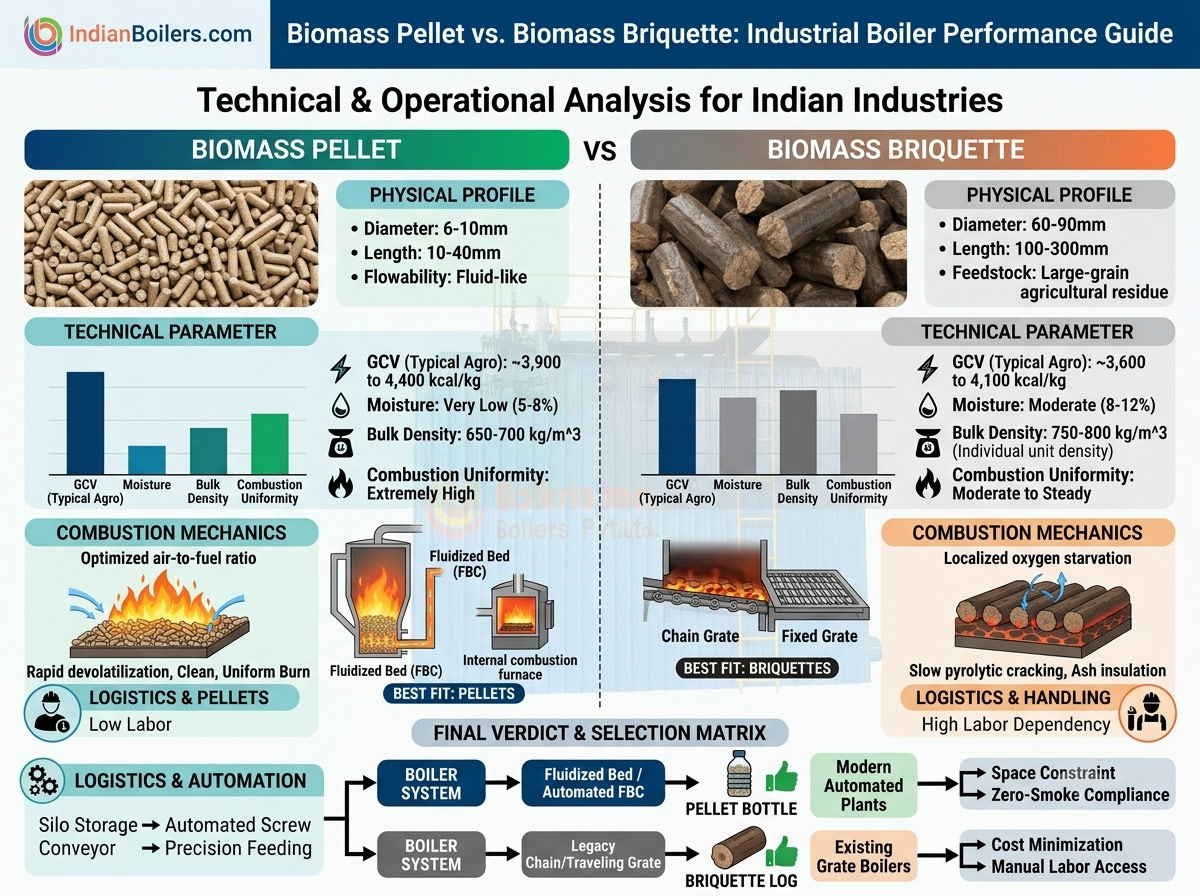
Biomass pellets are small, highly standardized cylindrical pieces — typically 6–10mm in diameter and 10–40mm in length — produced by forcing finely ground biomass through a metal die under high pressure, where the material’s natural lignin melts under friction heat and binds the pellet together without artificial chemical binders. The result is a highly uniform, extremely dry fuel with a “fluid-like” quality that’s genuinely easy to automate through pneumatic or screw-feeding systems.
Biomass briquettes (often called biocoal or white coal in India) are much larger, log-like blocks — typically 60–90mm in diameter and 100–300mm in length — manufactured through mechanical ram-piston presses or hydraulic briquetting machines. They’re rugged and bulky, designed specifically to substitute sized coal directly in traditional grate systems without requiring complex material handling.
Technical Comparison
| Parameter | Biomass Pellets (Premium Industrial) | Biomass Briquettes (White Coal) |
|---|---|---|
| Gross Calorific Value (GCV) | ~3,900–4,400 kcal/kg | ~3,600–4,100 kcal/kg |
| Moisture content | Very low (5–8%) | Moderate (8–12%) |
| Bulk density | 650–700 kg/m³ | 750–800 kg/m³ (individual unit density higher) |
| Ash content | Low to moderate (2–6%) | Moderate (4–10%, depending on feedstock) |
| Fines content (dust) | Low (<1%) | Moderate to high, from handling degradation |
| Combustion uniformity | Extremely high | Moderate to steady |
Pellets generally lead in raw thermal performance metrics, largely because the pelletization process demands tighter moisture control at the input stage — biomass generally can’t be pelletized effectively above roughly 12% moisture. That consistently drier finished product means less combustion energy gets wasted evaporating internal moisture, translating into higher net energy yield and flame temperature. This is a real, structural advantage tied to the manufacturing process itself, not just marketing framing.
Combustion Mechanics: Why Physical Form Matters More Than GCV Alone
Boiler performance depends on combustion kinetics as much as raw calorific value — specifically, how efficiently the fuel’s surface area interacts with combustion air.
Pellets’ advantage comes from a high surface-area-to-mass ratio: a bed of small, uniform pellets presents a large combined surface area to incoming combustion air, enabling rapid devolatilization and clean, uniform burning that minimises unburnt carbon losses in the bottom ash.
Briquettes’ challenge stems from their thick core mass: when fed onto a grate, the outer layer burns off rapidly, forming an ash layer that insulates the still-unburned core. That core then undergoes slower pyrolytic cracking, which can produce localised oxygen starvation and higher unburnt carbon if the boiler’s draft system isn’t well calibrated — a real engineering consideration, not a disqualifying flaw, but one that demands proper furnace design to manage.
Boiler Compatibility: The Decision That Actually Matters Most
Your existing (or planned) boiler architecture is the single biggest factor in this decision — feeding the wrong fuel format into a combustion system built for the other is a reliable way to tank efficiency regardless of either fuel’s inherent quality.
Chain grate and travelling grate boilers suit briquettes well — they behave like sized coal, sitting heavily on the moving grate and burning steadily as they traverse the furnace. Pellets are genuinely a poor fit here: they’re too small for standard grate air gaps and will fall through into the riddlings hopper before catching fire, or get entrained by forced draft and blown into the convection tubes, causing unburnt fuel carryover and fouling.
Fluidized Bed Combustion (FBC) and bubbling bed boilers are where pellets deliver a genuine performance advantage — crushed or small-diameter pellets fed into a hot fluidizing sand bed gasify and combust with strong efficiency. A solid 80mm briquette, by contrast, will sink to the bottom of the sand bed, disrupt fluidization velocity, cause cold spots, and can lead to bed choking or clinker formation requiring an unscheduled shutdown.
Small-capacity package boilers (1–5 TPH) benefit particularly from pellets’ automation compatibility — screw feeders can precisely control fuel input based on real-time steam pressure changes, something genuinely difficult to achieve with large, irregular briquettes.
Our guides on grate speed’s effect on steam production and fuel consumption and Vibrating Grate vs Reciprocating Grate performance go deeper into matching grate mechanism to fuel form factor.
Material Handling and Storage: A Real OPEX Driver
Briquettes have high individual density but pile irregularly, requiring large, dry, covered storage yards — critical, since briquettes exposed to monsoon moisture rapidly expand and revert toward loose compost, becoming unusable.
Pellets can be stored in vertical silos, and because they’re dense and flow like grain, you can store meaningfully more thermal energy per square metre of ground footprint using automated silo systems — a genuine space-efficiency advantage where floor space is constrained.
On feeding logistics: pellets support fully automated silo-to-screw-conveyor feeding requiring minimal manual labour, while briquettes typically depend on manual shovelling or tractor loading into batch-fed hoppers — a meaningful labour-cost and consistency difference worth factoring into your total operating cost comparison, not just the fuel price.
The Economics: A Worked Case Study
Consider a factory running a 6 TPH saturated steam boiler, 24 hours a day, 300 operational days a year, comparing two realistic options:
- Briquettes: GCV 3,800 kcal/kg, boiler efficiency 74%, cost ₹6,500/tonne
- Pellets: GCV 4,200 kcal/kg, boiler efficiency 82%, cost ₹8,500/tonne
Using the standard formula — hourly fuel feed (kg/hr) = steam thermal output required ÷ (GCV × boiler efficiency) — the briquette system requires roughly 1.35 tonnes of fuel per hour, working out to approximately ₹8,775/hour in fuel cost. The pellet system, thanks to its higher efficiency and lower moisture, requires only about 1.05 tonnes per hour, working out to approximately ₹8,925/hour — despite burning meaningfully less fuel by mass.
The genuine finding here: even though pellets are more efficient and cleaner-burning, their higher per-tonne price in the Indian market means briquettes come out marginally cheaper on a pure fuel-cost-per-hour basis in this scenario — roughly ₹150/hour, which compounds to a bit over ₹10 lakh annually across 7,200 operating hours. This is a genuine, real trade-off, not a case where one fuel wins outright on cost.
Where the calculation shifts in pellets’ favour: once you factor in reduced manual labour cost, essentially zero unburnt-carbon fuel waste, and meaningfully extended boiler tube lifespan from lower ash and soot buildup, the full lifecycle cost of pellets often matches or beats briquettes for a modern, automation-oriented setup — though this depends on your specific labour costs and how much you value automation and reduced maintenance downtime, so it’s worth modelling against your own numbers rather than assuming this holds universally.
Emissions and CPCB Compliance
As CPCB continues tightening particulate matter, SOx, and NOx limits — particularly across NCR, Gujarat, and Maharashtra industrial zones — emissions performance is a genuine operational parameter, not just a compliance checkbox.
Pellets burn with minimal smoke given their low moisture and clean combustion, though the high forced velocity inside pellet burners can still carry fine fly ash into the flue path, making a properly sized bag filter or cyclonic separator essential regardless. Briquettes made from lower-grade agro-residue with higher chlorine and potassium content can produce more soot accumulation on boiler tubes — this soot layer insulates the tube surface, gradually driving up flue gas exit temperature and degrading efficiency week over week if soot-blowing isn’t performed on a disciplined schedule. Our biomass boiler emission control systems guide and Pollution Control Equipment range cover what a compliant setup for either fuel format requires.
A Practical Decision Matrix
Choose pellets if: you’re installing a new, high-efficiency boiler or running FBC/pulverized-fuel technology, you’re committed to fully automated operations with minimal manual material handling, your site has genuine space constraints favouring vertical silo storage, or you’re in an environmentally sensitive zone with strict smoke-compliance requirements.
Choose briquettes if: you’re running an existing legacy chain-grate or fixed-grate boiler originally designed for coal, minimising raw fuel input cost is your top priority and manual handling labour is genuinely available and affordable, or you have adequate covered storage capacity to protect the bulkier fuel from moisture.
Verifying the Math Before You Commit
The worked case study above is presented with its calculation steps visible deliberately — before using any similar comparison to justify a fuel-format decision, re-run the formula with your actual boiler’s steam requirement, your site-specific delivered fuel prices, and your boiler’s genuine achievable efficiency on each fuel rather than the illustrative figures used here. Small differences in local pellet or briquette pricing, or in your boiler’s actual efficiency at each fuel type, can shift which format comes out ahead on pure fuel cost — the framework matters more than this specific outcome, since your regional pricing will differ from the numbers used in this illustration.
Our Multi-Fuel, Multi-Format Approach
There’s no universal winner — the right choice depends on your existing boiler architecture, automation priorities, and specific cost structure. Balkrishna Boilers Pvt Ltd — IndianBoilers.com and Balkrishn.com — designs custom combustion chambers and multi-fuel feeding systems that let factories switch between fuel form factors as market pricing shifts, rather than locking into a single expensive format. Our Steam Boiler range includes the compact COMCUBE system and husk-specific HUSKPOWER, alongside our overview of multi-fuel boilers as the future of industrial heating in India.
Frequently Asked Questions
Is pellets vs. briquettes purely about which is cheaper? No — while pellets often cost more per tonne, they can deliver a comparable or better total lifecycle cost through reduced labour, lower ash-related maintenance, and extended equipment life. Fuel price alone doesn’t capture the full comparison.
Can I feed pellets into an existing coal-designed grate boiler? Generally not well — pellets are too small for standard grate air gaps and tend to fall through unburned or get carried into the convection section by forced draft, causing fouling and unburnt fuel loss.
Can I switch from briquettes to pellets on the same boiler later? Only with a properly engineered retrofit — feeding mechanism, grate or bed design, and combustion air control typically need modification to handle the different physical characteristics, it’s not usually a drop-in fuel swap.
Which format is better for a plant prioritising minimal labour? Pellets, given their compatibility with automated silo storage and screw-conveyor feeding, which substantially reduces manual handling compared to briquettes’ typical shovel-and-hopper approach.
Do pellets always burn cleaner than briquettes? Generally yes, given their lower moisture and more uniform combustion, but both still require proper filtration (bag filters or cyclonic separators) to meet CPCB particulate limits — neither format eliminates the need for emission control equipment.
Talk to Our Engineering Team
Choosing between pellets and briquettes doesn’t have to be a guess. Get in touch with our thermal engineering team for a complete fuel compatibility audit specific to your boiler and site, or browse our complete product range.
Further reading: Rice Husk vs. Mustard Straw: Which Biomass Fuel Offers Better ROI for Indian Factories? · Fuel Moisture vs Boiler Efficiency · Common Biomass Boiler Problems and Their Solutions · Multi-Fuel Boilers: The Future of Industrial Heating in India