
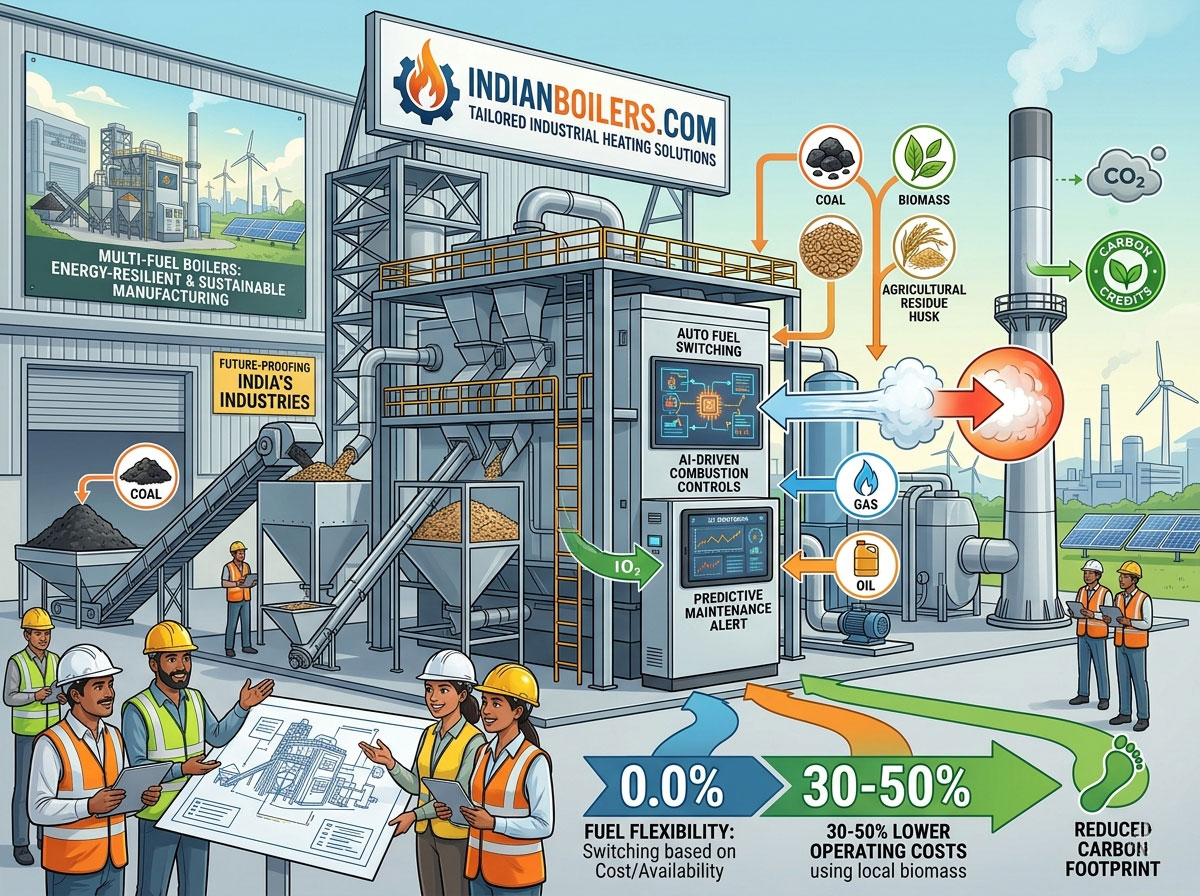
Multi-Fuel Boilers: Engineering Flexibility Into Your Fuel Strategy
Relying on a single fuel source has always carried some risk — a price spike, a supply disruption, a sudden regulatory shift. What’s changed in recent years is how frequently that risk has actually materialized for Indian manufacturers: fuel price volatility, tightening emission norms, and periodic supply constraints have all made single-fuel dependency feel less like a minor operational detail and more like a genuine business risk worth engineering around.
Multi-fuel boilers are the direct engineering answer to that risk — systems designed from the ground up to burn more than one fuel type, sometimes simultaneously, sometimes as a deliberate switch based on current pricing or availability. This guide covers what actually makes a boiler genuinely multi-fuel capable, not just theoretically convertible, and where this technology makes the most practical sense. If you’re specifically weighing biomass against a single alternative fuel, our biomass vs. coal comparison and LPG vs. wood briquettes comparison cover those specific fuel-pair decisions in depth.
1. What Genuinely Makes a Boiler “Multi-Fuel”
It’s worth being precise about this, because the term gets used loosely. A boiler that can theoretically burn a different fuel with extensive retrofit work isn’t meaningfully multi-fuel — genuine multi-fuel capability is engineered in from the design stage, and it shows up in a few specific ways:
Convertible or hybrid grate design — Fluidized Bed Combustion (FBC) systems and certain reciprocating grate designs can handle a genuine range of solid fuels — coal, biomass, agro-waste — without requiring furnace redesign between fuel types, because the combustion mechanism itself (suspension combustion in FBC, or a mechanically adjustable grate) accommodates varying fuel particle size, moisture content, and ash behavior.
Dual-fuel burners — for liquid and gaseous fuels specifically, dual-fuel burner assemblies allow switching between, say, natural gas and furnace oil without swapping equipment, typically with automated combustion tuning that adjusts air-fuel ratio appropriately for whichever fuel is currently firing.
Multiple fuel storage and handling infrastructure — genuine multi-fuel capability requires storage and feed systems for more than one fuel type simultaneously available on-site, which is a real infrastructure investment beyond the boiler itself — a system that can theoretically burn two fuels but only has storage for one isn’t operationally multi-fuel in any practical sense.
2. Why Fuel Flexibility Has Become More Valuable, Not Less
Fuel price volatility genuinely affects industrial planning — natural gas and oil pricing both remain sensitive to international markets and periodic supply constraints, making multi-year cost forecasting difficult for any facility committed to a single fuel source.
Regulatory tightening on emissions continues to affect coal and, to a lesser degree, oil-fired combustion specifically, which means a facility with flexibility to shift toward biomass as norms tighten avoids the disruption of an emergency, unplanned fuel transition later.
Regional supply variability matters more in India specifically than in many other markets — biomass availability genuinely varies by season and by proximity to agricultural regions, and a facility that can shift between biomass and a fallback fuel during a weak harvest season avoids a production risk that a biomass-only system would carry.
The practical value of multi-fuel capability isn’t necessarily using multiple fuels constantly — it’s having the option available when conditions genuinely call for it, which functions as a form of operational insurance against exactly the kind of fuel-supply and pricing volatility that’s become more common in recent years.
3. Fuel Arbitrage: Switching Based on Current Economics
Beyond risk management, multi-fuel capability enables genuine cost optimization — running whichever fuel is currently most economical, rather than being locked into one choice regardless of how relative pricing shifts over time.
This works particularly well where local biomass access fluctuates seasonally: a facility might run predominantly on rice husk or agricultural residue during harvest season when local supply is abundant and cheap, then shift toward a fallback fuel during off-season periods when biomass becomes scarcer and more expensive. This kind of dynamic fuel-switching genuinely requires the storage and feed infrastructure covered in section one — it’s not something a single-fuel system can approximate through operational discipline alone.
4. Aligning With India’s Sustainability Direction
Multi-fuel systems that include biomass capability position a facility favorably as India’s regulatory and sustainability expectations continue evolving.
Waste-to-energy potential — many Indian manufacturers, particularly in agricultural-adjacent and food processing sectors, generate their own biomass byproduct waste, and a multi-fuel system capable of using that waste as a supplementary or primary fuel source turns a disposal cost into a genuine energy input.
Regulatory positioning — as emission norms continue tightening for fossil fuel combustion specifically, a facility with genuine biomass-blending capability already built in avoids facing an urgent, unplanned equipment transition when norms shift, compared to a facility locked into single-fuel fossil combustion.
A note on incentives, stated accurately: formal government incentive programs — carbon credit markets, PAT scheme benefits, MNRE-linked support — depend on specific eligibility criteria and designation status, not automatic qualification for any facility incorporating biomass. Confirm actual eligibility for any specific program directly with the relevant authority rather than assuming qualification based on fuel-mix changes alone.
5. Smart Technology: What Automated Multi-Fuel Control Actually Does
Modern multi-fuel systems genuinely benefit from automation in a way that matters specifically because of the fuel-switching complexity involved.
Automated combustion tuning — sensors detect current fuel characteristics and adjust air-to-fuel ratio in real time, which matters more for multi-fuel systems than single-fuel ones, since a fixed manual tuning appropriate for one fuel is often meaningfully wrong for another.
Predictive maintenance across fuel types — smart monitoring tracking ash buildup, tube fouling, and component wear becomes more valuable in multi-fuel operation, since different fuels create different wear patterns, and a monitoring system tracking actual condition rather than a single fixed maintenance schedule adapts better to genuinely varying operating conditions.
Our digital twin technology guide and AI and IoT in boiler operations posts cover this monitoring technology in more depth, and it applies with particular relevance to multi-fuel installations given the added operating complexity fuel-switching introduces.
6. The Honest Economic Picture
Upfront cost for a genuinely multi-fuel-capable system runs higher than a comparable single-fuel unit — the additional storage infrastructure, dual-fuel burner or convertible grate engineering, and more sophisticated combustion control all add real capital cost.
Operating cost savings depend entirely on how effectively you actually exploit the fuel flexibility — a facility that installs multi-fuel capability but never actually switches fuels based on current economics captures the risk-mitigation value but not the cost-arbitrage value. Where local biomass access genuinely fluctuates seasonally, and a facility actively shifts fuel usage accordingly, meaningful savings versus a single-fuel-locked alternative are achievable — but the exact figure depends heavily on local fuel pricing at the time, so build your own comparison using current numbers rather than a general industry estimate.
Payback period varies considerably based on how large a role fuel flexibility genuinely plays in your specific situation — a facility facing real fuel supply risk or genuine seasonal biomass access will see payback materialize faster than one installing multi-fuel capability purely as future-proofing insurance. Rather than quoting a fixed timeline, we’d recommend building your own calculation using your actual current single-fuel costs and realistic multi-fuel utilization pattern — our biomass ROI calculation framework covers the underlying methodology, which applies to multi-fuel economics as well.
7. Where Multi-Fuel Capability Makes the Most Practical Sense
Facilities in regions with seasonal biomass availability — genuinely benefit from a fallback fuel option during off-season periods rather than facing a production risk from biomass-only commitment.
Facilities managing their own biomass byproduct waste — waste-to-energy capability alongside a conventional fallback fuel makes practical sense where byproduct volume alone can’t reliably cover full steam demand.
Facilities anticipating regulatory tightening on their current fuel — building in biomass-blending capability now avoids an urgent, disruptive transition later.
Facilities with genuine exposure to fuel price volatility — where a meaningful share of operating cost is tied to a single volatile fuel, flexibility to shift toward a more stable or currently cheaper alternative is worth the additional upfront investment.
For facilities without any of these specific pressures, a well-specified single-fuel system — matched properly to local conditions as covered in our biomass vs. coal comparison — may deliver better value than paying for flexibility you won’t actively use.
Conclusion: Flexibility Is an Investment in Optionality, Not a Universal Default
Multi-fuel boilers aren’t simply “the future” in some inevitable sense — they’re a genuine engineering answer to a specific set of risks: fuel price volatility, seasonal biomass supply variability, and evolving emission regulation. Where those risks genuinely apply to your facility, the additional upfront investment in multi-fuel capability is a sound operational insurance policy. Where they don’t apply meaningfully, a well-matched single-fuel system likely delivers better value.
Balkrishna Boilers Pvt Ltd designs both single-fuel and genuinely multi-fuel-capable systems, engineered around your actual fuel access and risk profile rather than sold as a one-size-fits-all upgrade. Explore the full range on IndianBoilers.com or Balkrishn.com.
Weighing whether multi-fuel capability makes sense for your specific situation? Contact our engineering team for an assessment based on your local fuel access and risk exposure.
Related Reading
- Biomass Boilers vs. Coal: Which Wins for Indian Businesses
- LPG vs. Wood Briquettes: A Head-to-Head Comparison of Steam Generation Costs
- The Biomass Boiler ROI Calculation: A Framework, Not Just a Percentage
- Digital Twins for Boilers: Simulating a Steam Plant Before It Ever Fails
- How AI and IoT Are Transforming Biomass Boiler Operations in 2026