
Coal vs. Biomass: The Total Cost of Ownership Breakdown for Industrial Plants
If you’ve already read our general biomass vs. coal comparison — the GST treatment, the regulatory pressure, the broad case for switching — this piece goes a level deeper into the specific number that actually determines the decision for most industrial plants: total cost of ownership across the full equipment lifecycle, not just the fuel invoice. It also clears up a common point of confusion worth addressing directly before anything else.
An important clarification first: India’s biomass co-firing mandate — the government policy requiring a percentage of biomass blended with coal — applies specifically to coal-based thermal power plants generating electricity for the grid, currently running at 5–7% depending on plant type and location, with enforcement actions already issued against non-compliant power generators. This mandate does not apply to industrial process boilers — the kind used for steam generation in textile mills, food plants, or chemical facilities. If your plant runs a coal-fired industrial boiler rather than a utility power generation unit, you’re not subject to this specific compliance requirement, though the broader regulatory and cost pressures covered below still apply.
1. CAPEX: What You’re Actually Paying For Upfront
A biomass-ready system genuinely costs more to install than a comparable coal-fired unit, and understanding exactly why matters more than just accepting the higher number.
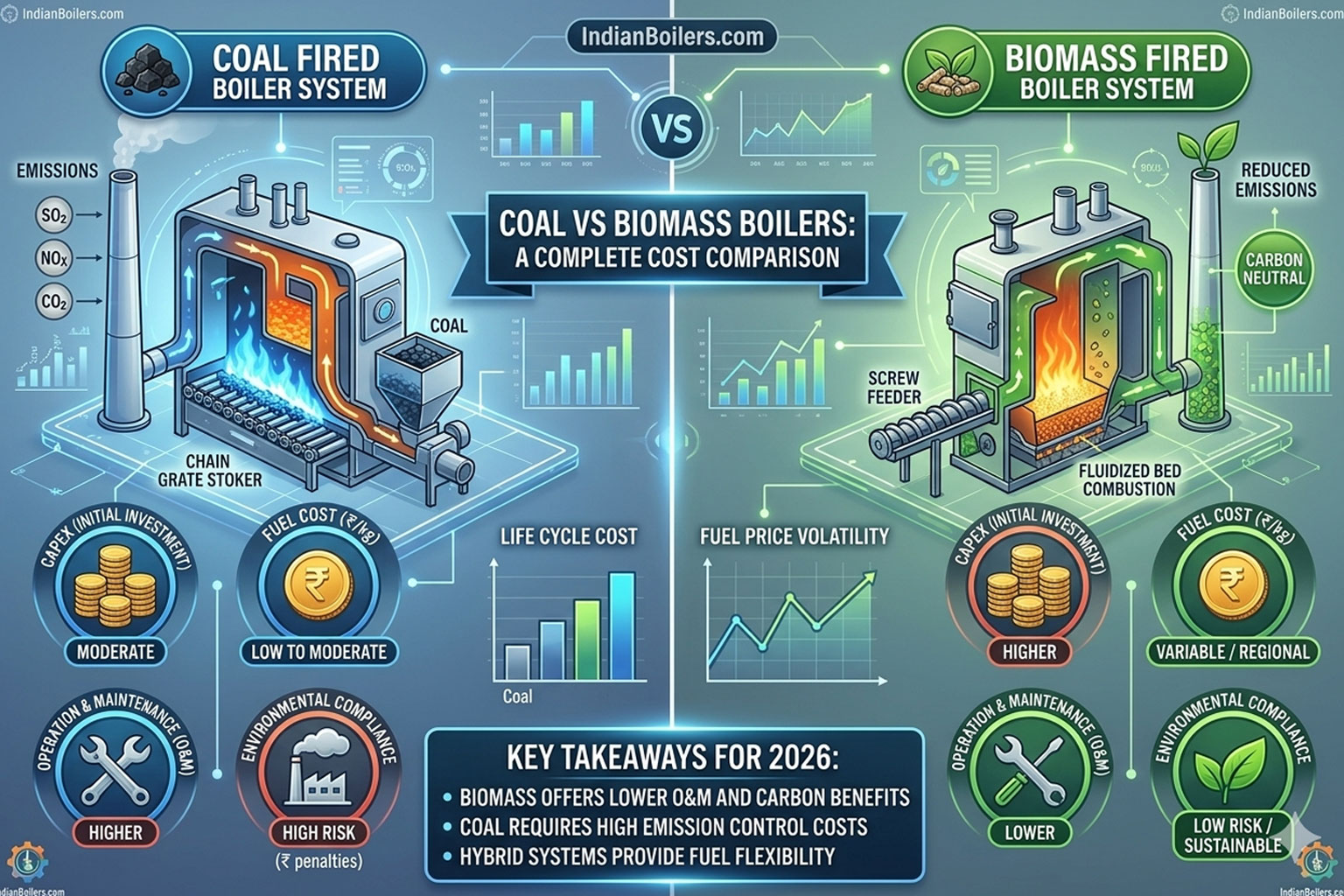
Fuel handling infrastructure — biomass requires larger, covered storage specifically designed to prevent moisture absorption, since wet fuel measurably reduces combustion efficiency. Automated screw feeders for pellets or briquettes cost meaningfully more than the simple hoppers a coal system needs.
Combustion technology — Fluidized Bed Combustion (FBC) systems, widely considered the strongest combustion approach for biomass fuel, typically carry a real capital premium over a standard grate-fired coal boiler of comparable capacity, reflecting the more sophisticated combustion engineering involved.
Emissions equipment, where the comparison actually shifts in biomass’s favor: coal-fired systems increasingly need substantial investment in flue gas desulfurization and electrostatic precipitators to meet current environmental norms — genuinely expensive equipment. Biomass systems, by contrast, typically only require a cyclone separator or bag filter to reach compliant emission levels, which meaningfully offsets some of the higher combustion-system cost noted above. When you account for this emissions equipment difference, the net CAPEX gap between well-specified coal and biomass systems is often smaller than a simple “biomass costs more” comparison suggests.
2. OPEX: Where the Real Financial Case Lives
This is where the comparison genuinely favors biomass in most scenarios, and it’s worth breaking down by category rather than treating it as a single number.
Fuel Cost
On a pure energy-delivered basis, biomass fuel — particularly briquettes sourced from local agricultural residue — is commonly priced below coal in regions with strong local biomass supply, though the exact differential depends heavily on your specific region and current market pricing at the time you’re calculating. Rather than quoting a fixed rupee figure that will be stale by the time you read this, build your own comparison using current local quotes from both a coal supplier and a biomass supplier — our biomass boiler ROI framework walks through exactly how to structure that calculation.
Maintenance
Coal is genuinely more abrasive on internal boiler components than well-sourced biomass fuel. Coal’s higher sulfur and ash content contributes to clinkering and scale buildup that requires more frequent deep cleaning and more shutdown days annually than a comparable biomass system typically needs — a real, structural maintenance cost difference rather than a marketing claim.
Ash Handling
This is a cost category worth highlighting because it flips from a cost to a potential minor revenue stream depending on fuel choice. Coal ash disposal is a genuine ongoing cost, and disposal regulations continue to tighten. Biomass ash, by contrast, is often rich in potash and commonly finds a market as an agricultural soil amendment sold to local farmers — turning what would be a coal-fired plant’s waste disposal cost into, at minimum, a cost-neutral outcome for a biomass system, and sometimes a modest revenue offset.
Labor
Coal handling is genuinely more labor-intensive and dirtier work than a well-automated biomass pellet or briquette system, which supports meaningfully more automated fuel handling with less manual intervention required day to day.
3. The Regulatory Picture, Stated Accurately
Beyond the co-firing mandate clarification above, the broader regulatory trend genuinely favors biomass, though it’s worth being precise about what actually applies to your situation:
Emission norms under CPCB and, depending on location, CAQM continue to tighten for particulate matter specifically — this applies to industrial coal boilers as much as utility plants, and older coal-fired equipment can face a genuinely harder path to renewed operating consent in regulated zones.
Carbon Border Adjustment Mechanism (CBAM): the EU’s carbon tariff, in full operational phase as of January 2026, currently covers only iron and steel, aluminium, cement, fertilizers, electricity, and hydrogen. If your business exports products in one of these six specific categories to the EU, the carbon intensity of your energy sourcing genuinely matters to your competitiveness there — but the exact cost impact depends on the actual carbon price differential at the time of import, not a fixed percentage, so avoid budgeting around any specific quoted figure without checking current EU carbon pricing and your product’s specific CBAM classification. If your business isn’t in one of those six sectors, CBAM itself doesn’t directly apply to your exports.
4. A Framework for Your Own TCO Calculation
Rather than a fixed comparison table with figures that will age quickly, here’s the actual structure to build your own:
- Current annual fuel cost — your current coal consumption × current delivered coal price.
- Projected biomass fuel cost — estimated biomass tonnage needed for equivalent output (based on relative calorific values) × current local biomass pricing.
- Maintenance cost differential — compare your current coal system’s annual maintenance spend against a realistic estimate for a comparable biomass system, ideally sourced from your equipment vendor’s service history data rather than a generic percentage.
- Ash handling cost differential — your current disposal cost versus the biomass system’s likely net-neutral or modestly positive position.
- Additional capital cost of biomass-ready equipment — the genuine CAPEX premium, offset partially by lower emissions equipment requirements as covered above.
- Payback calculation — divide the additional capital cost by your calculated annual OPEX savings to reach your specific payback period.
This produces a genuinely different number for every plant, which is exactly why a generic industry comparison table can’t substitute for running your own figures.
5. Where Hybrid Systems Fit Into This Decision
For plants uncertain about committing entirely to one fuel — whether due to biomass supply reliability concerns in their specific region, or a desire to hedge against future fuel price movements in either direction — multi-fuel boiler systems offer a genuine middle path, allowing fuel switching or blending based on current market pricing rather than locking in a single fuel commitment. Our multi-fuel boilers guide covers how these systems are engineered and where they make the most practical sense.
Conclusion: The Real Decision Lives in Your Own Numbers
The structural case for biomass on OPEX is real — lower fuel cost in most regions, reduced maintenance burden, and a genuinely favorable ash-handling position. The CAPEX gap is real too, though it’s smaller than a simple headline comparison suggests once you account for the emissions equipment coal now requires. Where this actually nets out for your specific plant depends on your current coal costs, your local biomass supply access, and your existing equipment’s condition — not a generic industry table.
Balkrishna Boilers Pvt Ltd’s engineering team builds this calculation with your actual current data rather than industry averages. Explore our full range on IndianBoilers.com or Balkrishn.com.
Want a TCO calculation built around your plant’s actual coal costs and consumption? Contact our engineering team for a tailored comparison.
Related Reading
- Biomass Boilers vs. Coal: Which Wins for Indian Businesses
- The Biomass Boiler ROI Calculation: A Framework, Not Just a Percentage
- Multi-Fuel Boilers: The Future of Industrial Heating in India
- Understanding the Working Principle of Biomass Steam Boilers
- Biomass Boiler Emission Control Systems: A Complete Guide