
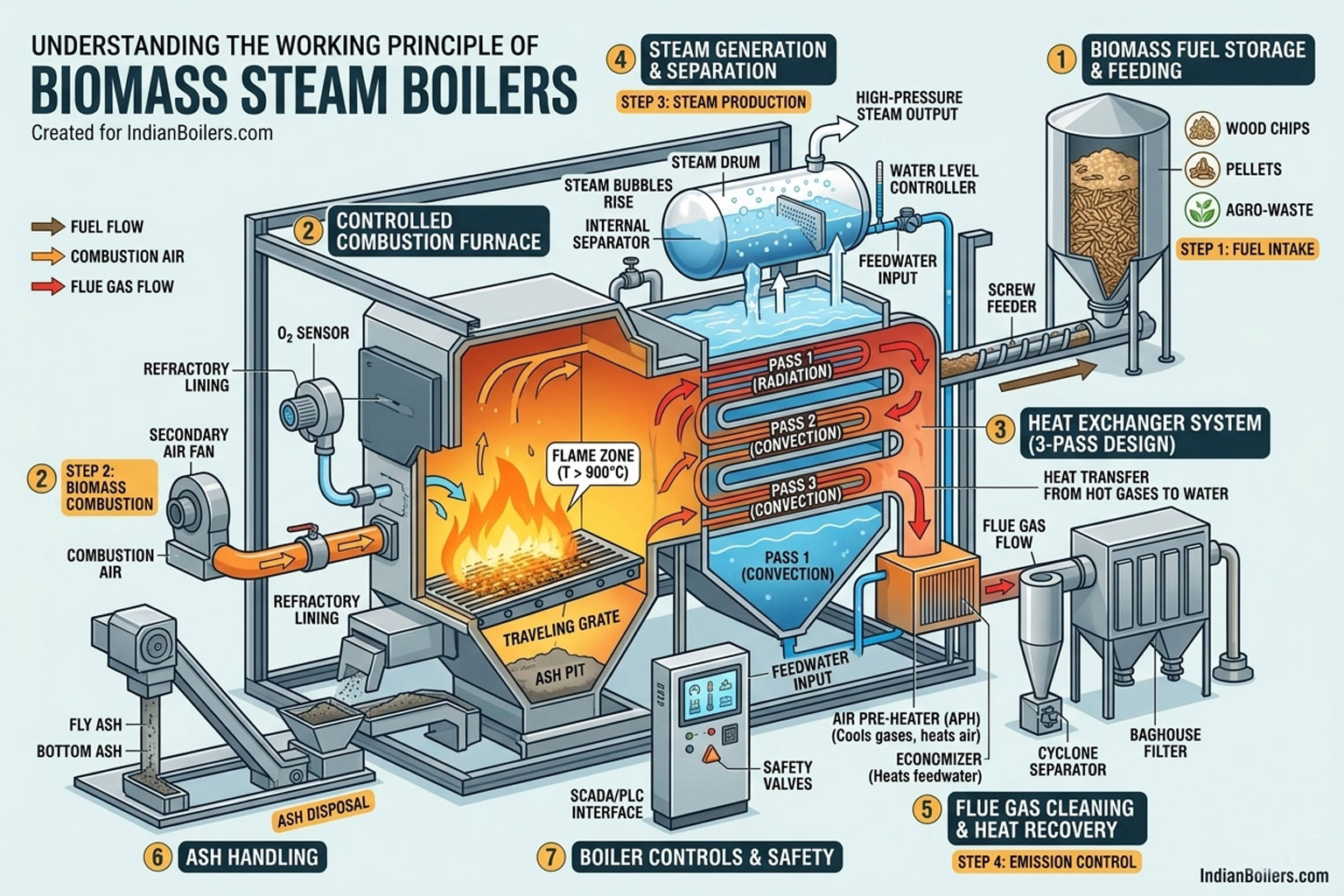
Burning biomass sounds simple — light the fuel, get heat — but the actual combustion process inside a well-engineered biomass boiler is a genuinely staged chemical process, and understanding those stages is what separates a boiler that extracts maximum energy from its fuel from one that wastes a meaningful share of it as unburned residue and excess emissions. If you’re still working through the basics — what biomass is and why it’s carbon-neutral — our what is a biomass boiler? post covers that foundation. This piece goes further, into exactly what happens inside the furnace from the moment fuel enters to the moment clean flue gas exits the chimney.
1. The Fuel Itself: What You’re Actually Combusting
Biomass fuel differs fundamentally from liquid or gaseous fuels in one important way — it’s solid, and its combustion behavior is governed by particle size, moisture content, and chemical composition in ways LPG or oil simply aren’t. Common fuel categories include:
- Wood pellets and briquettes — compressed sawdust and wood waste, offering relatively high calorific value and consistent, predictable combustion behavior.
- Agro-waste — rice husk, mustard stalk, groundnut shells, and similar agricultural residue, generally lower calorific value with more variable ash content depending on the specific source material.
- Forestry residue — wood chips and bark, which typically arrive with higher moisture content than processed pellets or briquettes.
Fuel choice directly determines combustion behavior, which is why the four-stage process below plays out somewhat differently depending on what you’re actually burning.
2. The Four Combustion Stages: What Actually Happens in the Furnace
Complete combustion of solid biomass fuel moves through four distinct stages, each with its own chemistry and each contributing differently to total heat output.
Stage 1: Drying
As biomass fuel enters the furnace, the first thing that happens has nothing to do with combustion at all — residual moisture within the fuel evaporates, consuming heat rather than producing it. This is why moisture content matters so much to overall efficiency: wetter fuel spends more of the furnace’s available energy simply evaporating water before any useful combustion heat is generated, which is why pre-drying or using properly seasoned, low-moisture briquettes measurably improves overall system performance.
Stage 2: Pyrolysis (Gasification)
As temperature continues rising, the solid biomass begins breaking down chemically, releasing volatile gases — a mixture including carbon monoxide, methane, and hydrogen. This stage matters more than its name suggests: in a well-designed boiler, these volatile gases can account for a substantial majority of total heat eventually generated from the fuel, commonly cited around 70% in biomass combustion literature — meaning the flame you actually see burning above the fuel bed is doing most of the real thermal work, not the glowing char beneath it.
Stage 3: Gas Combustion
The volatile gases released during pyrolysis mix with secondary air introduced above the fuel bed and burn at high temperature — this is where the majority of visible flame and thermal energy production actually occurs. Getting secondary air introduction right — proper mixing, correct timing, adequate turbulence — is what determines whether this stage burns cleanly and completely or leaves unburned hydrocarbons in the flue gas.
Stage 4: Char (Charcoal) Combustion
What remains after volatile gases have released is solid carbon char, which burns on the grate itself using primary air introduced from below. This stage provides a steady, glowing heat source that does something important beyond generating its own heat — it helps sustain the pyrolysis of newly introduced fuel, effectively keeping the whole combustion cycle self-sustaining as fresh biomass continuously enters the furnace.
3. Getting Heat Into the Water: The Transfer Mechanism
Once combustion generates high-temperature flue gas, that energy still needs to actually reach the water before it’s useful — and this happens through two distinct heat transfer zones, common to both hybrid and full water-tube biomass boiler designs.
Radiation zone — water-cooled furnace walls, often membrane wall construction, absorb the intense radiant heat coming directly off the burning fuel bed. This is a highly efficient, direct heat transfer mechanism precisely because radiant heat transfer doesn’t require the gas to physically contact a surface — it transfers as electromagnetic radiation across open space.
Convection zone — after leaving the primary combustion area, hot flue gases pass through smoke tubes or across water tubes, transferring residual heat through metal tube walls into the surrounding water as they travel. This is where much of the remaining recoverable heat gets extracted before flue gas exits toward emission control equipment and the chimney.
4. Grate Technology: How Fuel Actually Moves Through the Furnace
The specific grate design underneath the combustion process significantly affects how well a system handles different fuel types and how much automation the system supports:
Fixed grate — the simplest configuration, suited to manual feeding and smaller-scale operations where automation isn’t a priority.
Moving or chain grate — fuel moves slowly across the furnace on a conveyor-like grate mechanism, enabling continuous ash removal and automated feeding without manual intervention — a meaningful operational improvement for continuous, higher-volume operation.
Fluidized Bed Combustion (FBC) — fuel is suspended within a “boiling” bed of hot sand and air rather than resting on a stationary or moving surface, creating intense mixing and contact between fuel and air. This design achieves very high combustion completeness — commonly cited in the high-90s percentage range for how thoroughly the fuel’s carbon content actually burns — and is particularly well suited to lower-grade, variable-quality fuels like rice husk that other grate designs handle less efficiently. It’s worth distinguishing this combustion completeness figure from overall boiler thermal efficiency, which also depends on the heat recovery and insulation factors covered separately below — a system can burn fuel very completely while still losing recoverable heat elsewhere if those other factors aren’t equally well engineered.
5. Cleaning the Exhaust: Managing What Combustion Leaves Behind
Biomass combustion produces ash and particulate matter that needs proper management before flue gas reaches the chimney — this isn’t optional equipment, it’s what keeps a biomass installation compliant with current emission norms.
Cyclones and multi-cyclones use centrifugal force to spin heavier ash particles out of the gas stream before it continues toward finer filtration.
Bag filters capture the finer, microscopic dust that cyclonic separation alone can’t remove, bringing final stack emissions within regulatory particulate limits.
Induced Draft (ID) fans create negative pressure through the system, pulling flue gases through the entire cleaning sequence and out the stack — this maintains proper draft throughout the boiler and cleaning system while keeping the boiler house itself free of smoke or gas leakage.
6. Additional Efficiency Multipliers Worth Understanding
Beyond the core combustion and heat transfer mechanics, two additions genuinely change overall system efficiency:
Air preheaters (APH) use residual exhaust heat to warm incoming combustion air, which speeds up the drying stage covered above and supports more complete combustion — a genuine efficiency gain that compounds with everything else in the system.
Economizers recover residual flue gas heat to preheat incoming feedwater before it enters the boiler, directly reducing the fuel needed to bring that water to boiling temperature. Our guide to modern boiler efficiency techniques covers both of these mechanisms, along with several others, in more depth if you want the full efficiency picture beyond biomass combustion specifically.
7. Matching Grate and Fuel: A Practical Note
Understanding these combustion mechanics has a direct practical payoff: it explains why fuel-grate matching matters so much in system specification. A fixed or simple moving grate handling consistent, low-moisture wood pellets will perform reliably; feed that same grate design highly variable, high-ash agro-residue, and you’ll see incomplete combustion, more frequent ash-related maintenance, and reduced overall efficiency compared to a properly matched FBC design. Our Biomass Boiler and Agro-Waste Fired Steam Boiler ranges are engineered with this fuel-specific matching in mind, rather than a single generic design applied across all biomass fuel types.
Conclusion: Combustion Physics Determines the Efficiency You Actually Get
A biomass boiler’s working principle isn’t a single mechanism — it’s four sequential combustion stages, two heat transfer zones, a grate design matched to your specific fuel, and emission control equipment that all need to work together properly. Understanding this staged process is what lets you evaluate whether a specific system is genuinely well-engineered for your fuel source, rather than taking an efficiency claim at face value.
Balkrishna Boilers Pvt Ltd engineers biomass systems around this full combustion process, matched to your specific fuel type. Explore the full range on IndianBoilers.com or Balkrishn.com.
Want your specific biomass fuel source matched to the right grate and combustion design? Contact our engineering team — we can evaluate your fuel and recommend the appropriate configuration.
Related Reading
- What is a Biomass Boiler?
- How Modern Boilers Achieve 90%+ Thermal Efficiency
- Bagasse and Pellets: The Engineering Behind India’s Two Biggest Biomass Fuels
- Biomass Boiler Emission Control Systems: A Complete Guide
- Fuel Moisture vs Boiler Efficiency: Finding the Ideal Range for Reciprocating Grate Boilers