
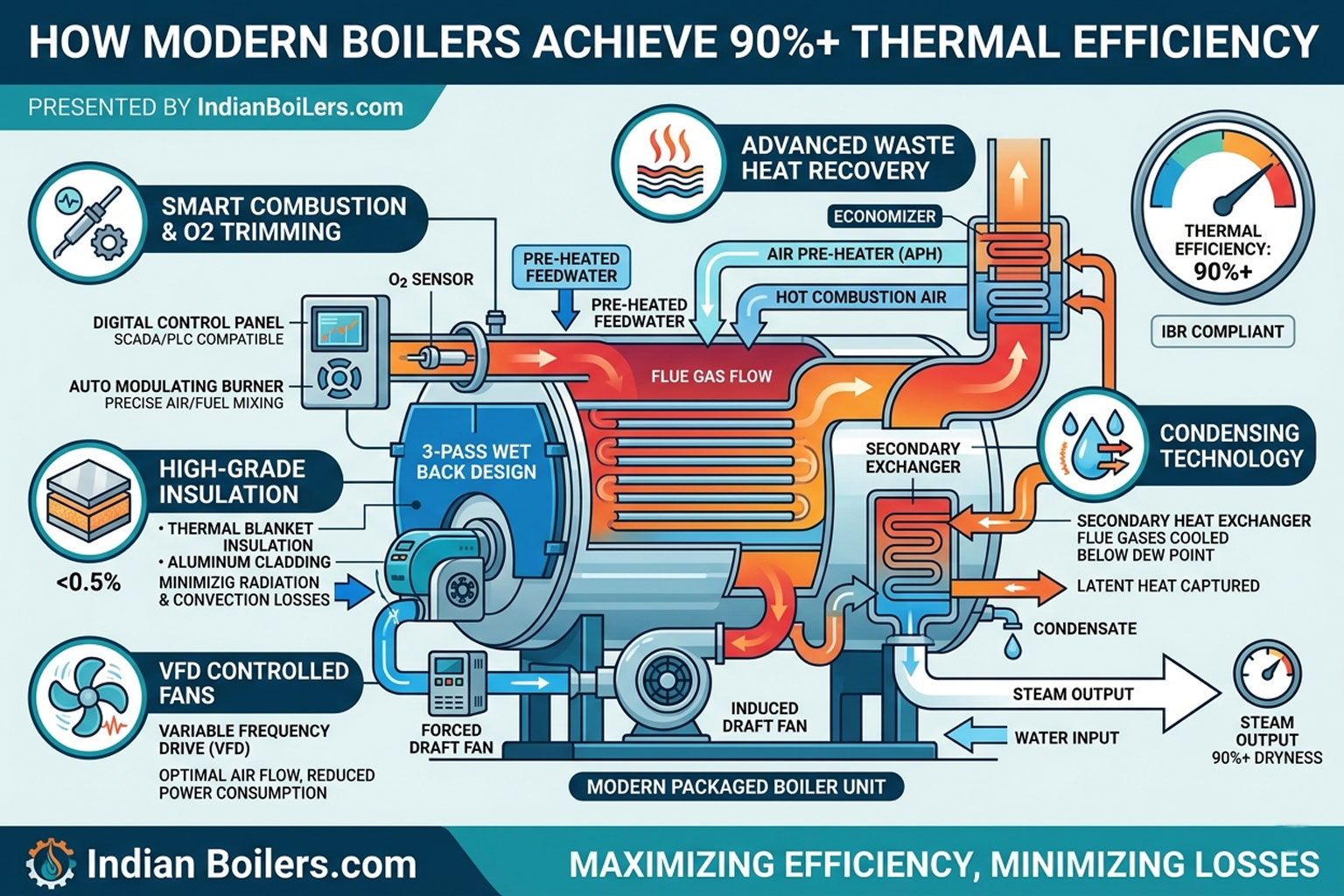
A boiler running at 75% efficiency and one running at 92% efficiency can look nearly identical from the outside — same footprint, same basic fuel-to-steam function. The difference lives entirely in a handful of specific engineering additions, each addressing a distinct way heat otherwise escapes unused. Understanding what those additions actually do, rather than just the headline efficiency number, is what lets you evaluate whether a vendor’s efficiency claim is genuinely earned or just asserted.
This guide breaks down the five real engineering levers that separate a conventional boiler from a genuinely high-efficiency one. If you’re deciding between fuel-fired and electric technology as part of this efficiency conversation, our complete guide to industrial electric steam boilers covers why electric systems reach 98–99% efficiency by an entirely different mechanism — no combustion at all, which sidesteps most of what follows here.
1. Waste Heat Recovery: Where the Biggest Single Gain Lives
The chimney is the single largest source of efficiency loss in any combustion boiler. Older, poorly-optimized systems can exhaust flue gas at temperatures well above 250°C — energy that was paid for as fuel and is now simply escaping into the atmosphere unused.
Economizers intercept flue gas on its way to the chimney and use its residual heat to preheat incoming feedwater before it enters the boiler. This directly reduces the fuel needed to bring that water up to boiling temperature, since it’s arriving already partially heated.
Air preheaters (APH) apply the same principle to combustion air rather than feedwater — particularly valuable in solid-fuel and biomass systems, where preheated combustion air supports more complete, vigorous combustion and reduces thermal shock to the furnace at ignition.
A genuinely useful rule of thumb in boiler engineering: each roughly 20°C reduction in flue gas exit temperature achieved through heat recovery translates to approximately a 1% gain in overall thermal efficiency — which is why economizers and air preheaters are considered close to mandatory equipment on any system targeting genuinely high efficiency, rather than optional add-ons.
2. Precision Combustion Control: The Oxygen Balancing Act
Combustion efficiency is fundamentally a balancing act. Too little combustion air and you get incomplete combustion, wasted fuel, and dangerous carbon monoxide buildup. Too much excess air and that surplus air acts as a cooling agent, absorbing heat from combustion and carrying it straight out the stack unused — effectively “heating the sky” at your expense.
Modern boilers address this with oxygen trim systems — real-time sensors positioned in the flue gas path that continuously monitor oxygen levels and automatically adjust the burner’s air-to-fuel ratio to hold excess air at the minimum level required for safe, complete combustion (typically in the low single digits for gas fuel, somewhat higher for oil). This precision, held consistently rather than approximated by a fixed manual setting, is a genuine and measurable efficiency gain that compounds over the boiler’s full operating life — the difference between a burner tuned once and left alone versus one continuously self-correcting as conditions shift.
3. Condensing Technology: Capturing the Heat Standard Boilers Simply Discard
This is the mechanism behind the largest single efficiency jump available in gas-fired systems, and it’s worth understanding precisely because the physics is genuinely elegant.
Standard combustion boilers only extract what’s called “sensible heat” — the heat you can measure as temperature change. But combustion of any hydrocarbon fuel also produces water vapor as a by-product, and that vapor carries additional stored energy called latent heat of vaporization — energy that a conventional boiler simply vents to atmosphere along with the flue gas, unused.
Condensing technology uses a secondary heat exchanger to cool flue gases below their dew point — typically around 55°C for natural gas combustion — which causes that water vapor to condense back into liquid, releasing its latent heat directly back into the system rather than losing it up the chimney. This single mechanism can push a boiler’s efficiency from a conventional 85% range into the mid-90s or higher, which is why condensing technology represents the single largest efficiency jump available on gas-fired combustion systems specifically.
4. Design and Insulation: The Efficiency Gains That Don’t Involve Combustion at All
Not every efficiency lever is about the combustion process — the physical architecture and insulation of the vessel itself matter meaningfully.
3-pass wet-back construction maximizes the surface area over which combustion gases transfer heat to water, by routing flue gas through the water-filled shell three separate times before exit, with the rear reversal chamber fully surrounded by water rather than heat-leaking refractory brick. Our dedicated guide to 3-pass wet-back design covers this construction principle and its steam-quality benefits in full detail.
High-density insulation — typically rockwool or ceramic fiber blanket with aluminum cladding — minimizes radiation and convection losses from the boiler’s outer shell surface. A well-insulated modern boiler commonly loses well under 1% of total generated heat through shell surface losses, a genuinely minor factor compared to flue gas losses but one that compounds meaningfully over decades of continuous operation.
5. Automation and Variable Frequency Drives: The Efficiency Lever Beyond Heat
Boiler efficiency isn’t purely about combustion — it also involves the electrical power the system itself consumes to run its own auxiliary equipment.
Traditional Forced Draft (FD) and Induced Draft (ID) fans historically ran at fixed, full motor speed regardless of actual load, using mechanical dampers to throttle airflow when less was needed — a genuinely wasteful approach, since running a motor at full power and then physically restricting the airflow it produces burns electricity for no corresponding benefit.
Variable Frequency Drives (VFDs) solve this directly by adjusting motor speed to match actual real-time load requirements, rather than running at fixed speed and throttling mechanically. This reduces the electrical “parasitic load” the boiler places on a plant’s overall power bill, while also maintaining a more stable, precisely-matched flame across varying load conditions — a genuine efficiency gain on the electrical side that complements the combustion-side gains covered above.
Comparing Conventional and Modern Systems
| Feature | Conventional Boiler | Modern High-Efficiency Boiler |
|---|---|---|
| Typical efficiency | 70–78% | 90–95%+ |
| Flue gas exit temperature | 240–300°C | 110–140°C |
| Combustion control | Manual or fixed linkage | Automated O2 trim |
| Heat recovery | Rarely integrated | Standard (economizer + APH) |
| Fan control | Fixed speed with dampers | VFD, load-matched |
| Fuel monitoring | Periodic, manual | Real-time SCADA/IoT |
Where This Leads: A Genuine Comparison Worth Making
Every technique above addresses one specific type of loss in a combustion process — flue gas heat, excess air, latent heat, radiation, and parasitic electrical load. Stack all five together, and a well-engineered modern combustion boiler genuinely approaches the mid-90s in efficiency. It’s worth being direct about the natural next question this raises: electric boiler technology achieves a comparable or higher efficiency figure (98–99%) by removing the combustion process entirely, since there’s no flue gas loss path to recover heat from in the first place. Whether that trade — no combustion at all, versus a well-optimized combustion system with all five efficiency levers applied — makes sense for your plant depends on fuel access, electrical infrastructure, and the priorities covered in our electric boiler guide.
For plants staying with combustion technology, retrofitting an existing older boiler with economizers, O2 trim, and VFDs is often a genuinely cost-effective path to meaningful efficiency improvement without a full equipment replacement — the specific payback period depends on your current system’s baseline efficiency and your actual fuel costs, so it’s worth requesting a tailored assessment rather than assuming a fixed timeline.
Conclusion: Efficiency Is Built From Specific Engineering Choices, Not a Single Feature
“90%+ efficient” isn’t a single technology — it’s the compounded result of five distinct engineering decisions, each recovering or preventing a specific category of heat loss. Understanding which of these five levers a given system actually includes is what lets you evaluate an efficiency claim properly, rather than taking a headline percentage at face value.
Balkrishna Boilers Pvt Ltd integrates these techniques across our modern boiler range, and offers retrofit assessments for existing installations. Explore our full range on IndianBoilers.com or Balkrishn.com.
Want to know exactly which efficiency levers your current system is missing? Contact our engineering team for an efficiency audit and retrofit assessment.
Related Reading
- The Complete Guide to Industrial Electric Steam Boilers
- Why 3-Pass Wet-Back Design Is the Standard for Pharmaceutical Steam
- Digital Twin Technology: Revolutionizing Boiler Efficiency and Reliability
- The Steam Boiler Maintenance Checklist Every Indian Plant Actually Needs
- The Boilers Act, 2025 – Download PDF