
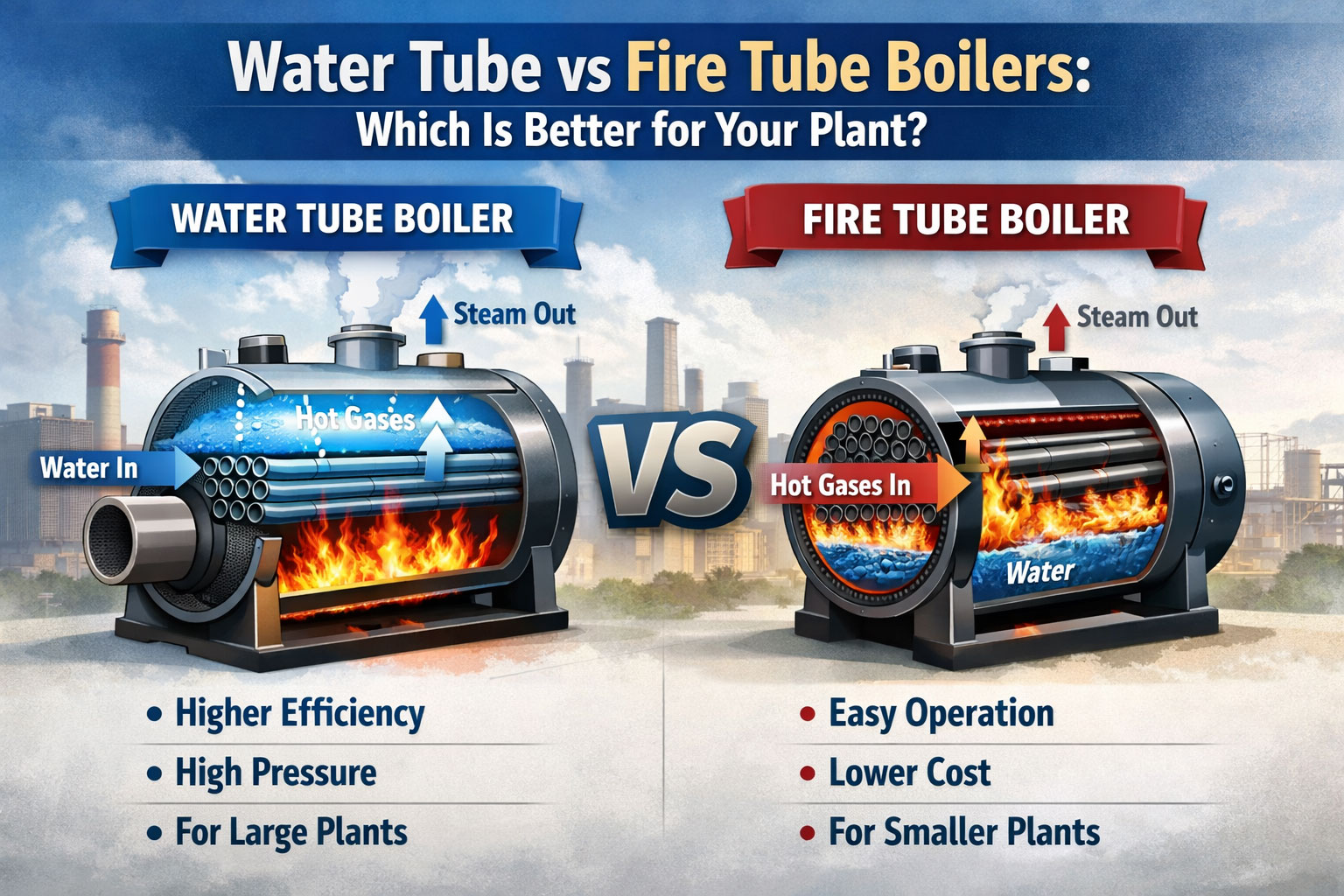
If you’ve already read a comparison of water-tube and fire-tube design mechanics — ours or anyone else’s — you likely already know the basics: water-tube handles higher pressure and responds faster, fire-tube is simpler and more forgiving. Knowing that doesn’t actually tell you which one your plant needs. This piece skips the mechanics rundown entirely (our water-tube vs. fire-tube design comparison covers that in full) and instead walks through the actual diagnostic questions that determine your answer — the ones a spec-sheet comparison table can’t ask for you.
1. Start With the Question That Actually Decides It
Before anything else, answer this: what’s your required operating pressure, and is it comfortably below or genuinely near 20 bar?
This single number does more decision-making work than any other factor on this page. Below roughly 20 bar, fire-tube design is almost always the more cost-effective, appropriately-scaled choice — you’d be paying for water-tube capability you don’t need. At or meaningfully above that threshold, fire-tube construction runs into a genuine physical limitation: the large-diameter shell that holds a fire-tube boiler’s water volume needs impractically thick walls to safely contain higher pressures, to the point where it stops being economically sensible well before it becomes physically impossible.
If your pressure requirement sits close to that boundary, don’t guess — get your process engineer to confirm the actual figure your equipment needs, not a rough estimate. This is the one number worth getting precisely right before any other question on this list matters.
2. Diagnostic Question Two: How Steady Is Your Actual Load?
Not every plant’s steam demand looks the same over a shift, and this genuinely changes which design fits better.
Ask yourself: does your steam demand stay relatively flat through the day, or does it spike sharply — an autoclave cycle starting, a dye bath heating, a batch process kicking off — then drop back down?
If your load is relatively steady: fire-tube’s large water volume isn’t doing much extra work for you here, and you can lean toward whichever design your pressure requirement points to without this factor changing the answer.
If your load spikes sharply and frequently: this is where the two designs genuinely diverge in a way that matters day-to-day. Fire-tube’s large water mass acts as a thermal reserve, absorbing sudden demand increases without a sharp pressure drop — but it takes considerably longer to reach operating pressure from a cold start, often over an hour. Water-tube holds far less water relative to its heating surface, which means it responds to demand changes almost immediately and can reach full pressure in well under half an hour — a genuine advantage if your process can’t tolerate startup delay, but it also means it has less thermal reserve to absorb an unexpected spike without some pressure response.
For pharmaceutical, food, and dairy applications with genuinely sharp cyclical demand, this question often matters as much as raw pressure requirement — our electric boilers for food, pharma & dairy guide covers how electric technology handles this same load-response challenge from a different angle entirely, worth considering alongside a fire-tube/water-tube decision if your priority is genuinely instant, precise response.
3. Diagnostic Question Three: What Does Your Water Actually Look Like?
This question gets skipped more often than it should, and it has real financial consequences if ignored.
Ask your water treatment team or a local lab: what’s your actual feedwater hardness, and what water treatment infrastructure do you currently have or are willing to invest in?
Fire-tube systems are meaningfully more forgiving of water quality variation — while treated water is always recommended, fire-tube tubes are relatively straightforward to clean mechanically through smoke-box access if scale does form.
Water-tube systems are considerably less forgiving. Because water moves through small-diameter tubes, even modest scale buildup can cause localized overheating and tube failure — commonly called “tube starvation.” This makes near-demineralized water quality a genuine operational requirement, not a nice-to-have, and means a water-tube decision effectively includes a water treatment infrastructure decision alongside it.
If your facility doesn’t currently have — or isn’t planning to invest in — robust water treatment capability, this factor alone can make fire-tube the more practical choice even where your pressure requirement might otherwise point toward water-tube.
4. Diagnostic Question Four: What’s Your Actual Site and Budget Timeline?
Ask your project team: do you need this operational within a standard commissioning timeline, or do you have the runway for extended field-erection work?
Fire-tube boilers are commonly sold as factory-tested, skid-mounted packaged units — they arrive largely ready to connect to fuel and water lines, meaningfully shortening installation time. Larger water-tube systems, by contrast, are frequently field-erected — built piece by piece on-site — which extends both installation timeline and upfront capital cost.
If your project has a hard commissioning deadline or your site access for large pre-assembled equipment is genuinely constrained, this practical factor deserves real weight in the decision, not just an afterthought once the technical spec is settled.
5. A Decision Framework, Not Just a Table
Rather than a single verdict, here’s how to actually work through the decision in order:
Step 1 — Pressure threshold. Confirm your genuine required operating pressure. Comfortably under ~20 bar → fire-tube is very likely your answer, skip to Step 4. At or above ~20 bar → continue to Step 2.
Step 2 — Capacity confirmation. At elevated pressure, confirm your required steam capacity (TPH) with your process engineer. High-pressure, high-capacity requirements point firmly toward water-tube.
Step 3 — Load pattern check. If your capacity requirement is more moderate but pressure still runs high, weigh your load pattern — a water-tube design’s fast response may matter enough on its own to justify the higher capital cost even at moderate capacity.
Step 4 — Water quality reality check. Confirm your actual water treatment capability against whichever design you’re leaning toward — this can shift the practical answer even after the pressure question is settled.
Step 5 — Site and timeline constraints. Factor in installation timeline and site access constraints as a final practical filter, particularly if you’re on the boundary between the two designs on technical merit alone.
6. Scenario Matching: How This Plays Out by Industry
A dairy or food processing plant running pasteurization and CIP cycles at moderate pressure, with cyclical but not extreme load swings, typically lands on fire-tube — often specifically a 3-pass wet-back configuration like our STEAMJET range, which combines fire-tube’s practicality with strong steam dryness for hygiene-sensitive applications. Our 3-pass wet-back design guide covers why this specific configuration performs well for exactly this kind of application.
A textile dye house with sharp cyclical demand and moderate pressure needs often benefits from the responsiveness water-tube offers, though many facilities find a well-sized fire-tube system with strong thermal reserve handles the load pattern adequately at meaningfully lower capital cost — our steam boilers for textile mills guide walks through this specific trade-off in more depth.
A power generation or large chemical processing facility needing high-pressure superheated steam at substantial capacity has, in practice, only one real answer: water-tube design, built around the specific high-pressure demands the application requires — our inside a water-tube boiler guide covers the engineering behind why this design scales to that requirement.
A sugar mill running cogeneration typically needs water-tube design specifically engineered around bagasse combustion characteristics — our bagasse and pellets guide covers the fuel-specific engineering considerations that apply on top of the basic water-tube decision.
7. Compliance Applies Regardless of Which You Choose
Whichever design fits your requirements, both fire-tube and water-tube boilers above the relevant pressure and capacity threshold require registration and inspection under the current Boilers Act, 2025 — this isn’t a factor that changes based on design choice, only a compliance step that applies identically to whichever configuration you specify.
Conclusion: The Right Answer Comes From Your Specific Numbers, Not a General Rule
“Which is better” was never really the right question — the right question is which design matches your actual pressure requirement, load pattern, water quality reality, and installation constraints, in that rough order of importance. Work through the diagnostic questions above with your own real numbers, and the answer usually becomes clear well before you need a formal comparison table at all.
Balkrishna Boilers Pvt Ltd’s engineering team runs exactly this kind of diagnostic assessment before recommending a configuration — not a generic recommendation, but one built around your actual pressure, load, and water data. Explore both design families across our steam boiler range on IndianBoilers.com or Balkrishn.com.
Want your specific pressure, load, and water data run through this diagnostic properly? Contact our engineering team for a site-specific assessment rather than a generic recommendation.
Related Reading
- Water Tube vs Fire Tube Steam Boilers: Key Differences Explained
- Inside a Water-Tube Boiler: How Natural Circulation Actually Generates Steam
- Steam Boilers for Textile Mills: Matching the Machine to the Mill
- Why 3-Pass Wet-Back Design Is the Standard for Pharmaceutical Steam
- The Boilers Act, 2025 – Download PDF