
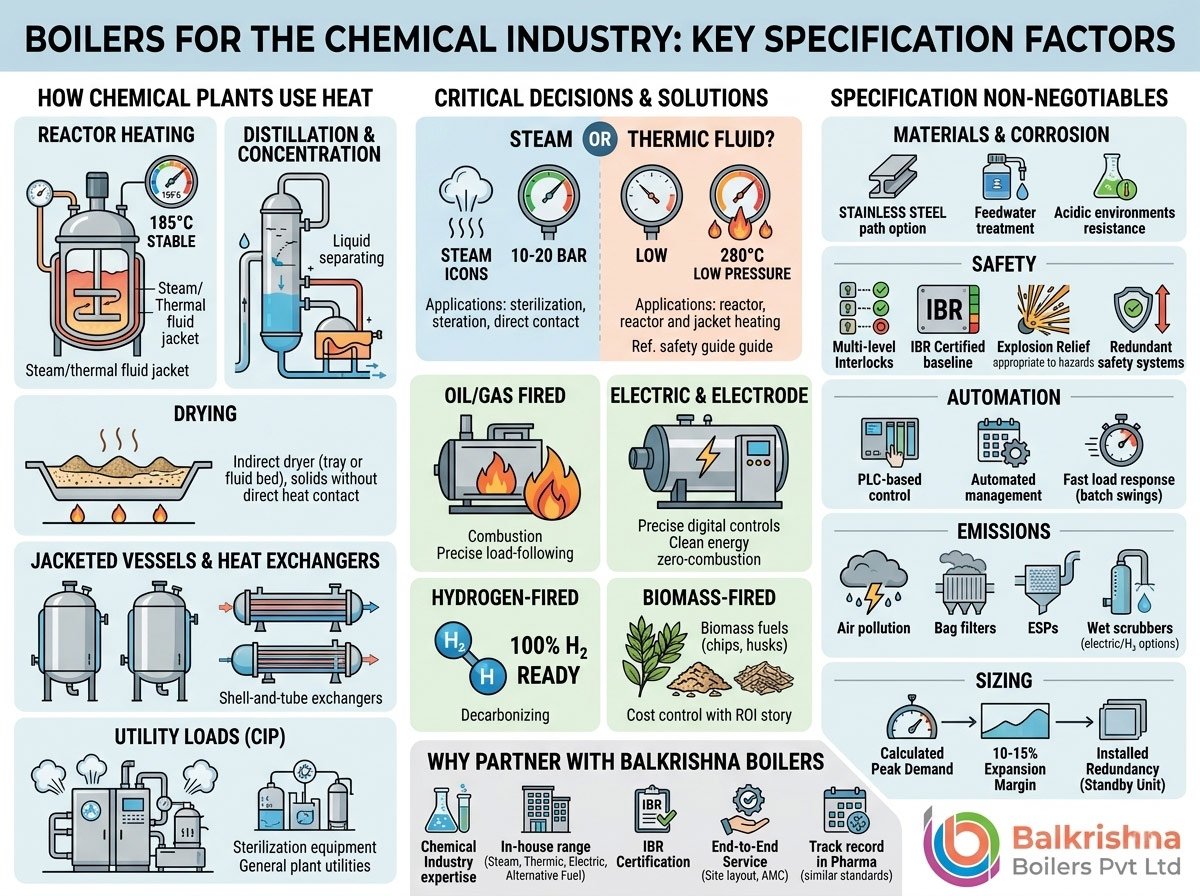
Few industries put more demands on a boiler than chemical manufacturing. Reactor vessels need steam or thermal fluid at exact, stable temperatures for hours at a stretch. Distillation columns need consistent heat input to hold separation quality. Batch processes swing from zero demand to full load in minutes. And because so many chemical processes are corrosive, flammable, or sensitive to contamination, the boiler isn’t just a utility — it’s a safety-critical piece of the plant.
This guide walks through what actually matters when you’re specifying a boiler for a chemical or agrochemical facility: how chemical plants use heat, which boiler and heater types fit which application, the safety and material considerations that are unique to this industry, and what to look for in a manufacturing partner.
How Chemical Plants Actually Use Heat
Unlike a textile or food plant where steam demand is fairly predictable, a chemical plant’s heat requirement varies enormously by process:
- Reactor heating: Many reactions need to be brought to and held at a precise temperature — sometimes for hours — with tight tolerance either side of the setpoint. Overshoot can trigger side reactions, degrade yield, or create a safety hazard.
- Distillation and concentration: Separating and concentrating chemical products typically needs sustained steam or thermal fluid at the reboiler, often at higher-than-typical process temperatures.
- Drying: Solid chemical products, intermediates, and agrochemical formulations frequently need controlled drying, where indirect heat is preferred to avoid contaminating the product.
- Jacketed vessels and heat exchangers: A large share of chemical-plant heat demand runs through jacketed reactors or shell-and-tube exchangers rather than direct steam injection, which shapes the choice between steam and thermal fluid.
- Utility and sterilization loads: CIP (clean-in-place) systems, tank heating, and general utility steam round out the demand profile.
Because these loads are so different from each other, most chemical plants don’t run on a single heat source — they typically combine a steam boiler for general process and utility steam with a thermic fluid heater for high-temperature, low-pressure reactor and jacket heating.
Steam Boiler or Thermic Fluid Heater — Which Do You Need?
This is the single most common specification question in the chemical sector, and the answer depends on temperature, pressure, and how the heat is actually delivered to the process.
Steam is the right choice when you need heat that condenses and gives up latent energy efficiently — utility loads, sterilization, general building or vessel heating, and processes where direct steam contact is acceptable or even required.
Thermic fluid is often the better choice when a process needs a high temperature (well above what steam can deliver at a reasonable pressure) but must stay at low operating pressure for safety — a very common combination in reactor and jacket heating. Because thermic fluid systems run at near-atmospheric pressure even at high temperatures, they carry a fundamentally different risk profile than a high-pressure steam system, which matters a great deal in a plant handling flammable or reactive chemicals.
We’ve covered the operational side of this in detail in our guide to thermic fluid heaters in the chemical industry: the ultimate safety guide — it’s worth reading in full if thermal fluid heating is on your shortlist, since correct flow interlocks and temperature control are what stand between normal operation and thermal fluid degradation or fire risk.
Boiler Types Commonly Specified for Chemical Plants
Oil and Gas Fired Steam Boilers
For plants needing fast response, clean combustion, and precise load-following, an oil/gas fired steam boiler remains the default choice across much of India’s chemical belt — particularly in clusters like Ankleshwar and Dahej, where reliable fuel logistics and tight process control both matter. Gas firing in particular gives cleaner combustion, which simplifies emissions compliance in areas with strict local air-quality norms.
High-Pressure Industrial Boilers
Some chemical processes — high-pressure reactions, certain distillation columns, or plants supplying steam to multiple downstream units — need boilers built for sustained high-pressure duty. A high-pressure industrial steam boiler is engineered for exactly this kind of continuous, demanding service.
Electric and Electrode Boilers for Clean, Precise Processes
Where product purity, contamination control, or precise digital load control matter more than fuel cost, an electric steam boiler is increasingly common in specialty and fine chemical manufacturing. For plants pursuing zero-combustion, zero-emission steam generation, our electrode boiler technology passes high-voltage electricity directly through water to generate steam with very high thermal efficiency and none of the flue-gas handling a combustion boiler needs — a meaningful advantage for a plant trying to simplify its emissions permitting.
Hydrogen-Fired Boilers for Decarbonizing Chemical Heat
Chemical manufacturing is one of the sectors under the most pressure to decarbonize high-heat processes. Our hydrogen fired boiler range is built specifically for this shift — capable of running on 100% hydrogen or a hydrogen-natural gas blend to deliver high-pressure steam while eliminating CO2 emissions at the point of use. For chemical manufacturers with sustainability targets or facing tightening emissions norms, this is worth evaluating alongside more conventional options.
Biomass-Fired Boilers for Cost Control
Not every chemical plant needs a fossil-fuel or electric solution. Where cost control matters more than combustion-source purity, a well-designed biomass fired steam boiler can cut fuel costs sharply. We’ve seen this play out directly: a chemical manufacturer in Vatva GIDC switched from a coal-fired system to a high-efficiency biomass-fired unit and cut their carbon footprint by 75%, with fuel savings paying back the new installation in 14 months. You can read the full story in our post on how boilers impact carbon emissions and how to reduce them.
Materials and Corrosion Resistance
Chemical plants are one of the few industries where the boiler’s construction material is as important as its capacity. Acidic or corrosive process environments, aggressive cleaning agents, and certain feedwater chemistries can accelerate corrosion far faster than in a typical factory setting. When specifying a boiler for a chemical facility, discuss with your supplier:
- Whether standard carbon steel construction is adequate, or whether stainless steel components are needed for the fluid path — particularly relevant if the boiler will ever see contact with process chemicals during upset conditions.
- Feedwater and condensate return chemistry, since chemical plants sometimes have contaminated condensate that needs additional treatment before it’s safe to return to the boiler.
- Insulation and lagging specifications suited to the ambient chemical environment, to avoid premature degradation.
Safety: The Non-Negotiable Priority
Because chemical plants routinely handle flammable, reactive, or toxic materials, boiler safety specification goes well beyond the standard mountings:
- Multi-level safety interlocks — flow-differential switches, high-temperature cutoffs, and flame-failure detection — are essential, especially on thermic fluid systems where fluid degradation and coking are real risks if flow drops while the burner is firing.
- IBR certification is mandatory for boilers above the regulatory threshold, and chemical plants should treat this as a baseline requirement, not a box to tick.
- Explosion relief and pressure-relief design appropriate to the specific hazard classification of your plant area.
- Redundant safety systems, including high-pressure cut-offs, low-water alarms, and spring-loaded safety valves, should be standard on any unit supplying a reactor or process critical to plant safety.
Automation and Load-Following
Chemical processes — especially batch operations — often swing between idle and full load quickly. A boiler with PLC-based combustion control and automated feedwater management responds to these swings far more reliably than manually operated equipment, and reduces the risk of the pressure fluctuations that can compromise reaction control. If your plant runs multiple reactors on staggered batch cycles, discuss turndown ratio and response time specifically with your supplier — this matters more in chemical plants than almost any other sector.
Emissions and Compliance
Chemical manufacturing clusters are frequently subject to tighter environmental scrutiny than other industrial zones, given the sector’s history and regulatory attention. Pairing your boiler with appropriate pollution control equipment — bag filters, ESPs, FGD systems, or wet scrubbers depending on fuel choice — should be built into your specification from the start rather than retrofitted later. Electric, electrode, and hydrogen-fired boilers sidestep much of this compliance burden altogether, which is part of why they’re gaining ground in this sector.
Sizing and Redundancy
Chemical plants — particularly multi-reactor or multi-line facilities — rarely rely on a single boiler. As with continuous-process industries, the standard approach is to calculate peak steam or thermal fluid demand across all connected vessels and processes, then add a 10–15% margin for expansion and process variability. Many plants also install a second boiler purely for redundancy, since an unplanned shutdown mid-reaction can mean lost batches, not just lost production time — a materially higher cost than in most other industries.
Choosing a Boiler Partner for the Chemical Sector
Given the safety, material, and compliance stakes involved, the manufacturer you choose matters as much as the boiler model. Look for a partner that can demonstrate:
- Direct experience supplying chemical and agrochemical plants, not just adjacent process industries.
- In-house expertise across steam, thermic fluid, electric, and alternative-fuel technologies, so you get an honest recommendation rather than a one-size-fits-all pitch.
- IBR certification and full documentation support.
- End-to-end service — site layout, fuel train design, burner selection, installation, commissioning, and ongoing AMC support.
- A track record across comparably demanding sectors, such as our work in pharmaceutical manufacturing, where steam purity and pressure control carry similar stakes to chemical processing.
Indian Boilers.com and Balkrishna Boilers Pvt Ltd supply steam boilers, thermic fluid heaters (including our THERMPAC and VTF Series ranges), and electric boilers engineered for the chemical and agrochemical sector, backed by decades of installations across India’s major chemical manufacturing hubs. Our engineering team can help you weigh steam against thermic fluid, evaluate electric or hydrogen options against your sustainability targets, and specify the safety systems your process actually needs.
Frequently Asked Questions
Should a chemical plant use steam or a thermic fluid heater? It depends on the process. Steam suits utility loads, sterilization, and processes where direct contact is acceptable. Thermic fluid is often better for high-temperature reactor and jacket heating that must stay at low operating pressure for safety.
Why do chemical plants need stainless steel or special materials in their boiler system? Corrosive process environments, aggressive cleaning chemicals, and contaminated condensate can accelerate corrosion well beyond what a standard industrial boiler is built for, so material selection needs to match your specific process chemistry.
Are electric boilers practical for chemical manufacturing? Yes, particularly for specialty and fine chemical plants where product purity, precise digital control, or simplified emissions permitting matter more than fuel cost. Electrode boiler technology in particular offers very high thermal efficiency with zero combustion emissions.
What safety features matter most for a chemical plant boiler? Multi-level interlocks (especially flow-differential protection on thermic fluid systems), IBR certification, explosion relief appropriate to your hazard classification, and redundant safety systems including high-pressure cutoffs and low-water alarms.
Can a chemical plant reduce its carbon footprint with its boiler choice? Yes — switching from coal to biomass, or to electric, electrode, or hydrogen-fired boilers, can cut emissions dramatically. One chemical manufacturer we worked with cut their carbon footprint by 75% after switching from coal to a biomass-fired system, with the fuel savings paying back the investment in 14 months.
How much redundancy should a chemical plant build into its boiler house? Most multi-reactor or multi-line facilities install more than one boiler, sized so a single unit going offline doesn’t halt production — the cost of an unplanned mid-batch shutdown is usually far higher than the cost of standby capacity.
Specifying or upgrading a boiler system for a chemical or agrochemical facility? Contact our engineering team for a process-specific recommendation on steam, thermic fluid, or electric heating.